
AI Citation Trends Report
Q2 2026
Q2 2026
Using the Profound platform, Tinuiti developed a systematic method for tracking AI citations across an array of categories over time to help brands and marketers understand key developments unfolding in the AI space.
The nine categories tracked are apparel, beauty, electronics, food and beverage, home and garden, manufacturing, OTC health, technology, and transportation and logistics. The AI platforms and features included in this report are ChatGPT, Perplexity, Google AI Mode, Google AI Overviews, Google Gemini, Microsoft Copilot, and Meta AI.
There are limitations to this data, including:
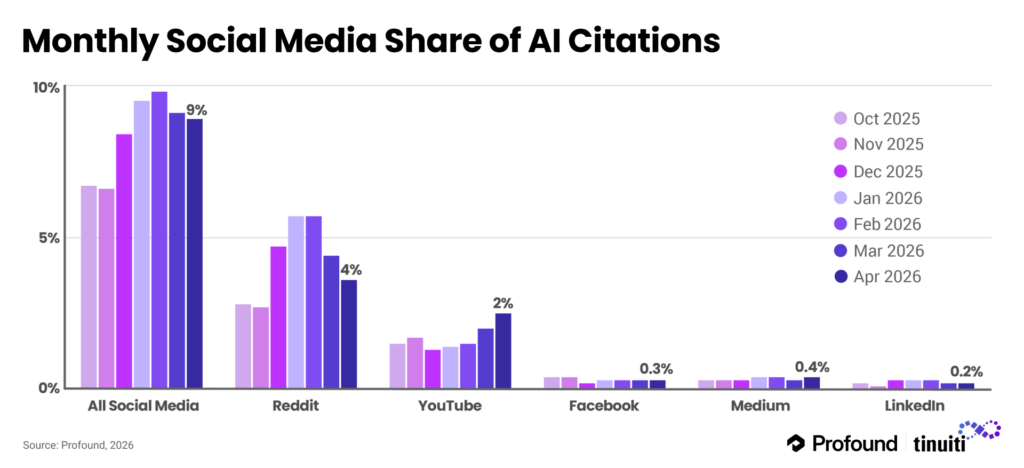
The average share of citations attributed to social platforms was 33% higher in April 2026 than in October 2025. However, average share declined in March and April following three straight months of growth.
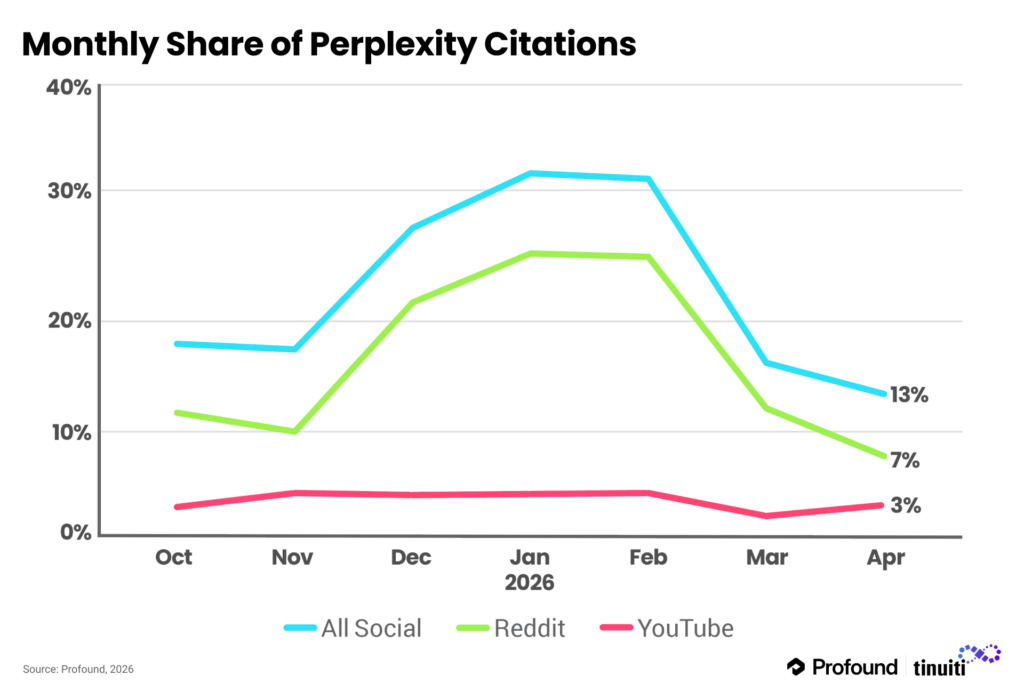
The primary reason for the decline was a steep reduction in the share of Perplexity citations attributed to social platforms, which fell from 31% in February to 13% in April. While citation share dipped for several social platforms on Perplexity, the biggest swing was attributed to Reddit, which dropped from 25% of all Perplexity citations in February to just 7% in April.
While Perplexity was still the AI platform with the highest share of citations coming from Reddit in April, it only barely beat out Google AI Overviews, which saw Reddit share grow from 5% in February to 7% in April. It’s unclear why Perplexity’s share of citations attributed to Reddit declined after a significant increase at the end of 2025 and into Q1.
All three Google platforms studied saw overall social share of citations grow meaningfully comparing January to April.
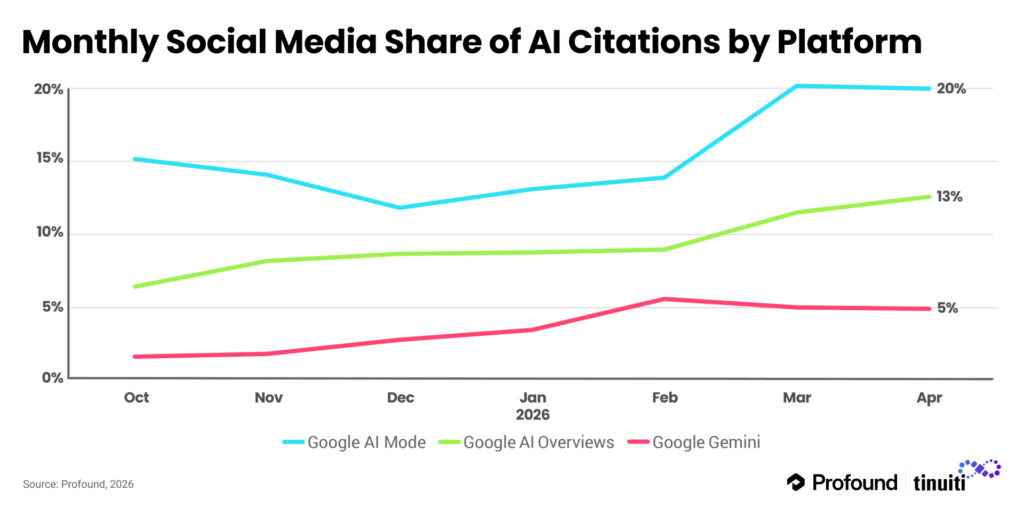
While Reddit contributed to that growth in the case of all three, AI Mode and AI Overviews social share also benefited from jumps in the prevalence of YouTube. In April, YouTube share of AI Mode citations was more than four times what it was in January, and share more than doubled for AI Overviews over the same time frame. YouTube citation share held roughly steady for Google Gemini over the first four months of the year.

Beyond the big two social platforms (when it comes to AI citation share) of Reddit and YouTube, Google AI Mode and AI Overviews are also increasingly tapping Instagram and TikTok.
Instagram’s share of AI Mode citations rose from 0.1% in October 2025 to 0.6% in April 2026, and jumped from 0.3% to 0.7% in AI Overviews results over the same period. This drove an increase in the average share of AI citations attributed to Instagram across all platforms, which landed at a seven-month-high of 0.2% in April.

TikTok citation share has also grown quite a bit for Google AI Mode and AI Overviews over the last seven months, and these two AI tools are the only ones studied that include TikTok in citations to any meaningful degree.

Social citation share varies meaningfully by vertical and product category. Apparel-focused prompts saw the highest social share of the categories tracked in April 2026 at 13%, while over-the-counter (OTC) health prompts saw just 3% of citations attributed to social media platforms, the lowest share.

The extent to which each social media platform is included in citations is tied to the nature of the prompt, with some platforms clearly more relevant for particular prompt categories than others. For example, while Instagram and TikTok only accounted for an overall average of 0.2% and 0.1% of AI citations in April, those figures jump to 0.7% and 0.6% for beauty prompts.

Similarly, while LinkedIn is absent from citations for beauty-related prompts, it accounts for over half of a percentage point of all citations related to manufacturing, technology, and transportation and logistics. The prompt category that had the closest citation shares attributed to Instagram, TikTok and LinkedIn in April was electronics.
It’s important for brands to understand the specific social platforms AI tools cite most frequently in their vertical, since citation patterns can differ significantly by industry and those patterns can change over time.
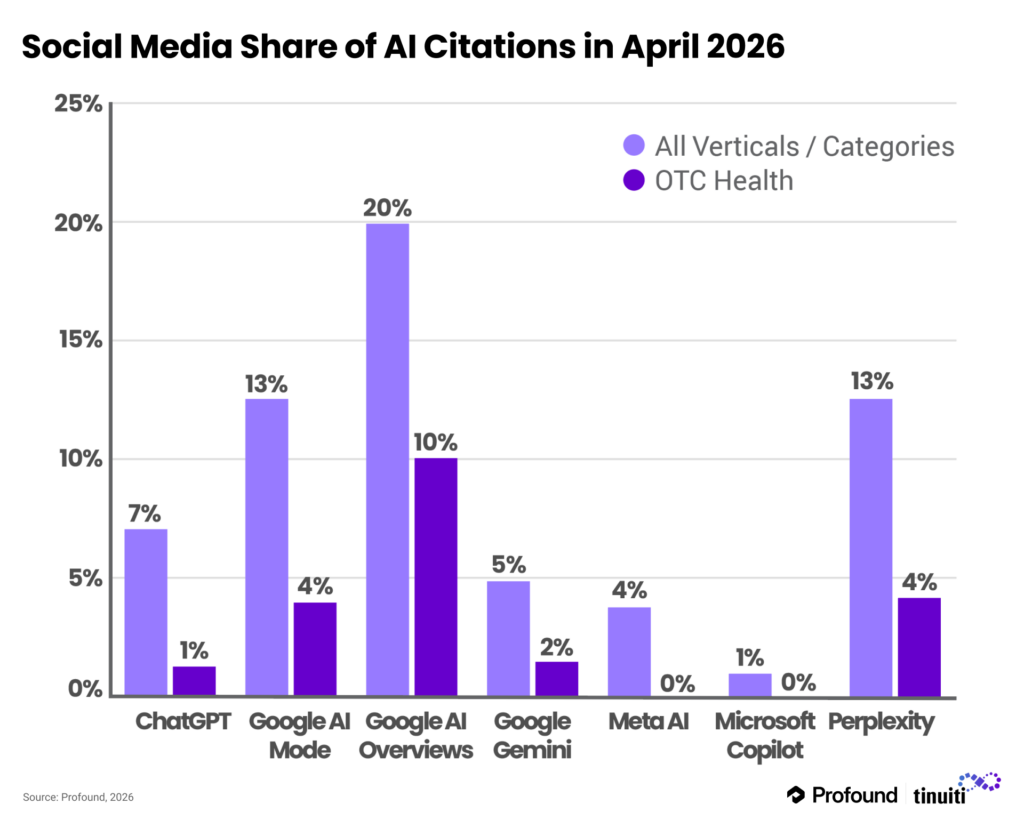
Across the board, AI tools are more hesitant to include social media platforms in citations for OTC health than other verticals and product categories. In the case of Meta AI and Microsoft Copilot, these platforms don’t include any social media citations for OTC health prompts at all.
Google AI Overviews have the smallest disparity between overall social media citation share and OTC health, but still cite social media only half as frequently for OTC health prompts as for all verticals and categories tracked.
Looking at which categories have seen the most movement in the share of AI citations attributed to social platforms over the last few months, OTC health prompts were one of just three groups to see a higher share in April than in January. Home and garden and technology saw the biggest social share declines from January to April, but every prompt category studied had a higher share of citations attributed to social in April than in October 2025.

Within the ecommerce space, Amazon’s positioning toward AI remains multifaceted. Like most tech giants, Amazon has invested heavily in AI, including developing an AI-powered shopping assistant, but primarily in growing its AI infrastructure and the selection of AI compute options available through AWS. At the same time, Amazon has been resistant to allowing its shopping listings to be crawled and cited in the AI results of other platforms.
Amazon has a deepening relationship with OpenAI, including an investment of up to $50 billion announced in February, but Amazon.com continues to block access to ChatGPT’s relevant crawlers, along with those of the other major AI platforms.
Despite these efforts, Amazon is still the most cited ecommerce site on average across most verticals, even though it is absent from the results of both Google Gemini and Perplexity, the latter of which Amazon sued in late 2025 over its alleged attempts to evade Amazon’s bot restrictions.

Compared to January, Amazon’s share of total AI citations was flat or higher in April across six of the seven platforms analyzed for this report, reaching 4% on average. Amazon’s citation share declined only for Google’s AI Mode, hitting 2% in April, although it remained at 0% for both Google Gemini and Perplexity.
Amazon accounted for 4% of Google AI Overview citations in April 2026, up from 2% in October 2025. Importantly, while Amazon is blocking the Google-Extended user agent that drives the Gemini models, Amazon.com does allow Google’s main Googlebot crawler that powers Google AI Mode and Overviews as well as Google’s core search engine.
While Amazon’s share of ChatGPT citations lags its share on Google AI Mode and Overviews, Amazon was still the citation leader on ChatGPT among multi-category retail sites in April 2026, just beating out Walmart.

Amazon’s share of ChatGPT citations spiked to 1.6% in February, before settling back to a little over 0.7% in April. Walmart’s share of ChatGPT citations picked up significantly over late 2025 but has trended lower over recent months to 0.6% in April. Target has seen steadier trends over the same period, with its citation share matching Walmart in April.
Notably, Walmart was one of a handful major ecommerce players, including Shopify and Etsy, to partner with ChatGPT in late 2025 to be part of ChatGPT’s Instant Checkout feature. In March, however, ChatGPT killed Instant Checkout in favor of shifting its role back toward product discovery with merchants taking responsibility for the checkout experience.
On Microsoft Copilot, Amazon’s share of citations is particularly high, jumping to nearly 19% in April 2026. As recently as October 2025, Amazon’s citation share was just 3% on Copilot, which was below its share of Google AI Mode citations at the time.
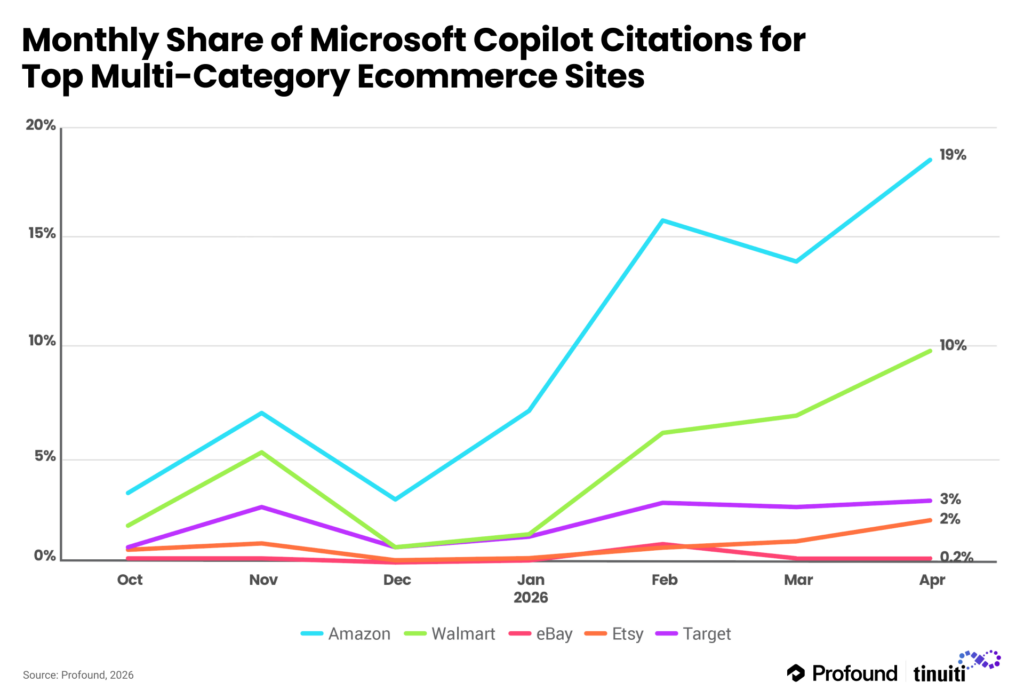
Citations from ecommerce sites seem to be on the rise in general across Microsoft Copilot results with Walmart seeing a nearly nine-point lift in citation share from January to April 2026, while both Target and Etsy both saw a nearly two-point increase over the same period.
While Amazon and Walmart consistently rank well across major ecommerce verticals for AI citation share, they are not without formidable competition. Best Buy has not seen as large a lift in Copilot citation share recently as some of the more general retailers have, but across all seven AI platforms assessed for this report, Best Buy still outpaces both Amazon and Walmart in average citation share for electronics-related prompts.

In April 2026, Best Buy accounted for just over 6% of citations for electronics prompts, ahead of Amazon at 4% and Walmart at just under 2%. Best Buy led Amazon in April electronics citation share on all platforms except for Copilot. Best Buy’s largest lead over Amazon was on Meta AI where it took 10% of electronics citations compared to 3% for Amazon.
Home and garden is another vertical where Amazon faces particularly strong competition with Home Depot accounting for 6% of citations on average in April 2026, compared to Amazon’s 7%. In late 2025, Home Depot led in home and garden citation share, but the particularly large lift in share that Amazon has seen on Copilot has pushed it into the lead.

Within the beauty vertical, Amazon is neck and neck with Ulta for the largest share of citations across beauty prompts with both at just over 4% on average in April 2026. There’s some distance between these two and the next tier of sites with Sephora, Target, and Walmart all generating closer to 2% of beauty citations.
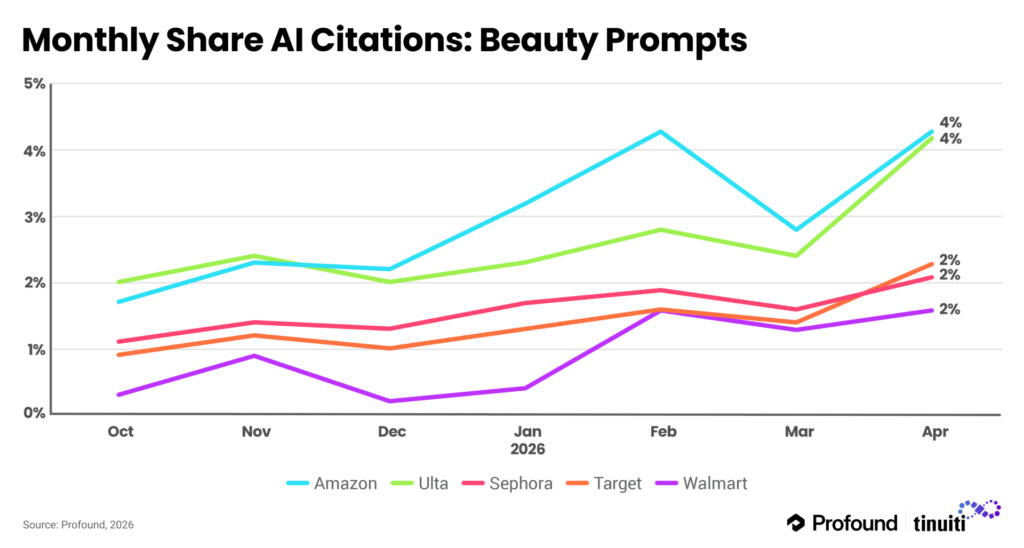
Similar to the electronics vertical, Amazon’s largest deficit in beauty citation share to Ulta is on Meta AI, where Ulta accounted for 14% of citations in April to Amazon’s 2%, while Amazon’s strongest relative showing is in Microsoft Copilot results (21% share vs. 7% for Ulta).

On ChatGPT, Amazon’s citation share is below its multi-platform average, but Amazon is still a significant ecommerce presence across prompt categories. For beauty prompts, Amazon accounted for just over 1% of ChatGPT citations in April, compared to 3.5% for leader Ulta. For electronics prompts, Best Buy led among ecommerce sites with 7% of ChatGPT citations in April, while Amazon accounted for 2%. Similarly, for home and garden prompts, Home Depot led with 7% of citations, while Amazon accounted for 2%.
Get all the data to understand key developments unfolding in the AI space.


