AI Citation Trends Report
Q1 2026
Q1 2026
While opinions vary on which acronym should be used to describe it, AI SEO is the art and science of understanding how artificial intelligence platforms and features are using source material to populate answers for users and what brands should do to optimize for visibility.
Part of understanding this new area of digital marketing is tracking how different domains are cited by major AI platforms over time to better understand which will ultimately be used in crafting generative answers.
Profound is a leading platform for helping brands quantify their own visibility in AI results across relevant prompts compared to competitors, and Tinuiti partners with Profound to help our clients unpack this data and act to increase visibility over time. Using the Profound platform, Tinuiti developed a systematic method for tracking citations across an array of categories over time to help brands and marketers understand key developments unfolding in the AI space. This report unpacks those learnings.
The nine categories tracked are apparel, beauty, electronics, food and beverage, home and garden, manufacturing, OTC health, technology, and transportation and logistics. The AI platforms and features included in this report are ChatGPT, Perplexity, Google AI Mode, Google AI Overviews, Google Gemini, Microsoft Copilot, and Meta AI.
There are limitations to this data, including:
With those limitations in mind, the data presented aims to give an accounting of how citations are trending over time, and how those trends differ across categories and platforms. Future iterations of this quarterly report will provide fresh insights into these and other trends as we work toward understanding the degree of change we should expect over time and what that
means for brands.

Across all categories and AI platforms tracked, the share of total citations attributed to social media climbed from October through January, topping 9% in the first month of the year. Overall share calculations weigh each of the seven AI platforms/features equally and do not take into account the relative popularity of each platform and feature.
This growth has been primarily the result of growth in the share of citations from Reddit, which grew significantly from late 2025 through early 2026. January share for the platform was nearly double what it was in October.
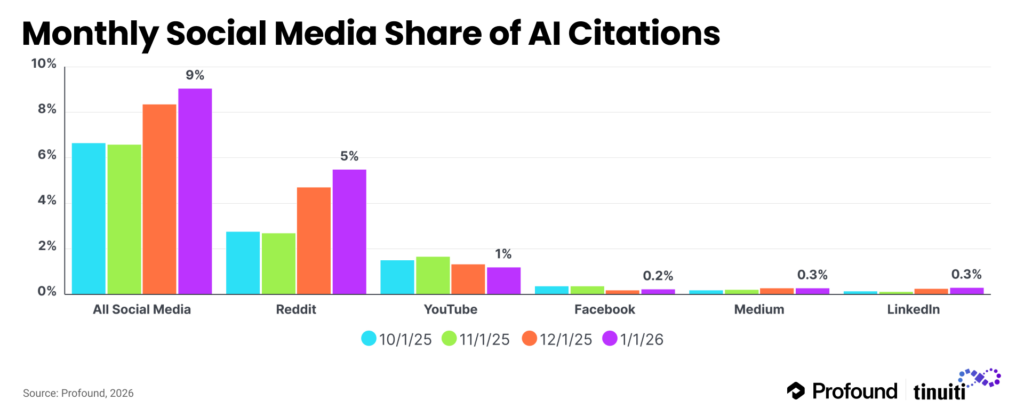
YouTube is the only other major social media platform to top 1% of citations consistently. While it looked like YouTube was gaining some ground on Reddit in November, that trend quickly reversed in December, and it remains to be seen how much month-to-month fluctuation brands should expect over time.
The extent to which specific platforms are represented in AI citations varies significantly by industry. For example, TikTok accounted for 0.06% of beauty AI citations in January, but just 0.02% of all citations in the same month.
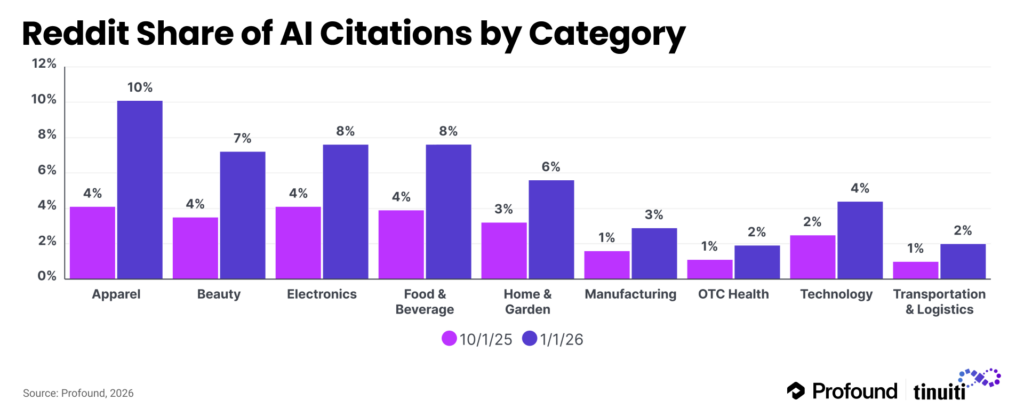
What has been universal is the growth of Reddit as a citation source. Across all industries and platforms studied, Reddit citation share grew by at least 73% from October to January, and more than doubled for some industries. Even for industries in which another platform was the top source of social media citations in October, such as YouTube for travel and logistics prompts, Reddit was the top platform by January.
However, there are significant differences in social media citation share depending on the AI platform. For example, nearly 7% of all ChatGPT citations were attributed to social media in January, compared to just over 3% for Gemini. Reddit share was above 5% on ChatGPT, compared to just 0.1% share on Gemini. YouTube was nearly excluded from citations on ChatGPT in January, compared to 0.7% share on Gemini.
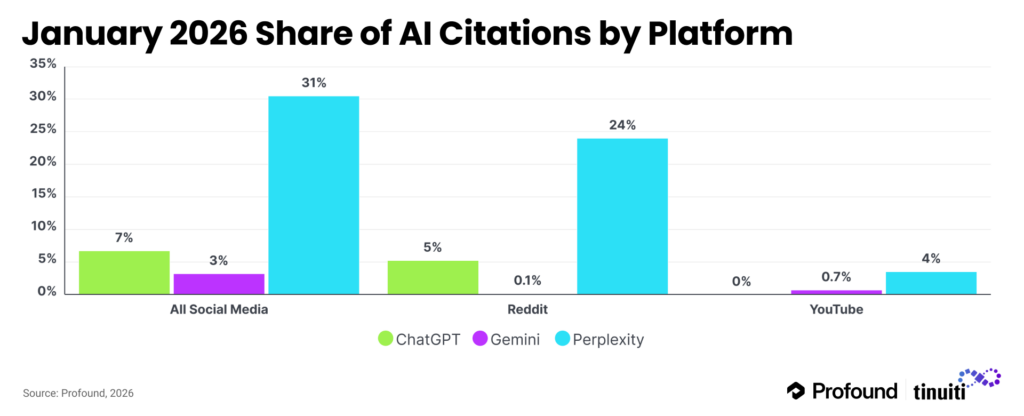
Excluding Google Gemini, Meta AI, and Microsoft Copilot, three platforms with very low social media share of citations, average social media share would be about 50% higher than it is including those three platforms.
Perplexity stands out among the AI platforms and features studied with 31% of all January citations coming from social media. This is heavily composed of Reddit citations, which accounted for 24% of all citations compared to 3% attributed to YouTube.
As such, the extent to which optimizing and/or growing social media content and mentions can influence AI visibility is very different depending on the platform or feature. This is true even between platforms and features run by the same organization.
As mentioned in the previous section, there are significant differences in the degree to which specific domains drive AI citations between platforms and features. This is even true for Gemini, AI Overviews, and AI Mode, three AI-powered experiences developed by Google.
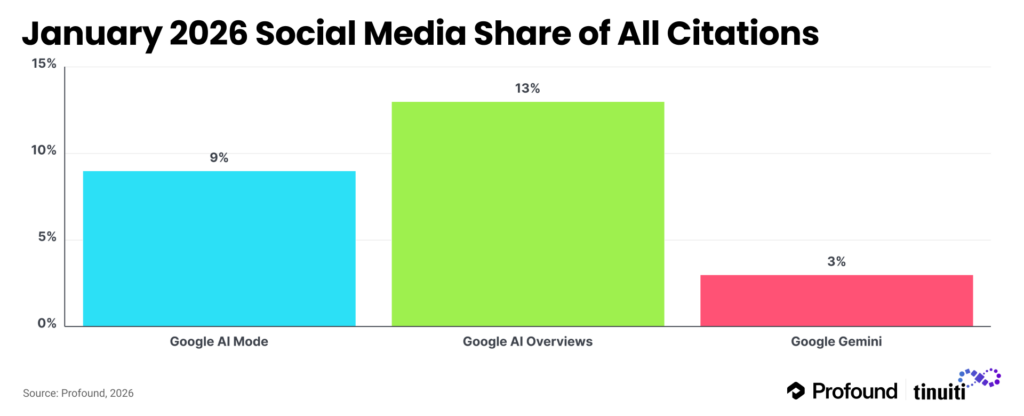
For example, just 3% of Google Gemini citations were attributed to social media in January, compared to 9% of AI Mode citations and 13% of AI Overview citations.
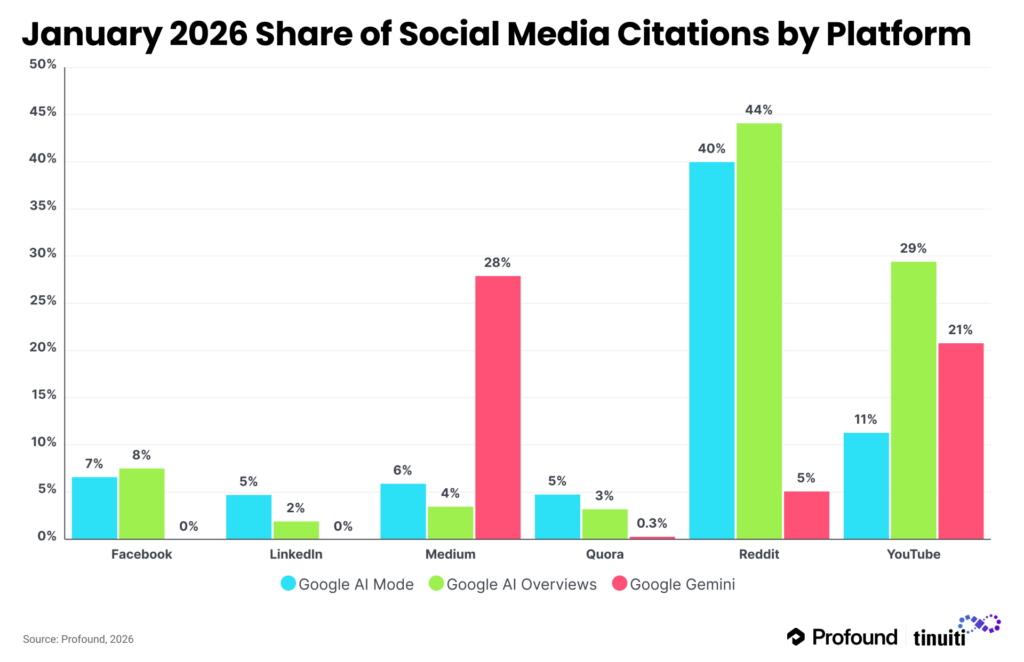
There is also huge variation when it comes to which specific social media platforms are cited. Reddit accounted for 44% of all January social media citations for AI Overviews, but only 5% of Google Gemini social citations for the same period. Reddit is nearly nine times more influential for one Google AI product than another!
Significant disparities also exist in the share of social media citations attributed to Medium, YouTube, Facebook, and LinkedIn.
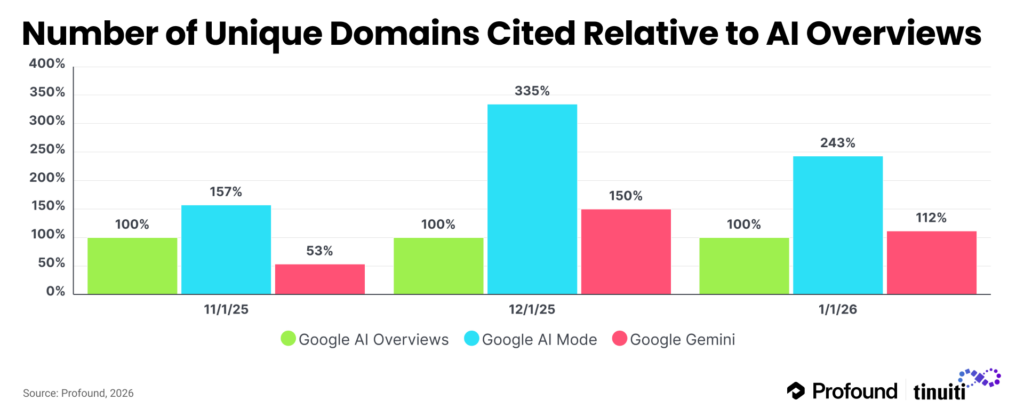
Zooming out, there’s been significant movement in how Google’s AI products compare to one another when it comes to the array of unique domains cited. In November 2025, AI Mode cited 57% more unique domains than AI Overviews and Gemini cited 47% fewer. By January 2026, AI Mode cited 143% more unique domains than AI Overviews, and Gemini cited 12% more.
This change in the relative number of unique domains cited is a result of a massive decline in the total number of tracked AI Overviews citations, which were down 46% comparing January 2026 to November 2025. Total tracked AI Mode and Gemini citations were about the same in January as they were in November.
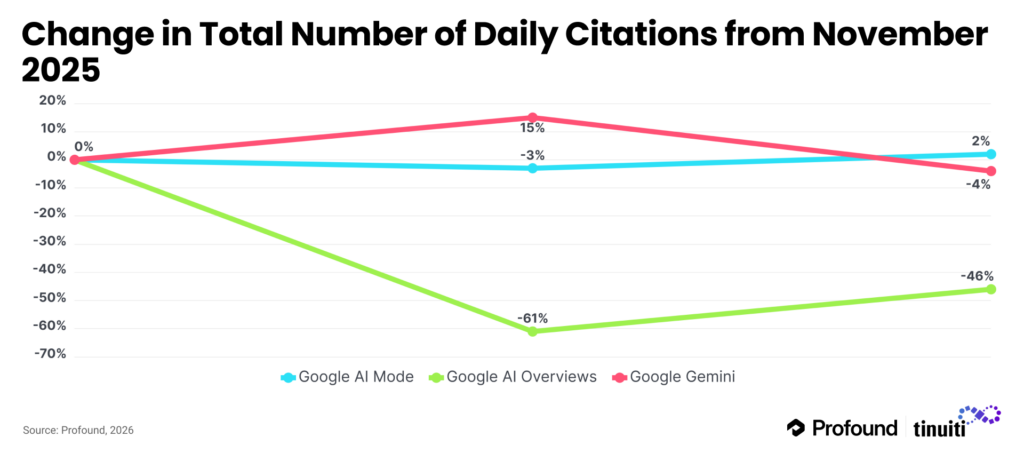
This means that not only are there big differences in the specific domains cited over time for each Google-run platform, but also that the depth and range of tracked citations in platforms like Profound can change very differently for each.
It’s possible and maybe even likely that at least some of the decline observed for the prompts studied is more indicative of the ability to track citations in AIOs rather than the extent to which citations exist within AIOs universally. Because AIOs are a feature included on search results pages that don’t always trigger them, citation tracking for AIOs can be affected by changes in the likelihood that tracking tools like Profound are able to trigger AIOs and track their citations over time.
More key differences for these and other AI products emerge when focusing on the role of major ecommerce platforms in AI citations, and at least part of the discrepancy is explained by the degree to which different crawlers are allowed to collect information from around the internet.
Amazon.com is the most commonly cited ecommerce site across the top generative AI platforms accounting for an average of just over 2% of all citations for prompts with commercial intent in January 2026. At first glance, this may not be surprising, but Amazon has made a concerted effort to block AI bots from crawling its site.
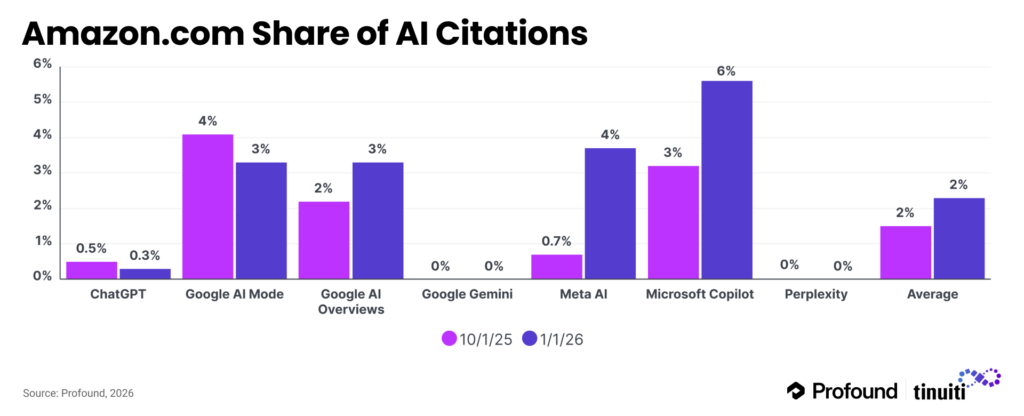
At the end of January, Amazon was blocking nearly 50 specific user agents in its robots.txt file, many of them for the most popular AI platforms, including all three of the crawlers used by OpenAI. Given the breadth of Amazon’s efforts to block AI crawlers, it may actually seem surprising how prominent they remain in AI results.
While Amazon still accounted for 0.3% of ChatGPT citations in January, despite blocking OpenAI’s crawlers, it accounted for a much larger share (3.3%) of citations for Google’s AI Mode and AI Overviews. This was not consistent across all of Google’s AI tools, however, with Amazon being effectively absent from Google Gemini citations.
Importantly, while Amazon is blocking the Google-Extended user agent that feeds Google’s Gemini models, it is allowing Google’s main Googlebot crawler that not only powers Google’s core search product, but also its AI Mode and AI overviews.
Amazon is also missing from the citations on Perplexity, a company that Amazon sued in late 2025 over claims that Perplexity tried to evade Amazon’s bot restrictions in order to provide an agentic shopping experience. By all appearances, Amazon would rather have human users go to its site directly where it can cross-sell and upsell them or get them to use Amazon’s own shopping agent, Rufus, all the while keeping Amazon’s data from helping power potential competitors.
The current climate around Amazon and AI platforms echoes the push and pull between Amazon and Google in the traditional search sphere, particularly with respect to Google’s paid shopping listings. For nearly five years, Amazon refused to pay Google to be part of its shopping listings when Google moved to a paid model, only to eventually run them for nearly a decade before turning them off in mid-2025, save for some limited listings for Amazon Pharmacy.
In both the AI and traditional search worlds, Amazon has had to weigh its immediate revenue interests against benefiting competitive platforms longer term — whether in direct financial payments, providing valuable data insights, or fuzzier notions like helping those competitors offer more comprehensive services. For the time being, Amazon has swung back toward a more isolationist approach.
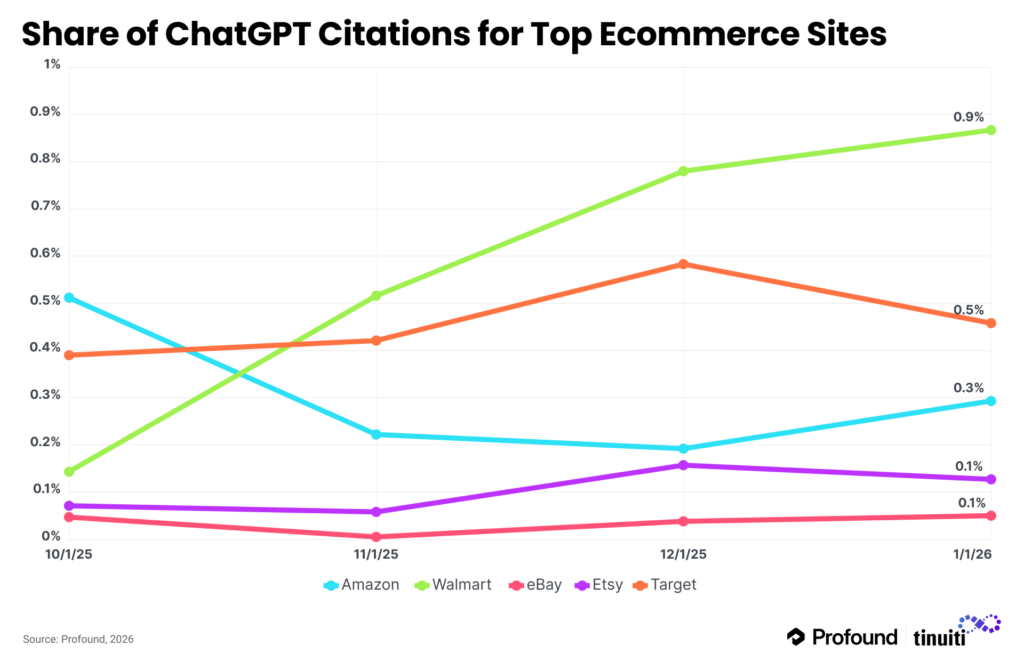
Amazon’s stance on AI bots has allowed Walmart to take the lead on ChatGPT citations among large multi-category retail sites. As recently as October 2025, Amazon led among this group, but while its share of citations dropped sharply in November, Walmart’s share spiked in the opposite direction and Walmart has seen its share continue to rise in the months since.
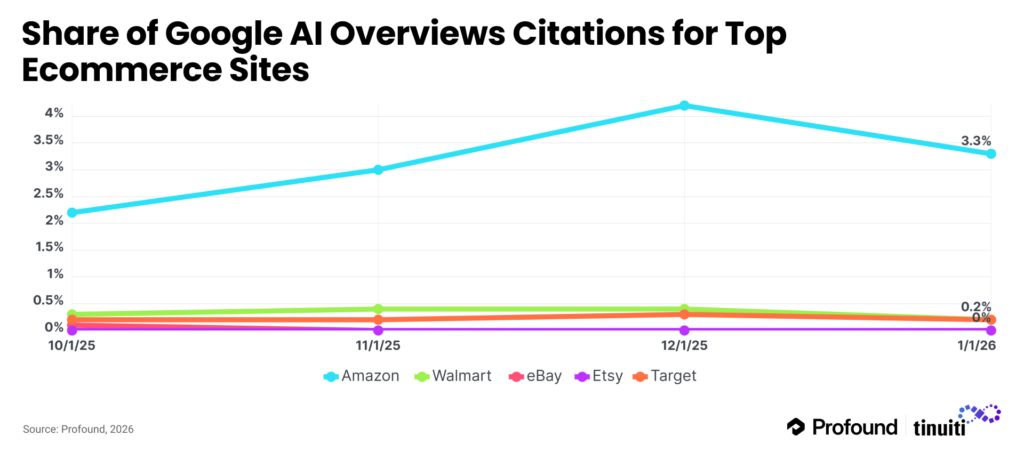
For Google’s AI Overviews, where Amazon is not blocking the relevant crawlers, citation stats and trends are quite different. Amazon’s citation share is much larger for AI Overviews and it continues to see a significant lead over the ecommerce competition. The gulf between Amazon and the next largest ecommerce site was wider in January 2026 than it was in October 2025, although Amazon did see a dip from December.
Check out our most recent AI Citation Trends Report for exclusive insights.
