Holiday Shopping Statistics 2026: Spending, AI and Timing


Holiday shopping is shaping up to be a test of how well brands actually understand consumer behavior, not just the scale of advertising spend.
Shoppers are starting earlier, watching their budgets, and using more channels to research gifts and compare prices. Yet the biggest promotional days remain central. According to Tinuiti’s 2026 Holiday Shopping Trends report, 25% of U.S. holiday gift buyers plan to do most or all of their shopping between Thanksgiving and Cyber Monday. Additionally, 23% expect to spend less than last year and 57% intend to use AI tools.
For marketers, the challenge is responding to these behaviors with a media strategy that reaches consumers throughout the season.
The Most Important Holiday Shopping Statistics for 2026
According to our survey of 1,000 U.S. holiday gift buyers, consumers are watching their spending, getting a head start, and hunting for deals across multiple channels. Here’s what stood out in our research:
While 27% of shoppers expect to spend more on gifts this year, 23% plan to spend less, and half anticipate spending about the same. However, 37% say they feel worse about their finances than last year, compared with just 29% who feel better.
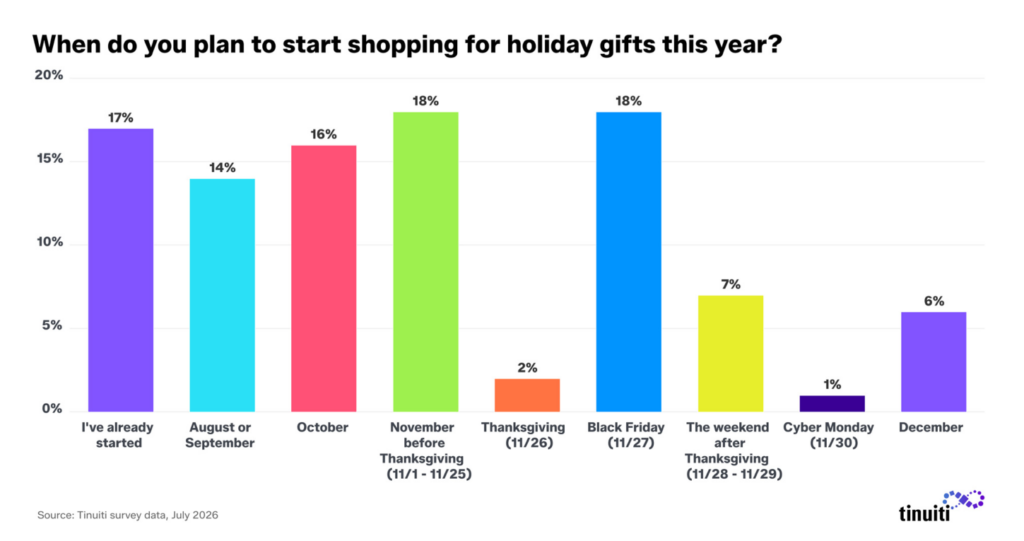
Holiday shopping is already underway: 17% of respondents had started buying gifts by September, and another 14% intend to begin before October. But Black Friday still matters: 18% say they’ll start shopping that day.
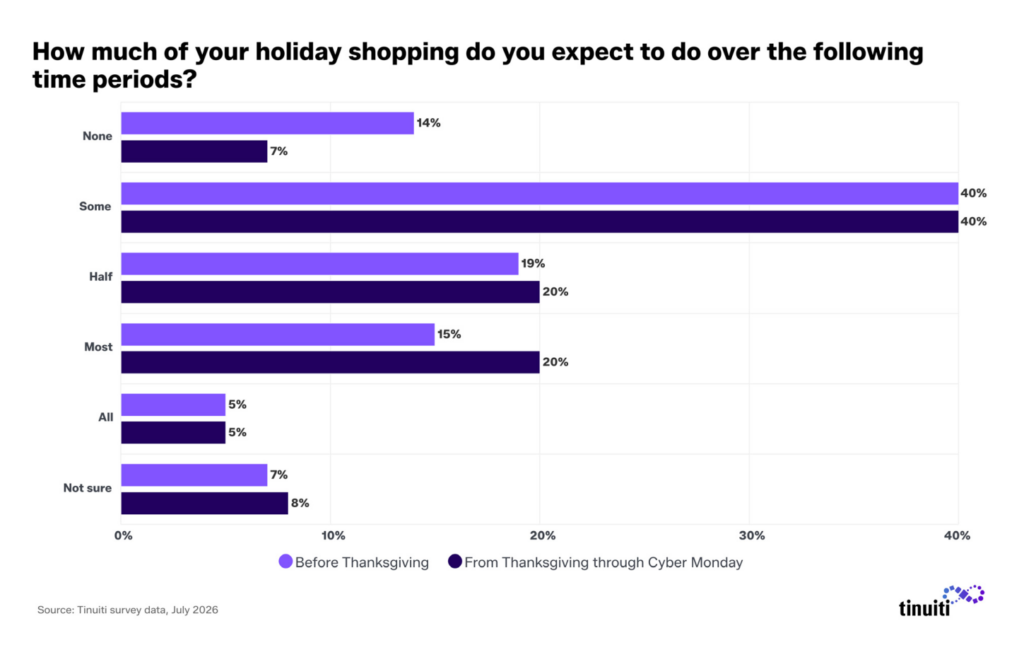
25% of shoppers intend to do most or all of their holiday shopping during Cyber Five, the five-day shopping between Thanksgiving and Cyber Monday. That’s a larger share than the 20% who anticipate finishing most or all of their purchases before Thanksgiving.
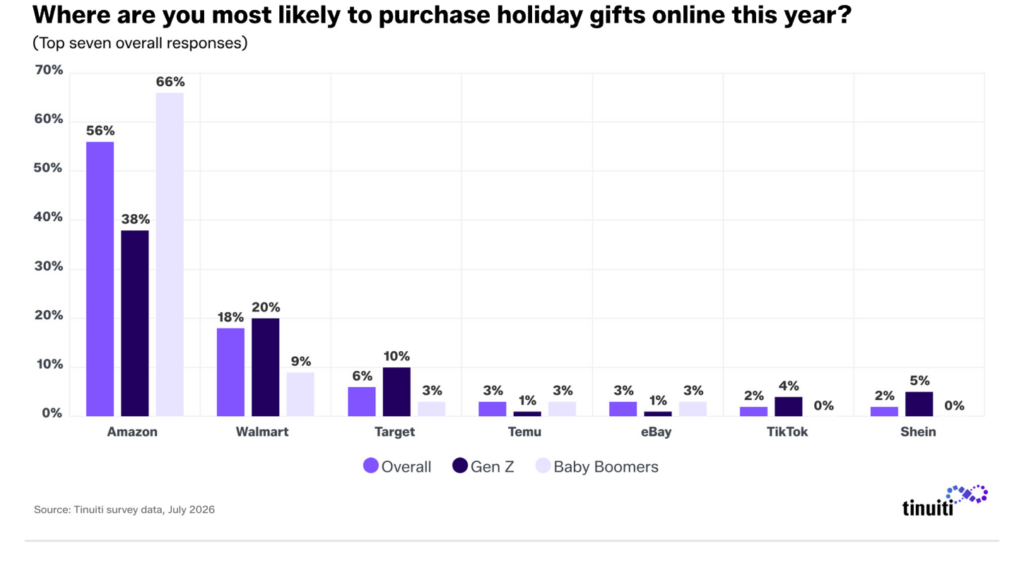
When asked where they’re most likely to buy gifts online, 56% of shoppers said Amazon.
AI is becoming more important to the holiday purchase journey: 57% of shoppers intend to use it this year, with product searches (26%), finding deals (25%), and comparing products (23%) among the most popular uses.
Nearly three-quarters of shoppers (74%) rank price among their top three purchase influences, followed by free shipping at 67% and sales and discounts at 61%.
Let’s dig into the findings in more detail.
Holiday retail sales are expected to increase in 2026, but individual shoppers are approaching their budgets with caution. Deloitte forecasts total U.S. retail sales of $1.70-1.71 trillion between November and January, up 4%–4.8%. Ecommerce sales are projected to grow faster, increasing 7.5%–8.4% to reach $316.1–318.9 billion.
PwC’s holiday outlook presents a different perspective: average spending per consumer is expected to fall 5%, with personal gift budgets dropping 11% to approximately $708.
| Source | Measure | 2026 outlook |
| Deloitte | Total retail sales, November–January | $1.70T-$1.71T; up 4%–4.8% |
| Deloitte | Ecommerce sales, November–January | $316.1B-318.9B; up 7.5%–8.4% |
| PwC | Average consumer spending | Down 5%; gift spending down 11% to $708 per consumer |
| Tinuiti | Gift-spending intentions | 27% of shoppers spending more; 23% spending less; 50% unchanged |
These findings are not necessarily contradictory, since total sales can grow even when some households reduce discretionary purchases. For context, the National Retail Federation reported holiday retail sales growth of 4.1% in 2025, exceeding $1 trillion for the November–December period.
Tinuiti’s research also highlights differences in financial confidence: 37% of respondents feel worse about their finances than a year ago, compared with 29% who feel better. Among those reporting weaker finances, 41% plan to reduce gift spending.
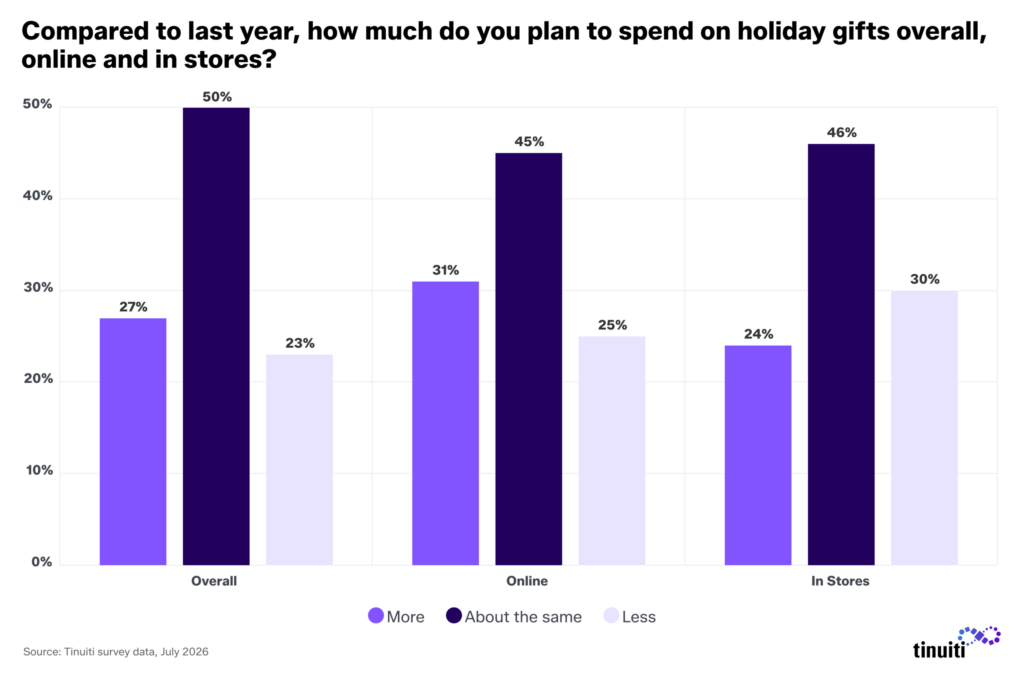
Generation and household composition matter, too. Gen Z shoppers are the most likely to increase spending (46%), yet only 36% expect to spend more than $250. Among shoppers buying for children, 55% anticipate spending over $250, compared with 34% of those who aren’t.
Don’t mistake aggregate sales growth for stronger demand across every audience. Segment campaigns by spending intent and household needs, then measure incremental sales alongside revenue and margins to determine whether promotions generate additional purchases or simply reduce profitability.
For nearly one-third of holiday shoppers, the season begins before October. But the timing varies considerably by generation.
Gen X and older consumers are more likely to begin in October (20%) than Gen Z and millennials (12%). However, 34% of younger shoppers expect to start between Thanksgiving and Cyber Monday, compared with 29% of all respondents.
Brands need to reach early shoppers without exhausting their budgets before Cyber Five. Rather than treating holiday campaigns as a single November launch, coordinate awareness, product discovery, and conversion campaigns throughout the season. Use early performance data to identify which products and offers deserve additional investment during the five-day promotional period.
Cyber Five, the five days from Thanksgiving through Cyber Monday, remains a major period for holiday purchases.
While 25% of shoppers plan to complete most or all of their holiday shopping during Cyber Five, only 7% expect to make no purchases during those five days.
Actual sales figures reinforce its importance. According to Adobe’s 2025 holiday shopping report, consumers spent $44.2 billion online during Cyber Week, an increase of 7.7% year over year. Cyber Monday generated $14.25 billion, up 7.1%, while Black Friday reached $11.8 billion, up 9.1%.
Tinuiti’s Black Friday and Cyber Monday recap also highlights shifts in advertising investment and performance in 2025:
Cyber Five performance depends on more than search and shopping ads. Retail media, paid social, and streaming can influence purchase decisions throughout the same five-day period. Coordinate budgets and measurement across channels to evaluate their combined impact, rather than allowing separate campaigns to compete for credit for the same conversions.
Online shopping continues to expand. Our study found that 61% of respondents expect to complete at least half their holiday shopping online, including 39% who plan to do most or all of it digitally. Meanwhile, 31% expect to increase online shopping compared with last year, versus 24% who anticipate making more in-store purchases.
This aligns with broader ecommerce trends. The U.S. Census Bureau reported that ecommerce accounted for 17.1% of seasonally adjusted U.S. retail sales in Q2 2026, with online sales up 12.2% year over year.
However, physical stores remain an important part of holiday purchasing. Large retailers attract shoppers across both channels:
Amazon leads among online holiday shopping destinations, with 56% naming it their top choice for gifts. That figure ranges from 38% among Gen Z to 66% among baby boomers. Walmart ranks second across generations, while Target, Shein, and TikTok attract above-average interest among Gen Z.
Connect online and in-store sales data to measure the full impact of your campaigns. Media exposure can influence purchases across both channels, so evaluating them separately may overlook their contribution to total revenue. An integrated commerce strategy can help brands connect these efforts.
It’s also important to match marketplace investment to your target audience instead of treating Amazon as the default destination for every shopper. You can use audience and channel performance data to determine where retail media budgets will have the greatest impact.
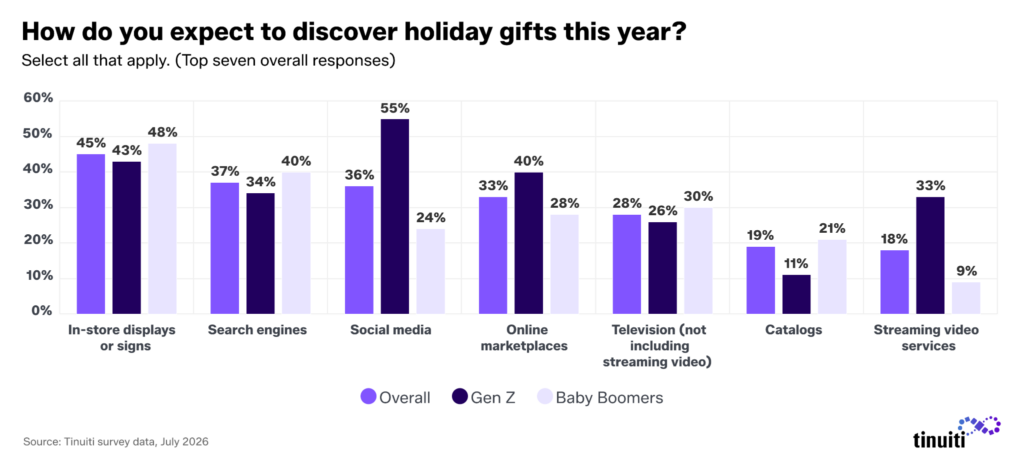
Holiday shoppers find gift ideas across physical stores, search engines, social platforms, and marketplaces. We found that in-store displays top the list at 45%, while search engines, social media, and online marketplaces each influence roughly one-third of respondents.
Traditional television also remains relevant, with 28% citing it as a discovery source compared with 18% for streaming video. Among Gen Z, however, streaming leads traditional TV, 33% to 26%.
Tinuiti’s Digital Ads Benchmark Report shows that advertisers are investing more heavily in streaming, with Prime Video ad spend up 48% year over year in Q2 2026.
Social media is another major source of gift inspiration, with Facebook leading at 52%, followed by YouTube (45%), TikTok (36%), and Instagram (33%).
Influencers also affect purchases: 30% of respondents have bought a holiday gift based on an influencer recommendation, rising to 52% among Gen Z.
But inspiration is only part of the shopping journey. When looking for deals, shoppers turn to a different mix of channels. Search engines are the most popular source at 44%, followed by social media (38%), email (34%), and browser extensions (20%).
Download our Digital Ads Benchmark Report for a deep-dive on data across Google, Meta, Amazon, and more.

A connected approach to social commerce is critical: a shopper might discover a product in a creator’s video, compare prices through search, and complete the purchase on a marketplace. Instead of measuring only the final transaction, think about how each channel contributes to discovery, consideration, and conversion. This can help you identify which investments influence purchases, even when the sale happens elsewhere.
AI is becoming a regular part of holiday shopping, but our findings suggest that interest may be leveling off. We found that 57% of shoppers expect to use general AI tools in 2026, nearly unchanged from 58% in our 2025 survey.
Other research points to continued growth in AI-assisted shopping. PwC reports that 29% of consumers plan to use AI for holiday purchases, up from 22% in 2025. Meanwhile, Adobe found that traffic to U.S. retail sites from generative AI tools increased 693.4% during the 2025 holiday season.
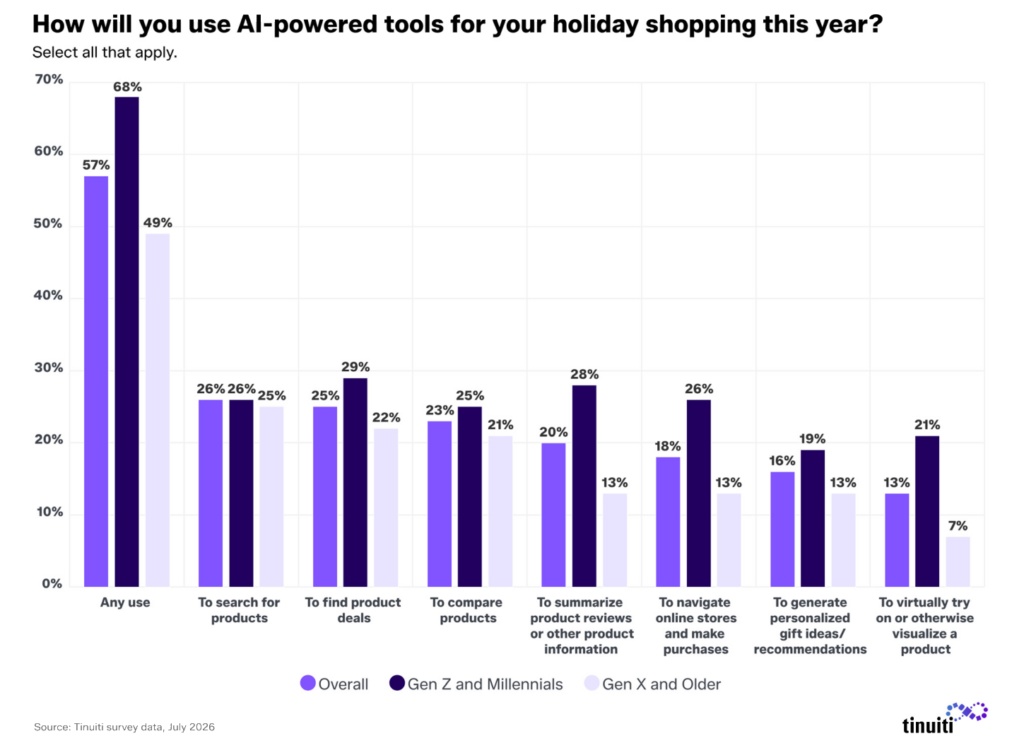
Discovery and deal hunting are among the most common use cases:
ChatGPT is the most popular general AI platform for holiday shopping, cited by 30% of respondents, followed closely by Google Gemini (28%). Google AI Mode ranks third. Younger consumers are particularly interested in ChatGPT: 41% of Gen Z and millennials expect to use it, compared with 22% of Gen X and older shoppers.
Retailers’ own AI assistants are also part of the picture. Nearly half of respondents (48%) expect to use one, with Alexa for Shopping ahead of Walmart Sparky. Among shoppers who favor Amazon, 37% plan to use Alexa for Shopping, compared with 24% of other consumers.
AI shopping isn’t just about advertising within AI tools. Shoppers are also using these platforms to find products, compare options, and evaluate prices before making a purchase. That makes accurate product information and visibility in AI-generated responses increasingly important. Marketers should review how their products appear in AI-powered search and shopping experiences, then look for opportunities to improve discoverability through a broader AI search strategy.
Price remains the strongest influence on holiday purchases, but shoppers also prioritize shipping costs, delivery speed, and perceived value.
When asked about the most important characteristics of gifts, 30% chose affordability and 28% selected value. Premium quality followed at 13%, with brand at 11%.
When it comes to deciding where to buy, shoppers consider several factors:
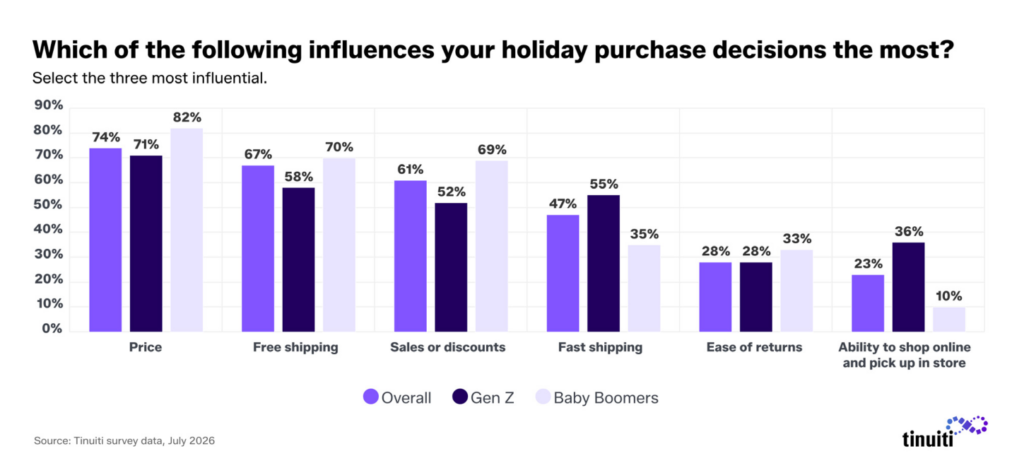
Delivery speed is particularly important for younger shoppers. Among Gen Z respondents, 55% identified fast shipping as a top-three influence, compared with 35% of baby boomers.
As the holidays approach, fulfillment options become more consequential. We found that last-minute shoppers plan to visit stores (35%), purchase gift cards (34%), or switch to retailers offering faster fulfillment (24%). Others expect to pay for expedited shipping (19%) or use buy online, pick up in store (16%).
As for what shoppers actually plan to buy, clothing and accessories are the most popular gift category (62%), followed by gift cards (55%) and toys or baby products (41%).
Brands should make pricing, delivery deadlines, and fulfillment options visible before checkout, since unclear information can create unnecessary friction when shoppers are making time-sensitive purchases. It’s also worth considering these factors as part of a broader conversion rate optimization strategy that spans every stage of the journey, from product discovery through checkout.
Gen Z and baby boomers approach holiday shopping with distinct priorities, from how they discover gifts to what they buy and where they shop. Our 2026 research reveals some notable differences:
| Holiday shopping behavior | Gen Z | Baby boomers |
| Feel better about finances than last year | 49% | 18% |
| Name Amazon as most likely online destination | 38% | 66% |
| Have bought a gift on an influencer’s recommendation | 52% | 12% |
| Identify fast shipping as a top-three influence | 55% | 35% |
| Plan to buy gift cards | 48% | 63% |
| Plan to buy video games or in-game currency | 48% | 13% |
The contrasts are especially pronounced in gift discovery and purchasing habits. Gen Z shoppers are more likely to act on influencer recommendations and prioritize fast delivery, while baby boomers demonstrate a stronger preference for Amazon and gift cards.
AI shopping shows a similar age-related pattern. Among Gen Z and millennials, 61% plan to use retail AI assistants, compared with 38% of Gen X and baby boomers.
A one-size-fits-all holiday strategy is unlikely to work equally well across generations. For Gen Z, consider investing more in creators, streaming, AI-powered discovery, and convenient fulfillment, while baby boomers may be easier to reach through established retailers and more familiar channels.
But generational differences should inform your strategy, not dictate it. Use audience and campaign performance data to test which channels, messages, and offers actually resonate with your customers.
Believe it or not, holiday shopping doesn’t end on December 25. In fact, we found that nearly half of consumers plan to shop end-of-year sales after the holidays. Another 36% expect to spend gift cards they receive, while 25% plan to purchase discounted holiday decorations.
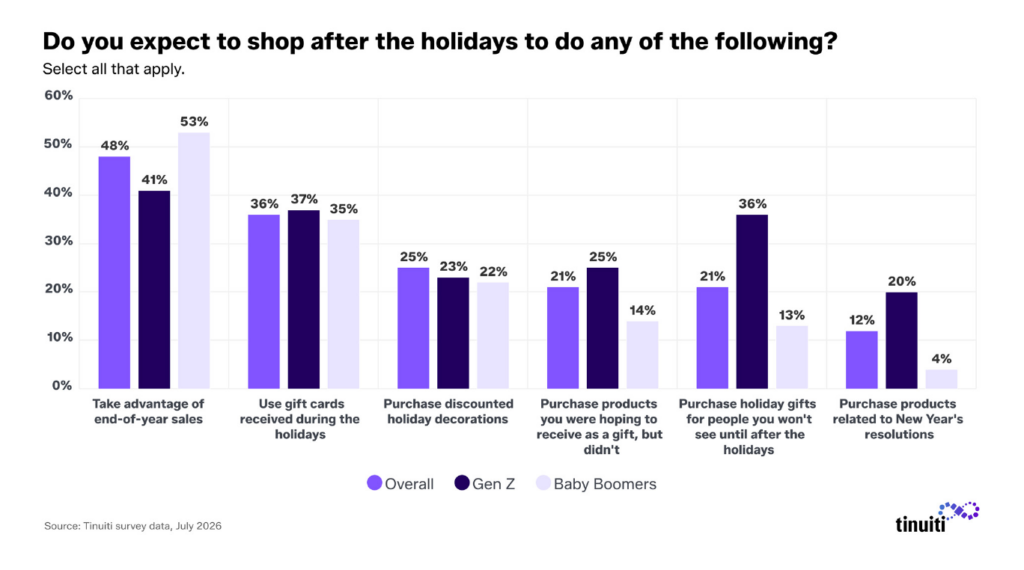
Post-holiday demand also includes purchases that shoppers delayed or could not complete earlier:
Commonly known as Q5, the period between December 26 and early January gives brands another opportunity to reach shoppers after Christmas.
Instead of ending campaigns immediately after Christmas, think about how you can adapt your creative, product selection, and offers to respond to post-holiday shopping behavior. Tailoring campaigns around gift card redemption, self-purchasing, clearance promotions, and New Year’s resolutions can help connect with shoppers looking to buy beyond December 25.
Our 2026 research makes one thing clear: brands need a holiday strategy built around how consumers actually shop. How?
Tinuiti’s Bliss Point Incrementality Lab helps marketers evaluate the incremental impact of their investments and make more informed budget decisions.
Measurement tech that shows what’s driving growth – and exposes what’s holding your campaigns back.

Holiday success takes more than a strong Black Friday campaign. Brands need to connect with shoppers throughout the season, coordinate their investments across channels, and measure which activities actually drive sales.
Tinuiti helps brands connect media, commerce, and measurement to identify growth opportunities and make more effective investment decisions.

Copywriter, Tinuiti
Rachel is a content marketer and writer with over a decade of experience. She specializes in developing original, story-driven content for B2B brands on AI and other technical topics. She is based in Charleston, SC and enjoys yoga, travel, and creative writing.
Check out our full research report, 2026 Holiday Shopping Trends, for more exclusive insights.