Prepare for Prime Day 2026: Maximizing Amazon Sales

Prime Day 2026 is coming a month early this year. Amazon has announced the event will happen June 23rd-26th, and 88% of Prime members plan to participate. But tariffs have shoppers demanding deeper discounts—33% need at least 30% off to consider a deal worthwhile. The brands that win will be those who prepare early, optimize for AI discovery, and build momentum before the event starts.
What you need to know:
Action items: Check inventory levels, verify account health, optimize listings for Alexa for Shopping and AI discovery, increase budgets for top keywords, and launch social campaigns now to warm up audiences before June 17.
Prime Day 2026 (a.k.a. Amazon’s biggest shopping moment of the year) will take place on June 23rd-26th, a month earlier than previous years. The event is also unfolding against a backdrop of tariff-driven inflation that’s reshaping how shoppers think about deals.
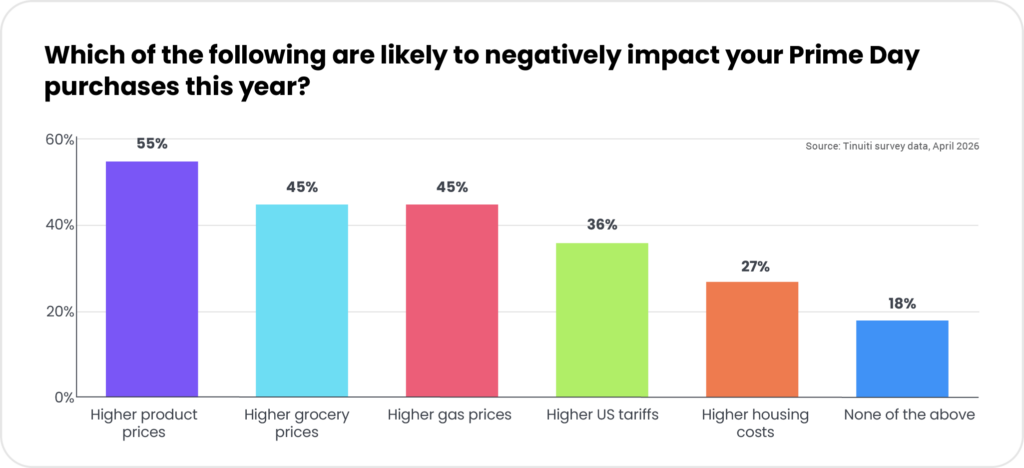
Our 2026 Prime Day Study of 1,000 US Amazon Prime members found that 88% plan to shop during the event, up from 81% last year. Nearly half of returning shoppers report being more excited than last year. But excitement doesn’t mean they’re not price-conscious. In fact, 55% anticipate that higher product prices will impact their purchases, while 45% cite higher gas and grocery prices as concerns.
From inventory planning to AI-optimized listings to the omnichannel campaigns that build awareness before the first deal drops, we’ve pulled together what you need to do before Prime Day to maximize sales and make this your most successful event yet.

Before we dive into tactics, let’s address the two biggest changes impacting this year’s event.
Amazon has confirmed Prime Day 2026 will take place on June 23rd-26th, a departure from the traditional mid-July timing. For brands, this means:
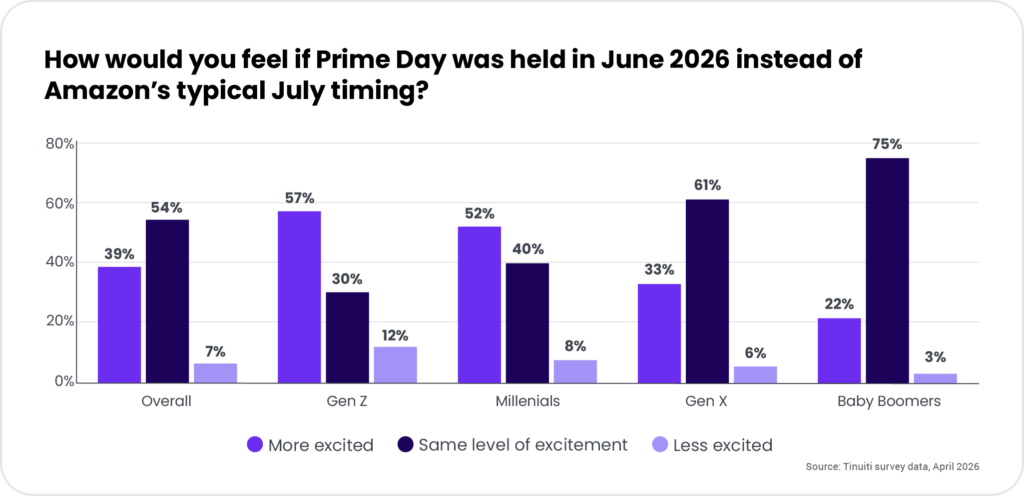
Our 2026 Prime Day Study found that 39% of shoppers would be even more excited about a June Prime Day, with Gen Z leading the enthusiasm at 57%. Only 7% would be less excited about the earlier timing. Translation: Earlier works in your favor if you’re ready for it.ugh inventory in stock to meet demand and overstocking. And if you’re not sure exactly where that line is, Amazon’s Inventory Performance Index can provide some clarity.
The economic backdrop for Prime Day 2026 is unlike previous years. Ongoing tariffs have driven product inflation across categories, and shoppers know it. Our study reveals the impact:
This means that deal depth matters more than ever. Shoppers aren’t just looking for discounts. They’re looking for proof that they’re beating inflation.
In 2025, Amazon broke from the traditional 48-hour format and extended Prime Day to four full days. While it’s not confirmed that this year’s event will follow the same duration, we’d recommend planning for a longer window.
Our 2025 data showed that 40% of shoppers spent more time shopping on Amazon due to the extended window, and 39% ultimately spent more money. It also meant that 24% waited until later in the event to make purchases, and 12% shopped around on other sites and apps more than they would have during a two-day event.
What this means for your strategy: You need sustained campaign momentum, not just a two-day sprint. Budget pacing, creative rotation, and bid management all require more sophisticated planning.
Important Dates to Remember:
We say it every year, and the data backs it up: Your Prime Day success is largely determined by what you do before the event. Below are the tried-and-true tactics we recommend to our clients, updated for the realities of 2026.
The key to winning Prime Day? Don’t stock out.
Stocking out during Prime Day triggers a cascade of problems. When a product goes out of stock, potential customers turn to competitors. Frequent stockouts risk losing the buy box to competitors with available inventory. Longer shipping times due to poor inventory distribution across Amazon’s fulfillment network can lead to order cancellations. All of this reduces visibility, revenue, and customer loyalty.
On the flip side, selling consistently and maintaining healthy inventory levels positively impacts your Amazon SEO ranking. The more you sell, the better your product ranks in search results, leading to even more visibility and sales. A successful Prime Day can boost your organic rankings for the rest of the year. But if you stock out, you’re leaving those gains on the table.
The Golden Rule for 2026: Get it in early. When the Prime Day window opens, Amazon shifts its entire operational focus toward getting products out the door to customers, not getting new inventory into the bins. If your product isn’t already sitting in a fulfillment center when the rush starts, it might as well not exist.
To make sure your products are Prime badge-ready, you need to account for true end-to-end transit times, including factory lead times, freight, and carrier delays, and align backward from Amazon’s strict 2026 receiving cutoff dates:
Pro Tip for 1P Brands: If you are operating on Vendor Central, don’t wait for the algorithm to save you. Review your initial rounds of purchase orders (POs) immediately. If the automated quantities look too lean to sustain a four-day marathon, aggressively escalate and reach out to your Vendor Manager or supply chain support team at Amazon right now to secure the inventory depth you actually need.
Margin pressure is not coming from tariffs alone. Experts in the Prime Day 2026 playbook webinar called out Amazon’s new 3.5% logistics and fuel surcharge as another headwind that sellers and vendors need to account for when setting promotions, media budgets, and inventory plans.
That matters because Prime Day shoppers are entering the event with elevated discount expectations. Tinuiti’s 2026 Prime Day research found that 33% of shoppers need to see at least 30% off to consider a deal worthwhile, while 20% need discounts of 50% or more to feel they are getting real value.
Before locking in deals, brands should model profitability with all margin pressures included: tariffs, the new surcharge, promotional costs, media spend, and fulfillment realities. In this environment, Prime Day planning should not just answer “can we drive volume?” but “can we drive profitable volume?”
Because the event window might span four days again, you’ll need more inventory than you would for a two-day event. We’d recommend using historical data from Prime Day 2025, Black Friday, and Cyber Monday to forecast demand, but plan for a longer sales tail across all four days.
Amazon’s Inventory Performance Index (IPI) can help you find the balance between stocking enough to meet demand and avoiding overstock penalties.
With tariffs continuing to impact product costs, you’ll want to work closely with your supply chain team to understand your true landed costs. If tariffs have increased your COGS, you may need to adjust your deal strategy or margin expectations. The brands that win Prime Day 2026 will be those that planned for these realities months in advance.
And tariffs aren’t the only macroeconomic pressure squeezing your margins this year. You’ll also want to account for Amazon’s new 3.5% 3P fuel and inflation surcharge.
Spurred by climbing gas prices and broader geopolitical tensions, Amazon recently implemented this surcharge across third-party sellers, effectively compounding the margin squeeze already felt from tariff inflation.
What does this mean for your Prime Day playbook? It means your baseline profitability calculations from 2025 are officially obsolete. When you are determining how deep your discounts can go to entice inflation-weary shoppers (remember, 33% of them need to see at least a 30% discount to move the needle), you must factor this 3.5% surcharge directly into your margin math.
The last thing you want is to discover that one of your most profitable ASINs is suspended the weekend before Prime Day. Proactive account health management is non-negotiable.
We recommend near-daily check-ins on the Account Health dashboard in Seller Central leading up to Prime Day. Look for:
This applies to your entire account, not just the ASINs you’re planning to promote during Prime Day.
Review the Voice of the Customer report in the weeks leading up to the event. It surfaces feedback about product quality, description issues, or fulfillment mishaps that could flag an ASIN during Prime Day resulting in lost sales or reputational damage.
Also, download your Returns Report and analyze items with high return rates. Sometimes returns are flukes (wrong address, customer changed mind). Other times, they signal real problems with your product page, product quality, packaging, or fulfillment process. Fix these issues now, before they scale during the event.
Historical performance analysis is your blueprint for smarter decisions and better ROI. Pull data from previous Prime Days, Prime Big Deal Days, Black Friday, and Cyber Monday. Look at:
When evaluating past promotional performance, look beyond sales volume. Consider the types of offers you ran, the promotional mechanics (Lightning Deal vs. coupon vs. price discount), and the advertising costs associated with each product sold. Return on ad spend (ROAS) becomes your critical metric.
In our Q4 2025 Digital Ads Benchmark Report, we observed that Amazon Sponsored Products delivered stronger year-over-year sales growth than Google paid search during most key holiday shopping periods. The median retailer saw Amazon Sponsored Products sales up 35% year-over-year on Black Friday and 34% on Cyber Monday. Use benchmarks like these to set realistic expectations for Prime Day.
When pulling historical data, remember that more sales often mean more returns. Check your returns report for the 30 days following Prime Day to cover the return window for products sold during the event.
Prime Day content strategy now has to work for both shoppers and machines. Product detail pages (PDPs) should not just read well for humans; they also need to be structured clearly enough for Alexa for Shopping, Google AI Overviews, Gemini, ChatGPT, and other AI systems to parse, interpret, and surface confidently.
That timing matters more than many brands realize. That’s because once PDP content is updated, it can take about six weeks for those changes to feed into the algorithm and begin driving a measurable lift in traffic, which means waiting until the last minute is waiting far too long.
“This AI research support is actually extending the consideration phase… shoppers then have more time to use AI tools to conduct more product research and make comparisons across products and across retailers.”
Sky Canaves, Principal Analyst for Retail and Ecommerce at eMarketer
Why this matters now
Amazon remains the most frequently referenced ecommerce source across non-Alexa for Shopping LLMs, giving brands an opportunity to improve visibility not only inside Amazon but across external AI-driven discovery experiences as well. At the same time, AI is extending the shopping journey rather than simply accelerating it: only about a third of shoppers using AI shopping assistants said it helped them buy faster, while the rest said it took the same amount of time or longer because they used AI for deeper research and comparison​.
What to optimize
Listing Optimization Checklist
Audit and update listings: Use tools in Seller Central and Vendor Central to review listings for accuracy and completeness. Have you included high-opportunity keywords in titles? Are bullets well-written and feature-focused?
Fix inactive or suppressed listings: Ensure you’re following Amazon’s guidelines and including all required information
Add a featured video: 96% of consumers report that video helps them make purchase decisions. For Prime Day, a compelling product video can be the difference between browsing and buying
Start A/B testing now: Identify variables to test (title text, images, bullet points) and run tests well before Prime Day so you have time to optimize for conversions
Optimize titles and descriptions for SEO: Draft concise, keyword-rich titles and descriptions. But remember: real shoppers read this content. Make it scannable and natural, not keyword-stuffed
Enhance with A+ Content: Use Amazon A+ Content to add comparison charts, lifestyle images, and detailed product stories that build trust and differentiate you from competitors
“From an operational standpoint, detail page content for images and copy descriptions are going to differentiate your product from a large selection of heavily discounted products—brands should optimize their detail pages to ensure maximum conversion.”
Emily Schwebs, Manager, Retail Operations, Tinuiti
In most cases, no. Prime Day is usually not the best moment for a true new-product launch because the event is crowded, expensive, and easy for an unproven ASIN to get lost in the shuffle.
There are also practical constraints. A brand-new ASIN may not have enough time to meet Amazon retail-readiness thresholds, qualify for certain promotions, build conversion history, or generate the learnings needed to spend media efficiently during a highly competitive tentpole event.
A better strategy is to soft launch 30, 60, or 90 days ahead of Prime Day. That gives the product time to build sales velocity, collect reviews, understand which audiences convert, and identify which keywords deserve budget before the Prime Day crescendo begins.
Prime Day can then become an acceleration moment rather than a cold start. That approach gives brands stronger media signals, clearer content priorities, and a better shot at entering the event with enough relevance and momentum to compete.
The one caveat is when the product already has substantial built-in demand, such as a major release from an established brand with anticipation already in market. Short of that kind of launch, most brands are better served by using Prime Day to scale an already-live product rather than debut one from scratch.
“There’s something to be said for wanting to launch around a tentpole event, and granted, you can benefit from all that momentum, all that engagement from customers… [But] you also run the risk of being lost kind of in the shuffle of everything else that’s going on, all your category competitors, and other churn.”
Mike Berba, Senior Manager of Strategy for Operations and Media at Tinuiti
AI is fundamentally changing how shoppers discover and evaluate products on Amazon. Our research found that 20% of shoppers plan to use Alexa for Shopping (previously Amazon Rufus) during the event, while 38% plan to use ChatGPT and 33% plan to use Google Gemini. These aren’t power users, these are everyday shoppers using AI to make smarter purchase decisions.
AI-influenced search is lengthening the consideration phase. Shoppers aren’t just typing “running shoes”—they’re asking Alexa for Shopping “what’s the best running shoe for flat feet and rainy weather?” Your product copy needs to answer those questions naturally.
Write PDP copy for questions, not just keywords: Think about the questions your target shopper asks. If they ask Alexa for Shopping “what stroller works best on city sidewalks,” your product description should explicitly address that use case
Expand use cases in bullets and A+ Content: AI agents surface products based on contextual fit, not just keyword matching. The more specific use cases you name, the more queries you can match to
Audit review quality, not just quantity: AI-generated summaries pull heavily from review content. A product with 500 reviews averaging 4.2 stars with substantive, detailed text outperforms one with 2,000 thin reviews averaging 4.6 stars
Check Alexa for Shopping responses for priority ASINs weekly: Ask Alexa for Shopping the questions your target customer would ask. If a competitor keeps getting surfaced instead of you, that’s a signal to A/B test your PDP content
Invest in structured content: Clear comparison tables in A+ Content, well-labeled images, and specific product attributes give AI agents cleaner signals to work with
Discover more strategies to optimize for Alexa for Shopping (formally Amazon Rufus and Alexa+) in our comprehensive Amazon Alexa for Shopping: Optimization Strategies for 2026 blog.
“This is going to sound really basic and simple, but don’t ignore your base layer… As you go to any conference, everyone’s talking about agentic shopping, but it’s real. Are your PDPs primed to be able to capture search when it comes to contextual elements that customers are now using in a world of AI? …It’s not if humans can read it, but can machines read it, and is it crawlable to give you more traffic and search when you see the spike in traffic that is sure to come.”
Dan Karner, CRO at Detail Page
Prime Day advertising is no longer just a search bidding exercise. Brands now need coordinated investment across both Sponsored Ads and Amazon DSP to win the full four-day window, not just the initial surge.
In 2025, Tinuiti saw sales climb 310% on Day 3 and 443% on Day 4 versus comparable non-event days, which means brands that blow through budget early or ignore upper-funnel media risk missing some of the event’s biggest gains.
Our Q1 2026 Digital Ads Benchmark Report shows that Amazon Sponsored Products clicks grew 19% year-over-year, with spending up 21%. That growth was outside of major shopping events—expect even more competition during Prime Day.
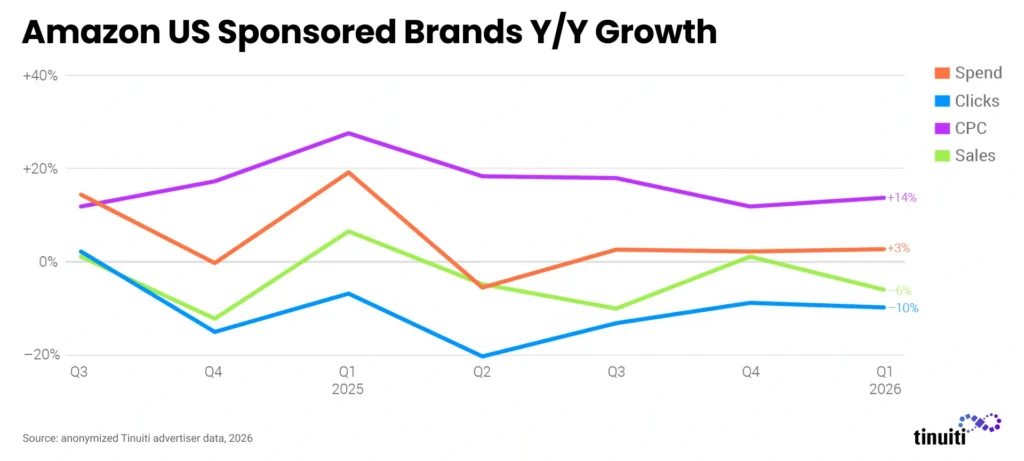
Search should still anchor your conversion strategy. Sponsored Products and Sponsored Brands remain the workhorses for harvesting shoppers who are actively searching for products and brands during Prime Day.
In practice, that means:
Lead-in (4–5 weeks out): Lean into non-brand and category keywords to drive new-to-brand traffic and PDP visits ahead of the event, while maintaining coverage on branded terms.
Prime Day week: Shift more budget toward high-intent and branded terms, defend the brand with stronger bids and budgets, and prioritize placements that keep you at or near top of search when deals go live.
Lead-out: Ease bids back toward pre-event levels, but continue supporting best sellers and mining search term reports for new queries and audiences that emerged during the event.
Amazon DSP has become a core pillar of modern Prime Day strategy. With a four-day event and a longer AI-influenced consideration phase, brands cannot rely on search alone to fill the funnel and bring shoppers back to convert.
A durable DSP plan should:
Lead-in: Ramp investment 2–4 weeks before Prime Day to build awareness among in-market audiences and non-brand prospects, and to grow retargetable pools with video and display.
During Prime Day: Pivot spend toward retargeting visitors who viewed PDPs, added to cart, or engaged with your brand in the run-up to the event, using AMC and first-party audiences where available.
Post-event: Retarget non-converters and cross-sell or upsell recent Prime Day purchasers based on product lifecycle so the event becomes a springboard for Q3 and Q4 growth, not just a one-time spike.
All of this requires more than a flat “Prime Day” line item. Budgets should be explicitly flighted across lead-in, the four event days, and the lead-out period, with clear targets for new-to-brand, ROAS, and customer lifetime value by stage.
The bottom line: allocate additional budget for Prime Day advertising, not just CPC bids. The brands that win now are those that fund both search and DSP across the entire curve—warming audiences before the event, staying present throughout all four days, and turning Prime Day shoppers into long-term customers afterward.
What level of media budget (ballpark) are you planning to recommend for Prime Day as a share of a typical month so this section can match your aggressiveness?
Tariff-driven price increases are on shoppers’ minds, and it’s affecting how they evaluate deals. Our 2026 Prime Day Study makes this clear:
This is a marked shift from previous years. Shoppers are more price-sensitive, more skeptical of shallow discounts, and more likely to compare across retailers to verify they’re truly getting a deal.
Here is what you should do before you submit your deals on May 28 to protect your margin:
Top purchase categories Prime Day shoppers plan to buy:
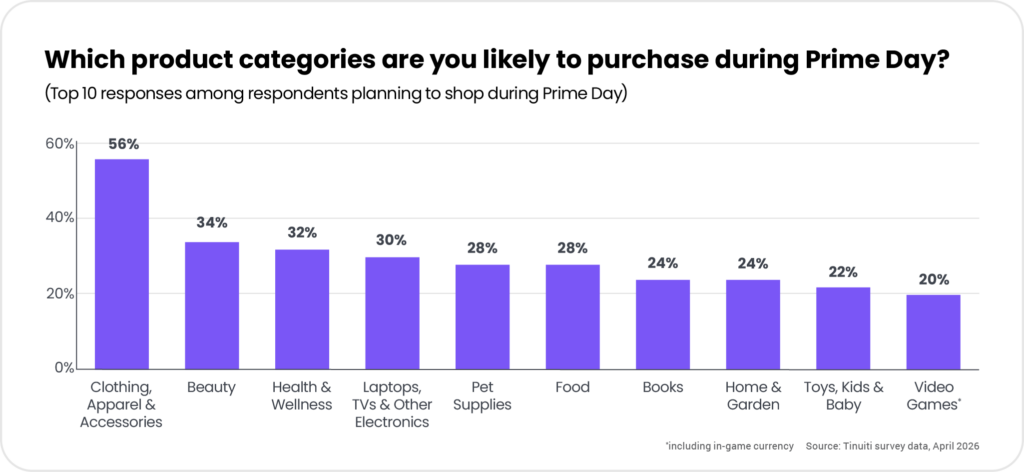
If your products fall into these categories, expect high competition—but also high intent.
“Brands really have to think a bit more strategically about how they’re building awareness in the lead-up to Prime Day, and the DSP and Prime Video are really important tools to build brand familiarity… we see that upwards of 80% of those who are planning to shop this Prime Day say that they’re regular Prime Video viewers.”
Sky Canaves, Principal Analyst for Retail and Ecommerce at eMarketer
Here’s the hard truth: If your target customer isn’t hearing about your brand before Prime Day starts, you’re losing mindshare to competitors who are.
During Prime Day, Amazon ad costs spike. But external channels like Facebook, Instagram, TikTok, and YouTube don’t see the same CPC inflation. That makes them incredibly cost-effective for building awareness and priming demand before shoppers hit Amazon.
Our Q1 2026 Digital Ads Benchmark Report shows strong advertiser investment across social platforms:
Download our Digital Ads Benchmark Report for a deep-dive on data across Google, Meta, Amazon, and more.
Your Prime Day strategy can’t live on Amazon alone. Our 2026 Prime Day Study found that 59% of Prime Day shoppers intend to check Walmart’s site/app during the event—a share that jumps to 80% among Walmart Plus members. Target is also a major comparison point, with 35% of shoppers checking its site/app.
But it’s not just about retail competitors. Social platforms play a massive role in product discovery:
And here’s the insight that should reshape your strategy: 43% of Prime Day shoppers don’t have specific products in mind when they start shopping, while 57% have purchased products they weren’t aware of before Prime Day.
That means your job isn’t just to convert existing demand, it’s to create demand.
Influencer marketing statistics show that over 90% of consumers engage with influencers weekly across platforms such as Instagram, YouTube, TikTok, and Snapchat. Influencers help customers build trust with your brand, making them more likely to try your product for the first time.
Use influencers to build anticipation in the weeks leading up to Prime Day. Amazon also offers the Amazon Influencer Program, which connects brands with social media influencers who recommend products and earn commissions on purchases made through their links.
“Influencers are incredibly effective for brands because they are authentic storytellers who emotionally connect with and are trusted by their audiences. But that is just one piece of the Influencer puzzle. Tinuiti understands the magic in omnichannel integration with other digital marketing tactics and the ability to measure Influencer performance beyond vanity metrics, truly making it a full-funnel driver. The integration across functions, including Social, Affiliate, and eCommerce, creates a larger amplification in a highly competitive space for brands to grow their business.”
Crystal Duncan, EVP, Brand Engagement, Tinuiti
Create a Variety of Promotional Offers
Not all shoppers respond to the same type of deal. Some hunt for Lightning Deals. Others prefer coupons they can stack. Some want bundles that offer added value. The most successful Prime Day strategies deploy a mix of promotional mechanics tailored to different shopper segments.
Promotion Type | Description | Best Use Case | Prime Day Strategy |
Product Bundles | Combine complementary items or offer multi-unit discounts | Increasing average order value and encouraging cross-category purchases | Bundle slow-moving inventory with bestsellers to clear stock while maintaining margin |
Lightning Deals | Limited-time offers exclusive to Prime members with significant discounts and countdown timers | Driving sales velocity, clearing inventory, and boosting product visibility | Reserve for hero products with deep inventory; creates urgency and FOMO |
Prime Exclusive Discounts | Special pricing available only to Prime members during the event | Rewarding loyal Prime members and driving Prime sign-ups | Go deeper on discount (30-50% off) to meet shopper deal expectations shaped by tariff concerns |
| Coupons | Digital coupons provide instant savings at checkout | Incentivizing trial, promoting new products, and rewarding repeat customers | Stack with other discounts where allowed to create “deal stacking” perception |
Subscribe & Save | Recurring deliveries at a discount (typically 5-15% off) | Converting one-time buyers into subscribers for repeat-purchase products | Offer an aggressive one-time subscription incentive during Prime Day to boost LTV without ongoing ad costs |
Other Promotions | BOGO, percentage-off, tiered discounts that appear on PDPs and search results | Attracting price-sensitive shoppers with enticing, easy-to-understand offers | Test tiered discounts (“Buy 2, save 20%”) to increase basket size |
Pro tip: If your product is a repeat-purchase item (pet food, supplements, household essentials), aggressively push Subscribe & Save during Prime Day. Offer an unbelievable one-time subscription deal designed to help retain customers long after the event without having to buy ads every month.
If you have an Amazon Store, create a dedicated Prime Day subcategory. Use it to feature all your deals and discounts in one place, and treat it as the landing page for all your Prime Day advertising on and off Amazon.
Amazon Stores provide a customizable, multi-page shopping experience that showcases your full catalog. During Prime Day, a well-organized Store can:
When you run Sponsored Brands campaigns or external social ads, point traffic to this dedicated Prime Day landing page. It makes it easier for shoppers to convert because everything they’re looking for is in one place.
Prime Day is never a “set it and forget it” event. While 80% of your effort should be focused on preparing for Prime Day, execution is everything. Make sure your deals are live and running, then continuously monitor those deals (and your ad budget) and get ready to shift your strategy based on live performance data. We recommend the following:
Brands are looking for ways to improve ROI during Prime Day. This includes separating low-converting keywords, tracking conversions, targeting competitive products, and identifying the change in keyword trends and search volumes. Staying on top of this will maximize visibility. In addition, bidding higher will result in a higher rank, and staying on top of your budget allows you to bid higher.
Prime Day generates a massive volume of sales and data. But without the right measurement strategy, you’re flying blind.
One of the best things a brand can do after Prime Day is pay attention to actions.
Dig up analytics and demographics from your Prime Day event and check to see if there was a noticeable increase in things such as new-to-brand customers or new search terms. The goal is to identify your successes and failures and make the changes necessary (or mimic the actions that produced positive results for your brand) to facilitate future growth.
“Whether your Prime Day sales met, exceeded or underperformed against your goals, it is critical to understand what influenced those results. Were your Sponsored Ad campaigns consistently visible throughout the event? Did you have the right onsite/offsite media mix to maximize reach across your key audiences? Are there any other audiences, or keywords, to consider targeting for your next sales event? These are just some of the questions that can help you understand what factors influenced your Prime Day performance. Amazon’s suite of analytics tools, including Amazon Marketing Cloud, can help uncover key insights that will improve your strategic approach for the next major sales event.”
Joe O’Connor Sr. Director, Strategic Marketplace Services at Tinuiti
Your underperforming ASINs have important performance marketing data behind them. About 30 days after Prime Day (allowing the return window to largely pass), download your Returns Report and sort it by ASIN. Focus on returns that are within your control, such as “defective,” “not as described,” “missing parts,” etc. Compare that against the total number of returns to calculate the “real return rate” as a percentage of sales for each ASIN.
Now, you can see which products aren’t going over well with your customers. Critically examine the return comments and reasons. Is the PDP misleading? Is there a quality control problem? Use this invaluable data to make tangible fixes to your product or listings before the critical Back-to-School and Q4 peak seasons.
That said, don’t be tempted to only zero in on mistakes. Look for the “hero products.” Which items surprisingly popped off during Prime Day, perhaps even without significant media support? Did any items go viral or find an alternative use case you hadn’t considered? These unexpected winners could be key to your strategy for future tentpole events.
Pay attention to the quality of reviews, not necessarily the quantity. It’s essential to see what people are saying, so you have the opportunity to improve and adapt. After the event, taking a good look at your reviews can affect future strategies and changes, product developments, listing changes, updates, etc. Another good practice is paying attention to competitors’ reviews and seeing what their customers are saying. Doing this can give brands an upper hand to improve and shine in areas where their competitors may not and win over a more extensive following.
A successful Prime Day is about making new customers for life. Implement strategic retargeting campaigns aimed at those who purchased during Prime Day, as well as those who showed interest but didn’t convert.
Try to entice first time customers to buy from you again. You could give them a reorder coupon to increase consideration. Or, better yet, use Subscribe & Save coupons to convert them into passive, recurring customers. This way, Prime Day will continue to deliver dividends for months or years to come.
Prime Day 2026 is shaping up to be the biggest yet. With 88% of Prime members planning to shop, an earlier June timing, a four-day event window, and heightened deal expectations shaped by tariffs, the opportunity is massive if you’re properly prepared.
Remember:
Our team has helped hundreds of brands crush their Prime Day goals. From inventory planning to AI-optimized listings to omnichannel campaigns that drive awareness before the event, we know what works.
Get the tactical playbook and fresh consumer data you need to dominate Amazon’s new four-day Prime Day surge


Copywriter, Tinuiti
Jenn Wheatley is a senior content strategist and copywriter who turns complex marketing data into clear, actionable stories. She develops research-backed reports and thought leadership that help brands navigate critical business decisions. Based in Utah, she enjoys cooking, strength training, and traveling with her family.