Public Perceptions of AI in Marketing
WHAT BRANDS NEED TO KNOW BEFORE USING GENERATIVE AI
WHAT BRANDS NEED TO KNOW BEFORE USING GENERATIVE AI
New generative AI-powered platforms are cropping up at breakneck speed, heightening the promise of new efficiencies for brands looking to take advantage of AI in their marketing and advertising efforts. But how do potential customers feel about AI at large, its use on existing platforms, and its application by brands? To better understand these and other key considerations, Tinuiti surveyed over 1,000 US adults who were at least slightly familiar with AI technology in June 2024.
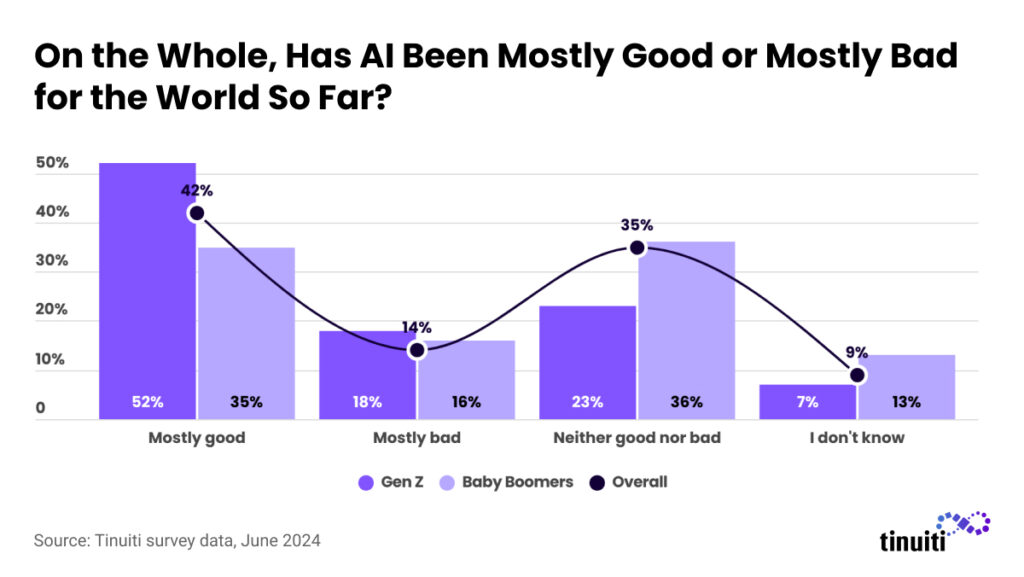
Among US adults who are at least slightly familiar with artificial intelligence (AI) technology, 42% say that it has been mostly good for the world so far, compared to just 14% who say it’s been mostly bad. More than a third said that it’s been neither good nor bad, while 9% didn’t know. Generally, younger generations were more familiar with and held more positive opinions about AI and its uses. Among Gen Z, 52% said that AI had been mostly good for the world so far.
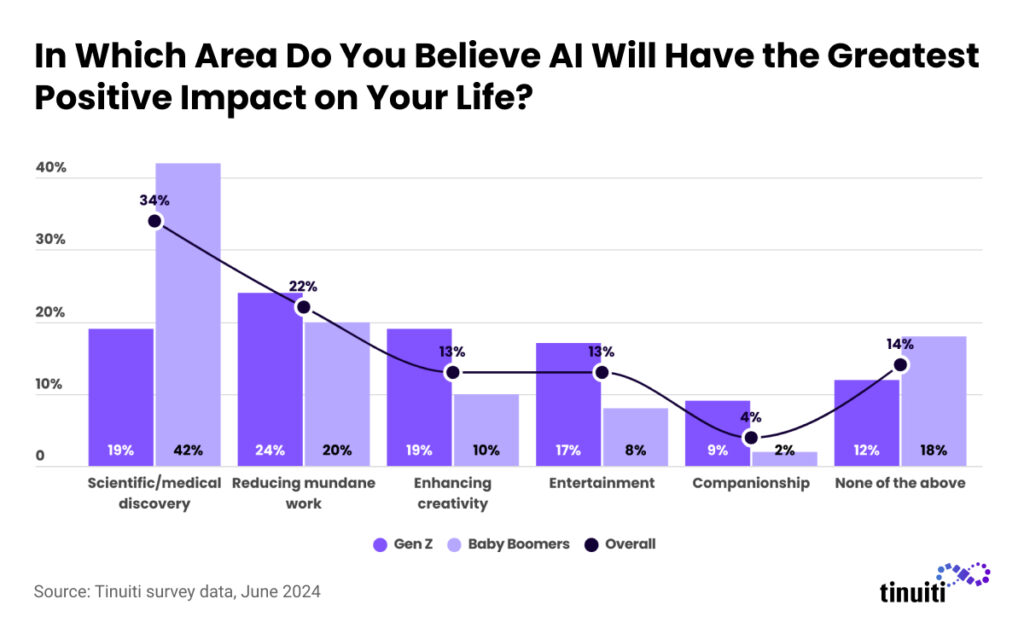
When asked what area of life will be most positively impacted by AI, 34% chose scientific/medical discovery, the top choice, followed by reducing mundane work at 22%. Just under 42% of baby boomers picked scientific/medical discovery, compared to 19% of Gen Z, which was most likely to pick reducing mundane work as the way AI will have the greatest positive impact on their lives.
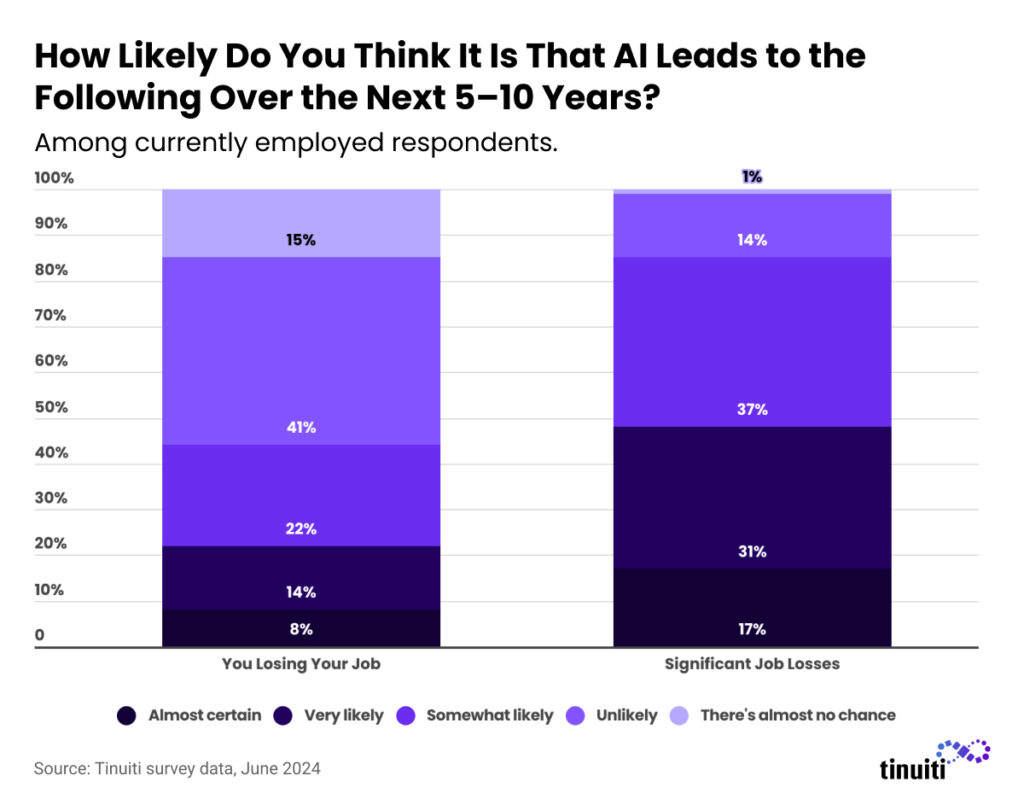
Zooming in on the impact to jobs specifically, 48% of employed respondents believe that it’s very likely or almost certain that AI will lead to significant job losses in the next five to ten years. However, when asked to judge the likelihood of losing their own jobs to AI, just 22% of those who are currently employed believe it’s very likely or almost certain.
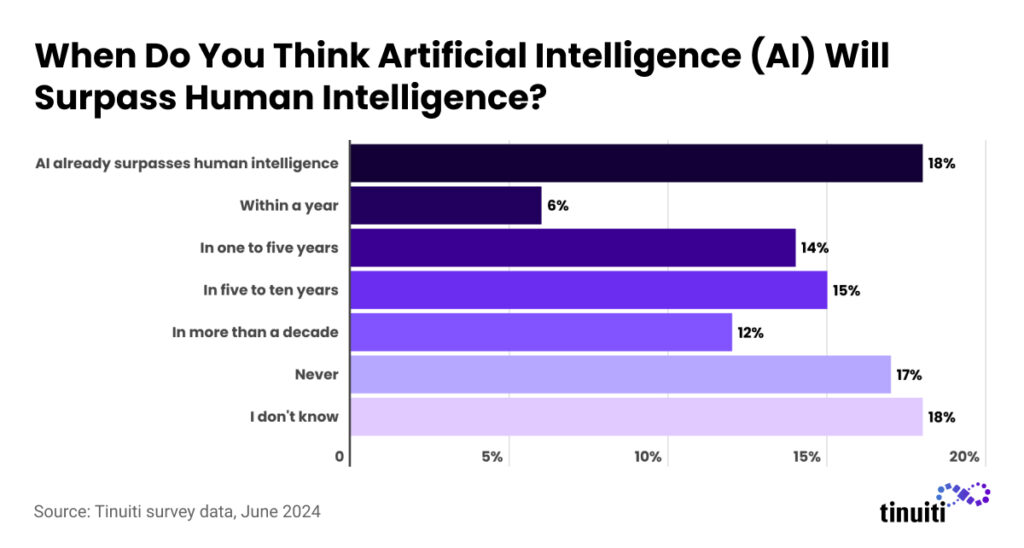
While 18% believe that AI already surpasses human intelligence, including nearly a quarter of Gen Z and millennial respondents, over a third of all respondents believe that AI will surpass human intelligence in the next ten years. Fully 17% say they don’t expect that to ever happen.
Fully 40% of adults who are at least slightly familiar with AI say they’ve used ChatGPT, nearly twice the share of respondents who used the second-most popular platform included in the survey, Google Gemini.
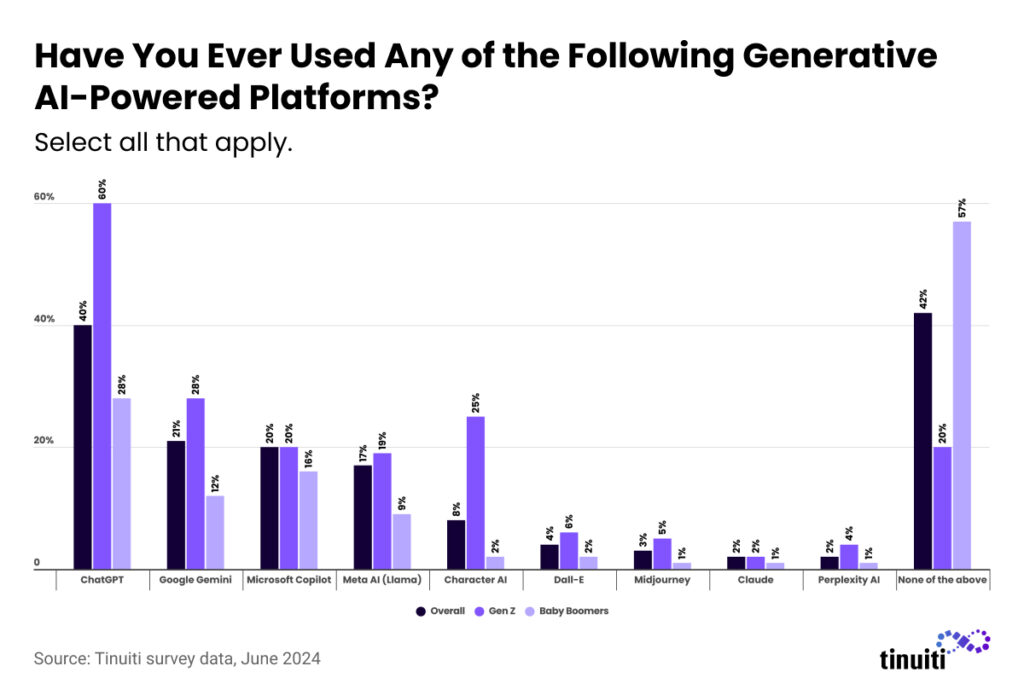
Among Gen Z, 60% had used ChatGPT, while 28% had used Google Gemini. Although just 8% of all respondents said they had used the AI chatbot service Character AI, it was the third-most popular generative AI platform among Gen Z, with 25% having used it.
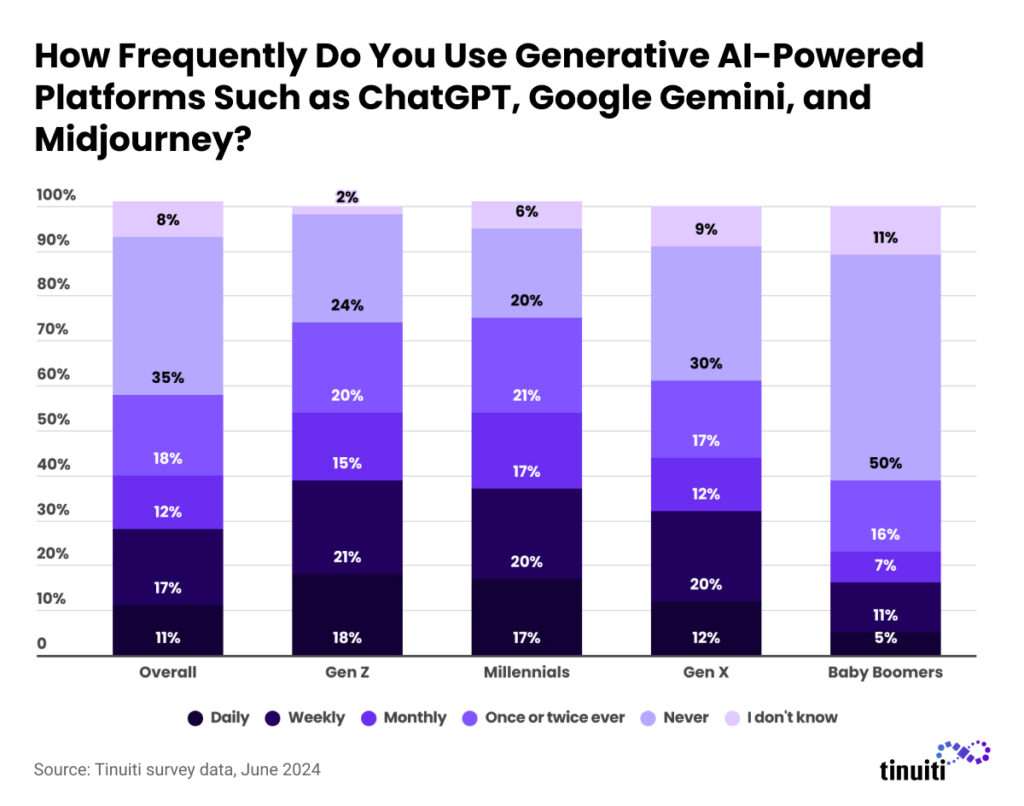
Just 11% of respondents say they use any generative AI-powered platforms like ChatGPT, Google Gemini, or Midjourney daily, and a majority say they’ve either never used such platforms or used them only once or twice ever. While over half of Gen Z and millennials respondents said they were at least monthly active users (MAU) of AI-powered platforms, only 23% of baby boomers said the same.
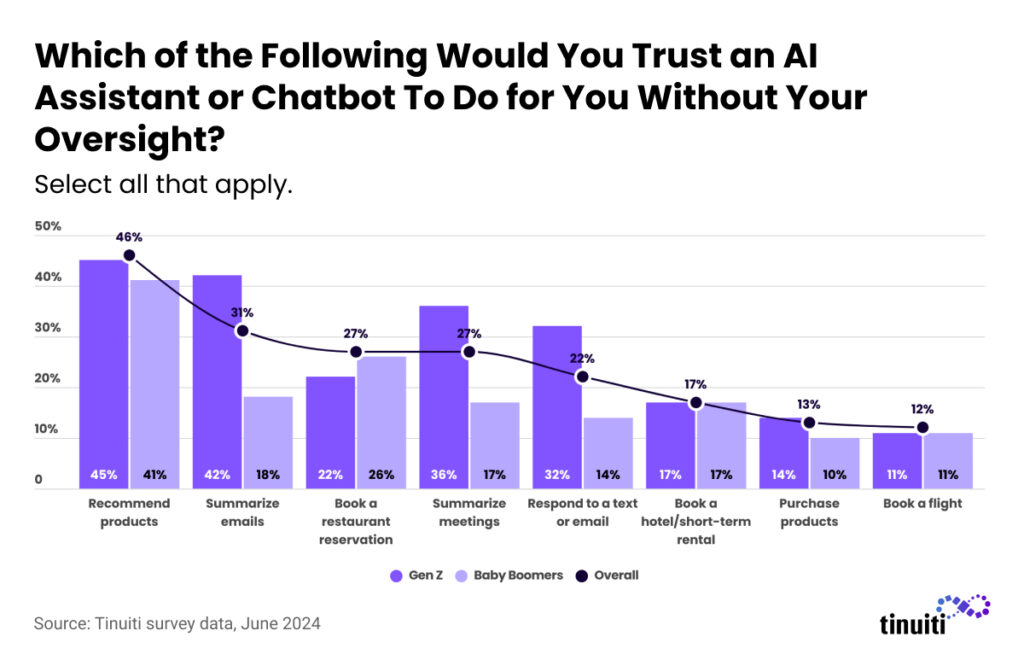
Nearly half of respondents said they’d trust an AI assistant or chatbot to recommend products without their oversight, but only 13% would be okay with AI purchasing a product without oversight. While different age groups had similar opinions on those particular tasks, they showed much greater differences for tasks requiring an AI to summarize emails or meetings, with Gen Z and millennials much more likely to trust an AI assistant or chatbot with that responsibility.
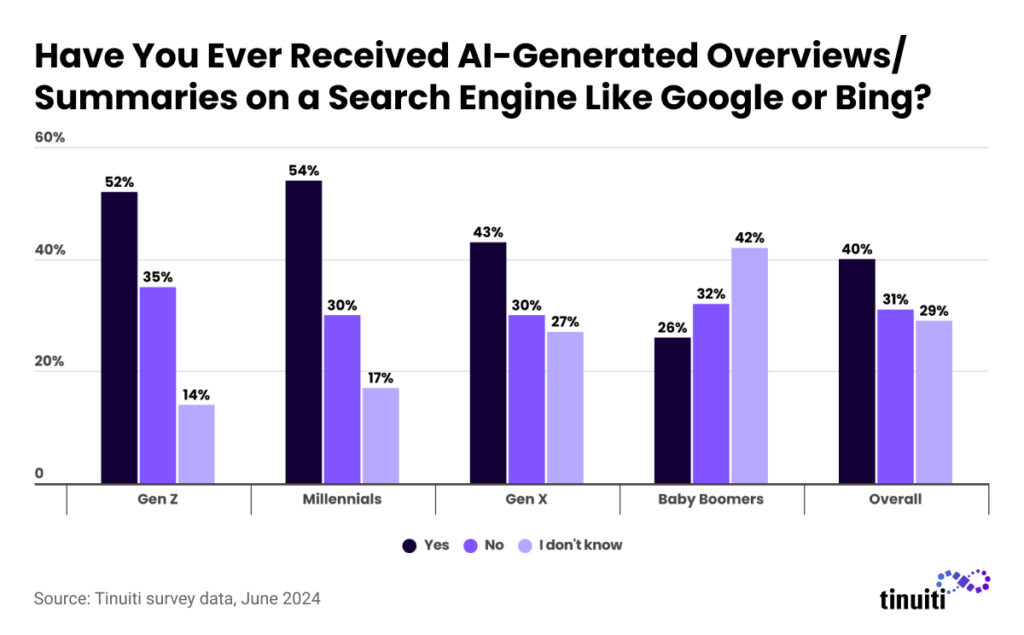
Only 40% of all respondents said that they had received AI-generated summaries/overviews on search engines like Google or Bing, with 29% unsure if they had or not. Given the relative similarity in appearance of AI overviews to traditional featured snippets from websites, it’s likely many searchers just aren’t aware when they’re getting a generative AI result.
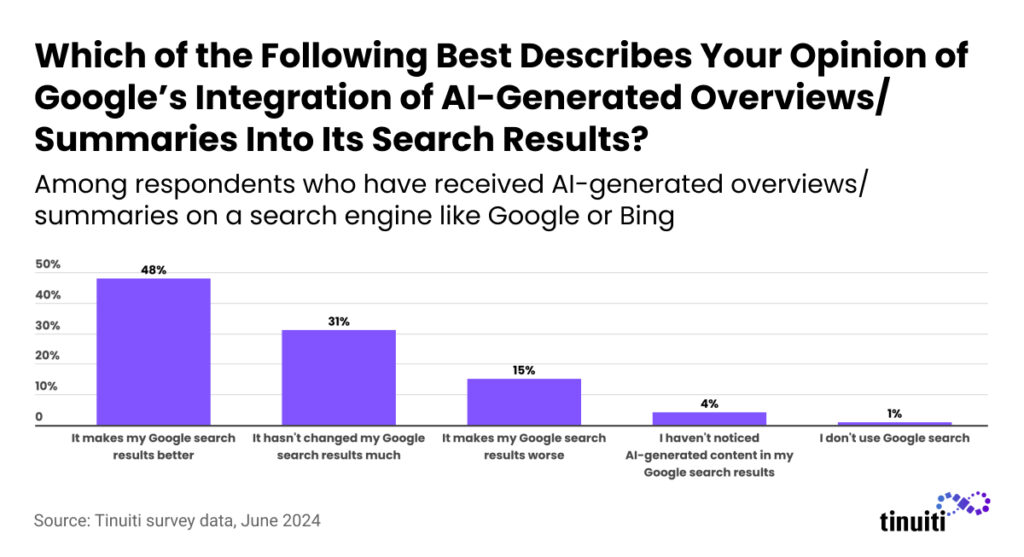
Asked how AI-generated overviews/summaries were impacting their Google search results, 48% of those who had received these summaries say their integration has made Google’s search results better, compared to just 15% who say worse. This represents a contrast to the perceptions of many in the search marketing industry who have found examples of inaccurate and sometimes dangerous generative AI answers.
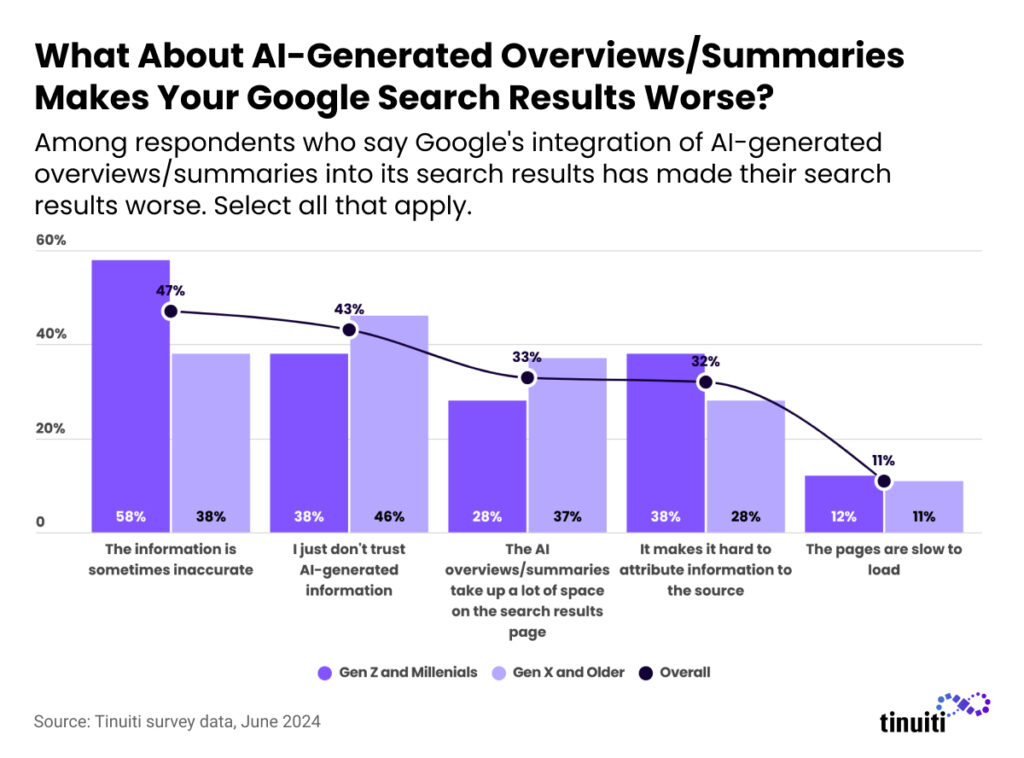
Among those who do say that AI overviews have made their Google search results worse, 47% say they’re worse because the information is sometimes inaccurate, and 43% say they just don’t trust AI. For Gen Z and millennial respondents who do not favor Google’s use of AI overviews, 58% cited inaccurate results, compared to just 38% among Gen X and older respondents. The older generations were more likely to say they simply don’t trust AI-generated information.
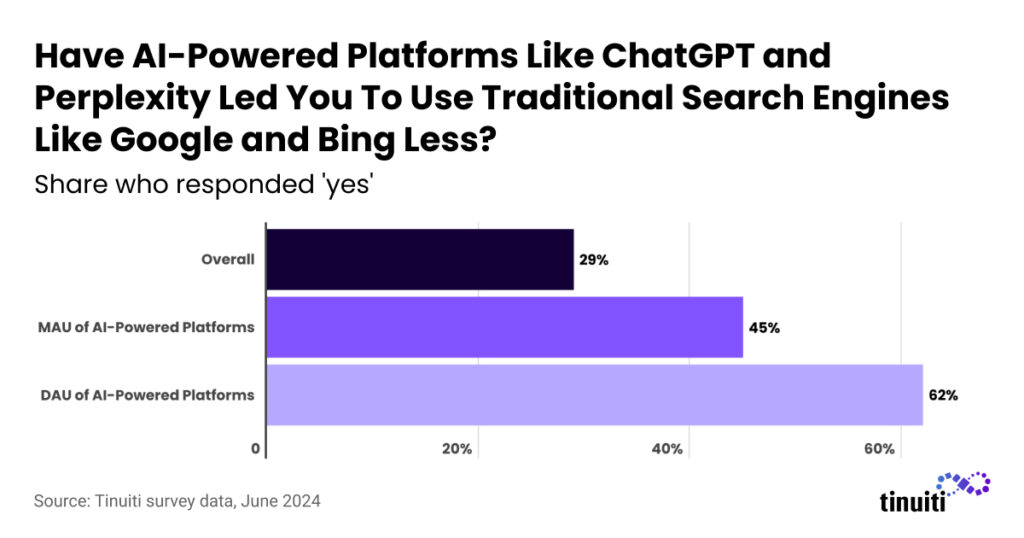
When asked whether AI-powered platforms like ChatGPT and Perplexity had led them to use traditional search engines less, 29% of respondents said yes. However, among respondents who say they use AI-powered platforms monthly or more, 45% said they are using traditional search engines less. For daily AI platform users, that rate jumps to 62%.
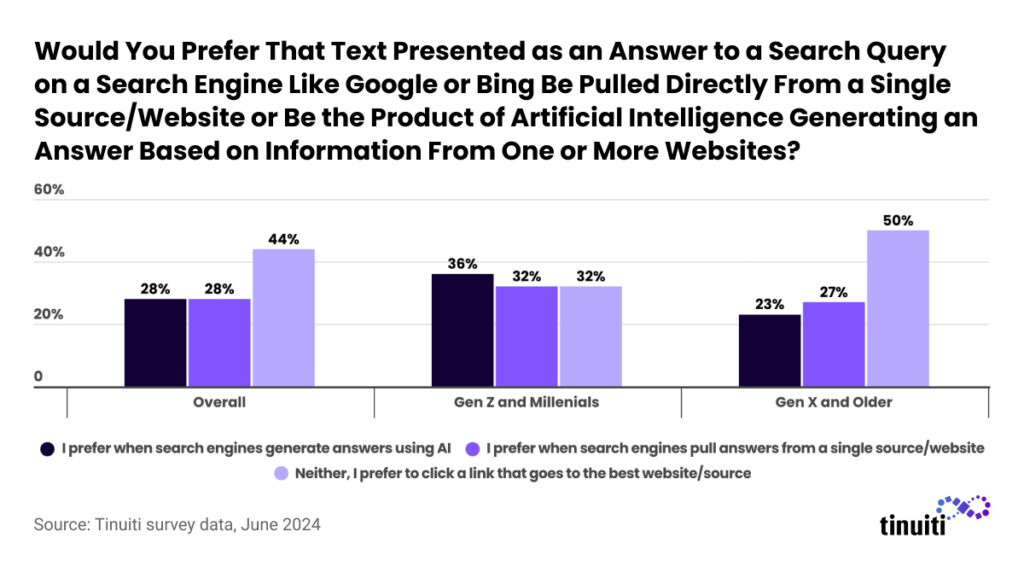
While the promise of answer engines is that users don’t have to leave the search engines they’re querying to get the information they need, 44% of respondents still prefer to click on a link to a website when they search. Fully 28% prefer for search engines to pull answers featured on search results from a single source/website, identical to the share who prefer when search engines generate answers using AI.
Though just 32% of Gen Z and millennials prefer to click a link on a search results page to get an answer, that rate was 50% among Gen X and older respondents. For the younger generations, AI-generated results were the most popular way of presenting an answer to a search query.
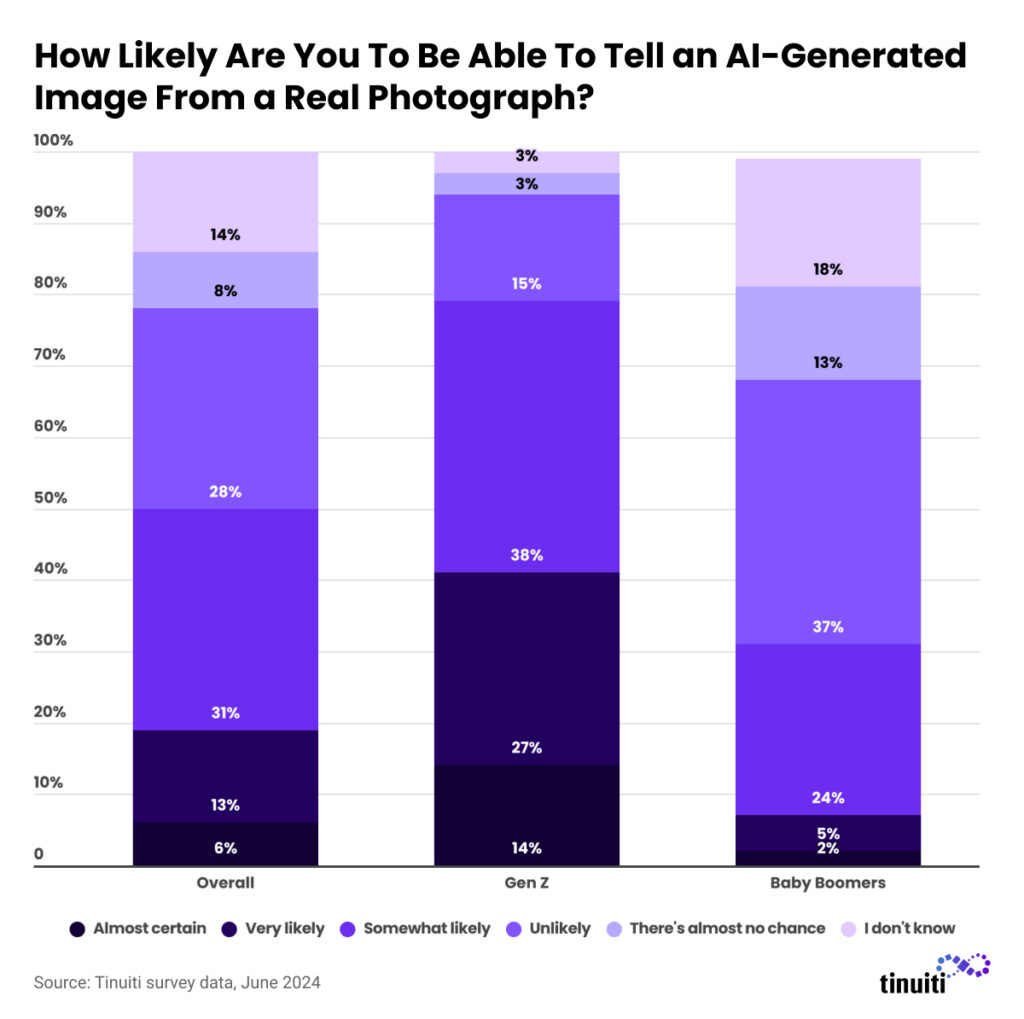
Just 19% of respondents believe that they are very likely or almost certain that they can tell an AI-generated image from a real photograph, with 8% saying there’s almost no chance they’d be able to. Gen Z is much more confident than their elders in their ability to detect AI with 41% saying they are very likely to be able to identify whether an image is AI-generated. That rate drops to just 8% for baby boomers.
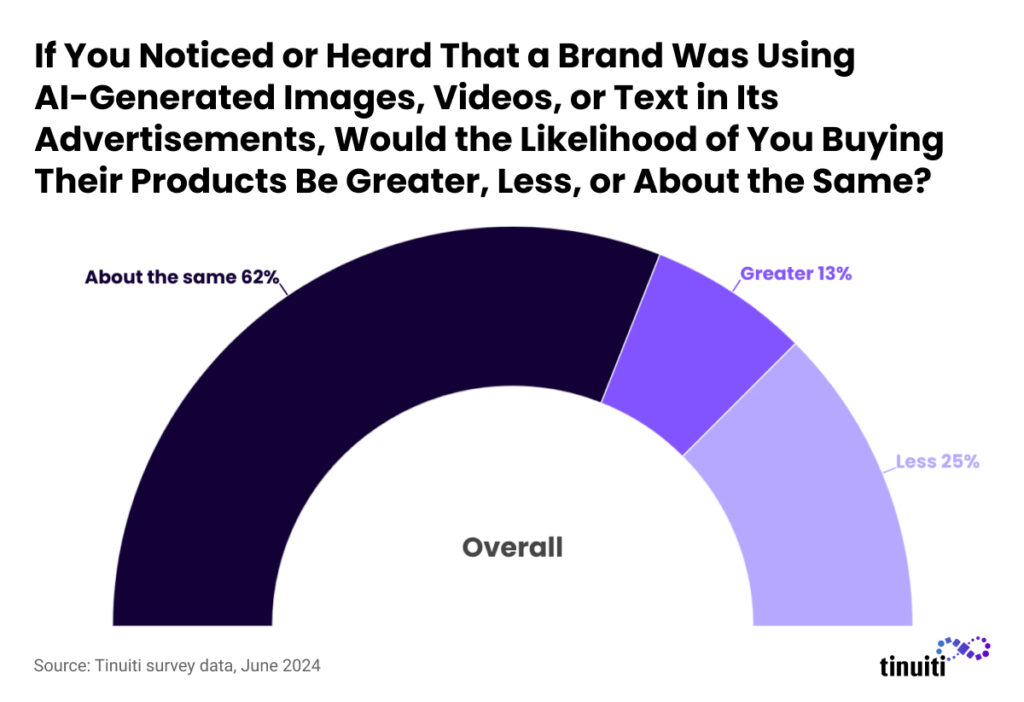
While many consumers don’t believe they can detect AI, brands using AI to create imagery still need to be careful, as 25% of respondents said that they would be less likely to purchase from brands using AI to produce images, video, or text in advertisements. This is nearly double the 13% who said AI use would make them more likely to purchase from a brand using AI.
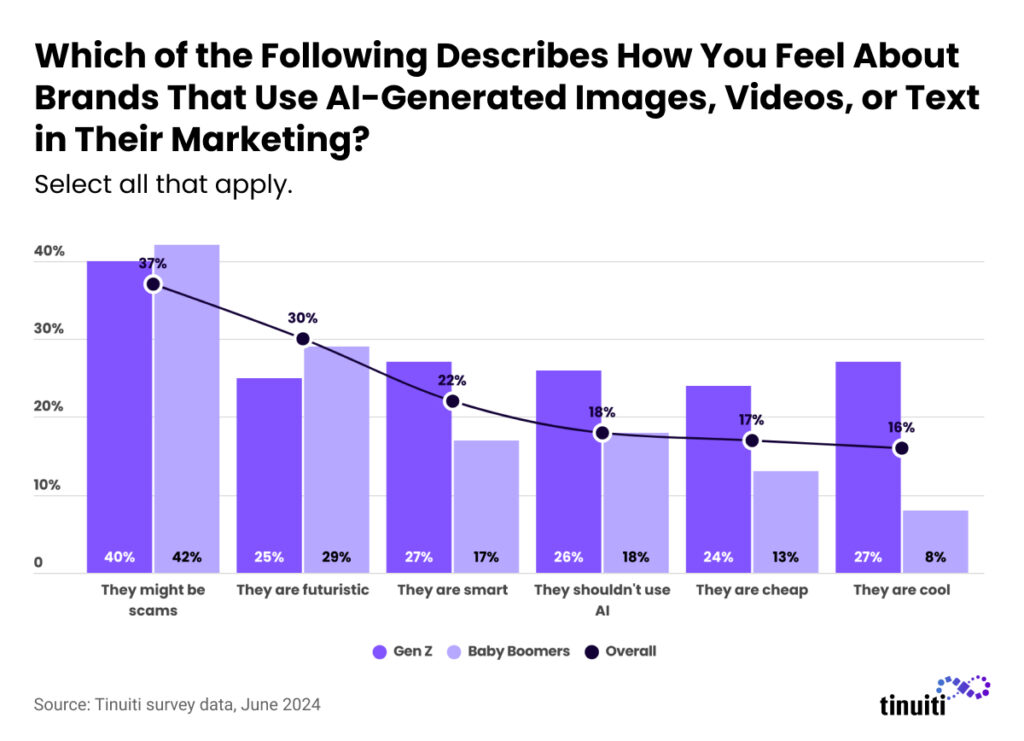
Respondents seemed most concerned that brands using AI to generate marketing assets might be scams, with 37% saying they would feel that way. That said, the next most common reaction was to feel that the brand was futuristic, followed by the brand being smart for using AI. Although Gen Z was a bit more likely than average to think a brand using AI for marketing assets might be a scam, they were also much more likely to feel that the brand was cool for doing so.
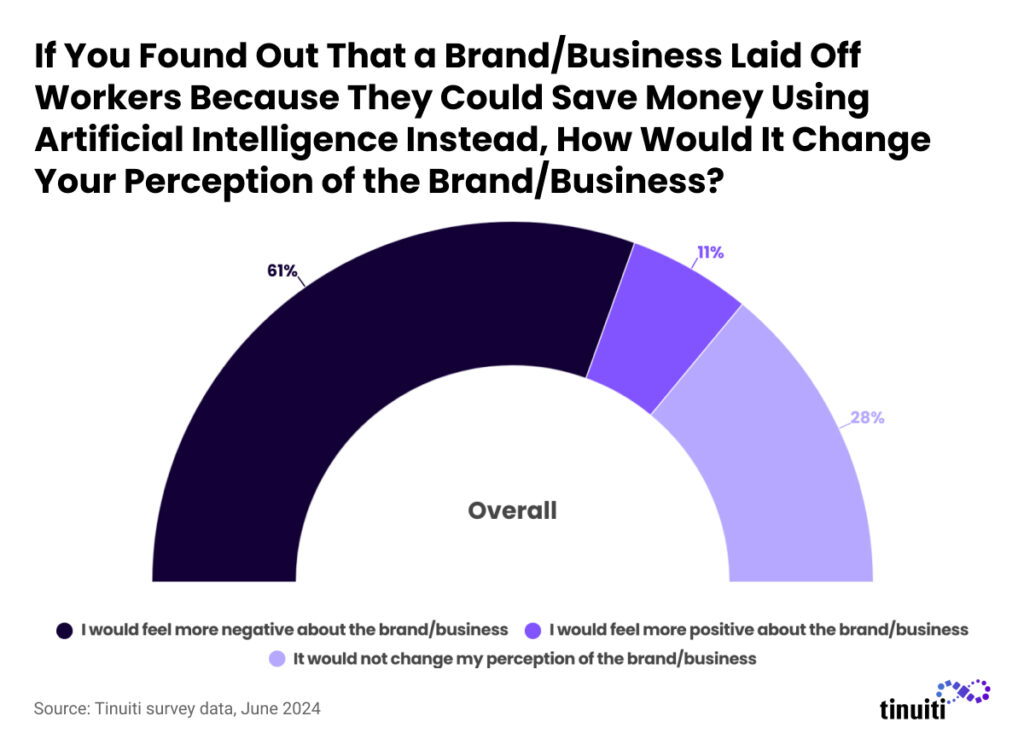
While over 60% say that the use of AI wouldn’t have much of an impact on their likelihood of purchasing from a brand, businesses should be wary of blowback from consumers if they learned that AI use led to job cuts. Fully 61% of respondents said that they would feel more negative about a brand if they found out that it had laid off workers because they could use AI to save money, compared to just 11% who would feel more positive.
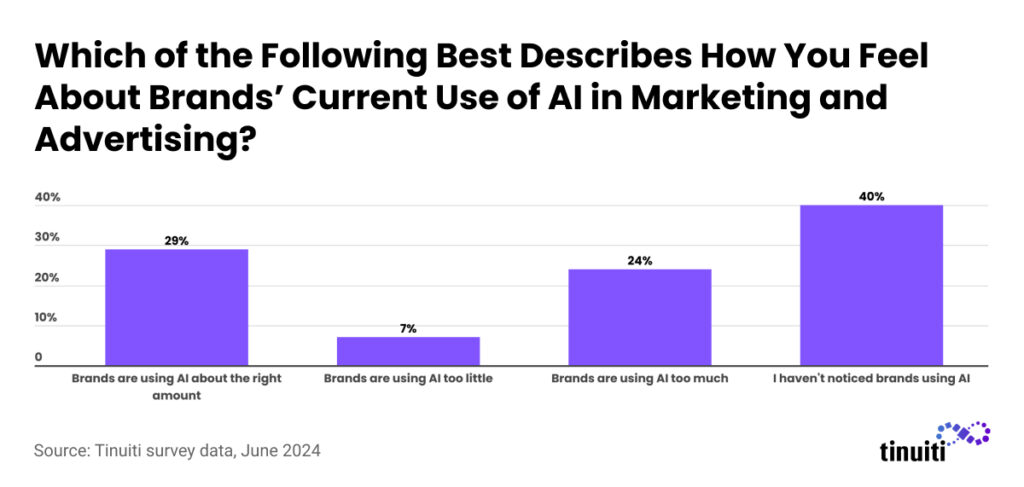
Fully 40% of respondents haven’t noticed brands using AI in marketing and advertising, and another 29% feel like it’s been used about the right amount. These shares outpace the 24% who believe that brands are already relying on AI too heavily in marketing and advertising.
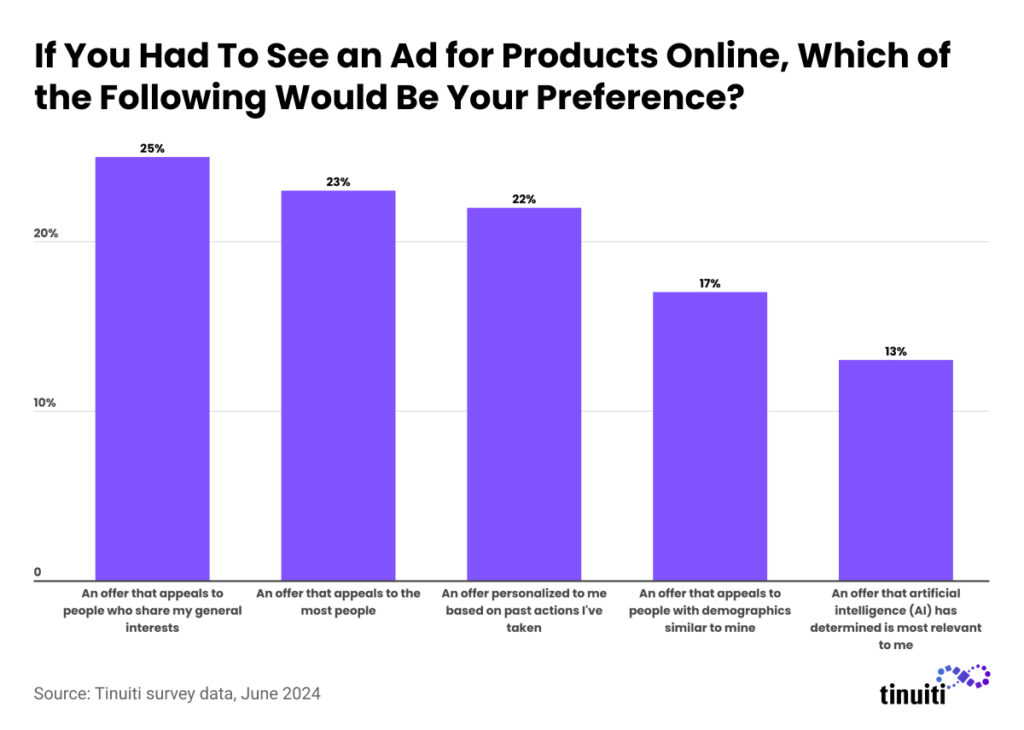
When asked what kind of ad they’d most prefer, respondents were more likely to choose offers that are based on more traditional forms of targeting, such as demographic, interest, and remarketing efforts, than they were to choose ads that had been selected for them based on AI. Of course, some forms of more traditional targeting are already powered to some extent by AI.
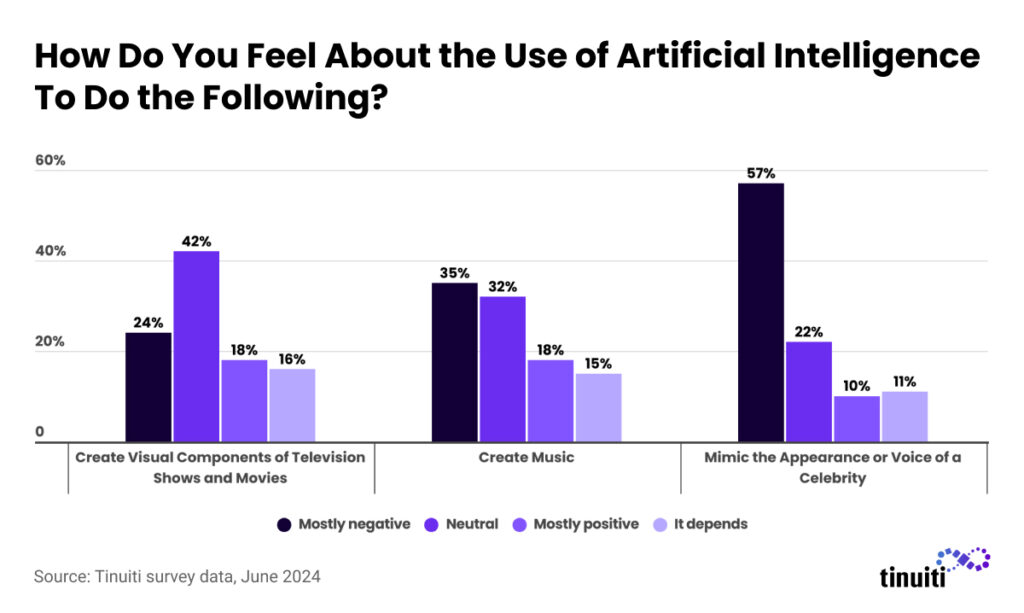
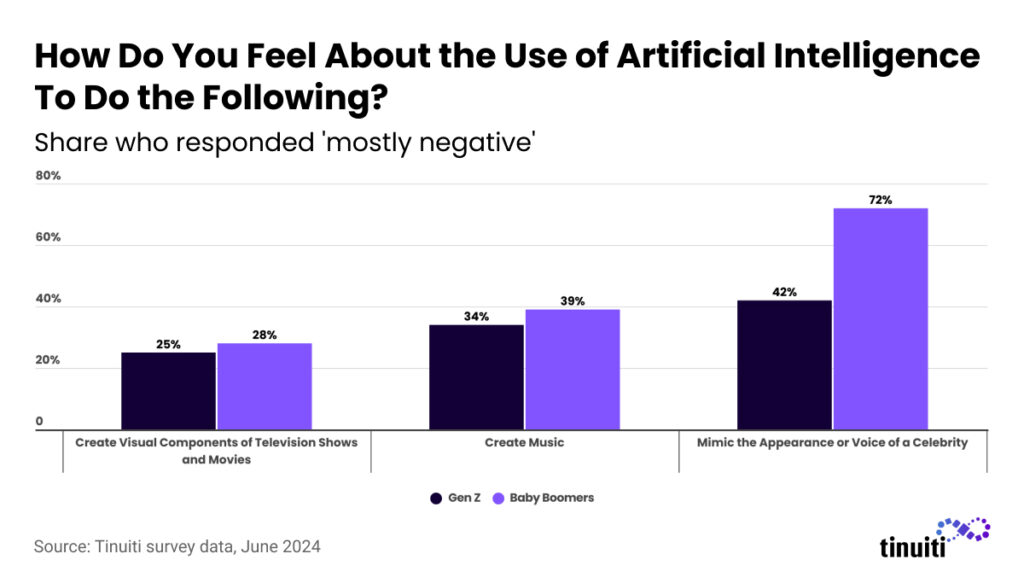
When it comes to different kinds of generative AI content, respondents were much more receptive to the use of AI to create visual components of television shows and movies than they were with using AI to mimic the voice or appearance of a celebrity. Only 24% felt mostly negative toward AI-generated visual components, compared to 57% who felt mostly negative toward celebrity mimicry. AI-generated music fell in the middle, with 34% of respondents feeling mostly negative about it.
Gen Z was less likely than the baby boomer generation to have a negative response to AI-generated content, but still had a net negative response to all three of the above scenarios. The greatest divide between Gen Z and boomers was on the use of AI to mimic the appearance or voice of a celebrity with 72% of boomers having mostly negative feelings about the practice compared to 42% of Gen Z.
Check out our most recent AI Study for exclusive insights.
