Amazon unBoxed 2026: AI For All (And What It Means for Marketers)


At unBoxed 2026 in San Francisco, the world’s largest retail media network made one thing perfectly clear: it wants AI involved in nearly every stage of advertising.
Amazon Ads Agent is moving deeper into media planning, targeting, and analytics, automating decisions across audiences, formats, and budgets, while Alexa creates conversational shopping experiences. AI is similarly transforming how teams use Amazon Marketing Cloud (AMC) and assemble creative assets.
There’s a lot to unpack here, as well as some claims brands shouldn’t necessarily accept at face value. Efficiency gains from AI don’t guarantee stronger performance, and marketers have to evaluate which capabilities actually improve results, which decisions should remain under their control, and where the technology still needs to prove itself.
Tinuiti is already digging into these questions. Here’s our take on what marketers should test, what they should watch, and where a healthy dose of skepticism is still warranted.
Amazon is creating more opportunities for brands to participate in conversational commerce. Expected to enter open beta in October, the CPC-based Sponsored Review Request allows advertisers to surface review requests to verified shoppers across high-traffic Amazon placements. At first glance, this looks like another way to support conversion with social proof, but reviews also provide crucial context to ensure Alexa is positioning your product against the right prompts. So, Sponsored Reviews should be a priority area of testing for all endemic Amazon advertisers.
Amazon is also enhancing Sponsored Brands with a new experience called Branded Conversations. This feature launches Alexa-powered conversations from the Sponsored Brand creative, combining information from catalogs and customer reviews to answer real product questions. General availability is anticipated between December 2026 and Q1 2027.
This means customer reviews are expanding beyond the product page to influence how Alexa understands a brand and formulates answers.
Sponsored Review Requests and Branded Conversations both point to where Amazon is heading — that Alexa will be the center of product discovery and research.
Joe O’Connor, Senior Director of Innovation & Growth
Sponsored Review Request should be a testing priority for brands selling on Amazon.
Reviews have always helped shoppers decide what to buy, but now they’re helping Alexa determine what to say. That makes freshness and volume even more valuable, giving brands another reason to build a consistent stream of customer feedback instead of treating review generation solely as a conversion tactic.
Branded Conversations raises a thornier question. How much can you influence the way Alexa describes your brand? Existing Sponsored Brands campaigns are automatically opted in, yet it’s still unclear what control advertisers will have over conversational prompts. This feature is worth test, but brands should ask their Amazon account teams what information shapes those responses and what recourse they have when an answer misses the mark.
We are no longer advertising to just humans. We are advertising to machines as well.
Aaron Gooden, Group Director Client Partner
One of the biggest topics at unBoxed 2026 was the expansion of Amazon Ads Agent across the advertising workflow.
Amazon has consolidated Sponsored Ads and Amazon DSP into a single platform, with Sponsored Products and Sponsored Brands sitting alongside Display, Video, Audio (“DVA”, and formerly known as the Amazon DSP) and new Full-Funnel Campaigns. Ads Agent lets advertisers use conversational prompts to plan media, identify targeting options, and analyze performance across the platform.
Tinuiti teams have already seen some platform consolidation in action since Amazon combined the Sponsored Ads and DSP interfaces earlier in 2026. What’s interesting is how many decisions Ads Agent is now being asked to help make:
The promise is straightforward: ask Amazon a question and get an actionable answer without spending as much time navigating reports, audiences, or planning tools. It’s still on marketers, however, to find out how good those answers actually are.
There’s real utility here, but we wouldn’t treat every recommendation as an instruction.
Media Planning could be useful for tactical budget decisions and understanding audience or ad-type reach, but advertisers should still evaluate recommendations against their own business priorities and performance data before acting on them.
Campaign Targeting looks more promising based on our early experience, as Tinuiti teams have already reported positive results using Ads Agent to suggest audience segments for DVA campaigns. The full scope of this feature is less clear. Amazon’s promotional materials include recommendations for audiences, keywords, and products, but current enablement materials only provide instructions for audience selection in DVA. We’ll be watching to see whether keyword and product targeting become practically available as the feature develops.
Analytics deserves the same scrutiny. Tinuiti is stress-testing where Ads Agent fits into existing workflows and comparing its output with third-party AI tools our teams already use. Amazon’s native advantage doesn’t automatically make its analysis stronger. For marketers, the best approach is to test where Ads Agent genuinely saves time, verify its recommendations, and rely on human expertise for decisions that affect performance or spend.
Amazon proved that its AI is ready to handle campaign execution. But ‘AI-powered’ is a product description, not a performance metric. As delegation gets easier, the most successful advertisers will be those who test the automation, validate the analytics, and keep human expertise focused where it matters: brand story through human connection and insights, strategic budget allocation and provable growth.
Nancy McLaughlin, Vice President, Commerce Media
Amazon isn’t limiting its AI to recommendations. It’s also using automation to reduce the number of decisions required to launch and manage campaigns.
The newly renamed Display, Video, Audio (DVA) includes DVA+, an AI-led, objective-first campaign creation workflow powered by Performance+ and Brand+. According to Amazon, advertisers can complete a four-step process and activate a campaign in under 15 minutes.
With Full-Funnel Campaigns, a single campaign can span Display, Video, Sponsored TV, and Sponsored Ads, while AI handles format orchestration and budget allocation. Amazon is also introducing Agentic Guidance for Sponsored Ads, which surfaces personalized recommendations directly on campaign overview pages, and Sponsored Ads Auto-Optimization, which automatically adjusts targeting, bids, and budgets across Sponsored Products and Sponsored Brands campaigns.
These capabilities can substantially reduce the manual work involved in campaign creation and optimization, but whether marketers want Amazon making all of those decisions is another matter.
Overall it’ll save the teams a lot of time, but I think it will still require human supervision to make sure that best practices are being followed.
Laura Pulgarin, Senior Manager, Marketplaces
The more complex the campaign, the less obvious the benefits. DVA+ could be particularly useful for advertisers with less experience managing programmatic display and video media.
Launching a campaign in less than 15 minutes sounds great in theory, but speed becomes less compelling if it comes at the expense of audience design, budget allocation, campaign structure, and optimization parameters that substantially influence performance.
We’re taking a similar approach to Full-Funnel Campaigns. Tinuiti plans to isolate tests to better understand how the product works, but we wouldn’t recommend broad adoption for most clients yet. Many sophisticated advertisers have intentional requirements around audience targeting and budget allocation that automated orchestration may not accommodate.
Sponsored Ads Auto-Optimization also deserves a closer look at the results. Amazon reports that beta advertisers saw a 13% increase in sales volume with a 7% decline in ROAS. Tinuiti hasn’t tested the feature yet, but those early results suggest a tradeoff between greater sales volume and lower efficiency rather than an unequivocal performance improvement.
Agentic Guidance is another feature to watch rather than immediately prioritize. Amazon hasn’t shared enough detail yet to determine how useful its recommendations will be in practice. Across these products, automation earns its place when it removes work without sacrificing the strategic controls responsible for performance.
Amazon is applying its conversational model to measurement as well. Planned to enter open beta in Q1 2027, Amazon MCP will allow users to turn questions in every day language into validated AMC SQL queries without requiring knowledge of the AMC schema.
This could remove a meaningful technical barrier, but generating SQL is only one part of the analytical process. Marketers still need to know whether the query reflects the business question they intended to answer, the methodology makes sense, and the resulting analysis supports the conclusion.
Amazon is also expanding the data marketers can analyze. Publisher Insights introduces new signals into AMC, including streaming TV show titles, content genres, and website categories. At the same time, Geo Insights and Activation (GIA) gives advertisers a self-service tool for identifying high-performing geographic areas using Amazon retail data.
Together, these capabilities could make sophisticated analysis faster and more accessible. The challenge, however, isn’t generating the analysis but determining whether marketers can trust it.
Accessibility and analytical reliability aren’t the same thing.
Amazon’s current Agent-written SQL is reliable for relatively simple AMC queries, but for more sophisticated analysis should still be reviewed by someone who can read SQL. (Amazon, themselves, recommends this within their AMC Ads Agent.) A query that executes successfully isn’t automatically the right one for the business question being asked.
Publisher Insights has potential, particularly as advertisers look for stronger connections between media exposure and business outcomes. Its usefulness, however, will ultimately depend on publisher participation and how consistently granular signals are available.
Proving the incremental impact of brand investments
Beyond the new measurement capabilities Amazon introduced, marketers also need to understand whether their media investments are actually generating incremental sales.
Tinuiti’s Laura Pulgarin, Senior Manager of Marketplaces, explored this challenge in a session alongside Scott Lester, Director of Digital & Ecommerce Marketing at eos; Jeffrey Cohen, Chief Business Development Officer at Skai; and Heather Liu, Partner Development Manager at Amazon Ads. They discussed how brands can demonstrate the measurable business impact of investments in TV, streaming, and major cultural moments.
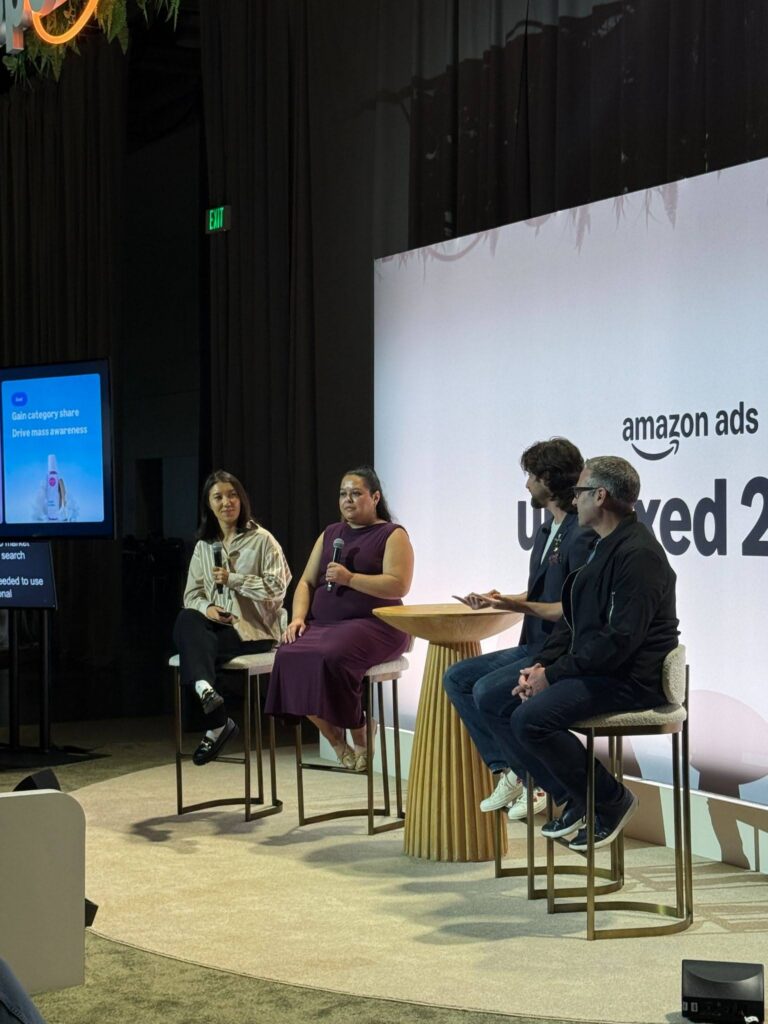
The exchange centered on eos’s successful body mist launch and its supporting measurement strategy. Tinuiti’s full-funnel campaign helped the brand move from zero category presence to #1 Best Seller in Women’s Body Spray in just eight weeks, setting the stage for its broader marketing efforts.
But increased sales alone don’t actually prove it worked. Using Skai’s incremental return on ad spend (iROAS) methodology, the team connected a national TV moment to an 81% incremental lift in Amazon sales, outperforming historical branded-search benchmarks by 197%. The analysis provided causal evidence of the impact, demonstrating its value beyond what traditional attribution metrics could capture.
For marketers facing growing pressure to justify their biggest brand investments, the session showed how combining full-funnel execution with incrementality measurement can help connect major awareness campaigns to provable results.
When it comes to creative and inventory, Amazon’s streaming TV offering is getting more sophisticated on both fronts. Dynamic TV Creative on Interactive Video Ads (IVA) can now personalize interactive overlays at the impression level using Amazon shopping signals from more than 300 million customers. Interactive Video Ads are also eligible to serve across select third-party publishers, including Samsung TV+, in addition to Amazon-owned and operated supply.
Tinuiti already has experience putting Dynamic TV Creative to work through campaigns for brands including Sony and Chomps. For advertisers making significant investments in streaming TV, the capability creates another opportunity to connect premium reach with commerce.
For streaming TV advertisers, however, reach is only the beginning. Marketers also need to understand what happens after the impression.
That’s particularly important for premium live sports, where significant investment can generate massive awareness without an obvious line between viewership and retail sales.
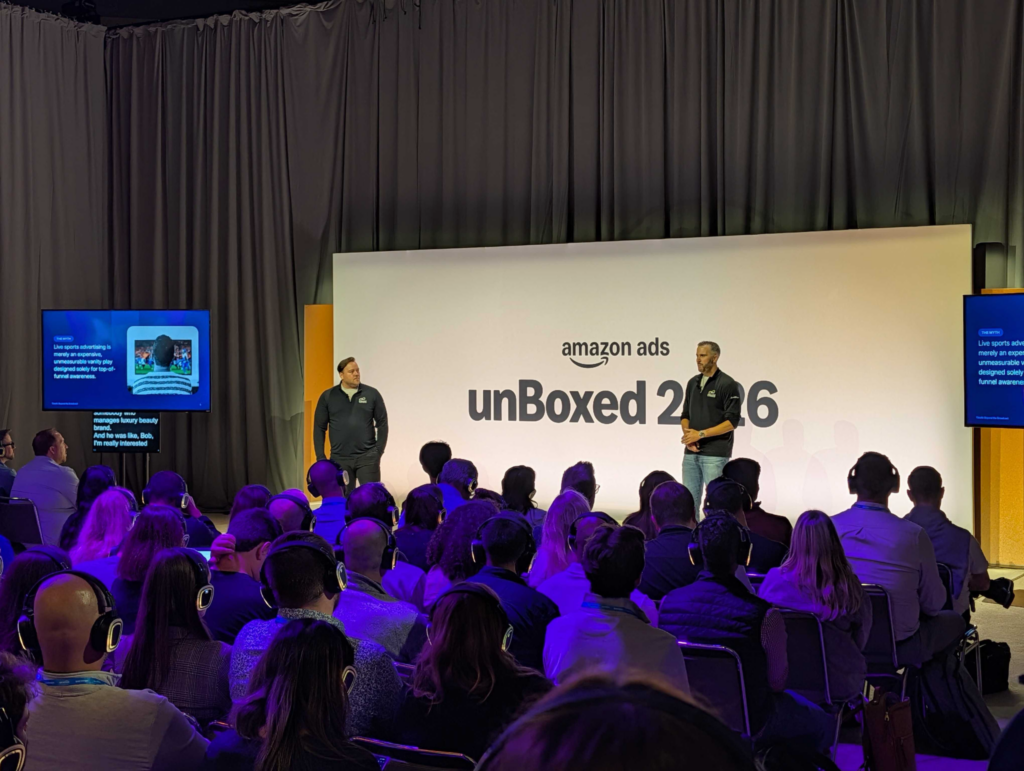
At unBoxed, Tinuiti’s own Bob Avellino, Senior Director, Innovation & Growth, and Jonathan Cole, New Business Director, hosted a session on the full-funnel impact of Thursday night football.
Live sports generate massive reach and awareness, but many brands still struggle to translate that exposure into tangible retail sales. As streaming becomes more interactive, advertisers have new opportunities to turn passive viewing into “couch-to-cart” purchases.
Bob and Johnathan demonstrated how brands can combine interactive video ads with search and display to create a coordinated, full-funnel strategy. They also explored how marketers can use Amazon Marketing Cloud to measure incrementality, repeat rates, and new-to-brand growth, revealing how streaming exposure contributes to customer acquisition as sales.
Their takeaway: premium streaming shouldn’t be treated as an isolated awareness investment, but an ongoing strategy. By connecting high-impact live sports advertising with lower funnel media and advanced measurement, marketers can more effectively evaluate its contribution to immediate conversions, repeat purchases, and long-term growth.
Brands need access to high-value inventory and the ability to determine whether their media spend drove incremental growth. As Amazon automates more of the media-buying process, access and measurement are two areas where agency expertise can continue to create value.
Campaign management isn’t the only area where advertisers will have to decide how much control to hand to AI. Amazon’s Responsive eCommerce Creative 2.0 (REC 2.0) add several new features to the already high performing creative type: video and Alexa prompt variants are now available, as well as the ability for Amazon AI to dynamically assemble display ads using retail signals.
Amazon isn’t simply recommending an audience or moving budget. Its AI-based optimization can actually alter client-uploaded creative assets, and advertisers will need to evaluate both what the automation does for performance and what it does to the creative itself.
The new REC variants incorporating video and Alexa prompts are high priority test areas.
The AI-based Dynamic assembly feature requires more intent. If you have strict brand guidelines regarding custom assets you’ve uploaded then we recommend keeping this feature off until we have a way to define those creative requirements to the AI. For brands with more flexibility, this presents another good test opportunity.
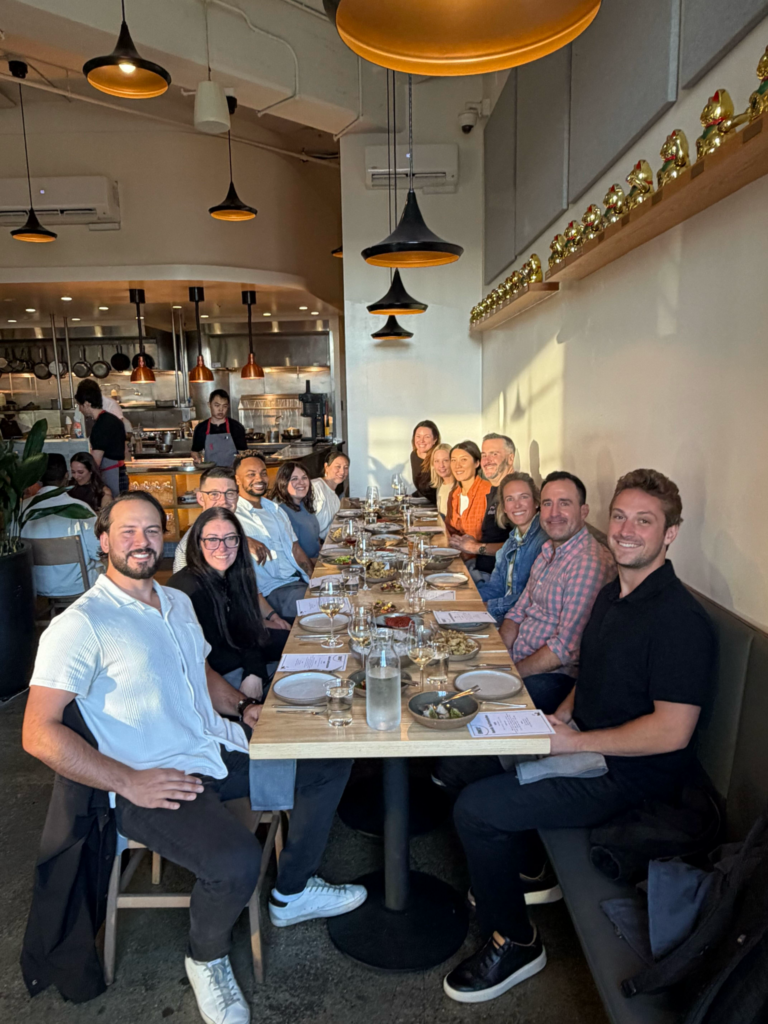
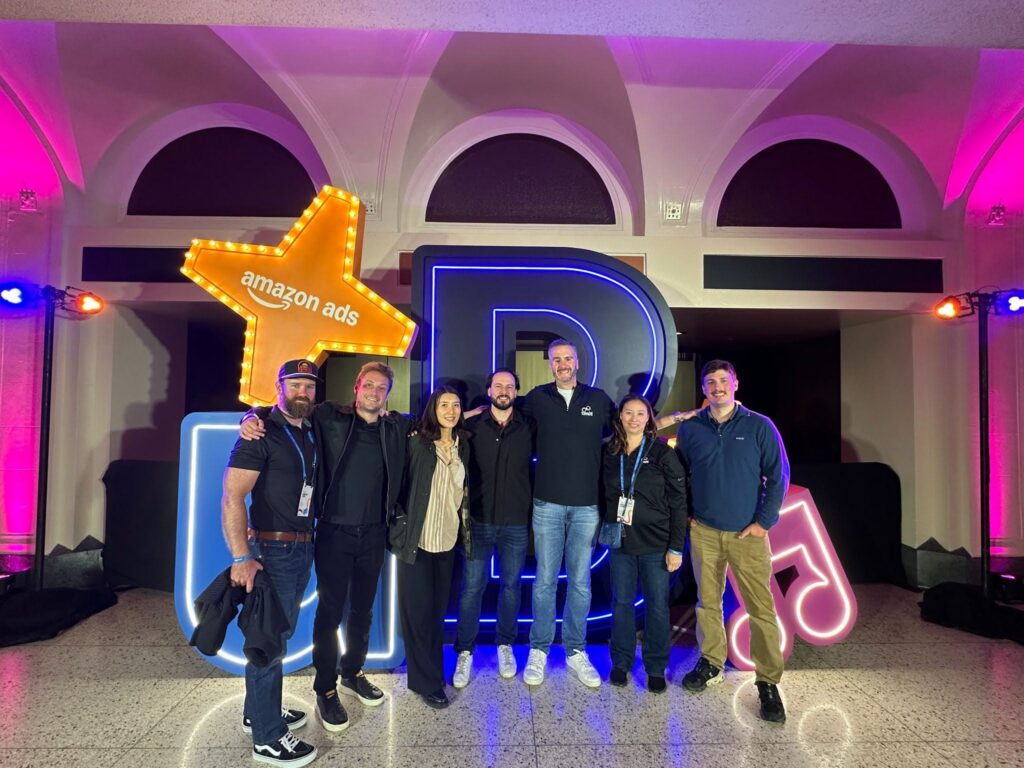
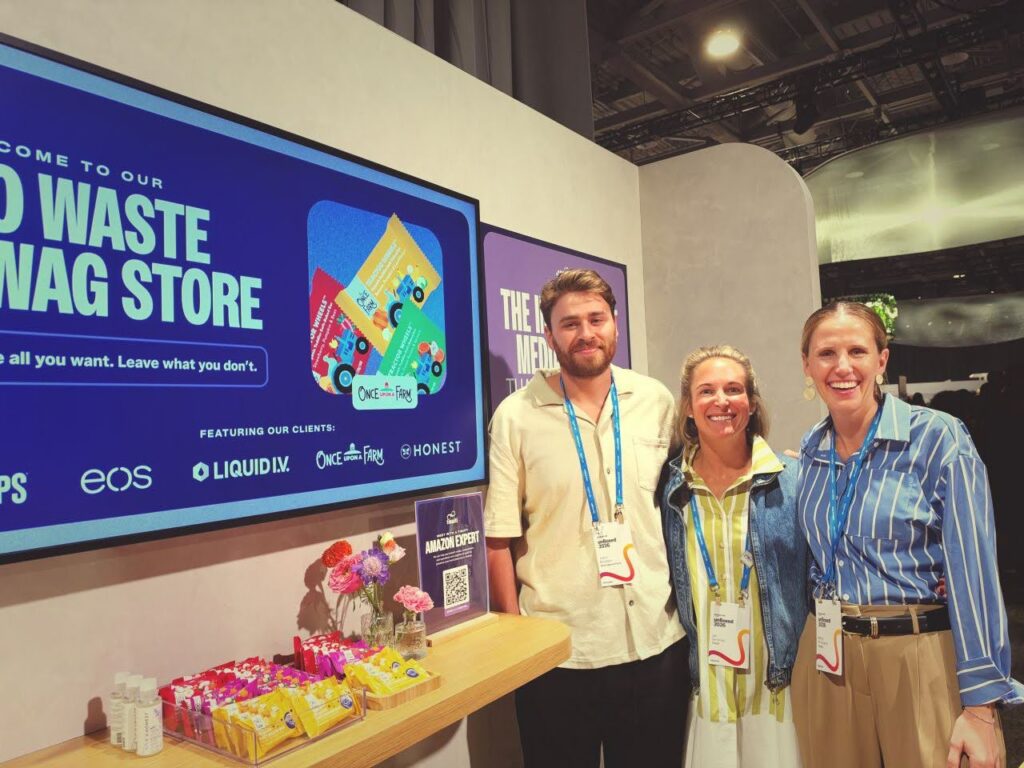
Of course, unBoxed is more than just product announcements and educational sessions. It’s also a chance to connect with real people shaping the future of commerce.
Tinuiti’s team was in the thick of it, engaging with fellow marketers, partners, and Amazon leaders alike. We dug into technology, chatted about new ideas and opportunities, and swapped insights and stories from the trenches.
Our experts showcased Tinuiti’s approach to adaptive commerce and connected with marketers navigating an Amazon advertising ecosystem that’s evolving faster than ever. We also took the opportunity to unwind at Chotto Matte, where we hosted a reception for industry professionals looking to connect beyond the conference floor.
Between the sessions, meetings, and networking, there was no shortage of energy. And while AI may grab the headlines, it’s these human connections that make unBoxed such a valuable event for our team and the brands we support.
The common thread at unBoxed isn’t simply “more AI”, but the shrinking distance between marketing decisions and Amazon’s execution.
Ads Agent can answer questions with a recommended budget. DVA+ can build a campaign from an objective. Full-Funnel Campaigns can allocate spend. Amazon MCP can write the SQL. REC 2.0 can assemble creative. And Alexa can use catalogs and customer reviews to help answer product questions.
That shift has real value, especially since shoppers shuffle between discovery, browsing, streaming, and buying rather than following a tidy funnel. Amazon is giving advertisers more ways to participate across touchpoints while eliminating some of the repetitive work required to reach them.
But more ways to activate also increase the risk of wasted investment. As delegation gets easier, marketers need to be more deliberate about which tasks they automate and how they evaluate the incremental value. Faster execution, easier campaign creation, and AI-driven decision-making are only useful when they improve the outcome. Marketers still need to test those capabilities against their existing approaches, validate the results, and know when greater control is worth the additional work.
These themes of agentic deference and orchestration are ones we’ve written and spoken about—and they’re shaping how we help brands navigate this new balance of automated execution and human strategy.
Amazon is giving advertisers more ways to reach shoppers and move faster when those opportunities appear. The brands that benefit from that ecosystem won’t necessarily be the ones that automate the most, but the ones that know where automation improves performance, where human judgment remains necessary, and which investments actually move the business forward.

Director of Content Marketing, Tinuiti
Traci Ruether is Tinuiti’s Director of Content Marketing, leading full-funnel content strategy across social, search, thought leadership, and more. A writer by trade, she focuses on creating and distributing content that makes people better at their jobs—ideally entertaining them along the way.