Media Update: Browser Wars – The AI Strikes Back


The browser wars are back, but this time, the battle isn’t about speed or UX polish. It’s about which AI agent will guide consumer journeys, capturing intent and monetizing fulfillment.
You may recall the fallout from Judge Mehta’s ruling that Google illegally maintained a search monopoly. At the time, some speculated that Google could be forced to divest Chrome. Instead, the remedies landed with a whimper; with little standing in its way, Google now appears poised to lead the next phase of agentic browsing, embedding AI companions directly into Chrome.
Browsers have long served as the internet’s control rails, and few understood that faster than Google. First with the Toolbar, and then decisively with Chrome, Google made clear that control of the browser meant control of the web’s underlying distribution mechanics. Meta, by contrast, has faced an uphill battle with iOS in part because it doesn’t control Safari.
A browser isn’t just a piece of software that displays the web. It’s a distribution layer, governing everything from data flows to ad placements. And where there’s distribution, there’s monetization.
Now, a new cohort of challengers is redefining the landscape – not as portals, but as companion agents. Perplexity, for example, recently launched Comet, a browser experience designed around conversational AI. Rather than search, users will rely on agents that parse, retrieve, and act on web information autonomously. We’ve previously covered this idea in the context of agentic commerce, but browsing may be the more immediate on-ramp to mainstream acceptance of agentic deference.
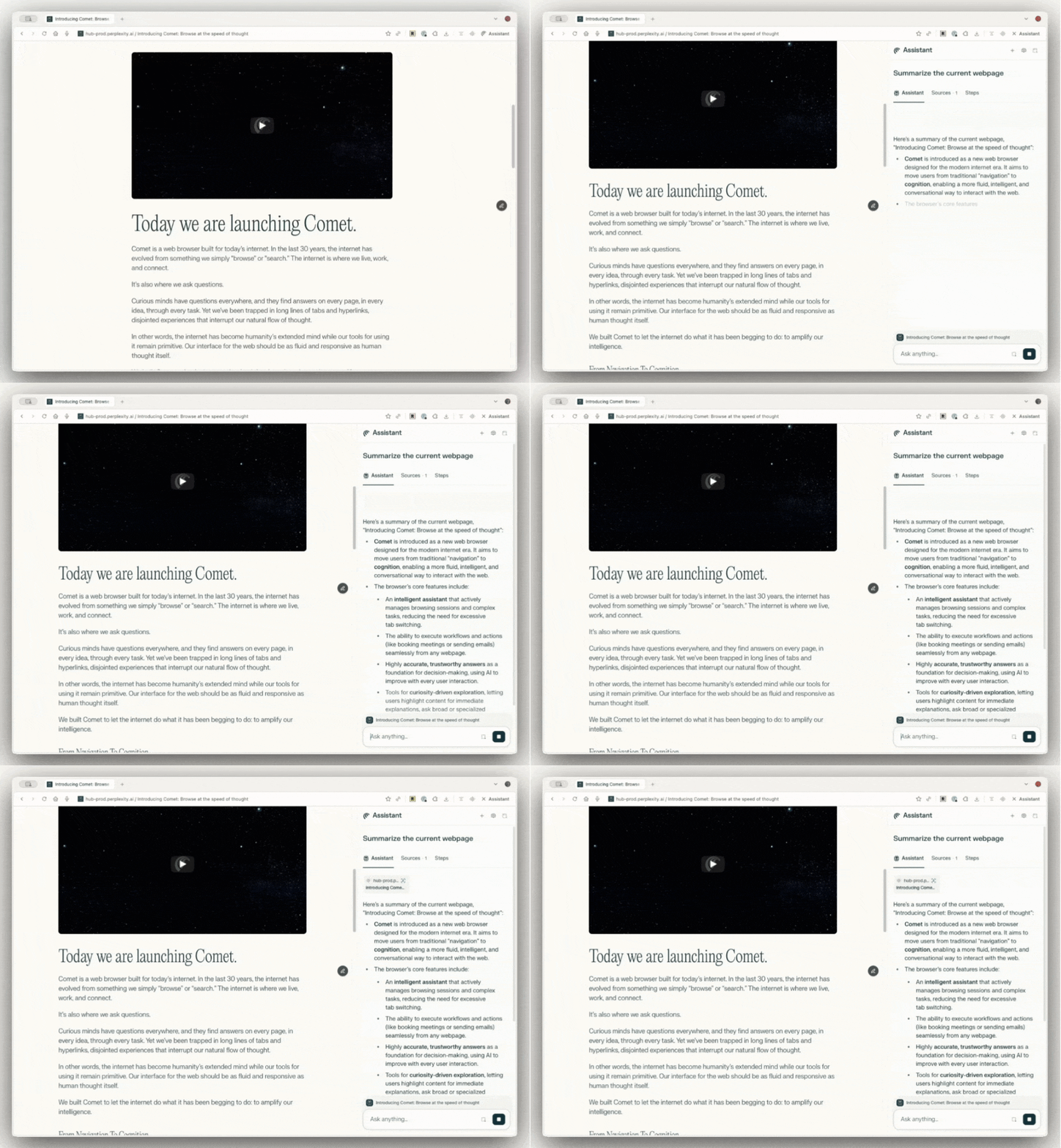
It’s a bold pivot for Perplexity, which had previously focused on monetization via contextual advertising and category takeovers. The sudden exit of Taz Patel, its Head of Advertising, raises questions about its ad ambitions. For now, Perplexity appears to be prioritizing distribution and trust-building over monetization, risking business model clarity in pursuit of market share.
OpenAI, meanwhile, while speculated to be launching a browser “in coming weeks” according to a Reuters article from July, remains oddly absent, only going so far as to embed browsing into ChatGPT rather than creating a standalone browser. The goal: a ubiquitous co-pilot that can weave live web context into every interaction.
And then there’s Atlassian, which announced its acquisition of The Browser Company (maker of Arc and Dia) to build a workplace-native browser. It’s a fundamentally different play, focused not on ads but on streamlining enterprise knowledge workflows.
Meta remains notably absent. Despite its dominance in apps and advertising, its browser ambitions remain unrealized, perhaps a legacy of failed hardware and OS bets.
Why this matters for advertisers: Browsers are no longer just entry points, they’re becoming fulfillment engines. The shift from “search” to “serve” is real. Google is uniquely positioned to profit through agent-driven ad experiences in Chrome. Perplexity may resist ads, for now. Atlassian’s bet isn’t on discovery; it’s on how knowledge workers interact with software itself. By abstracting enterprise tools into invisible APIs that feed an intelligent browser layer, Dia could reshape the user experience of work. This may not feel ad-adjacent today, but it’s a shift that could redefine productivity surfaces and influence long-path B2B buying behavior.
We’re heading toward a fractured ecosystem: Chrome at scale, OpenAI ambiently, Perplexity vertically, and Dia in the enterprise. Historically, new interfaces have layered atop existing ones—browsers on top of operating systems, apps on top of browsers. But today’s contenders are betting on replacement, not layering. They are wagering that the browser itself can become the new operating system.
That is a big swing. Browsers once fought to be your homepage. Now they want to be your co-pilot. And whoever wins will not just get your clicks. They will get your trust, your tasks, and your time. | BBC, TechCrunch, AdAge, Reuters
The news stories we’re tracking that are likely to impact advertisers in the month ahead.