2025 Apparel Marketing Study
Tariffs Shake Up Apparel Purchase Decisions, While AI, Social, and Streaming Redefine Discovery

Tariffs Shake Up Apparel Purchase Decisions, While AI, Social, and Streaming Redefine Discovery
Apparel shoppers in the US face an uncertain environment in the back half of 2025 and beyond, with huge shifts in trade policy set to have more sweeping implications on prices and product availability moving forward. That’s impacting how many are making purchase decisions, but longer-term trends like the rise of AI, the shift to online apparel shopping, and the growing sway of online influencers are also changing the landscape.
Tinuiti surveyed 1,007 US apparel shoppers in August 2025 to understand how they’re approaching new technologies, platforms, and tariff impacts. The results offer brands a map of where shoppers are discovering, researching, and purchasing apparel, and what they’re looking for from the products they buy.
Higher US tariff rates are changing apparel shopping behavior, with 30% of respondents indicating that they’re buying fewer products. Shoppers are also on the hunt for better deals, with 28% searching for more promos and/or coupon codes and 27% shopping around more.
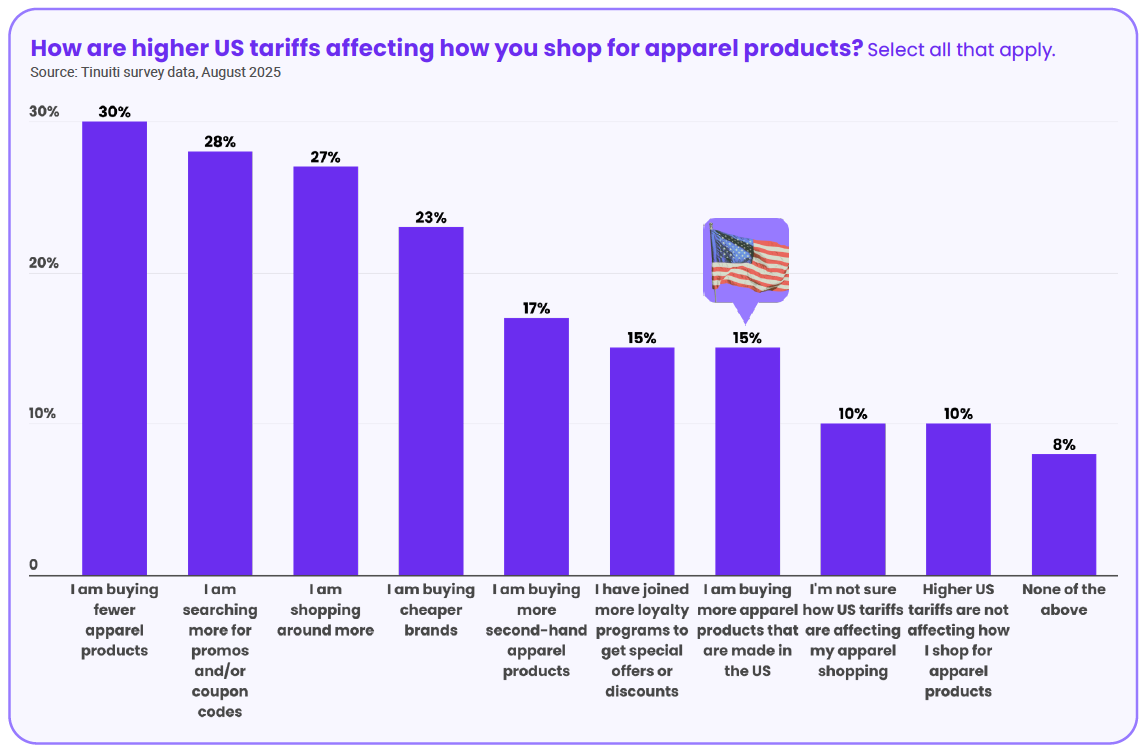
Some apparel buyers are also choosing more affordable options because of tariffs, with 23% buying cheaper brands. Members of households earning less than $75K per year were twice as likely (28%) as those earning more than $75K per year (14%) to say they are buying cheaper brands as a result of tariffs.
While one oft-stated goal of tariffs is to increase demand for US-produced goods, only 15% of respondents indicated that they’re buying more apparel products from the US.
Only 10% of respondents aren’t changing their apparel shopping habits at all as a result of tariffs, and the same share of respondents indicated that they’re not sure how tariffs are impacting their shopping.
Asked if higher prices on Shein and/or Temu have reduced shoppers’ likelihood of buying from those sites, 39% of all respondents indicated that they had, about the same as the share who said that they hadn’t (38%).
But considering just the 58% of shoppers who have previously bought from either brand, 48% say they are less likely to buy from them again as a result of tariff-induced higher prices. The de minimis exemption, which excluded packages valued under $800 from duties, ended for products shipped from China and Hong Kong on May 2.
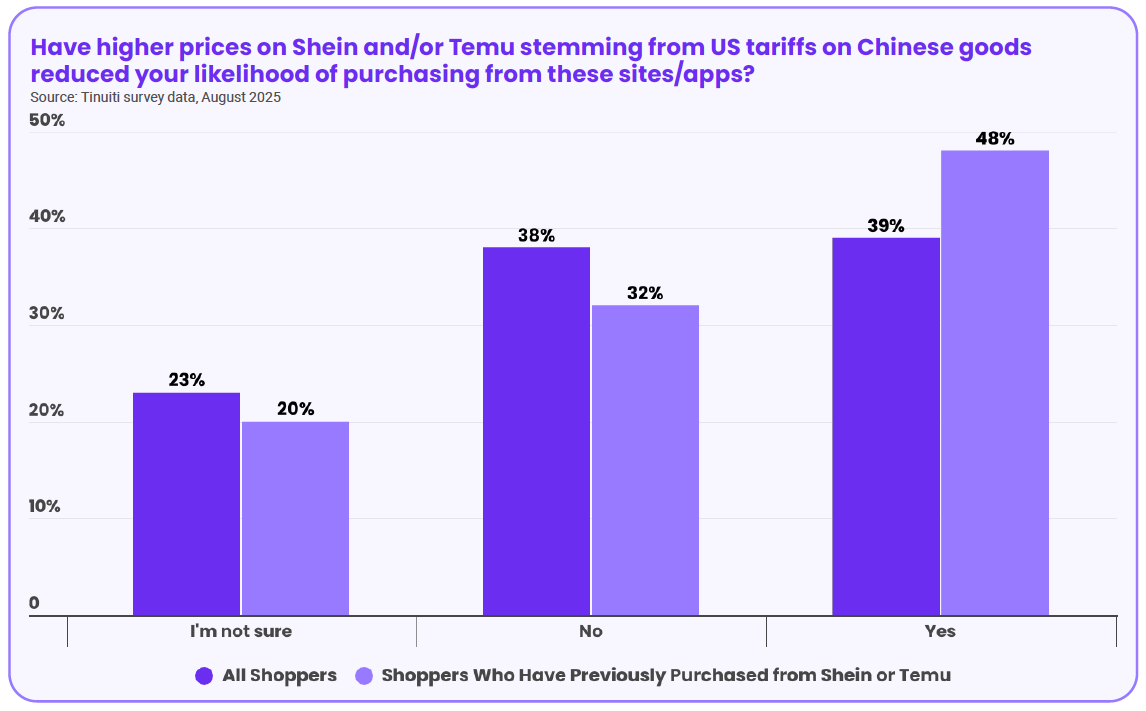
With the global suspension of the de minimis exemption going into effect on August 29, after the survey was administered, many consumers will likely be more impacted by higher tariff rates later in the year. However, given the speed and degree with which US policy has changed over the course of 2025, it’s difficult for businesses or shoppers to feel confident in their expectations for the rest of the year and onward.
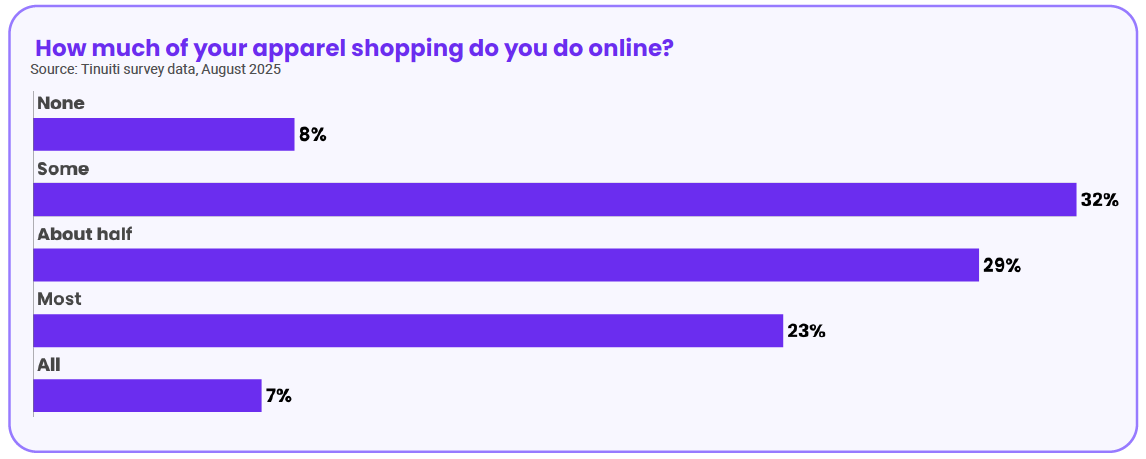
The vast majority of apparel shoppers make at least some purchases online, with just 8% indicating they don’t make any online purchases. Fully 23% of respondents say they do most of their apparel shopping online, and 7% make all of their apparel purchases through websites or apps.
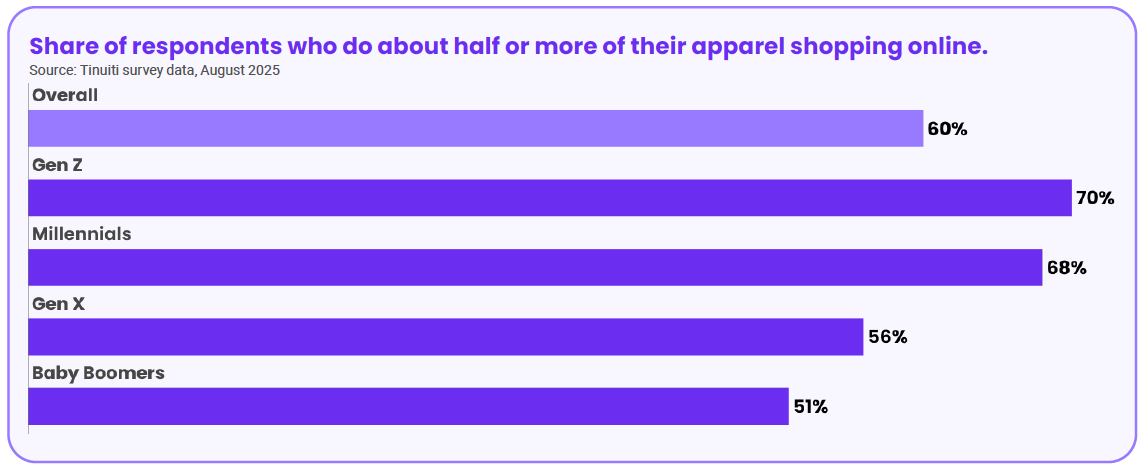
Among Gen Z, 70% of respondents say they do about half or more of their apparel shopping online. Millennials are close behind at 68%, while that rate drops to 56% for Gen X and 51% for baby boomers.

Asked where they purchased apparel in the last year, 69% of respondents shopped online from a large retailer like Amazon or Walmart, the top response. Big-box stores like Target or Walmart were the second-most chosen shopping destinations, selected by 60%.
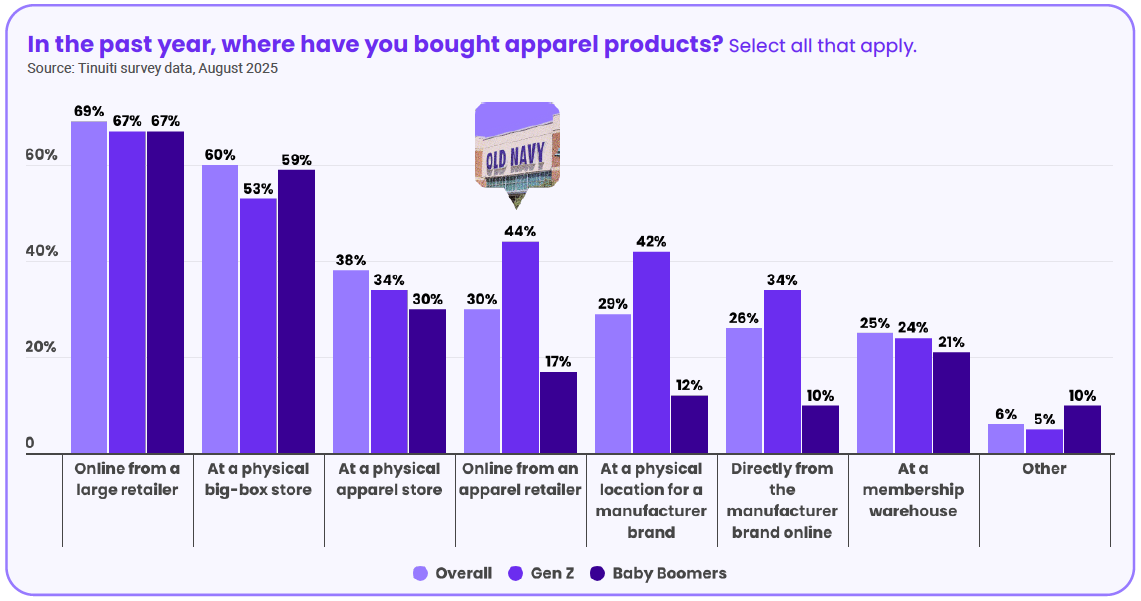
Brick-and-mortar locations are crucial for apparel-specific retailers like Gap and Old Navy, with 38% of all apparel shoppers indicating they’ve bought at such stores in the last year. This outpaces the 30% who purchased products online from an apparel retailer. Gen Z was only generation that was more likely to have bought online from an apparel retailer than at a physical store.

For manufacturer brands, however, that is not the case with 34% of Gen Z buying from the brand online compared to 42% shopping at a physical store. Older respondents were also more likely to purchase from brick-and-mortar locations for manufacturer brands than directly from the brands online.
Membership warehouses like Costco and Sam’s Club are also a key destination for many apparel shoppers, with 25% indicating they’d purchased apparel from such retailers in the last year. Next to large online retailers, membership warehouses saw the smallest divide between older and younger apparel shoppers with 24% of Gen Z having bought from membership warehouses in the past year along with 21% of baby boomers.
Even while they are in physical stores, many apparel shoppers are turning to digital actions to aid their decision making. Fully 41% of respondents have visited the store’s website while in-store to learn more about a product/brand, and 39% searched for the product/brand on a search engine.
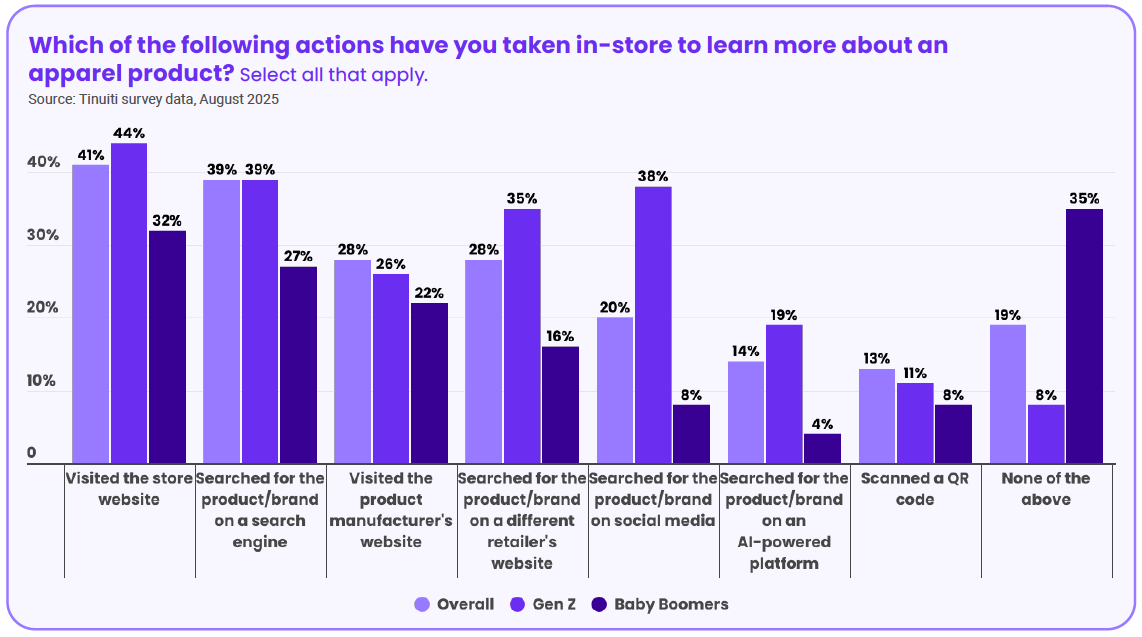
Gen Z was more likely than baby boomers to take each of the digital actions they were asked about, but the largest gap was for searching the product/brand on social media. That was followed by searching for the product/brand on a different retailer’s website and searching on an AI-powered platform like ChatGPT.
Looking ahead, 34% of apparel shoppers expect to ramp up online apparel shopping over the next year, compared to 18% who expect to do less. By comparison, only 26% of respondents expect to buy more apparel in store, compared to 28% who expect to buy less, as consumers are steadily growing more comfortable purchasing apparel online.
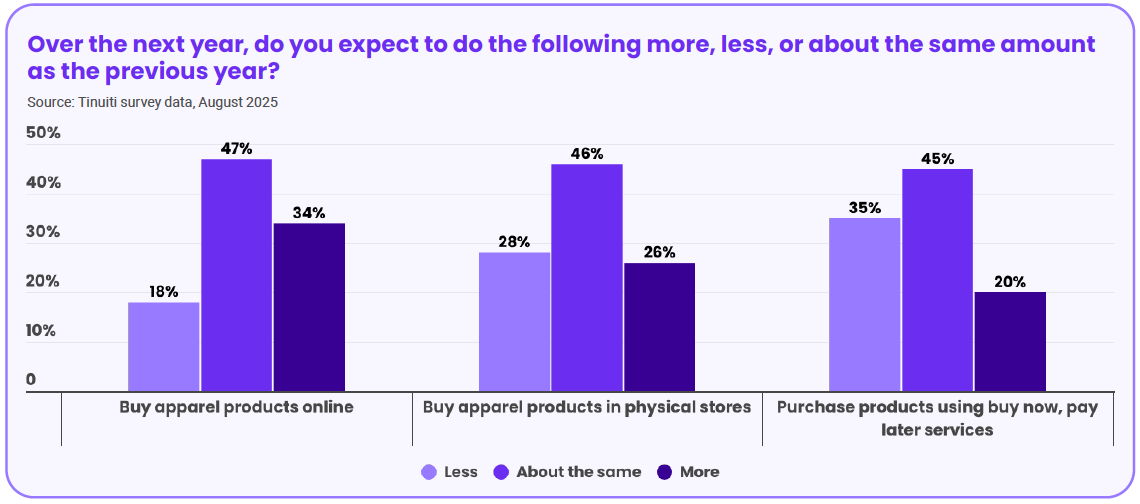
While 20% of apparel shoppers expect to use buy now, pay later services like Klarna more over the next year, 35% expect to do so less. Use of these short-term installment plans has exploded over the last few years, but some consumers may be shying away from them moving forward.
Results for these services are more positive among younger apparel shoppers with 30% of Gen Z and millennials expecting to use them more over the next year compared to just 13% of Gen X and older shoppers.
When it comes to where apparel shoppers are most likely to make their online purchases, Amazon is the clear leader overall with 46% selecting it, far outpacing the 19% share of second-place Walmart. Shein and Temu both beat out Target, as the US retailer has struggled to grow its ecommerce business relative to competitors like Walmart.
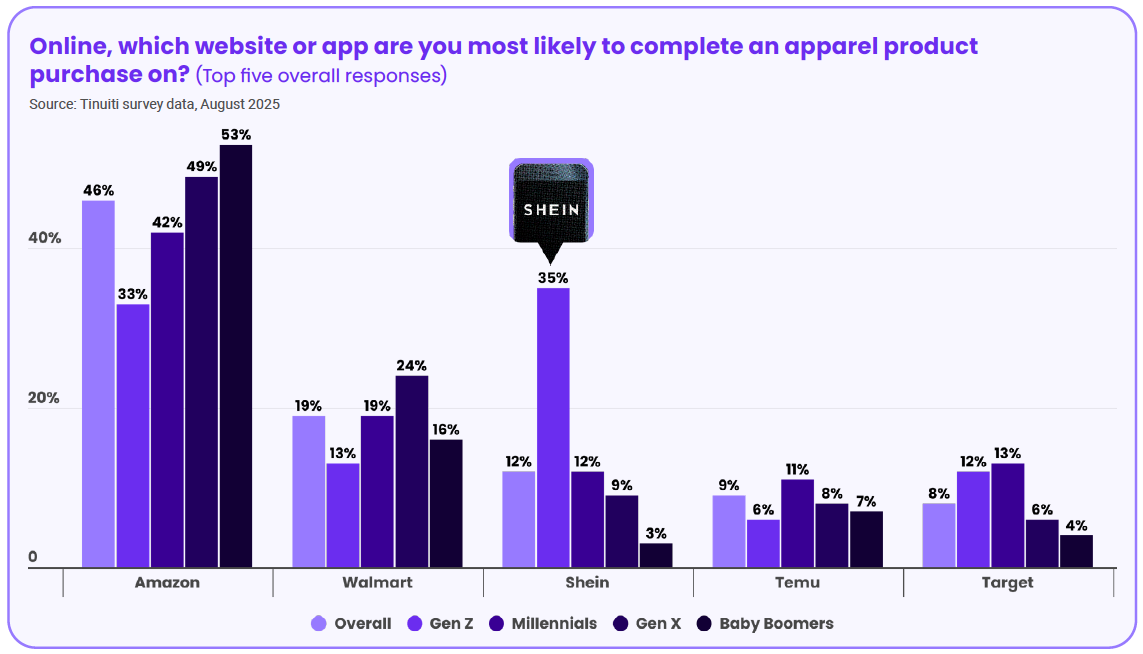
Among Gen Z, Shein just surpasses Amazon as the site where apparel shoppers are most likely to complete a purchase. Shein does not hold nearly the same status among older generations, however, as even among millennials, just 12% say it is where they are most likely to complete an apparel purchase online and that rate only sinks across Gen X and baby boomers.

When it comes to product discovery, social media is the most common channel where apparel shoppers find new products that they go on to buy, with 40% saying they’ve done so in the past year. In-store display and signs are the second-most common source of product discovery, followed by search engines in third.
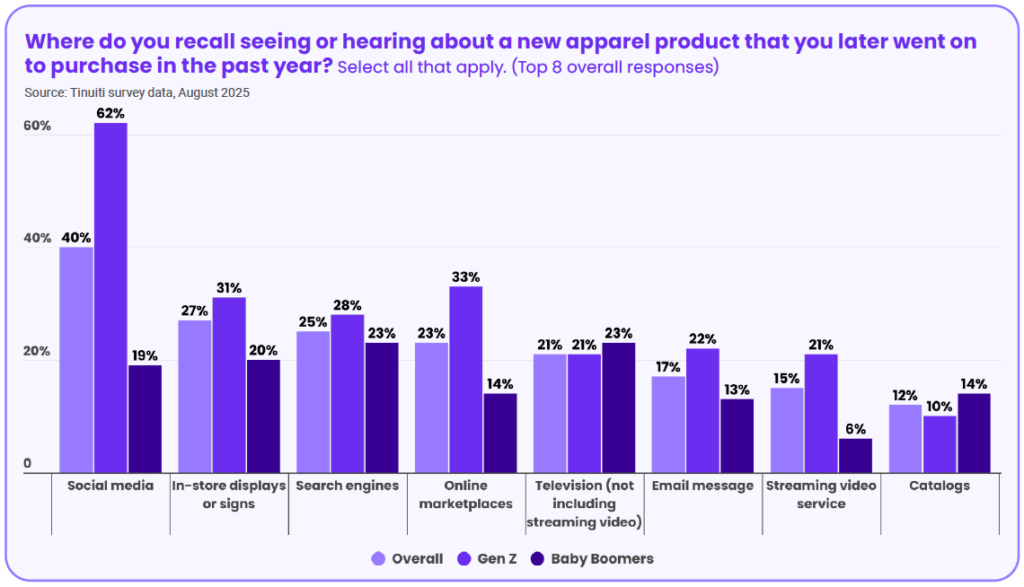
Along with traditional television, catalogs are one of just two channels where baby boomers are more likely to discover apparel products than Gen Z. Even so, catalogs still hold relatively consistent appeal across generations with product discovery rates at 10% for Gen Z, 13% for millennials, 12% for Gen X, and 14% for baby boomers.
Traditional television still outpaces streaming video for apparel discovery overall, but the two channels are roughly equally influential across Gen Z and millennials. Streaming video is also likely to grow in importance moving forward as more viewers are introduced to ad-supported streaming.
Amazon launched ads on Prime Video in January 2024, requiring viewers to opt in to paying for an ad-free experience, and the ecommerce giant has since significantly ramped up Prime Video’s ad load. Netflix launched its ad-supported tier in 2022 and now has 94 million monthly active users.
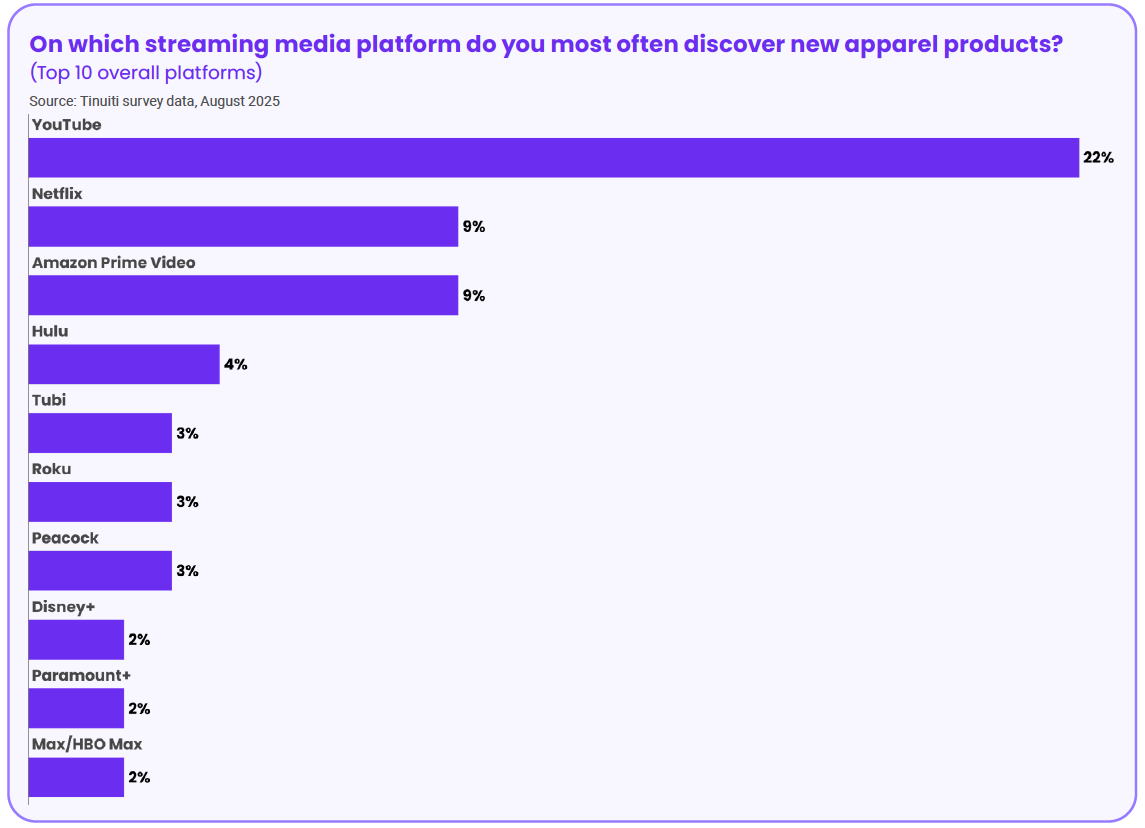
Overall, 9% of respondents say that Amazon Prime Video is the streaming platform where they are most likely to discover apparel products. The same share of respondents selected Netflix. Both platforms trail YouTube at 22%, however, while another 36% selected none of the above.

Digging into which social platforms are driving the most apparel discovery, Facebook won out overall with 23% of respondents selecting it, followed by TikTok at 16% and YouTube again ranking well at 12%.
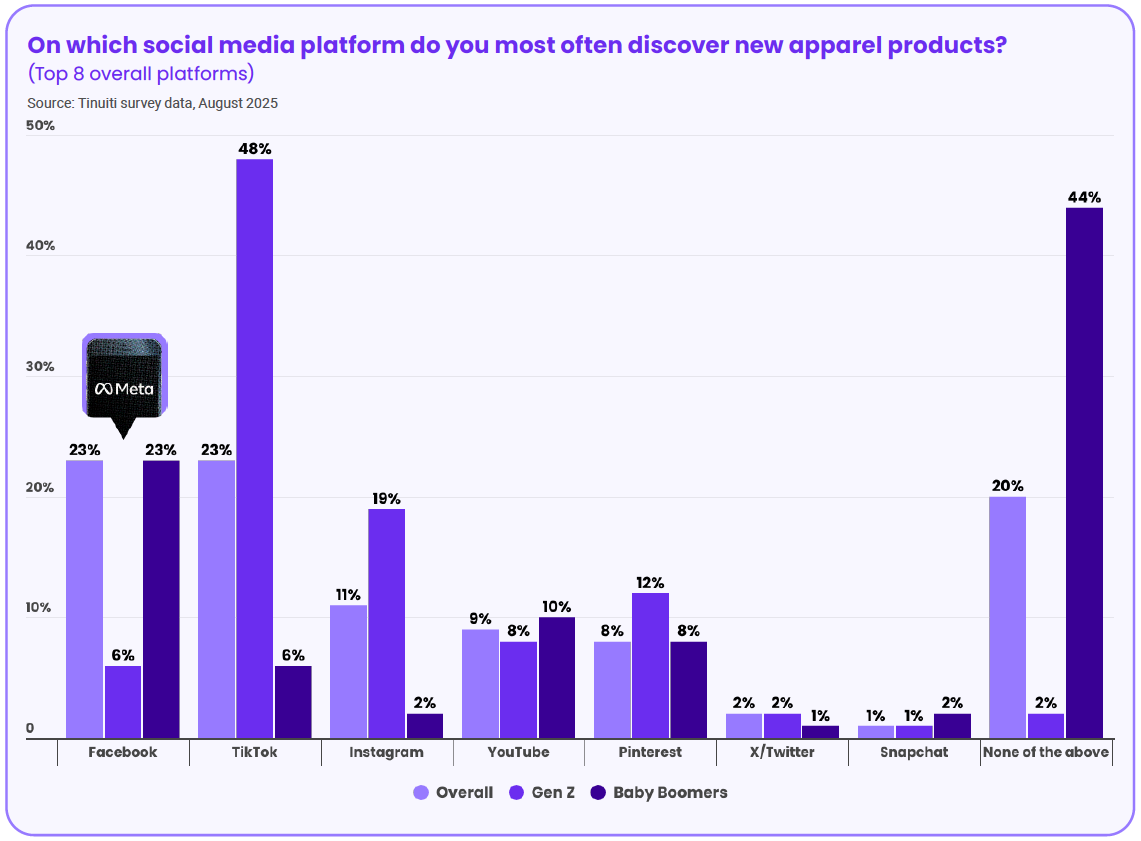
Facebook was the top choice for baby boomers, Gen X, and millennials, but ranked fifth among Gen Z, behind TikTok, Instagram, Pinterest, and YouTube. Just under half (48%) of Gen Z selected TikTok as the social media platform where they most often discover new apparel products.
Part of the influence of social media can be tied to the personalities that have grown strong followings on these platforms, and online influencers are now impacting more shoppers than traditional celebrities when it comes to driving apparel purchases.
Only 27% of respondents indicated that they’d purchased an apparel product in the past year based on the recommendation of an actor/actress, musician, or athlete, compared to 33% who have done the same based on the recommendation of an online influencer.
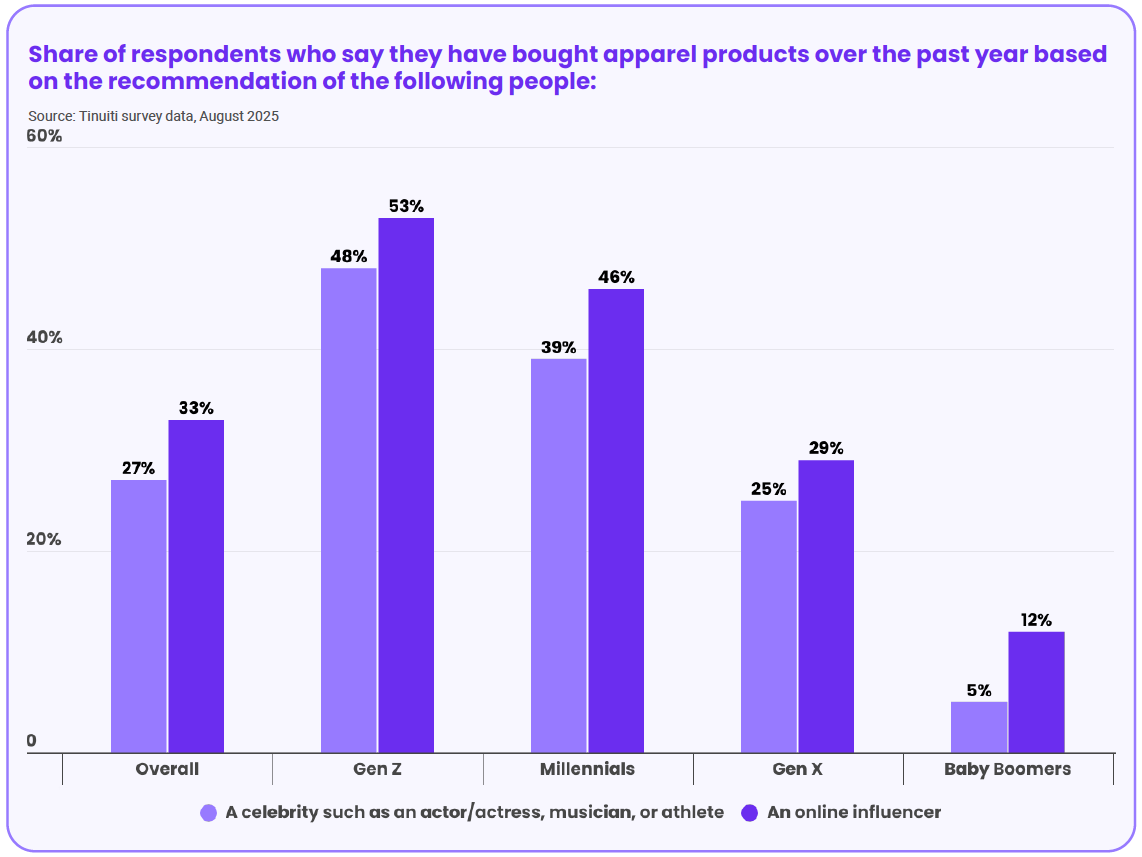
While younger generations are more likely to say they have bought apparel products in the past year based on the recommendation of online influencers than older generations, each generation from Gen Z through baby boomers was more likely to have been influenced by online influencers than traditional celebrities.
Many apparel shoppers are already wielding AI in a number of ways to aid in their product purchase decisions, most commonly to compare different brands (24%) or learn more about a specific brand (19%). Another 17% have turned to AI for product recommendations, while a slightly lower share have used AI to learn about general apparel trends or to visualize how a particular product would look.
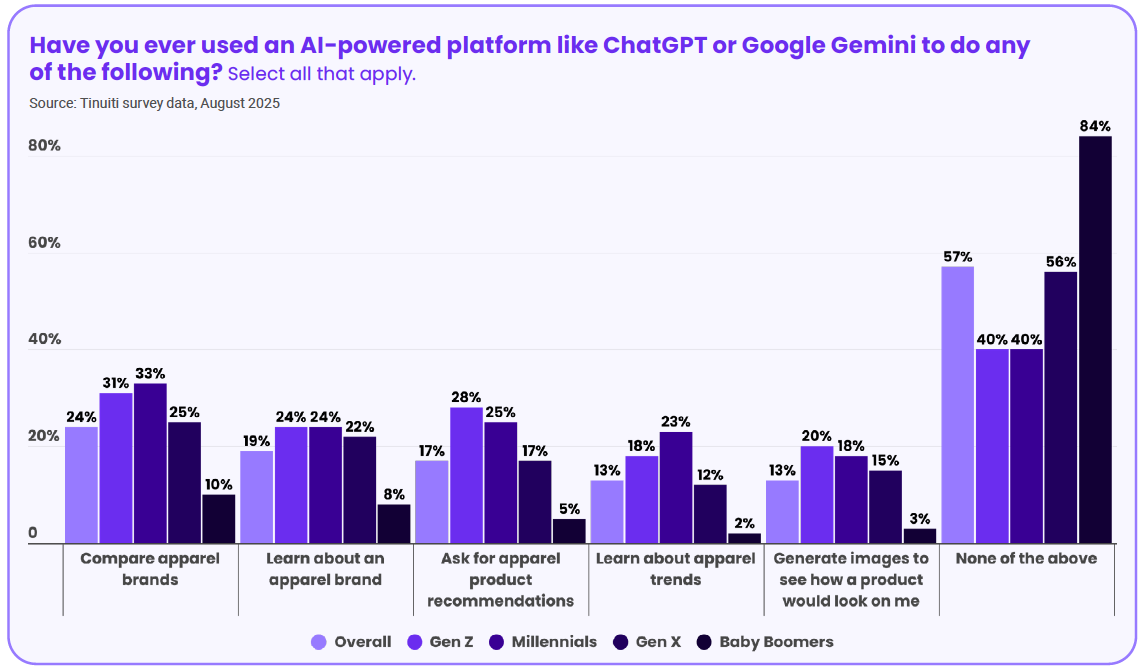
Although just 43% of all respondents have used AI in these ways, that share is only set to increase as comfort with these platforms grows and their capabilities expand. Particularly for tasks like generating images of how a product might look on a shopper, future advancements stand to enhance the buying journey and grow adoption.
Younger generations are already using AI for a wider range of tasks than their older counterparts. Among Gen Z, 60% have used AI for help in their apparel purchase path, compared to just 16% of baby boomers. In addition, millennials are using AI at roughly equal rates to Gen Z and even surpass the younger generation for some tasks.
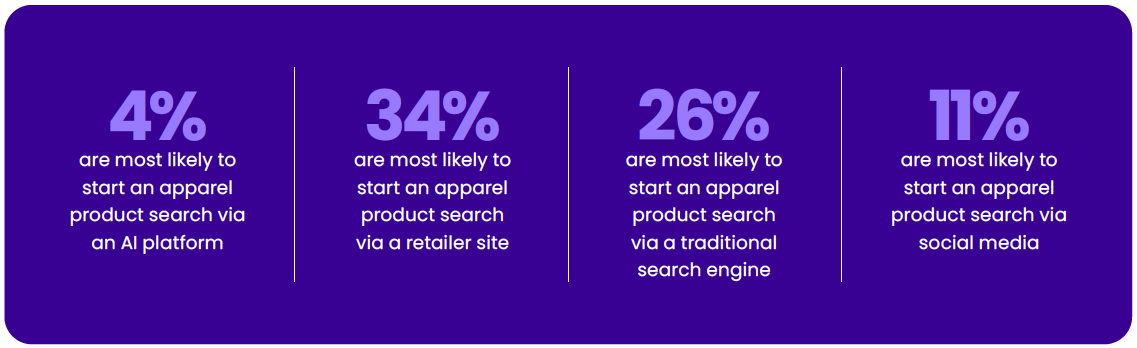
Still, just 4% of respondents say that AI platforms are the first site/app they start an apparel product search on, compared to 34% who go to retailers’ sites/apps directly and 26% who start on traditional search engines. While social media is clearly a huge source of product discovery, it’s not as crucial for product search, with just 11% of all respondents using social as their first stop for apparel searches.
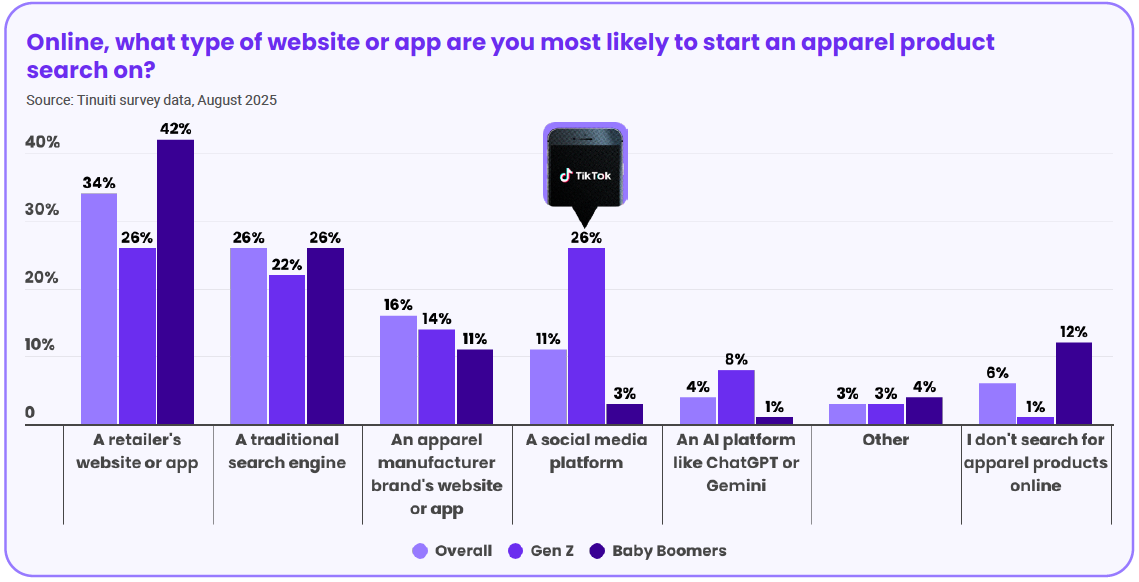
Social does match a retailer’s website or app as the place to start an apparel product search for Gen Z, however, with 26% choosing each option. Just 3% of baby boomers say they are most likely to start an apparel product search on a social media platform. AI also fares better among Gen Z but is still the top choice for just 8% of respondents.
Apparel shoppers are most likely to say that they’re typically willing to wait one week for an apparel product to be delivered after purchase, but many shoppers are looking for even faster delivery timeframes. Fully 21% indicated they’re typically only willing to wait two days, with 7% selecting one day and 4% looking for delivery within 24 hours.
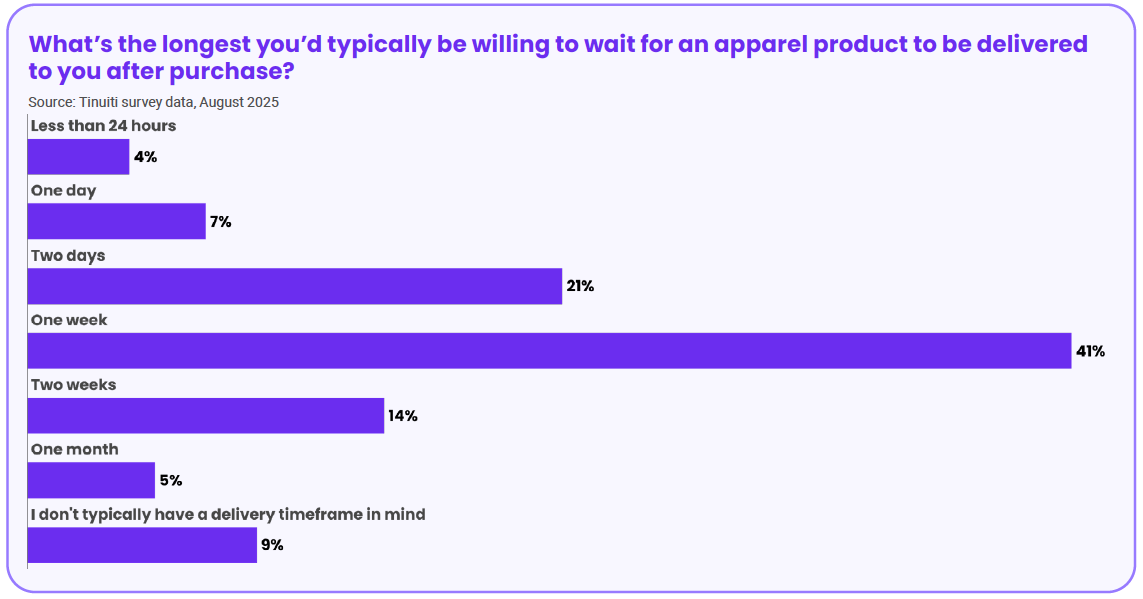
Millennials were a bit more impatient than both Gen Z and Gen X, with 38% not willing to wait more than two days for a typical apparel purchase to be delivered. For both Gen Z and Gen X that rate was 35%. Baby boomers were the most patient with only 18% saying they would typically not be willing to wait more than two days.

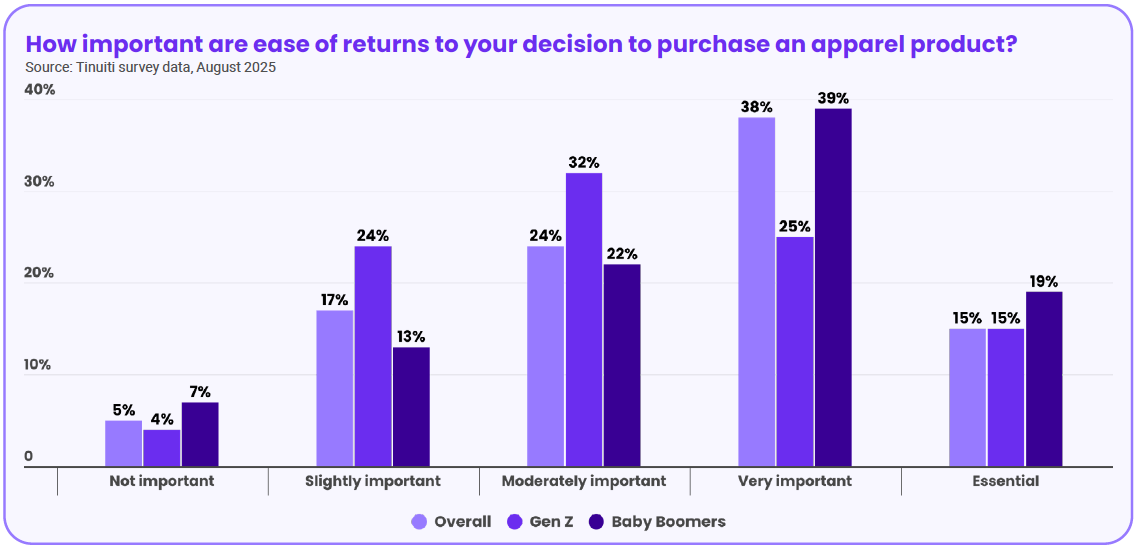
At the same time, though, baby boomers are more likely to place a high value on ease of returns than younger generations with 58% of boomers saying ease of returns is very important or even essential to their apparel purchase decisions. Among all respondents, 53% say that ease of returns is very important or essential, while just 5% of apparel shoppers say ease of returns is not important to their purchase decisions.
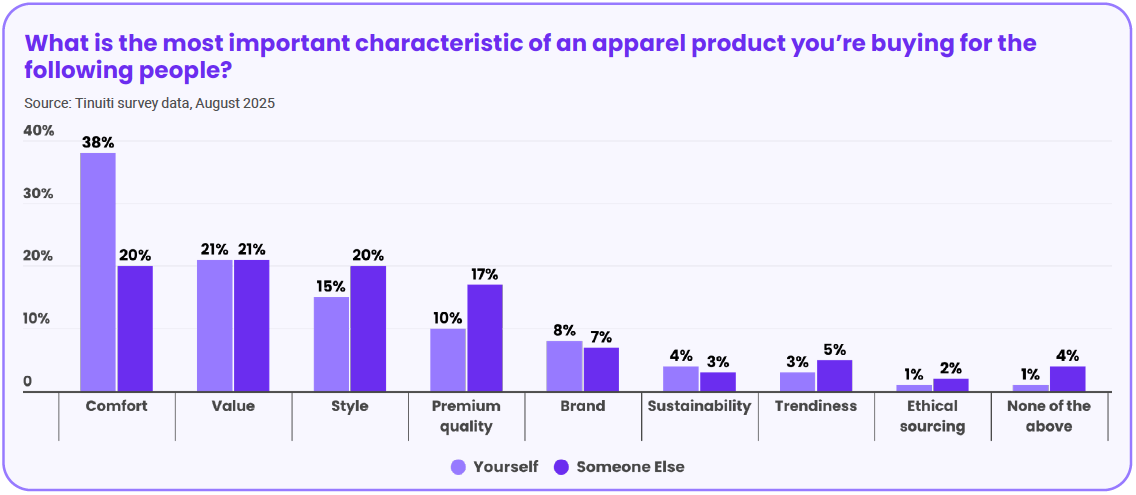
Considering the products themselves, the most important quality for shoppers purchasing apparel for themselves is comfort, which was selected by 38% of respondents. This is followed by value at 21% and style at 15%.
When it comes to apparel products shoppers purchase for others, however, comfort, value, and style were selected by nearly identical shares of respondents, with comfort being far less important than when buying for oneself and quality seeing the greatest lift.
Given a chance to explain what would make them become a repeat customer of a particular apparel brand or retailer, 46% of respondents spoke to notions of price or value, while about as many (45%) cited quality or durability. Nearly a quarter of respondents (22%) pointed to both, including one Gen X respondent who put it simply, “Good quality clothing at great prices.”
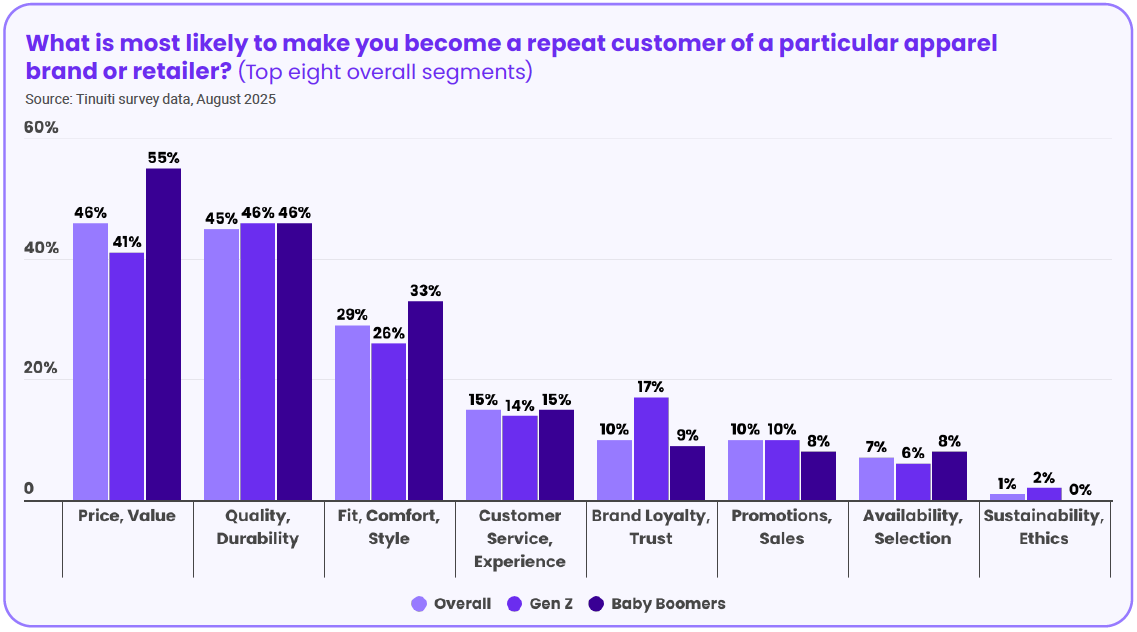
Price and quality are most important to younger apparel shoppers as well, but Gen Z also showed a higher propensity than older respondents to cite brand loyalty or trust as a reason to become a repeat customer. And although just 2% of Gen Z respondents spoke to issues like sustainability or ethics, they were about twice as likely as older respondents to do so.
Check out our most recent Apparel Marketing Study for more exclusive insights.