2025 Food & Beverage Marketing Study
Data-Rich Insights Into How Brands and Shoppers
Are Influenced by Tariffs, Al, and More

Data-Rich Insights Into How Brands and Shoppers
Are Influenced by Tariffs, Al, and More
There have never been more ways to reach food and beverage shoppers than there are today, with consumers increasingly tapping into new channels for product discovery, research, and purchases. Brands, in turn, are challenged to meet shoppers both online and in-store through platforms and mediums that continue to evolve.
To better understand how both consumers and marketers are approaching the food and beverage industry, Tinuiti surveyed 1,005 adult US food and beverage shoppers as well as 200 director level and above food and beverage marketing professionals in June 2025. This study unpacks the key trends from each of these surveys and marries the findings to uncover overlaps and gaps, diving into new developments like the impact of tariffs and the rise of AI-powered platforms along the way.
The marketers surveyed were limited to employees at brands with at least $10 million in annual revenue who participate in decision-making about the marketing channels their companies utilize. The shoppers surveyed were restricted to respondents who shop for prepackaged food or beverage products at least monthly.
Asked how tariffs have affected their food and beverage shopping behavior, 32% of respondents are buying cheaper brands, while 31% are shopping around more. Only 20% of respondents are not taking any of the actions included in the survey in response to tariffs, and nearly half are engaging in at least two of the responses included in the survey.
Select all that apply.
Food & Beverage Shoppers
Source: Tinuiti survey data, June 2025
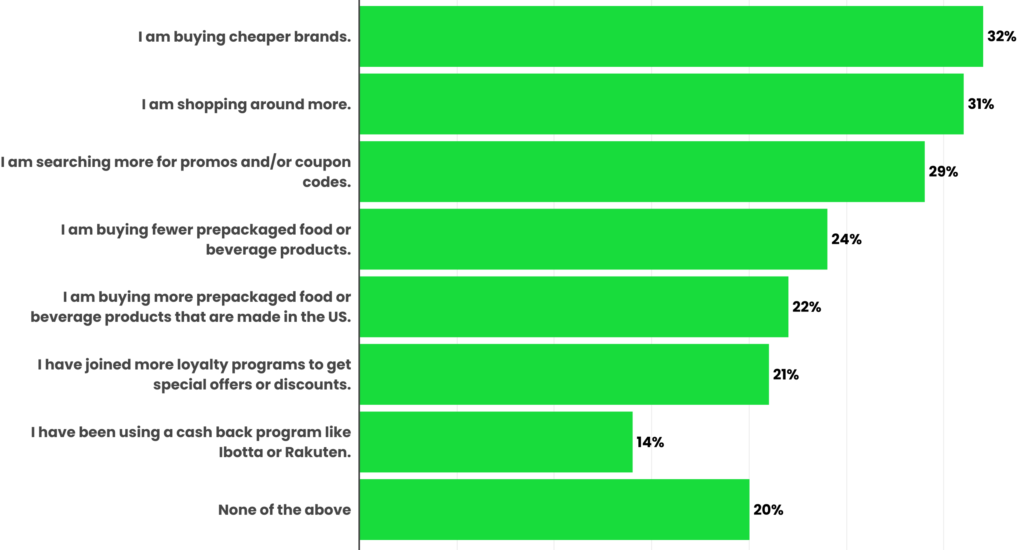
Among respondents in households earning less than $50,000 a year, 39% say they are buying cheaper brands due to tariffs, compared to 21% of respondents in households earning more than $150,000 a year.
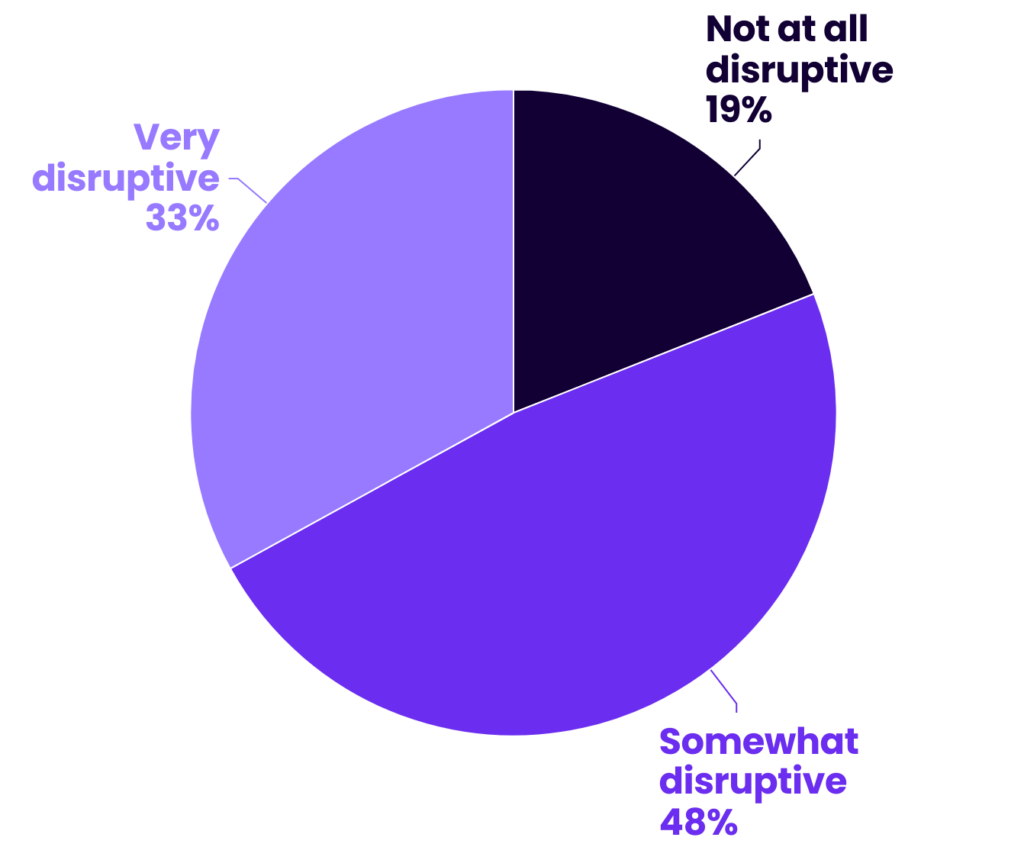
For food and beverage brands, the rapidly-changing specifics of the tariff landscape are proving to be a headache for many, with 48% indicating that the pace of change is at least somewhat disruptive to their business and 33% indicating it is very disruptive. Just 19% don’t feel that the changing nature of tariffs has been disruptive to their business.
Food & Beverage Marketers
Source: Tinuiti survey data, June 2025
Food & Beverage Marketers
Source: Tinuiti survey data, June 2025
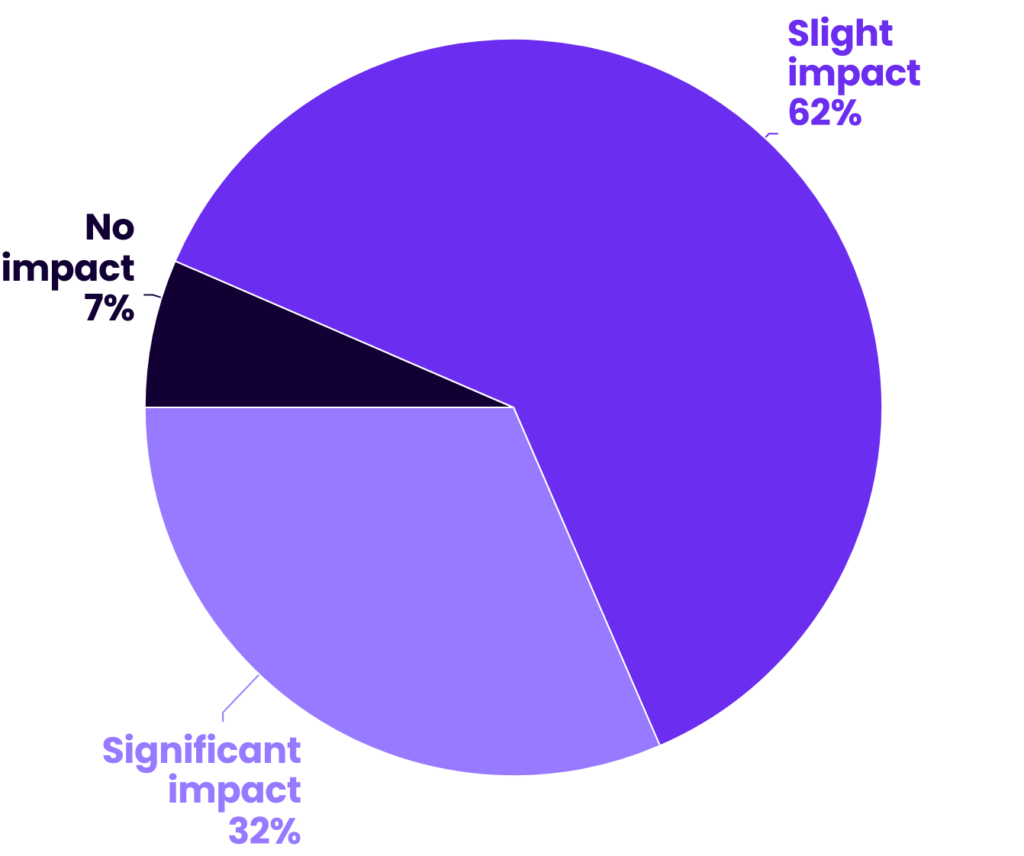
Looking ahead, nearly 1/3 of food and beverage marketing decision-makers believe that tariffs and import costs will have a significant impact on their advertising strategy, while 62% believe they will have a slight impact. By comparison, 40% of respondents indicated that economic inflation will have a significant impact on business, indicating that not all marketers directly tie tariffs to rising prices.
Concerns over the impact of tariffs are fairly consistent for marketers at food and beverage companies of all sizes. At least 27% of respondents are expecting significant impact and at least 61% are expecting slight impact across all four cohorts of annual revenue studied, from those making less than $20 million to those earning over $100 million.
Food and beverage shoppers are already wielding artificial intelligence (AI) in several ways that are primed to influence their buying behavior. Fully 26% of respondents have used AI to create a grocery list, and 24% have used it to find a recipe.
Select all that apply.
Food & Beverage Shoppers
Source: Tinuiti survey data, June 2025
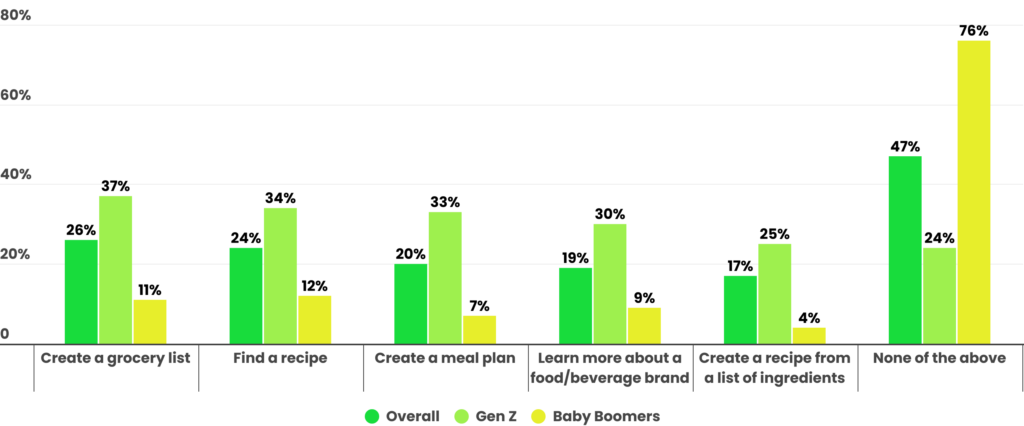
At least 15% of respondents have also created a meal plan, created a recipe from a list of ingredients, or learned more about a food/beverage brand with the help of AI-powered platforms. Just over half of all respondents have taken at least one of these actions, but that rate jumps to 76% among Gen Z.
Given the growing importance of AI in how food and beverage shoppers might discover, research, and ultimately purchase products, brands should clearly be thinking about how to rank in these tools. Three out of every four marketers surveyed indicated that they do have efforts in place to rank better or appear more frequently specifically in AI results on platforms like ChatGPT, Google, and Perplexity.
Asked to outline the details of their efforts to rank in AI platforms, several key themes emerged in how marketers are approaching the challenge.
Asked how they’re currently using AI in marketing efforts, marketing professionals are most likely to deploy AI for data analysis/insights and ad optimization. The rise in adoption of AI-powered campaign types like Advantage+ for Meta ads and Performance Max for Google ads among Tinuiti advertisers echoes the survey sentiment that AI is growing in popularity for ad optimization.
Select all that apply.
Food & Beverage Marketers
Source: Tinuiti survey data, June 2025
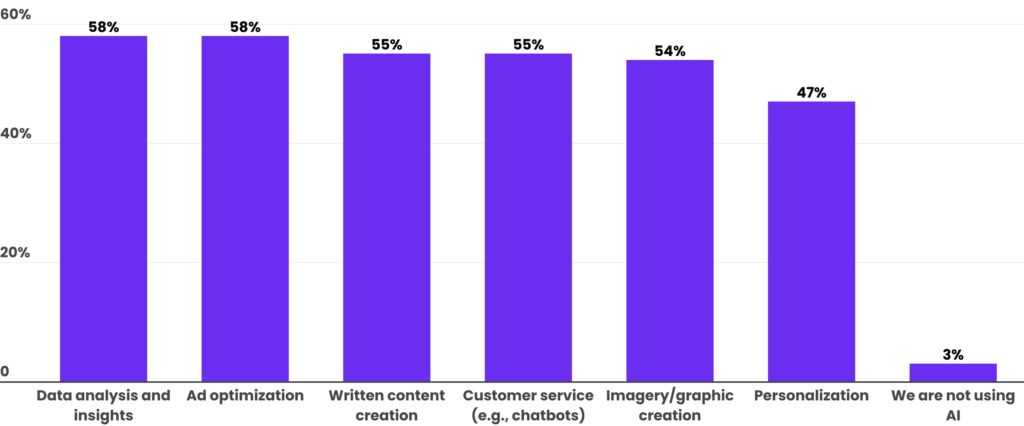
Other uses are also very popular, with over half of marketers using AI for written content creation, imagery/video creation, and customer service. Just 3% of respondents are not currently using AI in marketing activities.
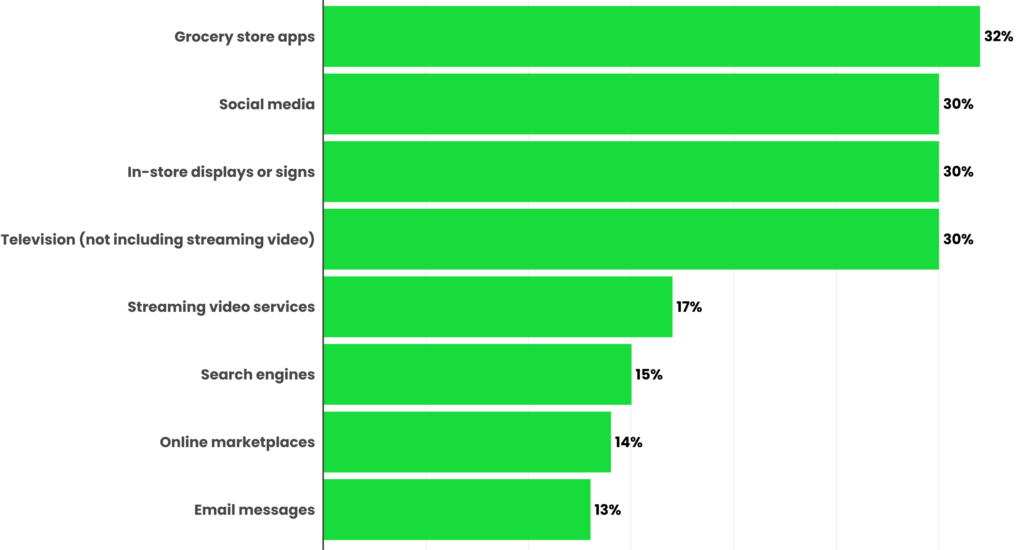
Asked to identify where they recall first seeing or hearing about a new prepackaged food and beverage product that they later went on to purchase, the shares of shoppers selecting grocery store apps, social media, in-store displays or signs, and television were nearly identical, with grocery store apps narrowly winning out above the rest. Streaming video services were next in line, selected by 17% of respondents.
Select all that apply. (Top eight overall responses)
Food & Beverage Shoppers
Source: Tinuiti survey data, June 2025
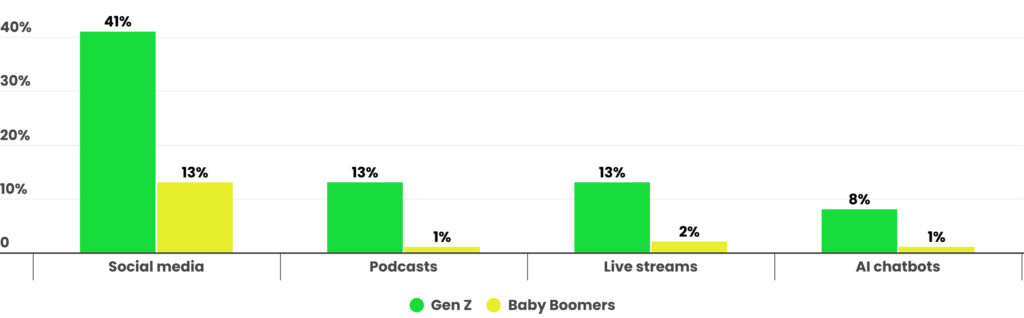
Although just 1% of baby boomers recall discovering a food or beverage product using an AI chatbot in the past year, that rate is 8% among Gen Z shoppers. Gen Z is also much more likely to discover food and beverage products on social media, podcasts, and live streams.
Select all that apply.
Food & Beverage Shoppers
Source: Tinuiti survey data, June 2025
Influencers are also an important source of product information, with 63% of food and beverage shoppers indicating that they had purchased a product based on the recommendation of an online influencer in the last year, including 82% of Gen Z.
Food & Beverage Shoppers
Source: Tinuiti survey data, June 2025

Brands founded or led by influencers are also carving out market share, with 33% of respondents having purchased from brands like Prime or Feastables in the last year. That rate was highest, 49%, among millennial respondents, including 61% of millennials with children under 18.
(Share who responded ‘yes’)
Food & Beverage Shoppers
Source: Tinuiti survey data, June 2025

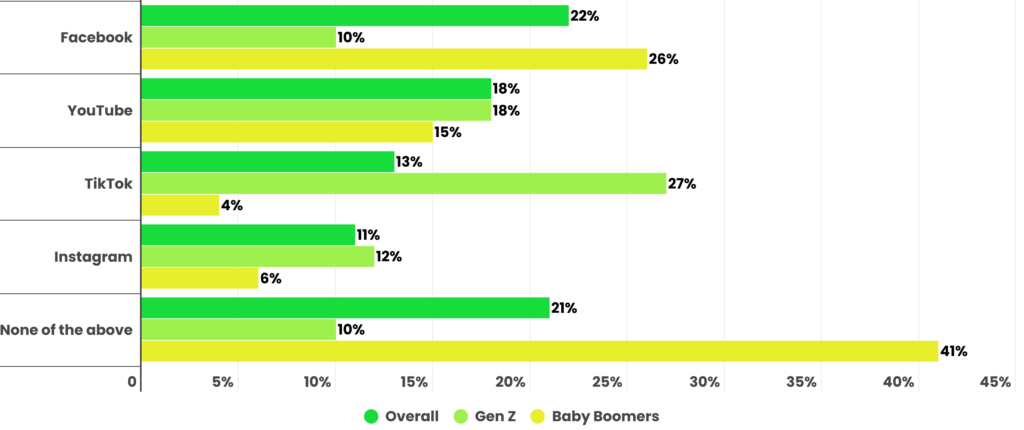
Facebook won out as the social media platform that respondents most commonly discover new food and beverage products on, followed by YouTube and TikTok. But while Facebook is the top choice for millennials and older respondents, it’s a distant third behind TikTok and YouTube among Gen Z.
(Top five overall responses)
Food & Beverage Shoppers
Source: Tinuiti survey data, June 2025
By comparison, marketers selected YouTube as the most effective social media platform for reaching customers, followed by TikTok and Instagram. Facebook placed fourth, with just 37% of marketers believing it to be a top three most effective social platform for customer reach.
Select up to three. (Top four overall responses)
Food & Beverage Marketers
Source: Tinuiti survey data, June 2025
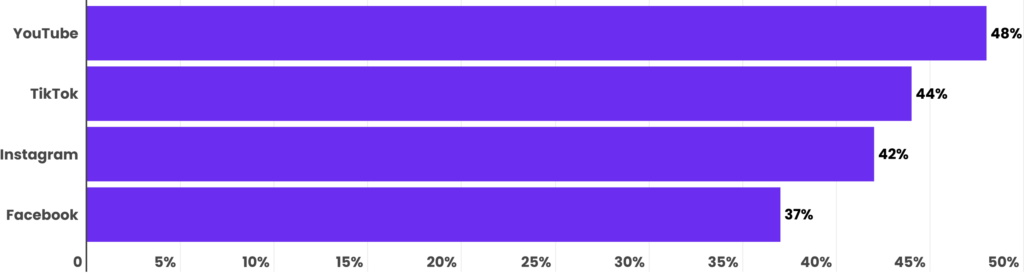
For marketers who see their audience as only millennials or older, Facebook fares better, with 56% of respondents citing it as a top three social platform. Among the same group of marketers, just 29% say the same about TikTok.
Asked which streaming video platform they most often discover new products on, 22% of food and beverage shoppers selected YouTube, the top response. This was followed by Netflix and Amazon.
(Top ten overall responses)
Food & Beverage Shoppers
Source: Tinuiti survey data, June 2025
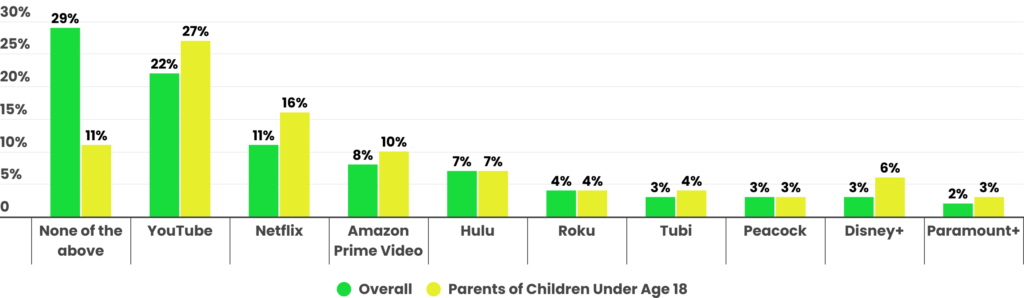
Parents of minor children were more likely to select most streaming networks than other respondents as just 11% of parents with younger children selected none of the above, compared to 29% of all respondents. Just 1% of respondents without children under the age of 18 say Disney+ is the streaming platform they most often discover new products, but that share jumps to 6% among those respondents who do have children under 18.
Marketers are most likely to say that YouTube is the most effective streaming media platform, followed by Amazon Prime Video. Only launched in Q1 2024, brand adoption of Prime Video ads has exploded and will likely continue to grow given Amazon’s competitive CPM rates.
Select all that apply. (Top two overall responses)
Food & Beverage Marketers
Source: Tinuiti survey data, June 2025

Among retailer/ecommerce websites and apps, food and beverage shoppers are most likely to start product searches on Walmart, with nearly twice as many respondents choosing to search on the brick-and-mortar giant’s website/app compared to Amazon. However, only 49% of brands are currently advertising on Walmart compared to 56% who are advertising on Amazon.
Food & Beverage Shoppers
Source: Tinuiti survey data, June 2025

Retail media networks rank as the top advertising/marketing channel in terms of effectiveness for food and beverage brands in the past twelve months, with paid search and organic search tied for the second-most selections.
Select up to three. (Top eight overall responses)
Food & Beverage Marketers
Source: Tinuiti survey data, June 2025

While retail media networks were the commonly selected option for both brand and performance-focused advertisers, other marketing channels saw greater differences among the two groups. Nearly twice as many brand marketers selected traditional television as a top channel, while performance-based marketers were more likely to select paid search and SEO.
Fully 60% of marketers are currently feeling pressure to meet ad spend requirements set by retailers as networks look to increase brand investment. While partnerships with retailers were the eighth-most commonly selected top advertising/marketing channel overall, they were second for brand-focused marketers who clearly value the impact that these partnerships can have on growing a brand name.
Nearly half of food and beverage shoppers indicated that ‘high quality’ is either very important or essential to their food and beverage purchase decisions. This was followed by ‘healthiness’, with 40% of respondents citing it as a trait that’s either very important or essential, and ‘convenience’ at 36%.
Food & Beverage Shoppers
Source: Tinuiti survey data, June 2025

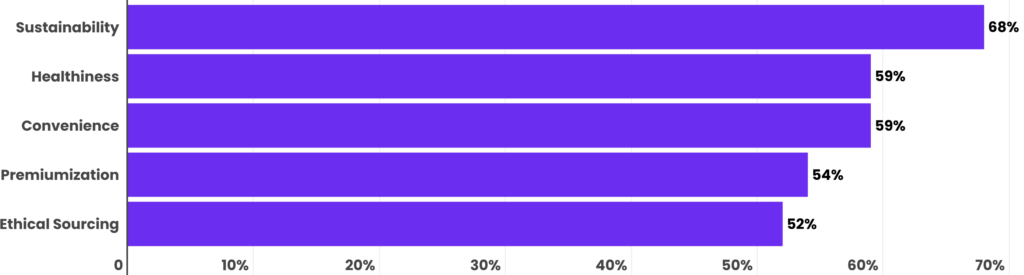
Just 25% of respondents indicated that sustainability is at least very important to their food and beverage purchase decisions, but it was the most commonly selected product attribute cited by marketers as a trait they’re leaning into through marketing. Healthiness and convenience were the next most commonly selected attributes for marketers, both chosen by 59% of respondents.
Select all that apply.
Food & Beverage Marketers
Source: Tinuiti survey data, June 2025
Consumers and marketers are very aligned when it comes to the nutritional characteristics they prioritize, with the explosion in demand for high-protein options shaping how brands market themselves.
Select all that apply.
Food & Beverage Shoppers
Source: Tinuiti survey data, June 2025

Nearly half of all food and beverage shoppers, including 61% of Gen Z, indicated that they’re prioritizing high-protein food and beverage products, and 68% of brands are leaning into marketing the protein content of their products, the top choices for both surveys.
Select all that apply.
Food & Beverage Marketers
Source: Tinuiti survey data, June 2025

The second-most commonly selected option also aligned across both surveys, with 33% of consumers prioritizing organic products and 59% of marketers focusing on the organic qualities of their products.
Given these rapidly evolving developments, it’s no surprise that marketers indicated a diverse set of obstacles are impacting their efforts. Asked to select the biggest gap in executing marketing campaigns, the difference between the share selecting the most common response, strategy, and the share selecting the least selected option, media buying, was just 9%.
Food & Beverage Marketers
Source: Tinuiti survey data, June 2025

Marketers also highlighted a wide range of hurdles when asked to describe in their own words the biggest marketing challenge facing their brands in 2025.
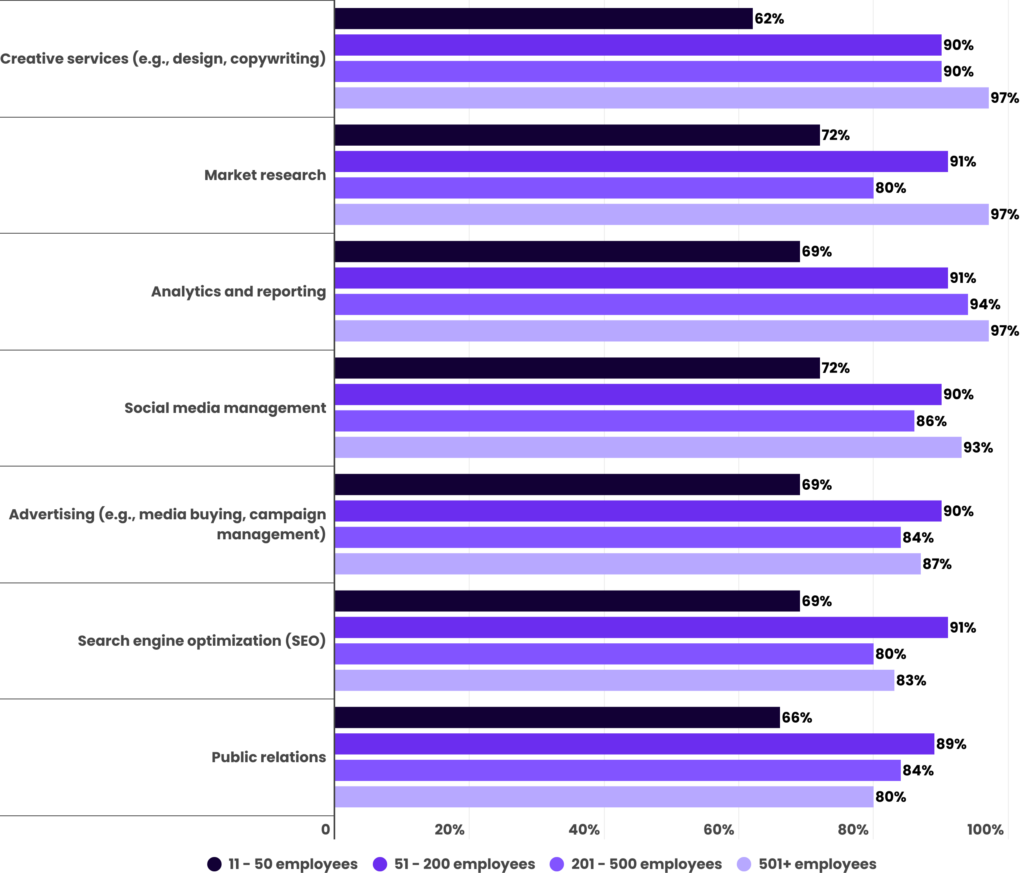
Asked to what extent their companies outsource various marketing functions, 62% of respondents indicated that most or all of their advertising is outsourced, the highest percentage among the marketing activities studied.
Food & Beverage Marketers
Source: Tinuiti survey data, June 2025

Just 10% of food and beverage marketers say their companies don’t outsource any analytics and reporting work, the lowest rate across the marketing activities studied.
Across all marketing activities studied, smaller companies – those with between 11 and 50 employees – are the least likely to outsource at least some of their work in these areas. Large brands with more than 500 employees are particularly likely to outsource at least some of the work for market research, creative services, and analytics and reporting, with just 3% of respondents at these companies indicating that none of this work is outsourced.
Food & Beverage Marketers
Source: Tinuiti survey data, June 2025
Looking ahead, 44% of marketers expect to bring more marketing functions in-house in the next 12 months, the most popular response. However, 40% expect to outsource more marketing functions, while 17% don’t expect to change the extent to which their companies outsource work.
Food & Beverage Marketers
Source: Tinuiti survey data, June 2025
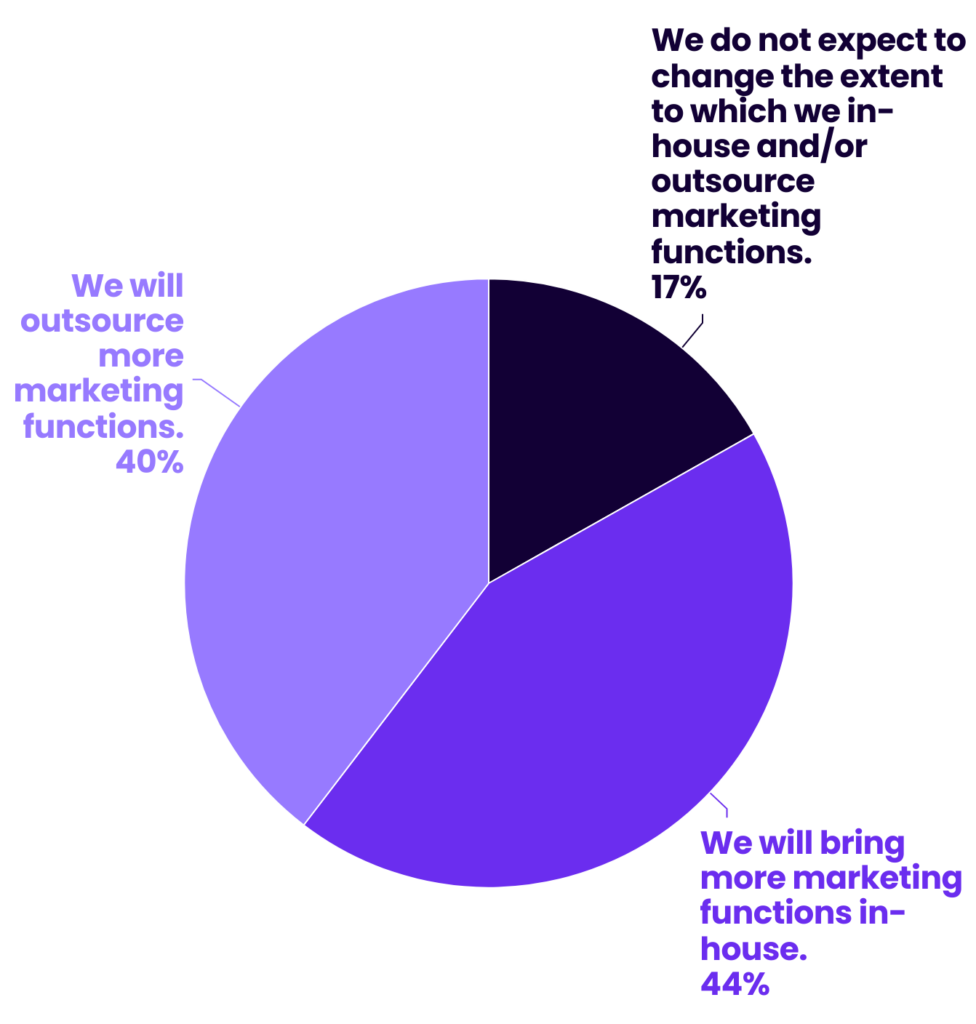
Marketers who expect the headcounts of their organizations to shrink in the year ahead are much more likely to anticipate outsourcing more marketing functions. Among this group, 49% intend to outsource more marketing functions in the next 12 months, compared to 34% among those who expect their headcount to increase.
In terms of what brands will be looking for when hiring agencies, marketers were most likely to select one-stop shop capabilities as a top reason why their brands work with a marketing agency, followed closely by proven results with similar brands. As such, agencies should highlight the breadth of their offerings while also drilling into how those offerings have helped the brands they’ve worked with in the past to win business from food and beverage brands.
Select up to three.
Food & Beverage Marketers
Source: Tinuiti survey data, June 2025

While strategy was the most-selected gap in executing marketing campaigns, innovation in digital strategy was the least-selected reason for why brands choose to work with a marketing agency.
Check out our most recent Food & Beverage Marketing Study for more exclusive insights.