YouTube TV Advertising: Campaign Best Practices & Ad Costs


YouTube today is simultaneously the largest streaming platform, a massive social feed, a search engine, and a growing shopping destination. For many viewers, the TV screen is now the primary way they experience that ecosystem—and YouTube TV is a major driver of that living-room, live-TV experience, sitting alongside broader YouTube viewing on connected TVs. That’s exactly why so many brands are interested in it, and also why it can be hard to know where it fits, how to buy it, and how to prove it’s working. This guide is designed to cut through that complexity so you can decide when YouTube TV belongs in your mix, how to activate it, and how to measure it with the same rigor as your other performance channels.
YouTube TV is an ad-supported subscription TV service, technically a vMVPD (Virtual Multichannel Video Programming Distributor), that provides subscribers with access to live TV, on-demand programming, and YouTube video content in a single interface. Instead of relying on traditional cable or satellite providers, viewers access YouTube TV via internet-connected devices like smart TVs, streaming boxes, and mobile devices. As its subscriber base has scaled, YouTube TV has become the leading live TV streaming provider in the U.S., outpacing other vMVPDs in total audience and projected growth.
Subscribers can watch live broadcasts from major broadcast and cable networks, regional sports networks, and news channels, alongside recorded content stored in unlimited cloud DVR. They can also access YouTube Originals and regular YouTube videos within the same experience, making YouTube TV a hybrid of traditional TV, a streaming service, and the broader YouTube video ecosystem.
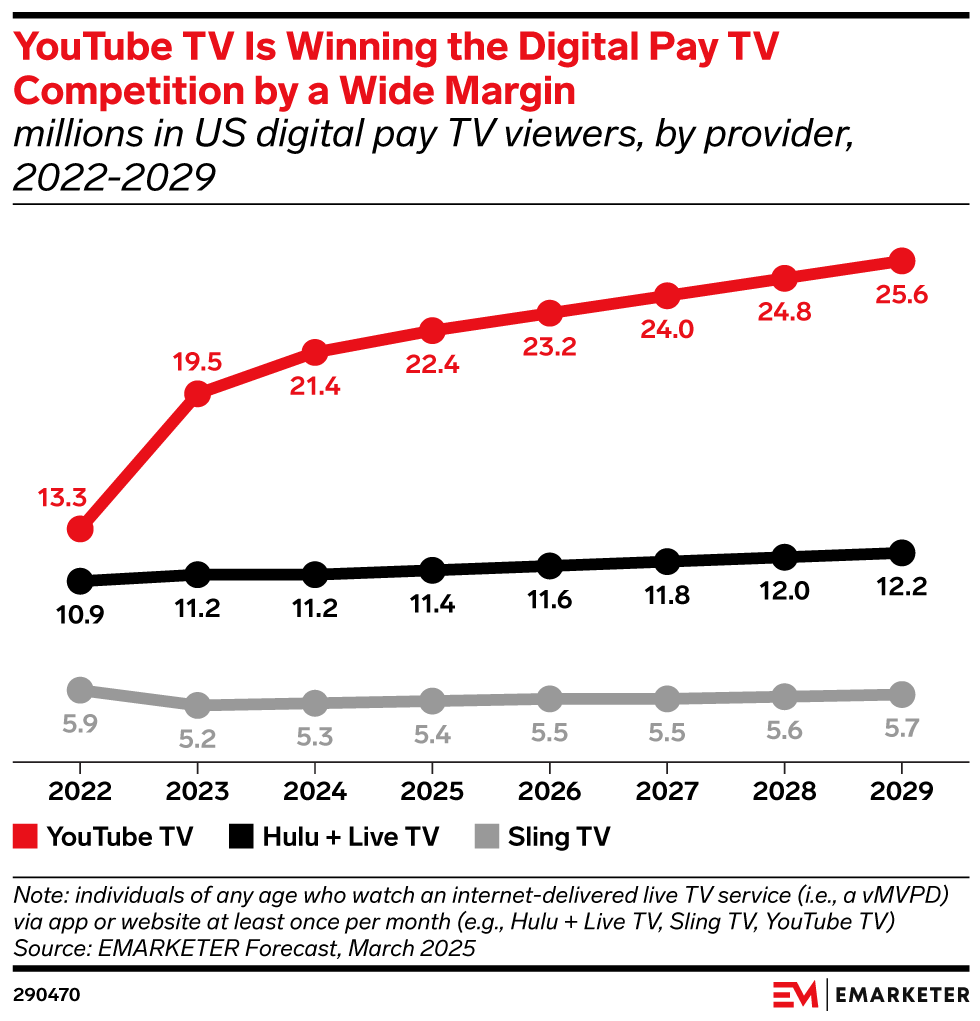
Source: EMARKETER, YouTube TV Is Winning the Digital Pay TV Competition by a Wide Margin (millions in US digital pay TV viewers, by provider, 2022-2029), March 1, 2025.
YouTube TV advertising is a form of OTT (over-the-top) advertising, meaning ads are delivered over the internet through streaming services and devices rather than traditional cable or satellite. From a viewer’s perspective, YouTube TV ads look and feel similar to traditional TV spots because they appear within live TV, recorded content, and eligible YouTube videos watched through the YouTube TV interface.
Ads can appear in three main contexts on YouTube TV:
The main exception is YouTube Premium members, who do not see ads on regular YouTube videos, even when watching via YouTube TV.
YouTube TV supports two primary video ad formats:
These formats are designed for TV-like reach and impact, with strong viewability on large screens and predictable delivery patterns. For brands, YouTube TV ads combine the familiarity of TV advertising with some of the targeting and reporting capabilities of digital, making them a useful complement to both linear and broader YouTube buys.
One common misconception is that a YouTube TV buy gives you every ad break on the platform. In practice, roughly 90% of ad time is still controlled by the TV networks themselves and is delivered as baked-in inventory that you access through traditional national and cable TV buys. YouTube TV ads purchased through Google control only a small slice of inventory (typically a few minutes per hour) on select cable networks, as well as free ad-supported streaming TV (FAST) and YouTube-originated channels, where Google has insertion rights and can apply digital targeting.
In the Q4 2025 Digital Ads Benchmark Report, we found that ad spend across the entire YouTube ecosystem across Tinuiti clients grew 13% year over year, even as YouTube CPMs fell 18%. Over the same period, streaming video ad spend outside of YouTube also grew 13% year over year, but CPMs declined just 1%, meaning YouTube delivered far more volume per dollar than the typical streaming partner.
That efficiency sits atop a rapidly scaling audience. As of late 2025, YouTube TV has surpassed 10 million subscribers, solidifying its position as the leading live TV streaming service and outpacing other virtual MVPDs like Hulu + Live TV by several million subscribers. This shows how aggressively brands are leaning into the YouTube platform over other streaming platforms and seeing a reward for doing so. Incorporating advertising with YouTube TV offers several advantages relative to both traditional TV and other streaming services:
These benefits make YouTube TV a powerful addition to a full-funnel video mix, especially when paired with standard YouTube campaigns and measured holistically across channels.
Download our Digital Ads Benchmark Report for a deep-dive on data across Google, Meta, Amazon, and more.

Despite its advantages, YouTube TV advertising has some constraints that marketers should understand:
These challenges are part of why Tinuiti invests heavily in planning tools and measurement infrastructure to make YouTube TV easier to buy and evaluate alongside other video and TV channels.
It’s important to distinguish between YouTube TV and watching regular YouTube on a TV screen. In the U.S., YouTube’s CEO has confirmed that TV screens have now surpassed mobile and desktop as the primary way people watch YouTube, underscoring how central the living room has become to the platform’s overall viewing.
That shift is mirrored in how advertisers spend. In Tinuiti’s Q4 2025 DABR, 67% of spend from traditional YouTube video campaigns ran on TV screens, compared with just 17% on phones. When you include Demand Gen and app campaigns, TV screens still accounted for 40% of total YouTube ad spend for Tinuiti clients, while phones represented 47%.
The YouTube app is available for free on many smart TVs and devices, letting users watch YouTube videos on the big screen without a YouTube TV subscription. To reach those viewers, brands buy “standard” YouTube ads targeted to CTV inventory; YouTube TV ads, by contrast, specifically reach paying YouTube TV subscribers inside the live TV and VOD experience and are bought through separate reserved deals.
There is currently no ad-free version of YouTube TV, so subscribers will see ads during their live and recorded content. Because YouTube TV carries linear network feeds, many of the ads viewers see are the same creative airing on traditional TV, combined with inventory sold directly by Google.
The subscription also features:
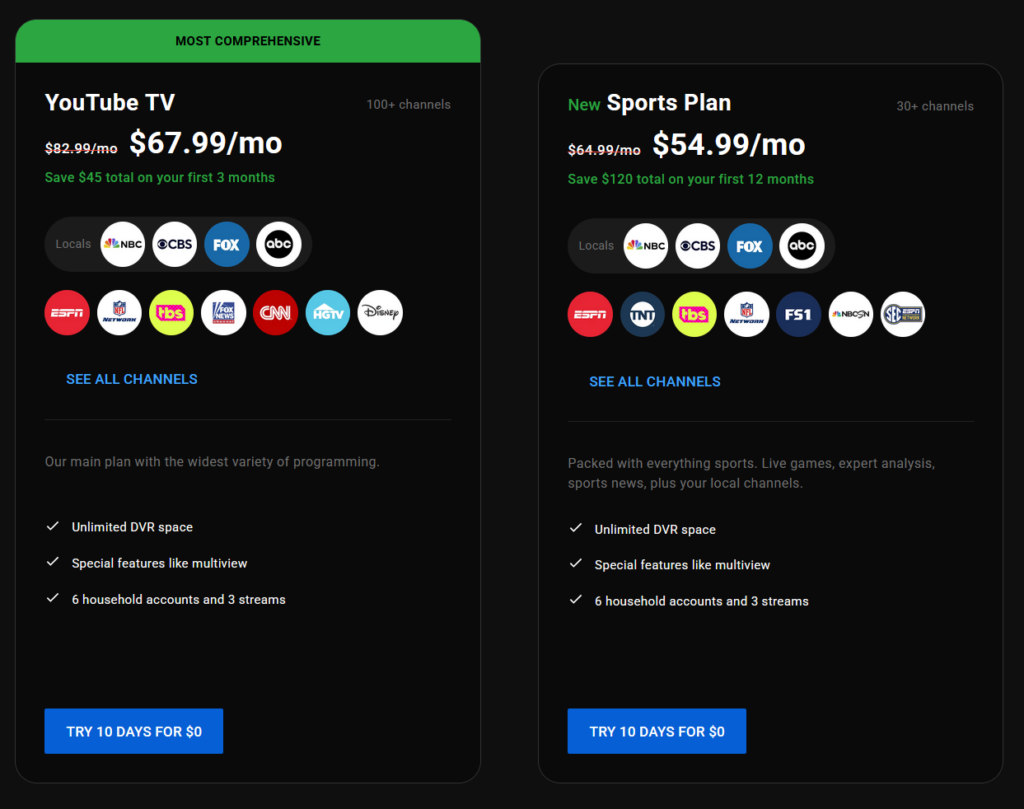
Users can add premium channels and bundles, such as sports, entertainment, and movie packages, on top of the base plan, including options that bundle services like Max, Starz, and Paramount+ with Showtime at a discount compared to subscribing separately.As of early 2026, the standard YouTube TV Base Plan is regularly priced at around $82.99 per month in the U.S., with frequent introductory offers for new subscribers that can temporarily bring the effective monthly cost into the mid-50s to low-70s range. For viewers who want higher fidelity and more flexibility, the 4K Plus add-on, typically priced around $9.99 per month, unlocks select live sports and on-demand content in 4K, offline downloads from your DVR library, and unlimited simultaneous streams on your home Wi-Fi network (while maintaining the standard three-stream limit outside the home).
Because YouTube is the leading streaming and TV provider with millions of viewers, it offers advertisers a way to recover reach lost to cord-cutting and to re-engage audiences who have shifted away from traditional TV toward streaming environments.
While premium streaming CPMs have generally held, YouTube CPMs declined 18% year over year in Q4 2025, compared with just a 1% decline for non-YouTube streaming video, giving brands a rare window to buy more TV-screen inventory at lower effective prices.
Though pricing varies by deal and lineup, most advertisers should expect YouTube TV CPMs to land above standard YouTube video averages (often 5-10 dollars CPM across devices) and broadly in line with other premium CTV placements, where TV-screen inventory in the U.S. frequently clears in the 20-30 dollars CPM range for comparable environments. Exact rates depend heavily on seasonality, audience layers, and whether you are buying base YouTube TV lineups, sports packages, or tentpole content.
From a planning standpoint, YouTube TV often provides more efficient reach than traditional cable for comparable audiences, because:
Because Google still has more YouTube TV inventory than demand in many dayparts, advertisers occasionally see “Moment of Zen” house ads or auction campaigns backfilling open avails. That surplus signals that inventory remains relatively accessible and can often be cleared at competitive CPMs compared with other premium CTV environments. An experienced OTT agency can help structure buys to hit efficient CPMs while aligning with the right content environments and audience segments.
On YouTube TV, ad formats are intentionally simple: most reserved buys lean on short, non-skippable video that behaves a lot like traditional TV, but with YouTube’s targeting and reporting layered on top. For most brands, that means the real question isn’t “which format exists?” so much as “when should I use a 15-second non-skippable vs. a 6-second bumper, and how do those spots complement what I’m already running on linear and broader YouTube?” In practice, most advertisers treat non-skippable in-stream as the workhorse format for extending TV creative into YouTube TV, and bumpers as efficient, high-frequency support to reinforce key messages between longer spots.
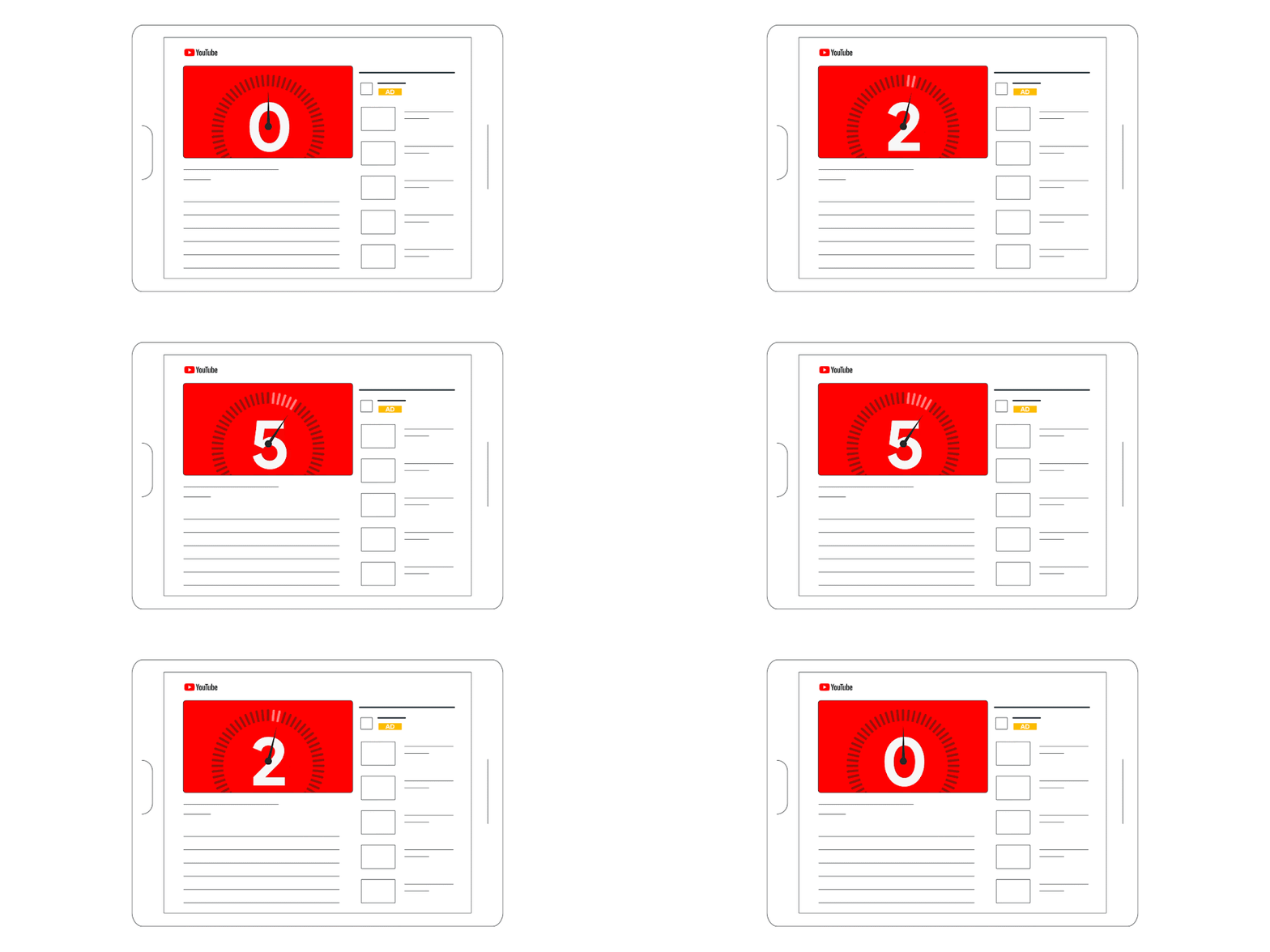
Non-skippable in-stream ads are 15-second video ads that viewers must watch in full before returning to their content. They can run before, during, or after programming on YouTube TV and are built to deliver guaranteed exposure for brand messages in a TV-like environment.
YouTube recommends non-skippable in-stream ads when advertisers want to ensure maximum message completion and when their creative is tailored to short, concise storytelling. On YouTube TV, these placements give brands an opportunity to mirror or extend linear TV campaigns with consistent creative and frequency.
Key specifications include:
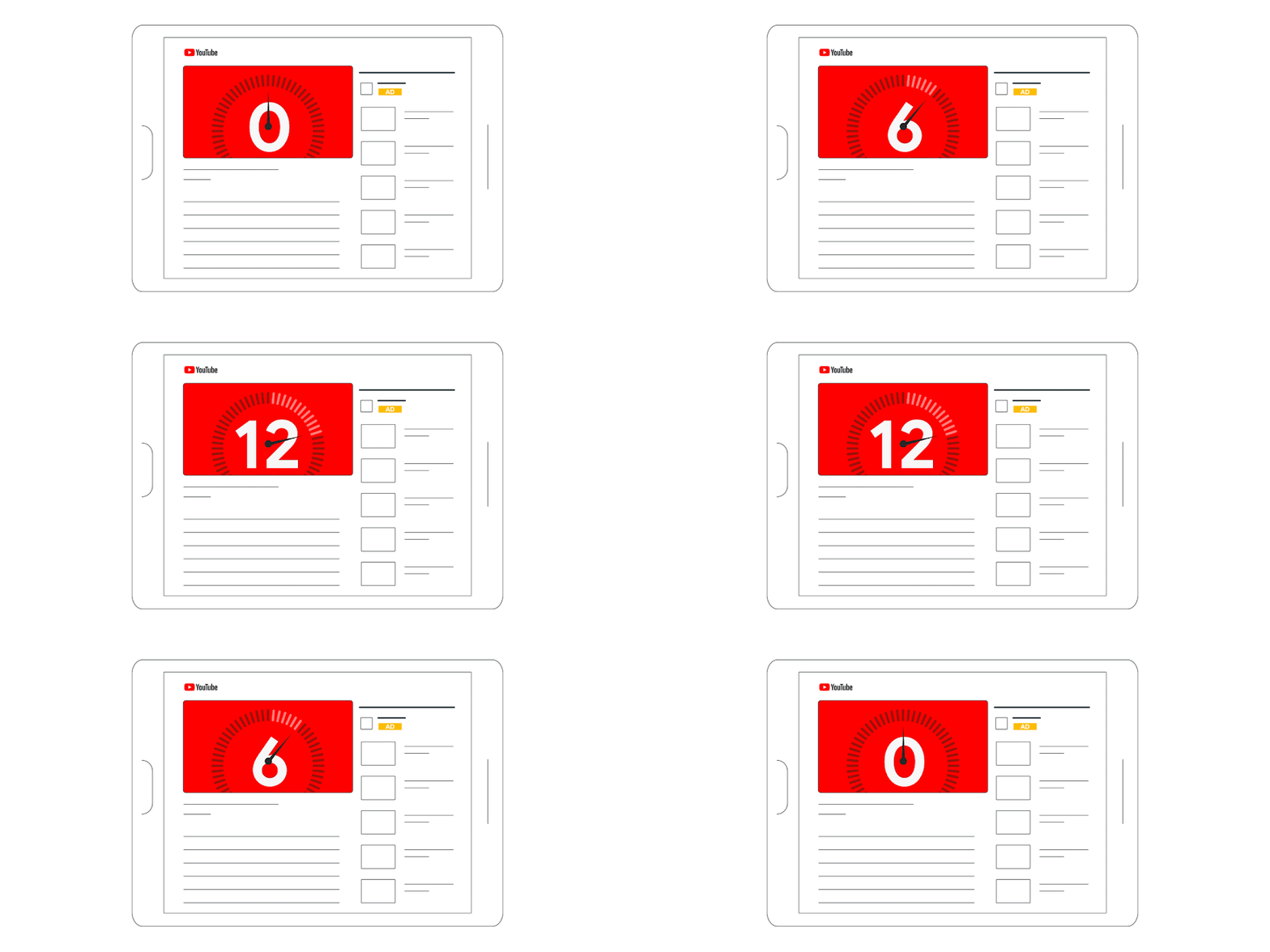
Bumper ads are unskippable video ads up to 6 seconds long that run before, during, or after content on YouTube TV. YouTube recommends using bumper ads “when you want to reach viewers broadly with a short, memorable message.”
As with non-skippable in-stream, bumper ads must be watched in full, which makes them well-suited to frequency-building and supporting larger TV and video campaigns.
Core specs include:
YouTube TV inventory is not sold through the open auction or third-party CTV supply; it is purchased directly from Google via reserved buys. There is no self-serve buying path. Brands must work with Google sales or an agency partner like Tinuiti to secure placements.
Today, there are three primary ways to reserve YouTube TV inventory:
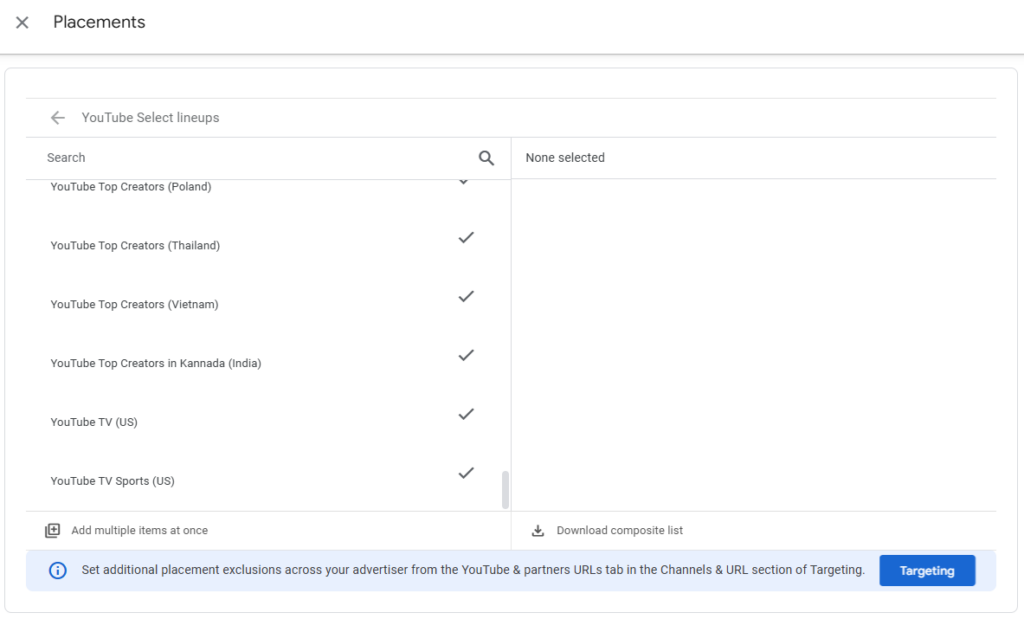
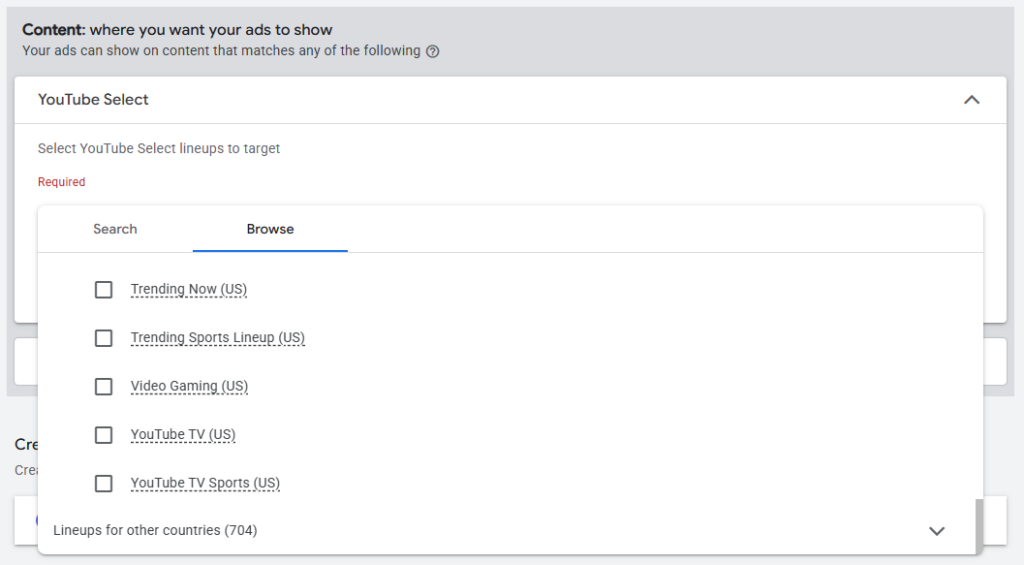
For the most premium and cost-efficient YouTube TV packages, advertisers often plan during the upfront period, either on a broadcast-year or calendar-year basis. After upfront commitments, brands can still access remaining inventory through scatter, but pricing and availability may be less favorable, much like traditional TV.
Some bumper ads and 15-second non-skippable in-stream ads bought in Google Ads or DV360 auction campaigns are eligible to serve on YouTube TV, and certain YouTube Select reservation campaigns can also deliver there. However, this delivery is not guaranteed or directly targetable as “YouTube TV only” inventory, so most brands should treat it as opportunistic reach rather than a primary buying strategy. If you want guaranteed YouTube TV delivery, you need to buy YouTube TV lineups (or the YouTube TV Sports lineup) on a reservation basis or via DV360 Instant Deals.
YouTube TV targeting uses many of the same levers as broader YouTube and Google Ads video buys, but with fewer knobs than a standard YouTube campaign. At the ad level, the primary decision is whether you want to run on all of YouTube TV lineup or the YouTube TV Sports lineup (and, where applicable, tentpole opportunities like NFL Sunday Ticket), with optional audience layers for an additional premium.
On top of those lineups, you can layer broad audience segments such as affinity and in-market, as well as demographics (age, gender, parental status) and geo filters at the state, DMA, or ZIP-code level. These layers refine reach but also increase CPMs, so most brands use them sparingly to avoid over-targeting high-value TV inventory.
Common targeting methods include:
Beyond explicit YouTube TV buys, some auction campaigns, such as Video Reach, Video View, and certain Demand Gen campaigns, can deliver impressions on YouTube TV when Google has surplus inventory to fill. You can’t force this behavior or target YouTube TV explicitly with those buys, but it’s a useful bonus for advertisers already leaning into TV screens as a device target.
In general, brands that meet Google’s standard ad policies and YouTube content guidelines can advertise on YouTube TV, but there are important nuances:
“The reason advertisers need to be on YouTube is simple: that’s where the audience is. YouTube isn’t just a streaming platform—it’s also a social feed, a search engine, a podcast hub, and a growing shopping destination. It wraps up what you’d normally get from multiple platforms into one, which is powerful but also overwhelming.
Brian Binder, Senior Director of Research at Tinuiti
Our measurement suite puts all of those YouTube products—YouTube TV, YouTube on TV screens, Video View, Video Reach, Demand Gen—on a level playing field so brands can finally see how each format actually performs, instead of relying on fragmented platform reporting.”
YouTube isn’t just a streaming service; it’s simultaneously the largest streaming platform, a massive social feed (Shorts), a search engine, a podcast destination, and an emerging shopping channel. YouTube TV and YouTube on TV screens are a big part of that story, but they work best when planned alongside YouTube’s broader video, Shorts, and Demand Gen formats so you can be present across the entire “messy middle” of evaluation and exploration, not just the last click.
Tinuiti’s YouTube experts can help brands design a full-funnel plan tailored to your goals. We can:
The net effect is that YouTube TV, YouTube on TV screens, and mobile/video formats can finally be planned as a single ecosystem instead of siloed tactics. Early adopter testing with Tinuiti’s YouTube measurement has shown that YouTube often drives substantially more conversions than platform attribution alone credits, underscoring the importance of full-funnel planning and advanced measurement.
Get strategies that integrate channels, create seamless experiences, and resonate across the customer journey.

Data from our Q4 2025 Digital Ads Benchmark report shows that 67% of YouTube video ad campaign spend now goes to TV screens, with phones at just 17%, and the rest is split between desktop and tablet. Google has highlighted that YouTube can shorten the average online video shopper’s journey by six days, reinforcing YouTube’s role from discovery to purchase. But measuring this can be challenging. Google provides baseline reporting for YouTube TV campaigns, including:
These metrics are helpful for understanding delivery and top-funnel impact, but they do not always capture the full incremental contribution of YouTube TV to business outcomes. Many advertisers find that YouTube TV’s native performance measurement lags behind that of other OTT apps, especially when trying to connect TV exposures to conversions within a consistent, cross-channel framework.
Historically, Google’s reporting has also fragmented performance across products: Video View, Video Reach, Demand Gen, and YouTube TV each receive a fractional share of conversions, and TV screen impressions are especially hard to connect to downstream actions. That makes it difficult to compare YouTube TV apples-to-apples with mobile-heavy formats that are easier for the pixel to see.
Tinuiti’s Bliss Point technology and YouTube Product Suite close that gap in two ways. First, our deterministic 1:1 measurement solution uses Ads Data Hub and first-party data to tie YouTube TV and other YouTube impressions directly to business outcomes, creating a person-level view of performance across devices and ad products. Second, our externalized Conversion Lift capabilities (user and geo) enable true incrementality tests that quantify the lift YouTube TV and YouTube are driving beyond what would have happened otherwise.
“Tinuiti is the first and only agency to connect YouTube exposure to real business results—and unify conversion, brand impact, and awareness in one complete view. This makes it possible for brands to see what’s actually working and scale YouTube like a true growth engine.”
Brian Binder, Senior Director of Research at Tinuiti
Measurement tech that shows what’s driving growth—and exposes what’s holding it back.

Tinuiti’s advantage in YouTube TV and YouTube advertising comes from combining media execution with proprietary measurement in Bliss Point. Under the hood, we’re stitching together Google’s clean room (Ads Data Hub), first-party conversion data, Search and Brand Lift, and Conversion Lift into a single, privacy-safe measurement toolkit. What’s unique is that we’re not just measuring demand gen or one campaign type; we put YouTube TV, YouTube on TV screens, Video View, Video Reach, and Demand Gen on the same playing field so you can see which combinations actually drive business results.
For brands, that means:
In partnership with Google, Tinuiti is currently one of the only agencies implementing this kind of deterministic, ADH-based 1:1 measurement for YouTube TV at scale, which is why many of our clients and Google stakeholders see it as a first-to-market capability.
“Historically, Google’s reporting hasn’t been great at stitching together what happens on the TV screen with what happens on a phone or laptop.
Our deterministic measurement uses Ads Data Hub and first-party data to connect those dots at an individual level, so we can show the full business impact of YouTube TV and other YouTube formats—not just the last engagement the pixel happens to see.”
Brian Binder, Senior Director of Research at Tinuiti
YouTube TV advertising gives brands a way to reach high-value audiences who have moved away from traditional cable, with TV-quality placements and better reporting than legacy linear. When it’s planned as part of a broader YouTube strategy and measured with the right tools, YouTube TV can play a critical role in both brand building and incremental performance.
Tinuiti’s YouTube Planning Tool and YouTube Cross-Functional Product Suite help brands cut through complexity, design full-funnel plans, and prove what YouTube TV actually delivers in terms executives care about. If you’re ready to rethink your TV and streaming mix, YouTube TV is one of the most important levers to get right, and the right planning and measurement approach is what unlocks its real value.
From balancing creative and messaging to tracking analytics and budgets, a performance marketing agency with specific expertise in OTT services can significantly boost your ROI. At Tinuiti, we work with brands to find the perfect mix of OTT buys and offer valuable transparency into buys, costs, and results.
Want to learn more? Contact us today!

Copywriter, Tinuiti
Jenn Wheatley is a senior content strategist and copywriter who turns complex marketing data into clear, actionable stories. She develops research-backed reports and thought leadership that help brands navigate critical business decisions. Based in Utah, she enjoys cooking, strength training, and traveling with her family.