Media Update: If Regulatory Pressure Lasts Four or More Quarters, Consult Your Lawyer Immediately


You may have heard the new Administration has taken an interest in advertising – specifically, the White House and HHS want to crack down on ‘deceptive’ pharmaceutical advertising as part of the ‘Make America Healthy Again’ policy agenda. This is a potentially major development for multiple industries: pharma accounts for 2.5% – 4% of total advertising investment in the US, and major drug companies spend 20% – 25% of their budgets on marketing and advertising. Let’s dive into what’s happening and why it matters.
Policy Developments
Bottom line, the federal government has made it clear that it will exercise stricter oversight at minimum, and may take even more extreme measures.
Pharma in Ad Land
Pharmaceutical companies are a critical species in the US advertising ecosystem. Pharma companies spent ~$11B on ads domestically in 2024, with more than $6B on TV alone, making it among the largest categories in linear and streaming. (if you’ve watched 60 Minutes recently, you know that it’s basically a pharma ad with some reportage sprinkled in!)
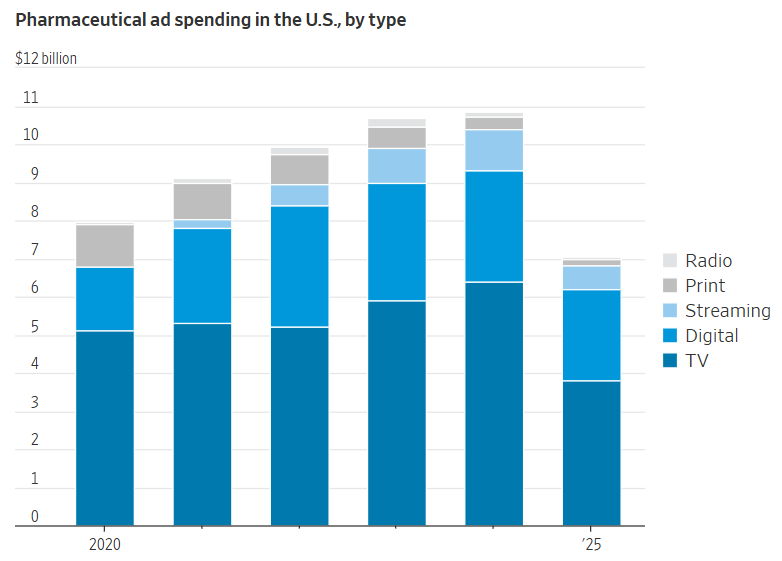
Bottom line, cracking down on pharma advertising, or banning it altogether, would have profound effects on nearly all participants in the advertising ecosystem.
Historical Precedent
Pharma would not be the first industry to see its freedom to advertise curbed; most famously, restrictions on tobacco advertising began to be introduced in the 1970s. This began with the tobacco broadcast ban in 1971, but this was a partial curb in the sense that tobacco companies remained free to advertise elsewhere, and indeed tobacco advertising budgets shifted to channels like print media. It was only later, with comprehensive bans via litigation settlements and congressional legislation, that tobacco advertising was genuinely suppressed.
It’s very important that we keep in view the critical disanalogy between tobacco and pharma – at the risk of stating the obvious, tobacco is extremely harmful to human health, while pharmaceuticals are, on average, highly beneficial. The most rigorous research on the topic suggests that 73% of the increase in life expectancy that high-income countries experienced between 2006 and 2016 was due solely to the adoption of modern drugs. Moreover, pharmaceutical expenditure per life-year saved was $13,904 across 26 high-income countries and $35,817 in the U.S., making it one of the most cost-effective interventions we have to extend life expectancy.
The Perimeter of Protected Commercial Speech
Advertising is, of course, speech. And speech in the United States is robustly protected by the First Amendment to the Constitution. However commercial speech is treated differently under the law than core political speech. Here’s a brief primer:
The Regulators’ Theory of Mind
It is worth asking, If the coercive power of the state is to be brought to bear on pharmaceutical brands’ discretion in advertising, what is the implied hypothesis about the current state of the world? And how will restrictions improve on that state?
Significantly restricting, or outright banning, pharmaceutical advertising is most consistent with a model of market failure where pharma marketers win by non-informational persuasion and consumers are highly malleable and easily manipulated. In such a world, consumers are genuinely harmed – in their wallets, and potentially their health – by ads that cause them to consume the wrong medications in larger quantities than would be optimal.
The world we actually live in does not look much like this. Advertising generally operates via the channels of raising awareness, overt persuasion, making promises, and honest signaling; all of which are fully compatible with broadly rational consumers. In this version of the world, restrictions or bans on pharma ads would risk removing useful signals and raising search costs: fewer reminders that a therapy exists, less credible reassurance that a company will stand behind it, etc.
Looking Ahead
It seems likely that policy will be updated in one of two ways. The ‘light’ possibility is that additional informational requirements are imposed for pharma ads on TV and maybe a small number of other channels, but there is no outright ban and many channels remain unaffected; the ‘heavy’ possibility is that onerous restrictions are imposed across all advertising channels, with outrights bans being a ‘nuclear option.’ Anything falling in the ‘heavy’ category is sure to be litigated extensively; the ‘light’ category may amount to more work for advertisers, agencies, and S&P departments, but otherwise minimal effects at the industry level.
The news stories we’re tracking that are likely to impact advertisers in the month ahead.