2024 Holiday Shopping Trends
Holiday Shoppers Look to Get an Early Start with Many Embracing AI and Self-Gifting
Holiday Shoppers Look to Get an Early Start with Many Embracing AI and Self-Gifting
The all-important holiday shopping season is fast approaching, and US consumers will have more tools and options at their disposal than ever as they look to discover just the right gift for each person on their list. Will shoppers embrace AI or favor a more traditional shopping experience, and what will ultimately matter most when they look to make their purchases? To help understand how shoppers are feeling and what they are planning ahead of the holiday season, in July 2024 Tinuiti surveyed over 1,000 US adults who said they were going to shop for holiday gifts this year.
Note: The data below is from 2024. Head here to see our most recent report.
When asked how much they plan to spend overall on holiday gifts this year compared to last, 54% of holiday shoppers said about the same amount, while 25% said more and 21% said less.
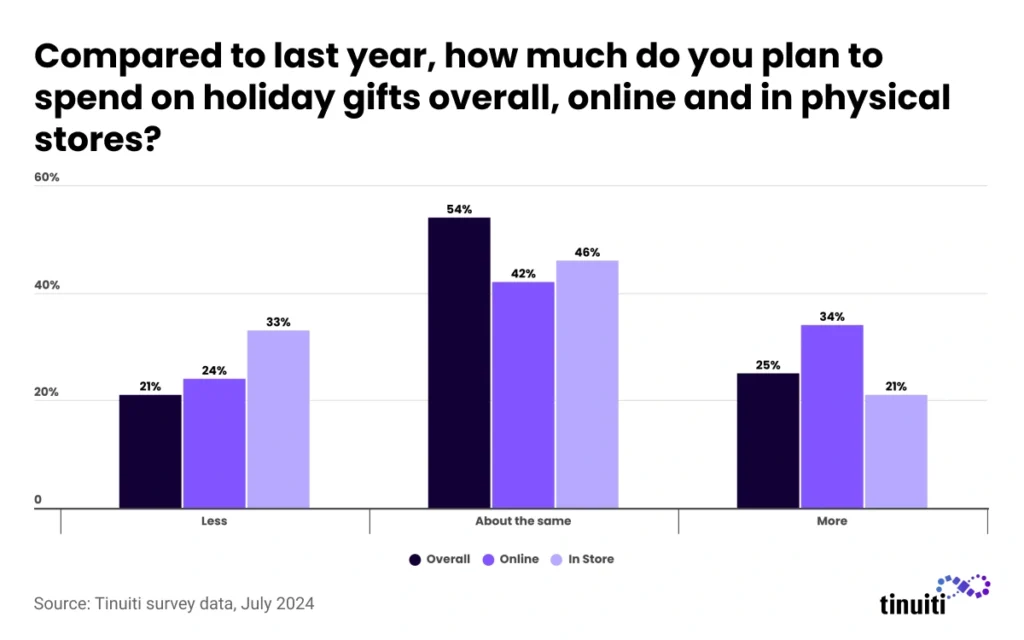
Considering their online shopping specifically, though, 34% of consumers buying gifts this year expect to spend more, while 24% said less. Those rates were roughly reversed for in-store shopping with just 21% expecting to spend more in physical stores and 33% expecting to spend less.
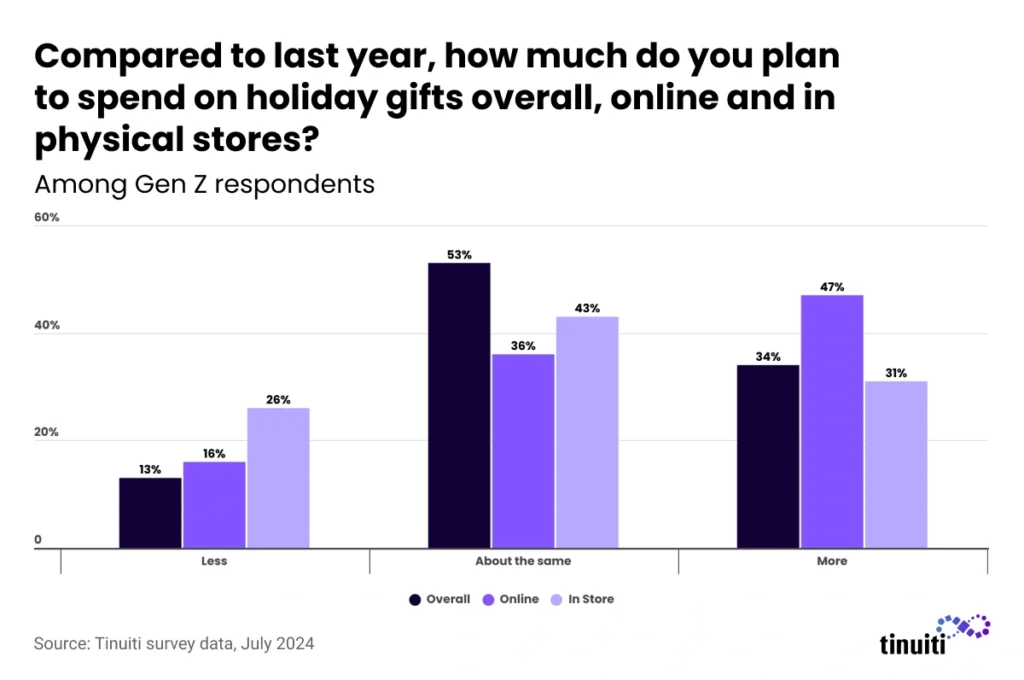
As their spending power is increasing, adult members of Gen Z are more optimistic than older generations in how their holiday spending will fare this year compared to last. Among Gen Z, 34% expect to spend more on holiday gifts overall this year, while 47% expect to spend more online.
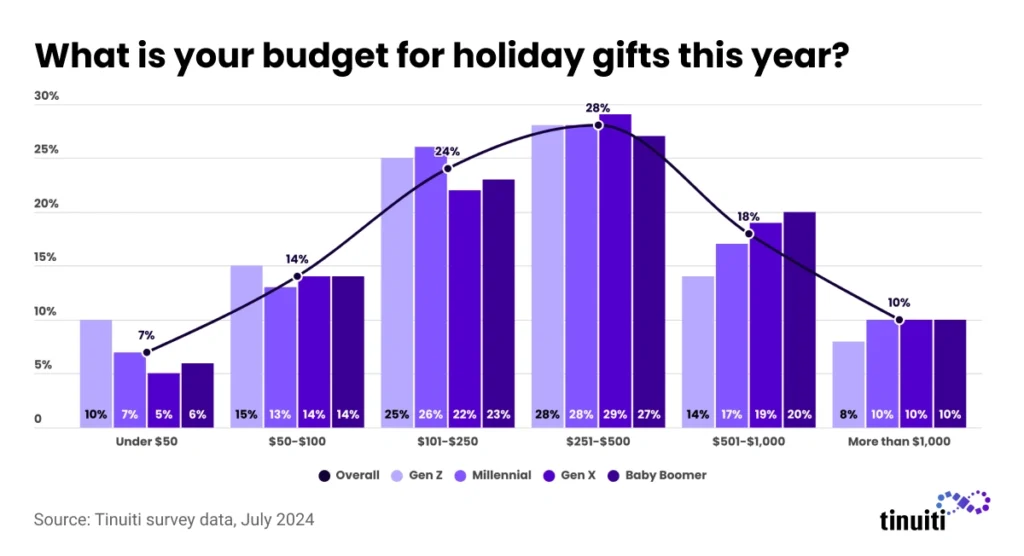
Gen Z still trails older generations in the amount they plan to spend on holiday gifts, though, with just 22% planning to spend over $500. Among Gen X and baby boomers, 30% plan to spend over $500.
That level of spending is the exception, however, as a majority of all respondents, 51%, say they will be spending between $101 and $500.
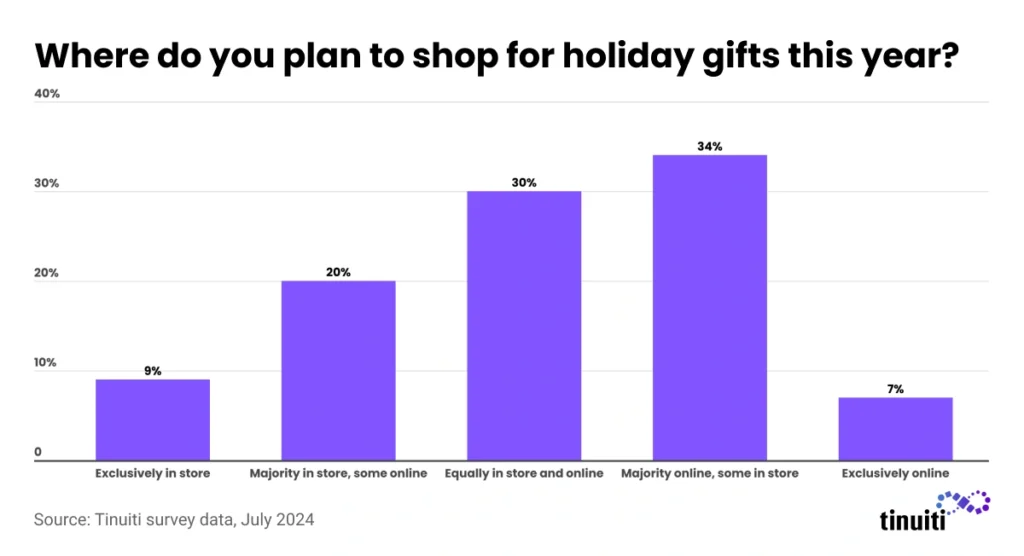
Although a larger share of holiday shoppers expects to spend less in-store this year than more, brick and mortar purchases will still play a sizable role for most consumers. A full 29% of respondents plan to do at least a majority of their holiday shopping in stores, while another 30% expect to shop equally online and in store. Online shopping was a bit more popular among respondents, however, with 41% expecting to do at least a majority of their holiday shopping online.
Considering the larger economic and geopolitical picture, inflation remains a concern for most shoppers while a significant number also believe that the US presidential could impact the amount they plan to spend on holiday gifts.
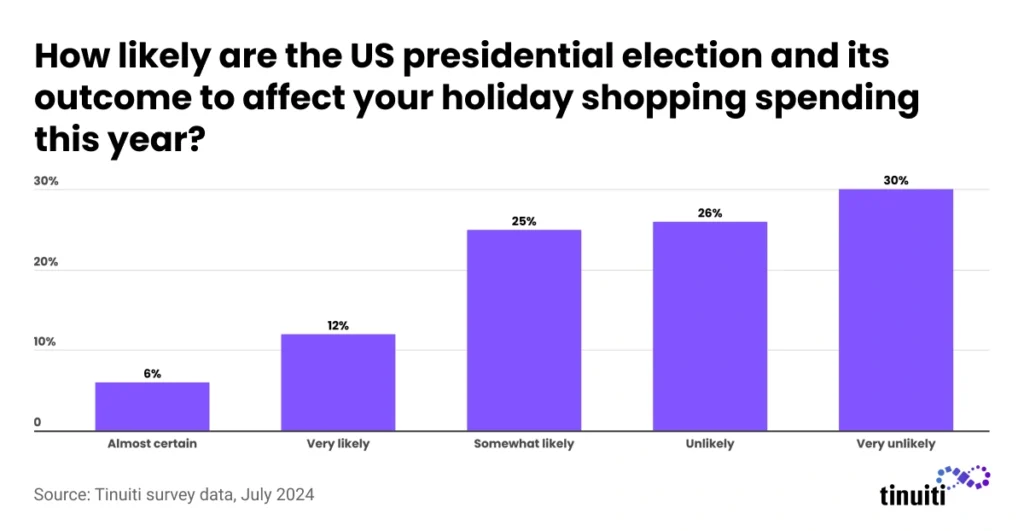
Even though US inflation growth rates have come down, a full 72% of respondents still believe the rate of inflation will have at least a somewhat negative impact on their holiday spending. At the same time, about one in five holiday shoppers believe the US presidential election and its outcome are very likely or almost certain to impact their spending.
Although Thanksgiving falls five days later in 2024 than it did in 2023, most consumers won’t be waiting around to begin their holiday shopping. Among all respondents, 60% said they plan to start shopping for holiday gifts before Thanksgiving, with a little over half of that group saying they will start shopping in October or earlier.
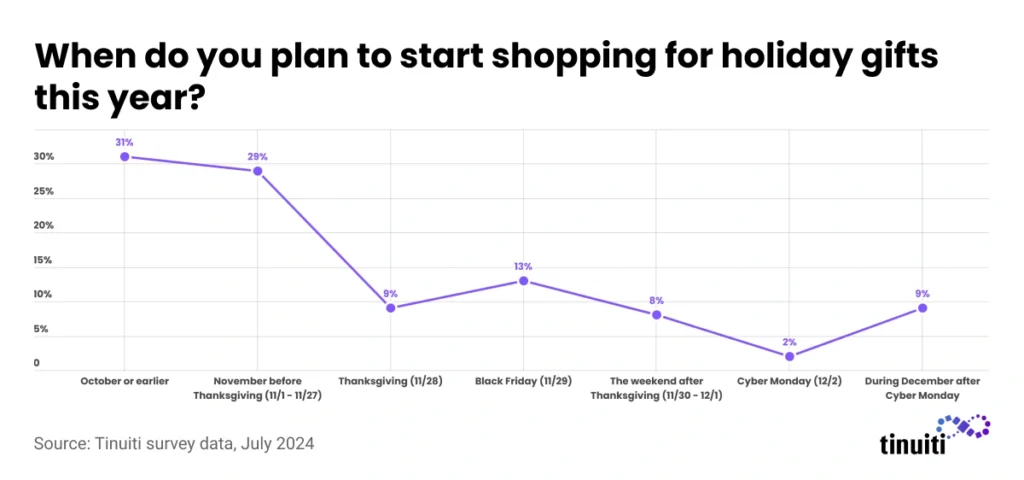
Over the last couple of years Amazon has made a big play for those early holiday shoppers by running a version of Prime Day in early October under different names. Consumers appear ready to not only start shopping well before Thanksgiving, but also complete a sizable portion of their total holiday purchases.
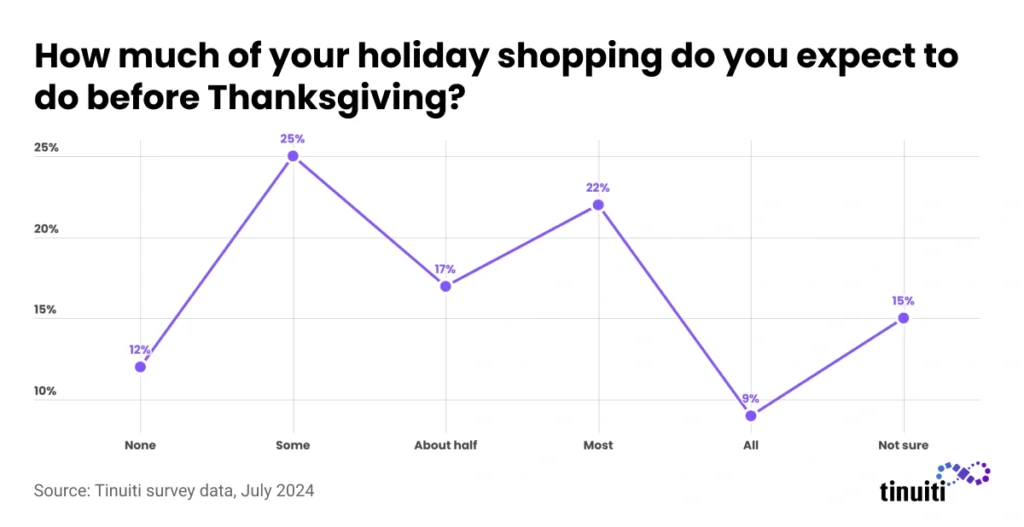
Across all holiday shoppers, 48% expect to do half or more of their holiday shopping before Thanksgiving this year. That rate jumps to 62% among those who plan to start their shopping before Thanksgiving.
While only about a third of shoppers will wait until the Cyber Five to start their holiday shopping, the 5-day period from Thanksgiving through Cyber Monday will still pack in a lot of sales. Another 48% of respondents expect to complete half or more of their holiday shopping just over the Cyber Five.
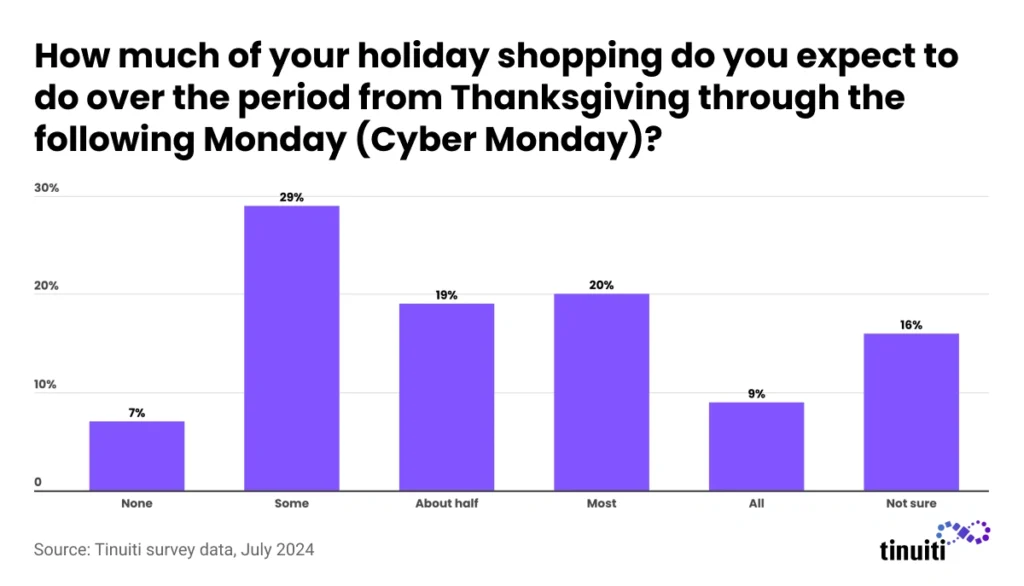
Younger generations are more inclined to wait for the Cyber Five and the deals that come along with it. Among Gen Z, 59% expect to do half or more of their holiday shopping over the Cyber Five. For baby boomers that rate drops to 39%.
Most holiday shoppers, 54%, say they will be buying gifts for between two to five people this year. Another 30% will be shopping for six to ten people, while 9% will be shopping for more than that.
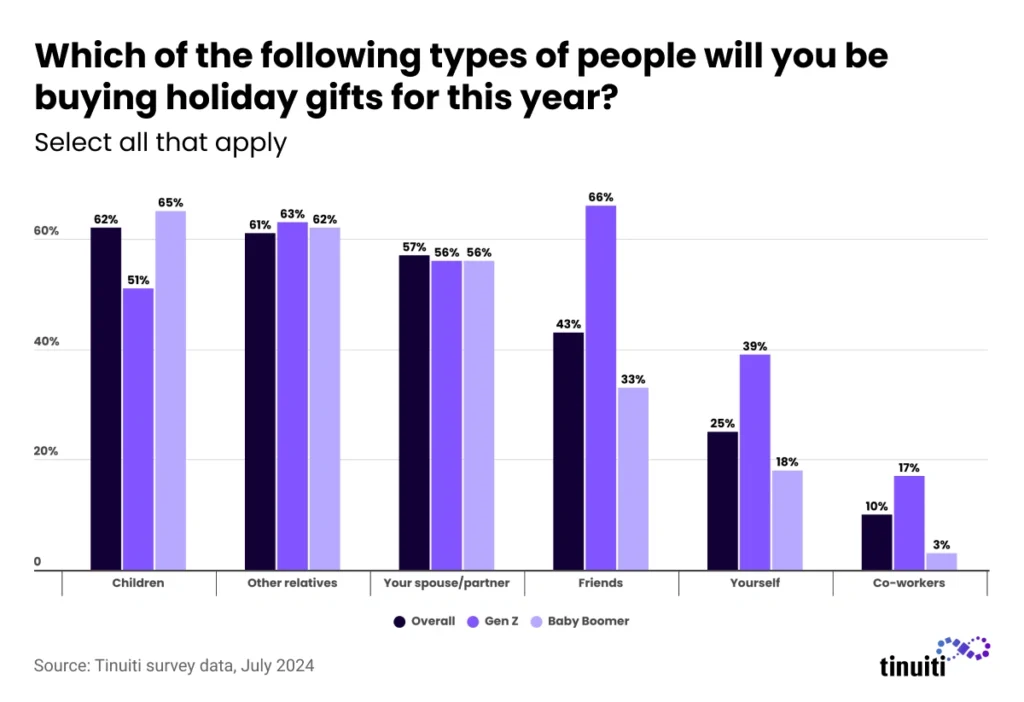
Among all respondents, children were the most common group to shop for, but that was not the case among Gen Z. Instead, friends were the top group Gen Z will buy holiday gifts for, with 66% saying they had plans to do so. Among baby boomers, just 33% plan to buy holiday gifts for friends.
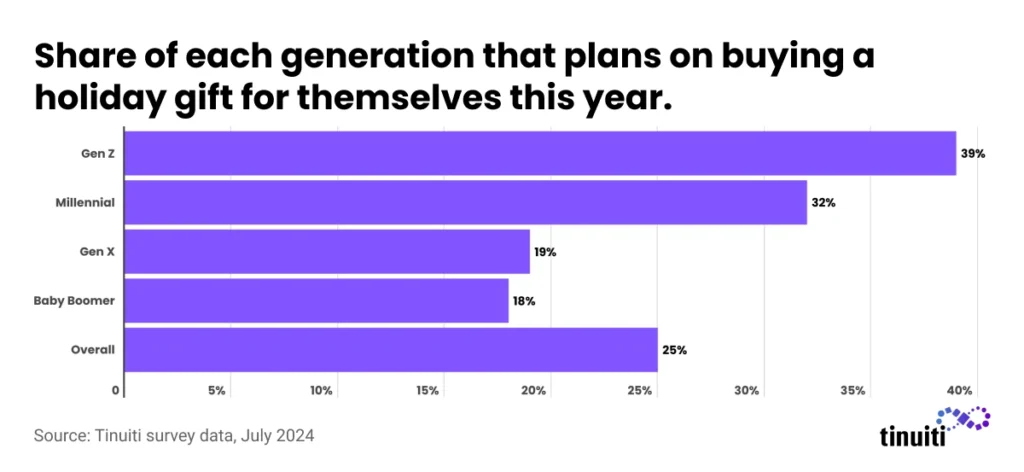
Gen Z was also more likely than older generations to say they would be self-gifting this year. While 25% of all respondents said they would buy holiday gifts for themselves this year, that rate was 39% among Gen Z. The self-gifting rate for baby boomers was a little less than half that for Gen Z.
When asked which types of gifts they expect to purchase this holiday season, 60% of shoppers selected apparel and accessories, the top response. This was followed closely by gifts cards at 58%.
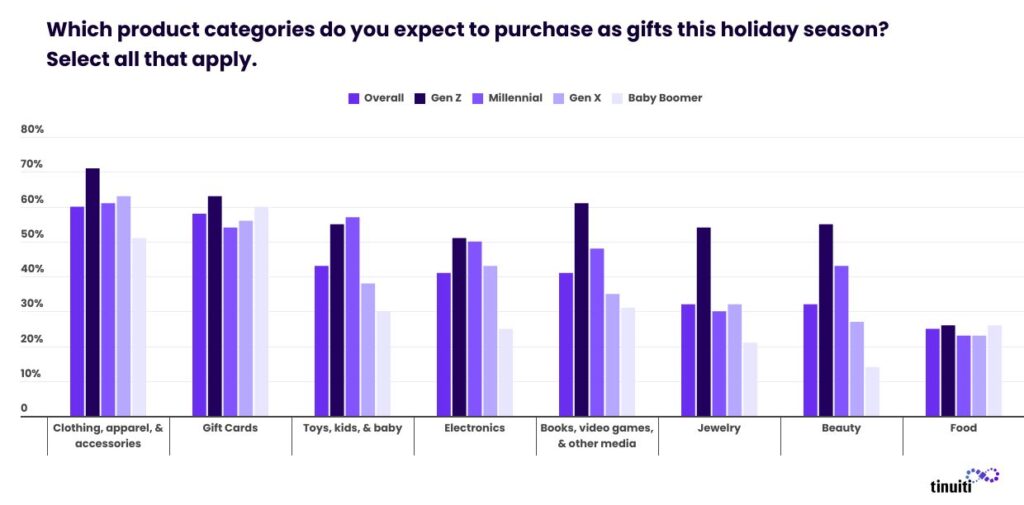
Apparel and gift cards were the only two product categories that a majority of baby boomers and Gen X planned to purchase from, while millennials and Gen Z plan to shop across a wider swath of product categories. A majority of Gen Z plans to buy products in seven of the thirteen product categories they were asked about.
The least popular categories for holiday gifts were automotive, sporting goods, and health and wellness products. Across these categories, though, health and wellness products fared better among Gen Z than older generations.
The widest gap in intent to purchase between Gen Z and baby boomers was for beauty products, which 55% of Gen Z shoppers expect to purchase, compared to just 14% of baby boomers. Gen Z is also much more inclined to purchase jewelry than baby boomers, as well as books, video games, and other media.
When it comes to product discovery, social media was the top channel through which holiday shoppers recalled seeing or hearing about a new product that they later went on to purchase last year. Among all respondents, 38% discovered holiday gifts on social media, but that rate jumps to 64% among Gen Z.
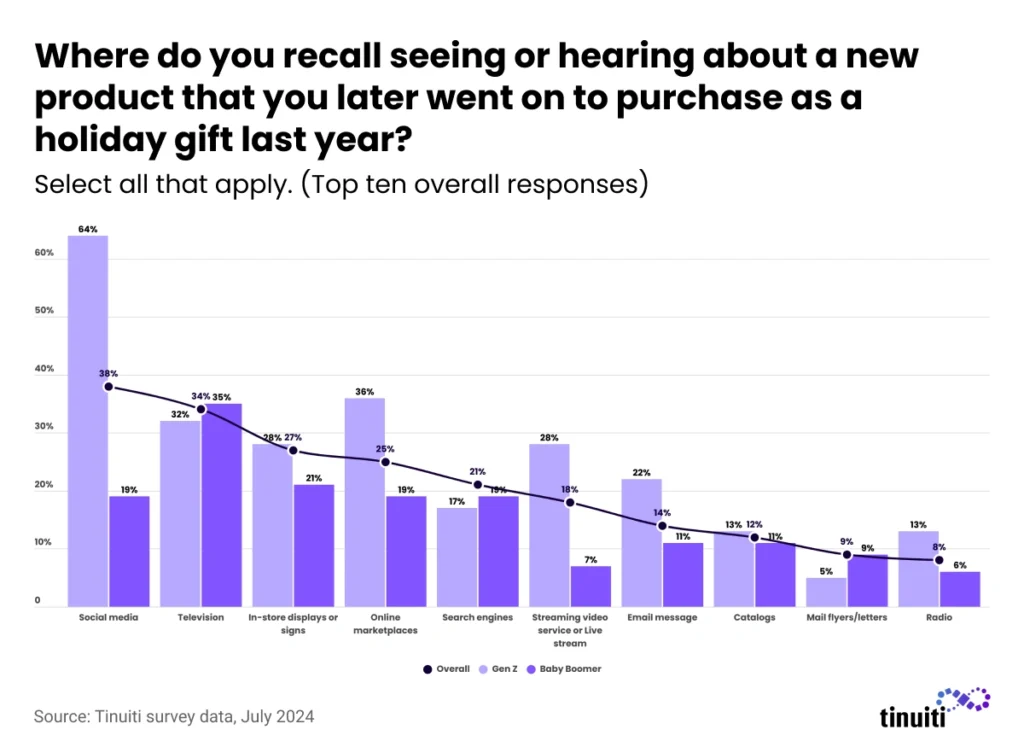
Traditional television was the second most common channel for holiday product discovery with 34% of respondents saying that they had heard of a product they later went on to purchase on TV. Another 18% said that they had discovered holiday gifts through streaming services.
In terms of the specific social platforms they turn to for holiday shopping inspiration, 45% of respondents said they look to Facebook, the top choice. YouTube was a close second with 41% of respondents choosing it as one of the platforms they turn to, while Instagram followed at 33%.
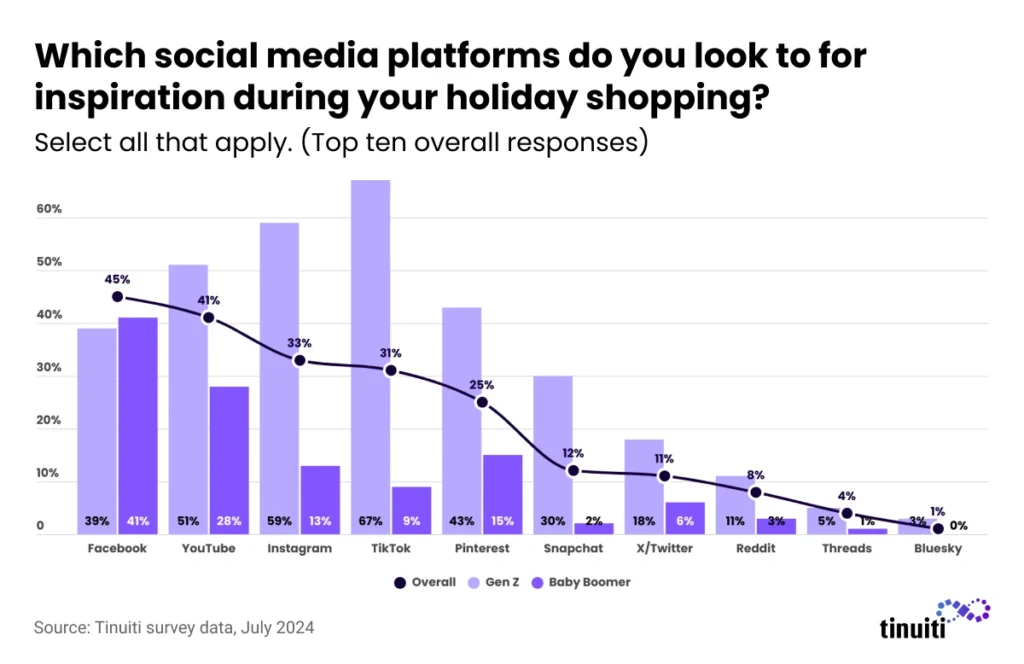
These figures varied considerably across generations though, with particularly stark differences between Gen Z and baby boomers. For Gen Z, TikTok was the top social platform for holiday shopping inspiration, with 67% using it for that purpose, compared to just 9% of baby boomers.
While Facebook was the top social platform for holiday shopping inspiration overall and among baby boomers, it ranked fifth among Gen Z, among whom it was outpaced by TikTok, Instagram, YouTube, and Pinterest.
Gen Z was also much more likely than older generations to say they had purchased a holiday gift after seeing a social media influencer use or endorse it. A full 44% of Gen Z had purchased a gift under this scenario, compared to just 25% of older respondents
Asked which websites they plan to use for their online holiday shopping this year, 75% of respondents planning to shop online said Amazon, the top choice. Walmart was the next most popular site at 55%, followed by Target at 32%.
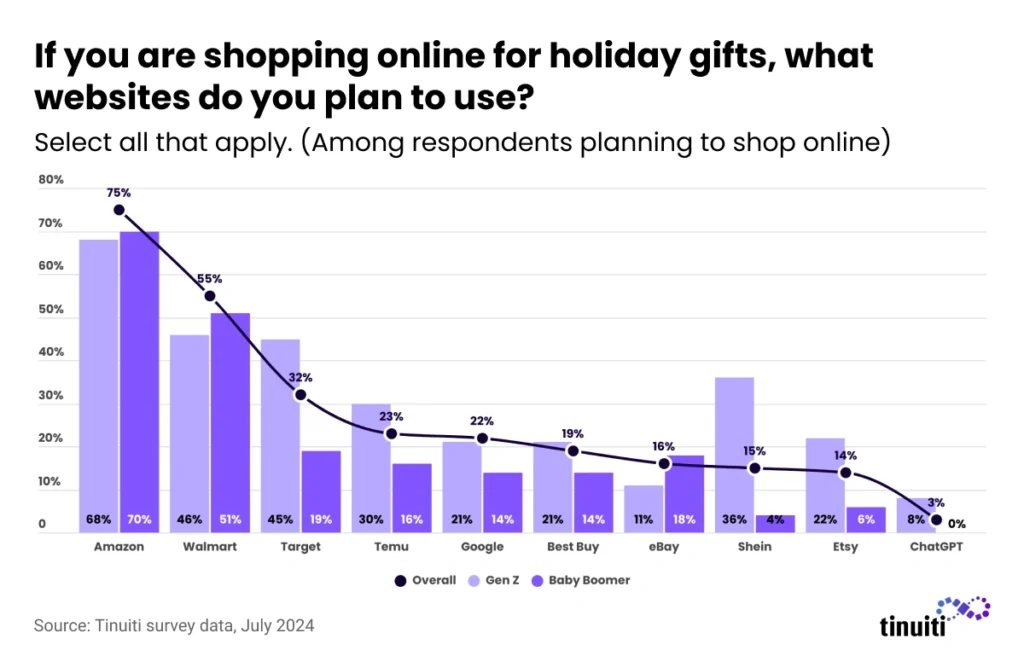
Temu and Shein were also popular online shopping destinations for holiday gifts, particularly among younger respondents. Among all online shoppers, 23% plan to use Temu, but that rate jumps to 30% among Gen Z. Shein sees an even larger lift from 15% among all online shoppers to 36% among Gen Z.
Although just 3% of holiday shoppers said they are planning to use ChatGPT specifically when they are shopping online for gifts this year, consumers were much more likely to say they would use AI-powered tools generally for their holiday shopping. In fact, 54% of all respondents said they would use AI tools in some capacity as they shop for holiday gifts.
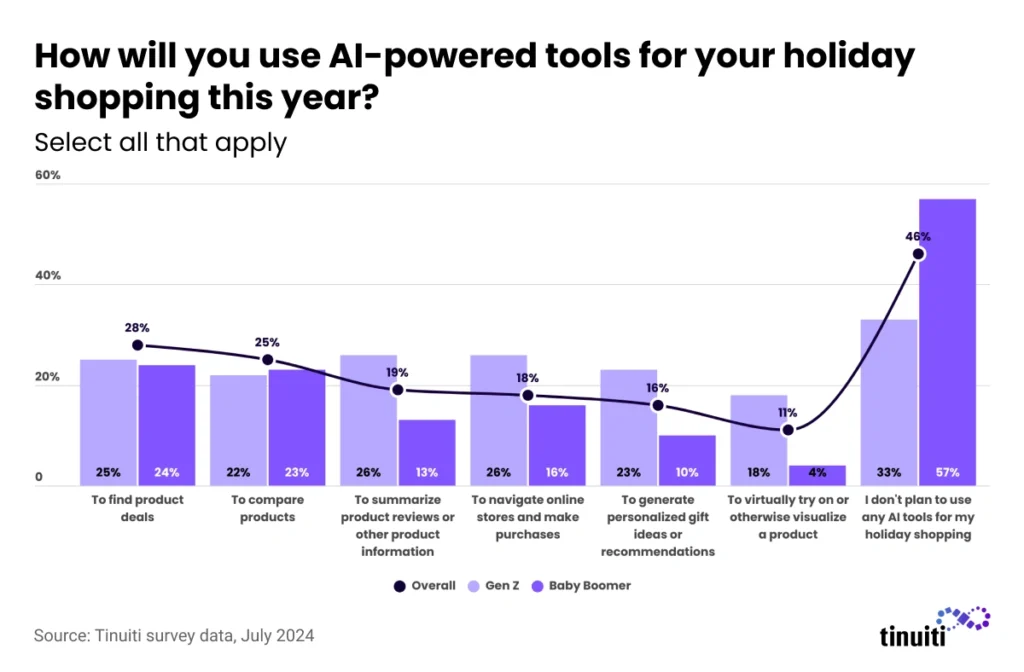
The most popular use cases for AI across all respondents were to find product deals followed by comparing products. For older generations there was a pretty steep drop in interest in using AI for other tasks beyond those two, but Gen Z showed similar interest in using AI for a wide range of tasks.
Roughly a quarter of Gen Z respondents expect to use AI to generate gift ideas, summarize product reviews, and navigate online stores and make purchases. A slightly lower share of Gen Z plans to use AI for product visualization, but Gen Z was still about five times as likely as the baby boomer generation to say they would use AI for that purpose.
As brands weigh which promotions or perks might win over holiday shoppers this year, for most consumers it will ultimately come down to price. Asked which of six factors was most influential to their holiday purchase decisions, 63% of respondents chose price. That was followed by another 20% who chose sales or discounts.
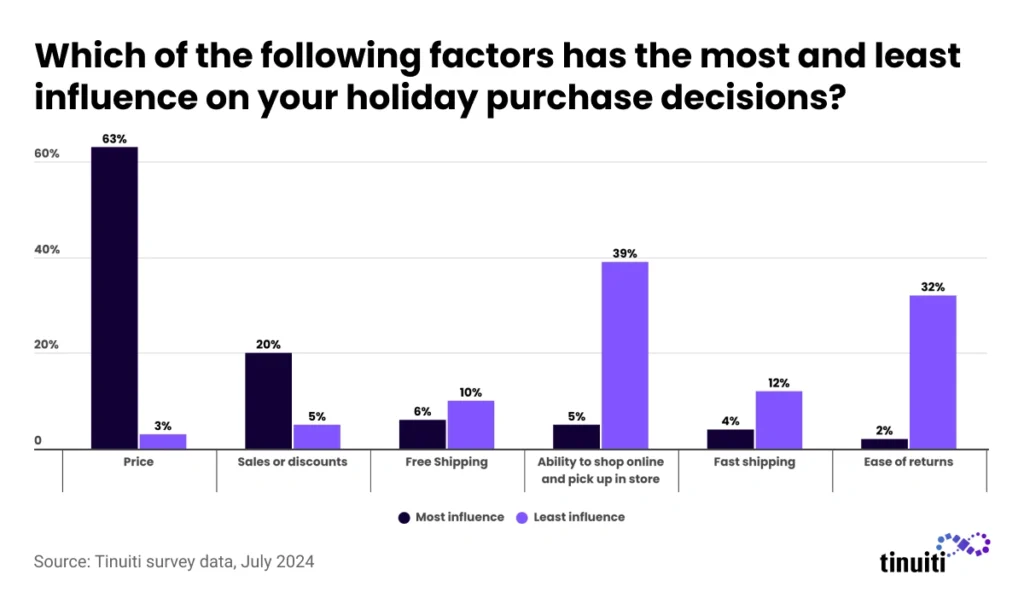
Just 6% of respondents chose free shipping as the most influential factor in their holiday purchase decisions, just beating the share of shoppers selecting the ability to buy online and pick up in store (BOPIS). Another 4% selected fast shipping, while just 2% chose ease of returns.
Although 39% ranked BOPIS as the least important of six factors to their holiday purchasing decisions, that is likely to change if things get down to the last minute. In fact, about one in five shoppers say they use BOPIS more when they get down to the last minute for holiday shopping.
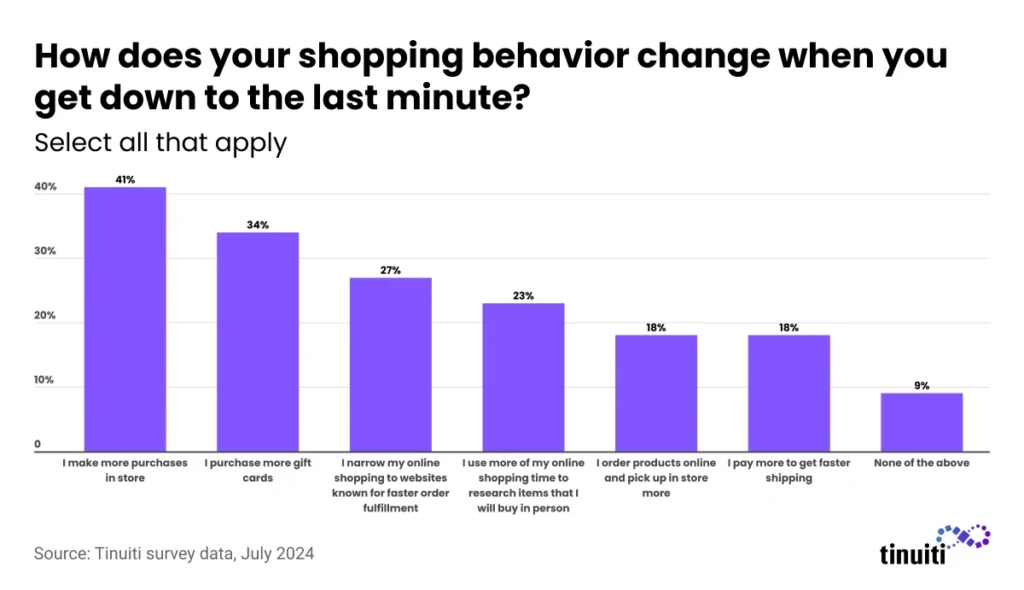
With 41% selecting the option, the most common way consumers change their holiday shopping behavior as they get down to the last minute is to simply make more purchases in store. Purchasing more gift cards was the next most popular option at 34%, but that rate does drop down to 27% among Gen Z.
It may be easier said than done to develop a reputation for quick and reliable order fulfillment, but many consumers take stock of those brands that can get them gifts quickly at the last minute. While just 18% of shoppers say they pay more for faster shipping if they get down to the last minute, a full 27% narrow their online shopping to websites known for faster order fulfillment.
Check out our most recent Holiday Shopping Trends Report for more exclusive insights.