2025 Holiday Shopping Trends
How Consumers Are Embracing AI, Navigating Tariffs, and Discovering Gifts This Holiday Season

How Consumers Are Embracing AI, Navigating Tariffs, and Discovering Gifts This Holiday Season
Between volatile tariff rates, rising AI adoption, and a relatively short stretch between Thanksgiving and Christmas Day, brands and marketers have plenty to think about when it comes to making the most of the holiday shopping season in 2025. Based on survey results from 1,000 US gift-buyers, the 2025 Holiday Shopper Study clarifies the impact of these developments, with insights into when consumers plan to kick off shopping, which platforms are most important for product discovery and research, and what qualities shoppers are most looking for in the products they’ll buy.
Fully 65% of holiday shoppers expect to start buying gifts before Thanksgiving this year, up from 60% in 2024. The traditional shopping period between Thanksgiving and Christmas Day is one day longer in 2025 than in 2024, but it is still shorter than any other year since 2019, so shoppers may need the early start.
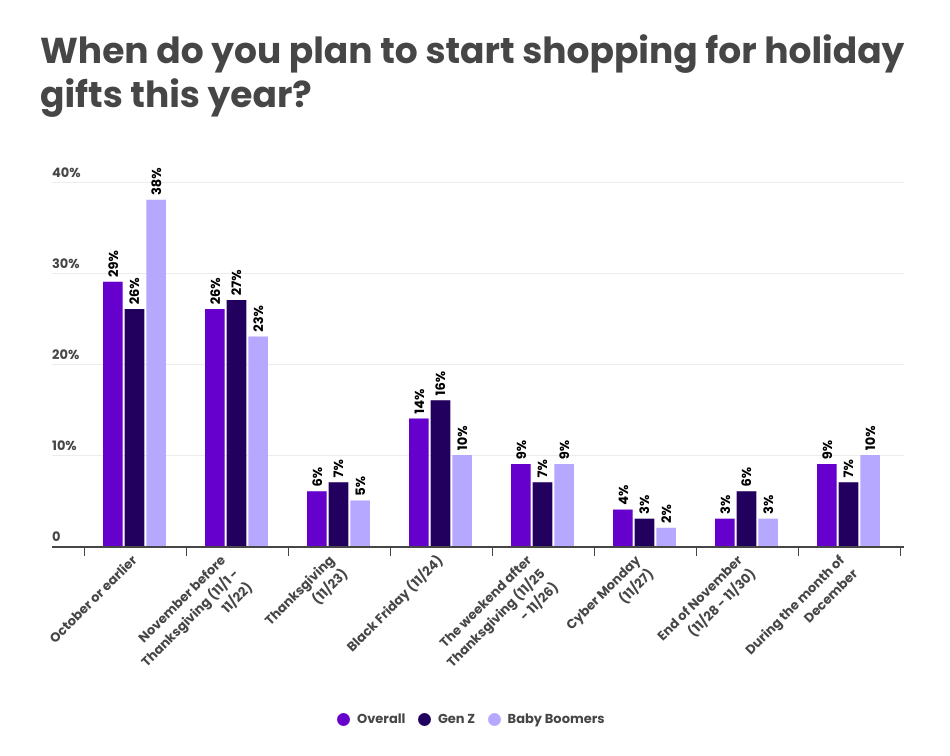
Many consumers are expecting to start shopping for holiday gifts before the calendar even turns to Q4, in fact, with 22% kicking off shopping in September or earlier. This isn’t altogether surprising given that more than one in every four Prime Day shoppers that Tinuiti surveyed in May expected to purchase Christmas or other winter holiday gifts during Amazon’s July sales event.
Just 59% of Gen Z plans to start shopping before Thanksgiving, compared to 68% of baby boomers, but young shoppers that do plan to get started before Thanksgiving expect to get a lot accomplished. Nearly the same share of Gen Z (57%) expects to complete about half or more of their holiday shopping before Thanksgiving, compared to 45% of baby boomers.

At the same time, a relatively strong contingent of Gen Z (22%) will be holding out until Black Friday specifically to start making purchases. Among baby boomers, just 8% plan to start their holiday shopping on Black Friday.
While some official measures of consumer confidence have wavered in 2025, current holiday shopping plans are optimistic, with 32% of respondents expecting to spend more overall this year compared to 20% expecting to spend less. This increase will largely come online, with 37% of holiday shoppers expecting to ramp up online shopping compared to 25% expecting to do the same in physical stores.

Gen Z and millennial shoppers are the most optimistic about their holiday spending with 44% expecting to spend more overall this year and just 14% expecting to spend less. For older shoppers, a slightly higher share (24%) expect to spend less than more (23%).
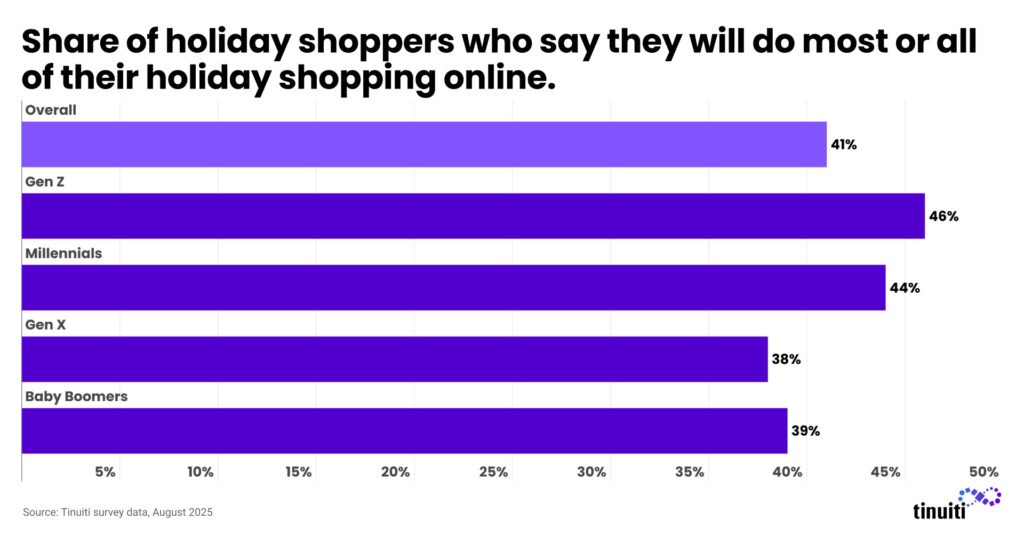
Over 90% of holiday shoppers expect to do at least some online shopping this year, with 41% anticipating doing most or all of their holiday shopping online. That rate rises to 46% among Gen Z with millennials close behind at 44%.
of holiday shoppers plan to do some of their shopping online
of holiday shoppers plan to do most or all of their shopping online
of Gen Z plan to do most or all of their holiday shopping online
of millennials plan to do most or all of their holiday shopping online
Asked how US tariffs will affect their holiday shopping plans, 25% of respondents say they’ll search for more promos and coupon codes, and 24% intend to shop around more. Tariffs are also at play in driving more shoppers to start shopping ahead of Thanksgiving, with 21% indicating that higher duties will push them to start holiday shopping earlier.
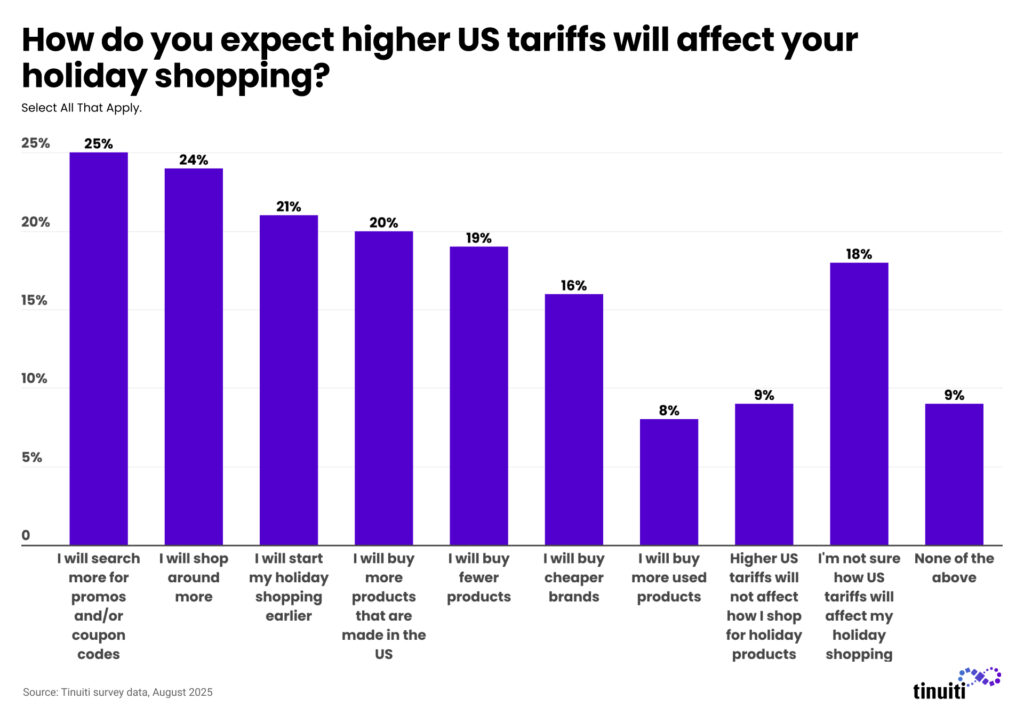
Some shoppers (16%) will buy cheaper brands because of US tariffs, while others (19%) expect to buy fewer total products. For shoppers that expect to spend less overall this year than last, 24% will buy cheaper brands due to tariffs, while 38% will simply buy fewer products.
Just 9% of holiday shoppers don’t think that tariffs will impact their holiday shopping, and 18% aren’t sure how tariffs will affect their holiday shopping. Younger shoppers are more confident in how tariffs will impact their holiday shopping with just 12% saying they are unsure, compared to 24% among baby boomers.
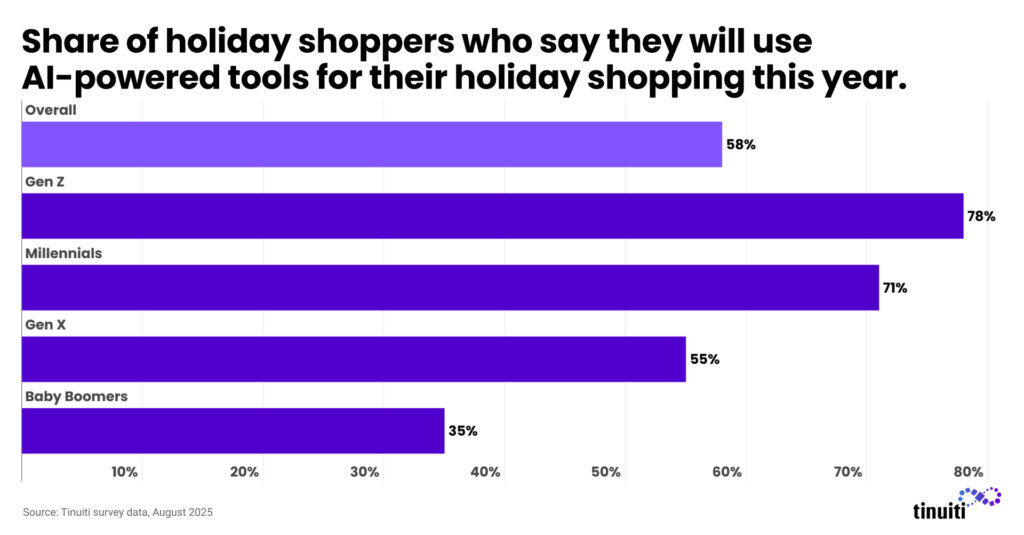
AI-powered tools and platforms have grown rapidly in adoption, and 58% of respondents expect to use at least one such tool for holiday-shopping-related tasks. The most popular use cases are to compare products and find product deals, with 30% selecting each of these. Over 20% also expect to use AI to summarize product reviews/other information and to navigate online stores and make purchases.
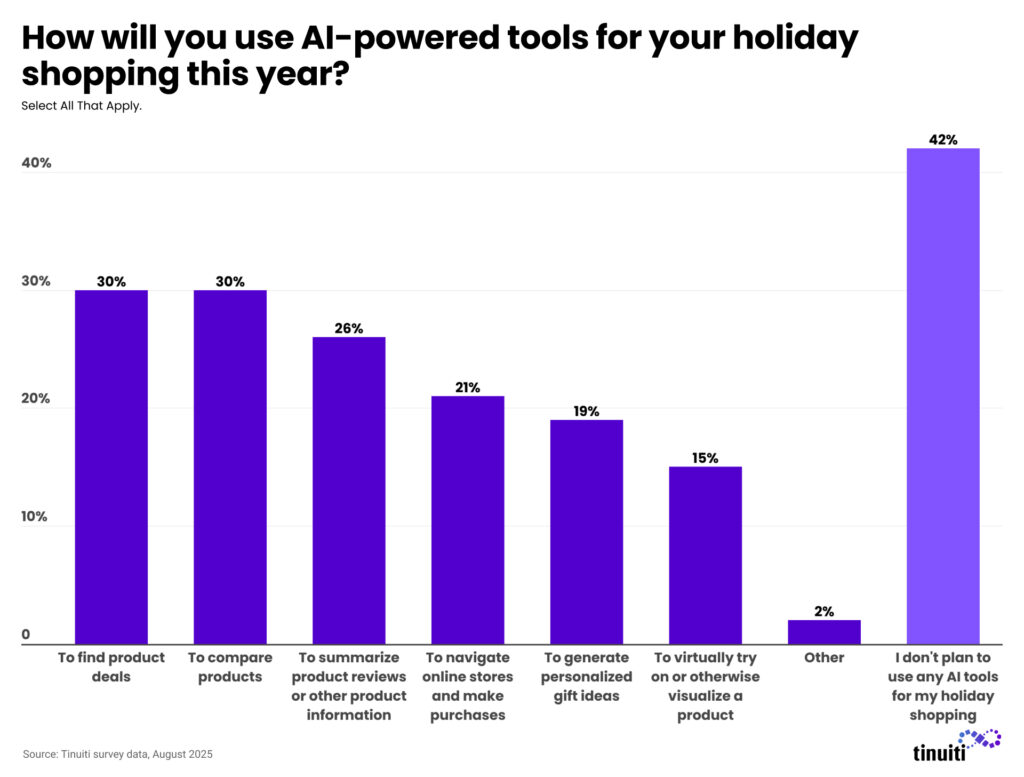
Not surprisingly, younger shoppers are most inclined to use AI tools for their holiday shopping, with 78% of Gen Z planning to do so, along with 71% of millennials. The share with plans to use AI falls sharply to 55% among Gen X and just 35% among baby boomers. While Gen Z was more likely to select each AI use case than baby boomers, the gap was narrowest for comparing products.
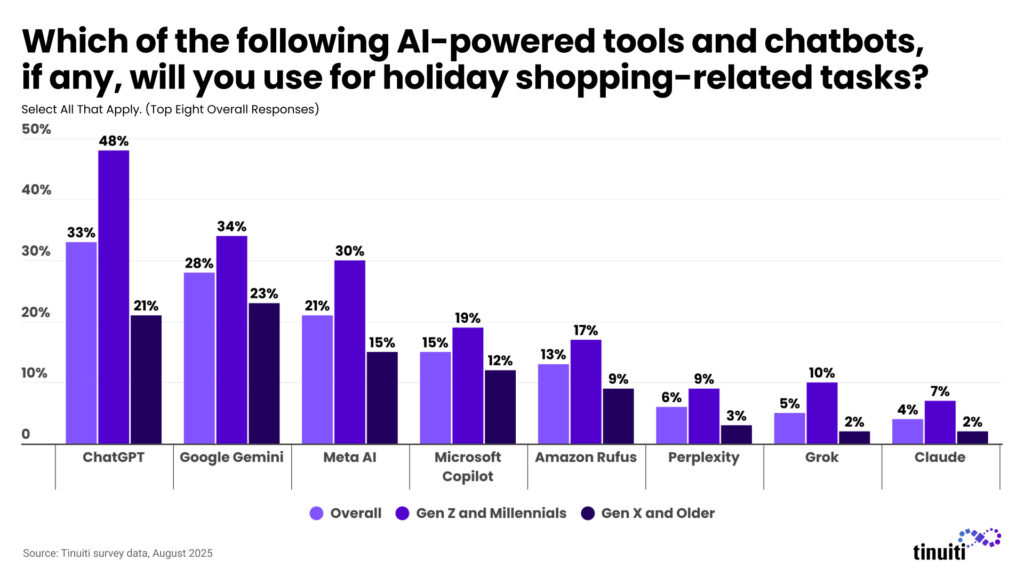
Asked to identify the specific AI tools they’ll use, one third of holiday shoppers selected ChatGPT, the top response. This was followed by Google Gemini in second place at 28% and Meta AI at 21%. Among Gen Z and millennials, 48% say they will use ChatGPT followed by Google Gemini at 34% and Meta AI at 30%. Gemini is preferred by Gen X and older generations, however, with 23% saying they will use it compared to 21% who will use ChatGPT.
While AI users are most likely to use just one platform for holiday shopping, 32% of AI users selected three or more different platforms/tools. This highlights the need for brands to stay visible across the different platforms that shoppers are now turning to during key periods like the winter holiday season.
Interestingly, while a higher share of Gen Z than millennials say they will use at least one AI tool for holiday shopping-related tasks, millennials are more likely to use multiple AI platforms. In fact, 45% of millennial AI users will use three or more platforms, compared to just 28% of Gen Z.
Asked which channels they recall first seeing or hearing about products they purchased as holiday gifts last year, 39% of respondents chose social media, the top selection. This was followed by in-store displays/signs and television, which were both selected by 32% of respondents.
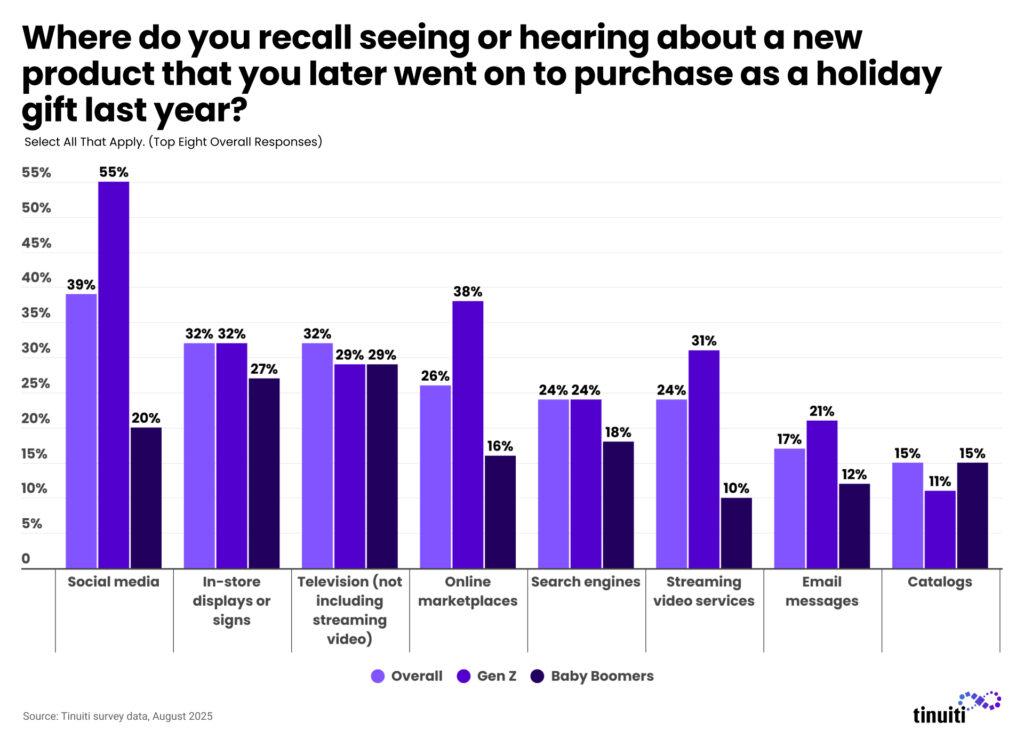
Streaming video services, online marketplaces, and traditional search engines were all selected by at least 20% of all respondents, but streaming video in particular held much greater sway among younger respondents. Across Gen Z and millennials, 33% said they had first discovered a holiday purchase on a streaming service, compared to just 16% of older respondents.
While many holiday shoppers expect to use AI for holiday shopping-related tasks, just 6% recalled discovering holiday gifts through an AI chatbot last year. This is likely impacted by the fact that modern AI platforms and capabilities were only about a year old during the holiday shopping season in 2024 (and are still relatively new in 2025), but it may also speak to shoppers’ viewing AI as more of a research tool than a product discovery engine.
AI fares better as a holiday gift discovery tool among younger generations with 12% of Gen Z saying they had first heard of a 2024 holiday gift through an AI chatbot. Still, AI chatbots ranked outside of the top ten discovery channels even for Gen Z, just ahead of radio, but behind podcasts and even billboards.
Facebook won out as the most influential social media platform for holiday gift inspiration overall, followed by YouTube and Instagram, but that order varies considerably from generation to generation. For Gen Z, Facebook ranks a distant fourth behind TikTok, Instagram, and YouTube, while YouTube is at the top of the list for millennials, followed by Facebook and Instagram.
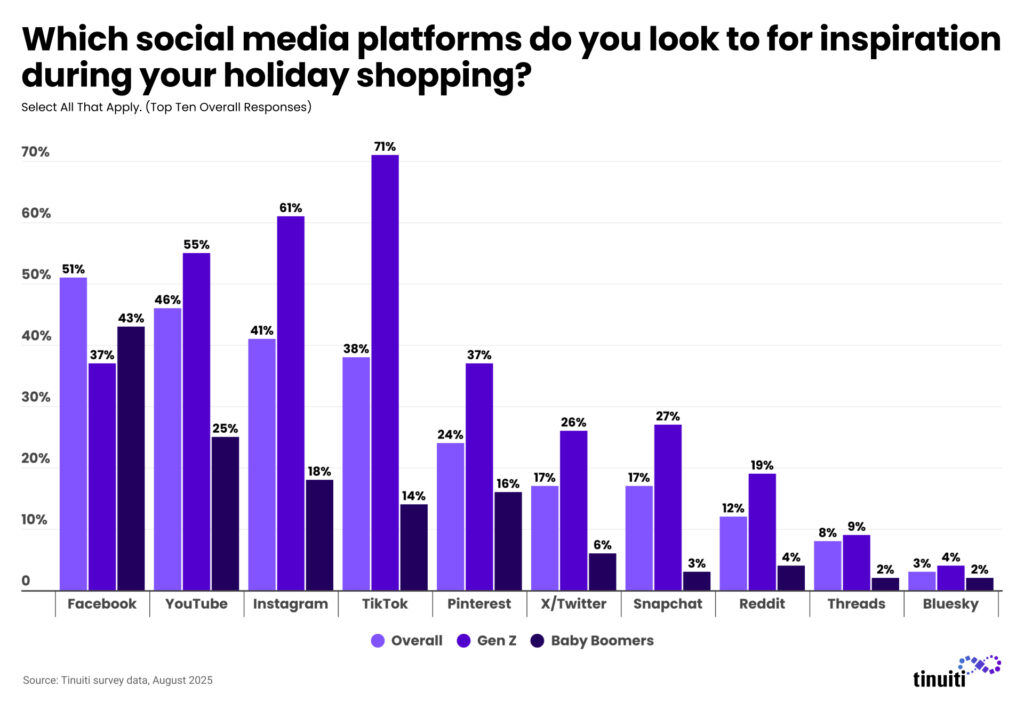
Gen Z was more likely than baby boomers to select nearly every social platform as one they turn to for gift inspiration, with Facebook being the lone exception. In fact, 60% of Gen Z say they turn to three or more social platforms for inspiration compared to just 22% of baby boomers.
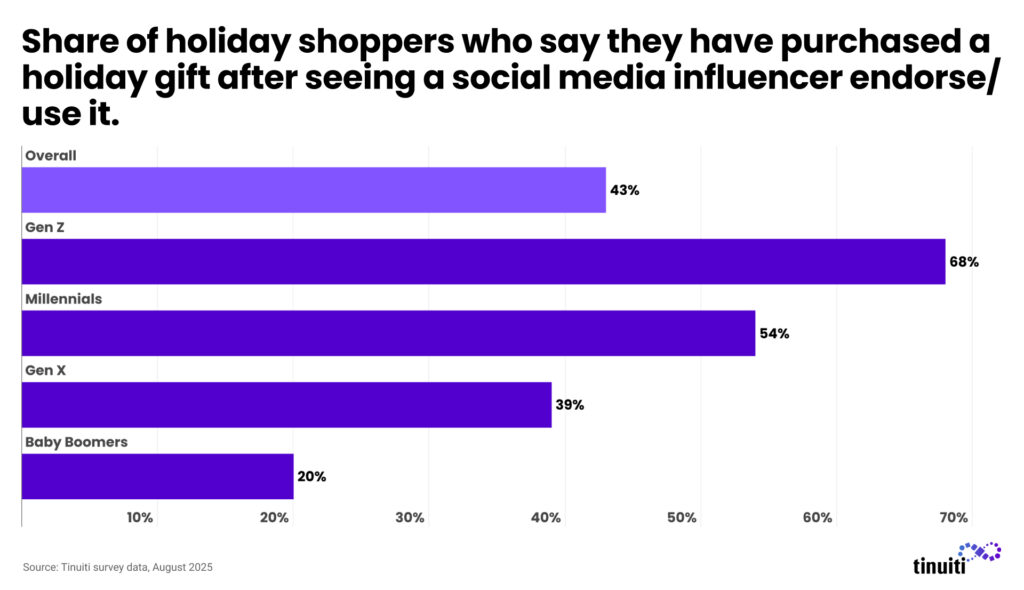
Social media influencers stand to impact holiday shopping decisions for many, with 43% of all respondents indicating they’ve purchased a holiday gift after seeing an influencer endorse it. That rate jumps to 68% among Gen Z and 54% among millennial holiday shoppers, but is just 39% among Gen X and 20% among baby boomers.
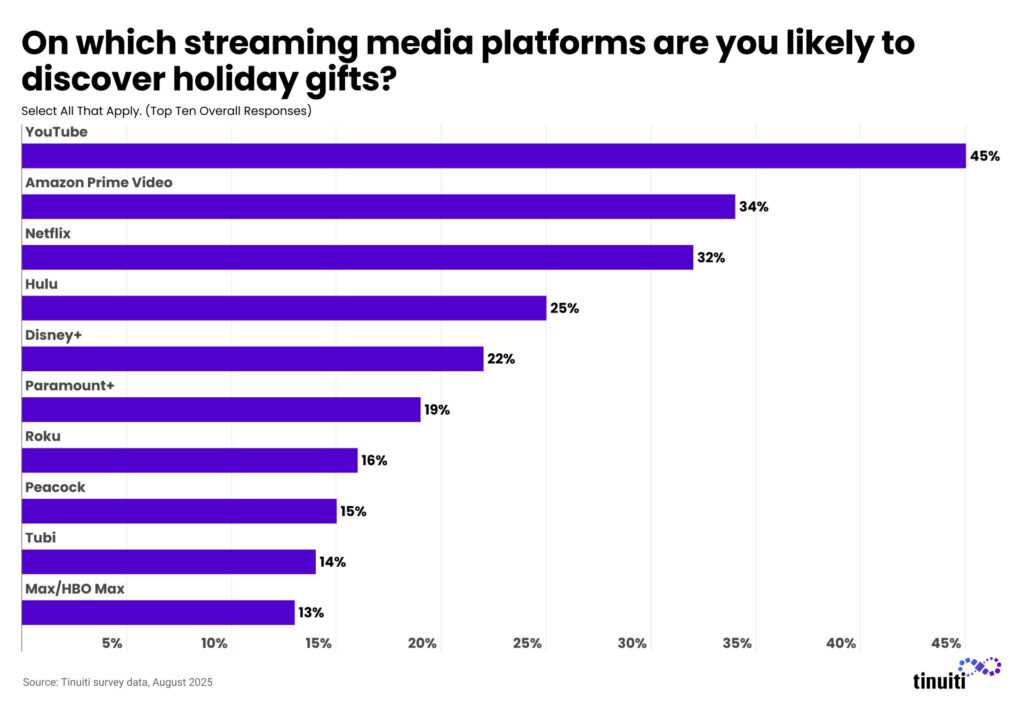
Looking at which streaming video platforms stand to have the most influence this holiday shopping season, YouTube was the most selected platform for discovering holiday gifts. Amazon Prime Video and Netflix, which have both rolled out and grown ad-supported tiers, were the second and third-most selected platforms.
The likelihood of discovering gifts on streaming platforms varies depending on who respondents expect to purchase gifts for. For example, 26% of respondents who intend to purchase holiday gifts for children say they’re likely to discover gifts on Disney+, compared to 14% of respondents who are not buying for children.
Amazon is set to play a massive role for holiday shoppers, with 80% of respondents intending to use it while shopping online this holiday season. Next in popularity, 61% of holiday shoppers will head to Walmart’s site/app, while 38% will shop on Target.

Although the evolving tariff landscape has had seismic impacts on China-based sites like Shein and Temu, many US shoppers still expect to use them during the holidays. Overall, 18% of holiday shoppers expect to use Shein in 2025, up from 14% a year earlier, while 22% expect to use Temu, which was steady with a year earlier.
Among Gen Z, 43% expect to shop Shein for holiday gifts this year while 26% plan to use Temu. In general, younger respondents expect to use a broader range of sites for their holiday shopping than older generations with 59% of Gen Z respondents saying they will use four or more sites, compared to just 28% among baby boomers.
The types of products respondents are looking to purchase will naturally have a heavy influence on which sites they visit. While 24% of all holiday shoppers expect to shop on Best Buy, that rate increases to 44% among those looking to purchase electronics. Among beauty shoppers, Target sees a particularly big lift with 55% planning to use it for holiday shopping.
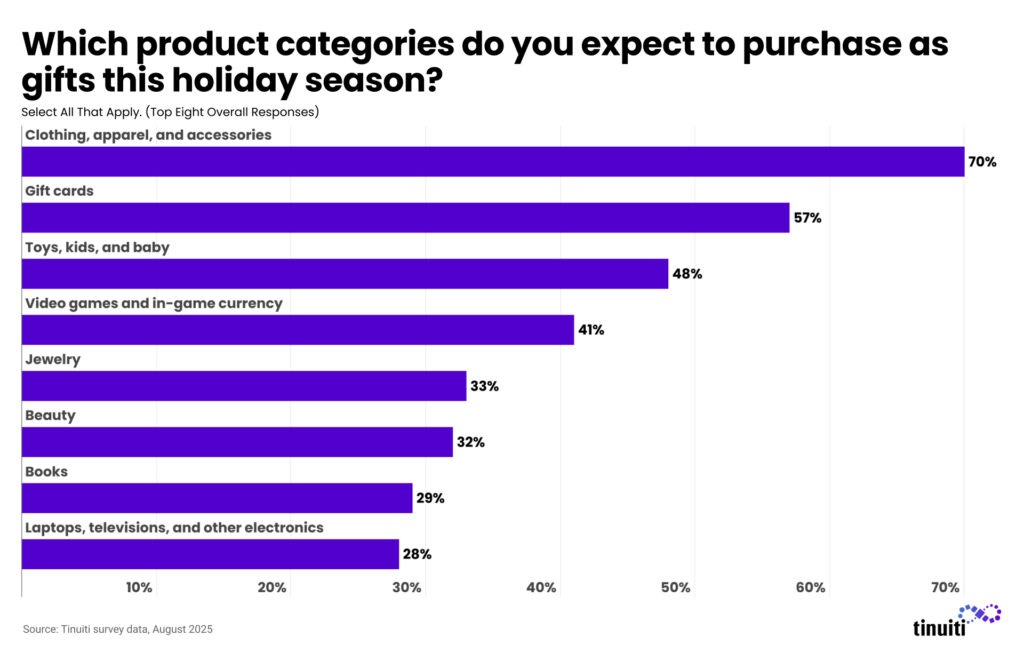
Sites selling apparel will see wide appeal for the holidays as 70% of shoppers expect to purchase apparel, clothing, or accessories as gifts, making it the top product category. This was followed by gift cards at 57%, and toys, kids and baby products at 48%.
Gift cards are particularly popular for shoppers with many people to buy for, with 77% of respondents who are buying gifts for more than ten people expecting to purchase gift cards, compared to 54% of those who are shopping for less than ten people.
of holiday shopping lists have video games & in-game currency on them
of shoppers buying gifts for children will buy video games & in-game currency
of shoppers not buying gifts for children will buy video games & in-game currency
of millenials buying holiday gifts for children will make video game-related purchases
Video games and in-game currency are on 41% of holiday shopping lists. That share is higher (46%) among those shoppers who are buying for children than it is for those who don’t have children on their shopping lists (32%). Among millennials that are buying holiday gifts for children, 65% expect to purchase video game-related gifts.
Just as younger generations plan to shop across a broader range of websites than older generations, they will also be looking to buy gifts across a broader range of product categories. Across Gen Z and millennials, 56% of respondents expect to purchase gifts from five or more different product categories, while that rate is just 30% for Gen X and older respondents.

While similar shares of women (57%) and men (56%) expect to purchase gift cards for the holidays this year, other categories can see pretty wide differences in intentions to purchase. The single largest gap is for beauty products which 39% of women expect to purchase compared to 25% of men. To the other end of the spectrum, 34% of men expect to purchase electronics compared to just 22% of women.
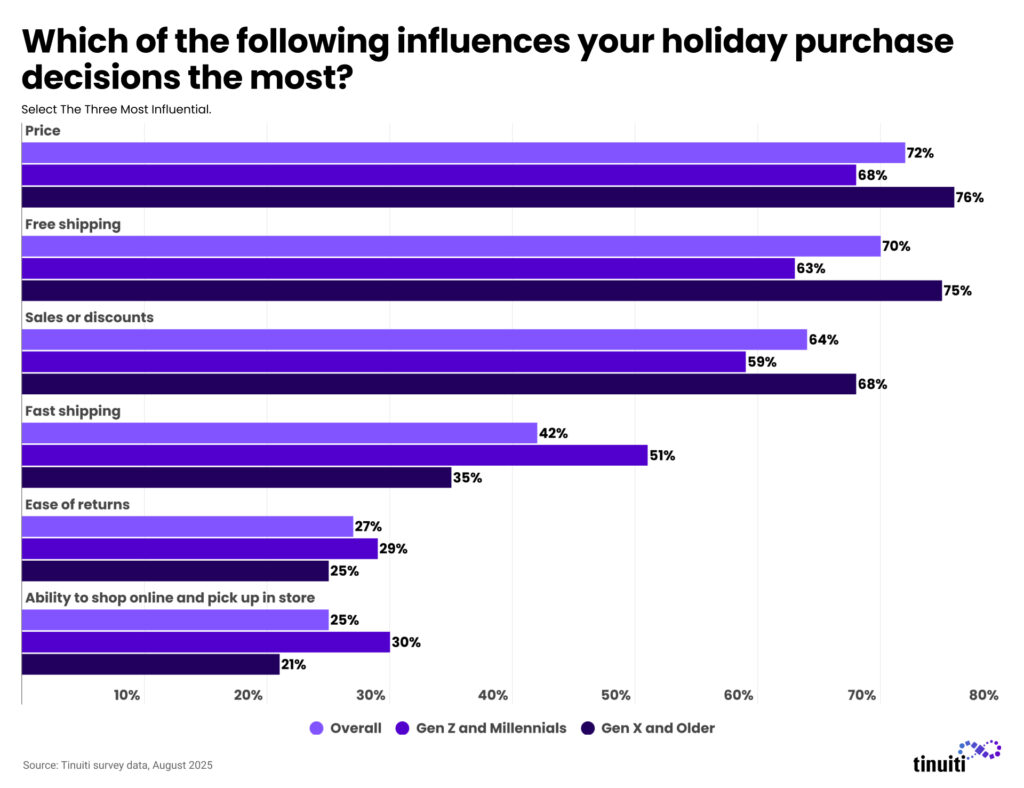
Asked to identify what influences their holiday purchase decisions the most, respondents were most likely to select price (72%) as one of the three most important influences. This was closely followed by free shipping, which was selected by 70% of respondents, with sales/discounts coming in third at 64%.
Fully 72% of shoppers who will search for more promos and/or discount codes due to tariffs selected sales/discounts as a top three influence. That surpasses the 61% of those who won’t chase more promos as a result of higher US tariffs.
Fast shipping is also important for many holiday shoppers, and 42% placed it in their top three. Respondents that are starting their holiday shopping earlier are more likely to feel that fast shipping is important, with 43% of those who plan to start before Cyber Monday including it in their top three compared to just 30% who will start their shopping on Cyber Monday or later.
Although older and younger respondents ranked their top gift purchase influences in nearly the same order, Gen X and older respondents were more likely to pick financial influences like price, free shipping, and discounts. Gen Z and millennial respondents were more likely to pick conveniences like fast shipping, ease of returns, and BOPIS.
When comparing the product characteristics of holiday gift purchases, holiday shoppers were most likely to select value as the single most important trait, with 45% doing so. This was followed by premium quality at 30%, and brand in a distant third at 14%.
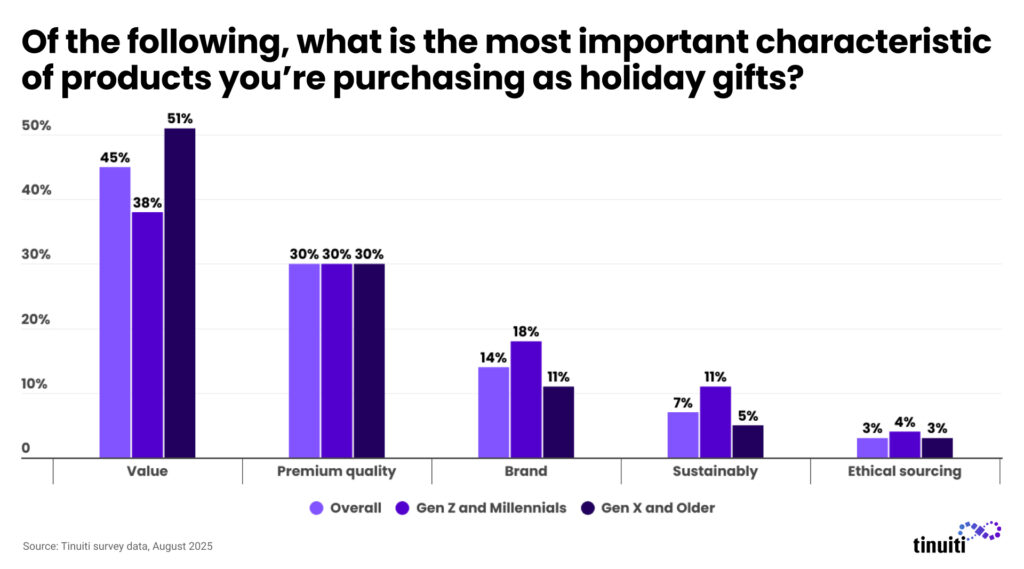
Just 10% of respondents chose sustainability or ethical sourcing as the top product characteristic for holiday gift purchases. While the product characteristic rankings were the same for younger and older respondents, Gen X and older shoppers were again more likely to choose a financial consideration, value, than younger shoppers, while Gen Z and millennials were more likely to pick less tangible choices like brand, sustainability, and ethical sourcing.
When it comes down to the final stretch of the holiday shopping season, 38% of shoppers say they make more purchases in stores. Fully 33% purchase more gift cards when they’re down to the wire, and 29% narrow online shopping down to websites that are known for faster order fulfillment.
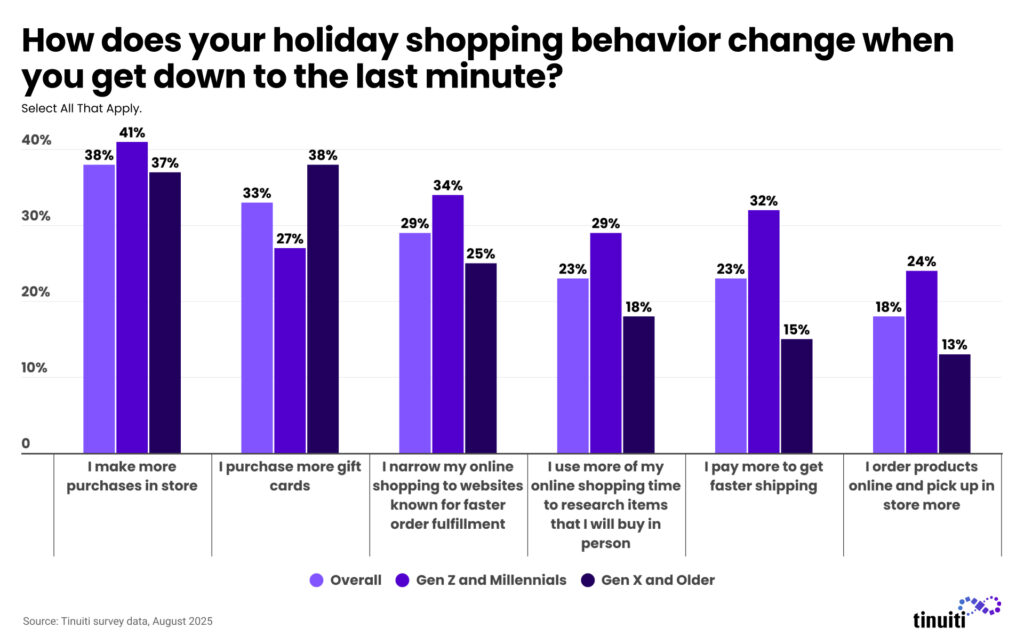
As such, it’s crucial for marketers to highlight in-person purchase options, gift cards, and shipping speed in the final stretch of holiday shopping. It’s also important to understand how these preferences differ across generations.
While similar shares of older and younger shoppers shift more purchases to in store at the last minute, Gen X and older shoppers are more inclined to turn to gift cards than Gen Z and millennials, who are more willing to try to make online purchases work by paying for faster shipping or turning to sites with faster fulfillment.
Brands also need to take advantage of the shopping period between Christmas Day and New Year’s Day, sometimes known as Q5. More than half of holiday shoppers expect to shop after the holidays are over in order to take advantage of end-of-year sales, and 38% plan to shop in order to use gift cards they received during the holidays. Fully 27% will be looking to stock up on discounted decorations after the holidays.
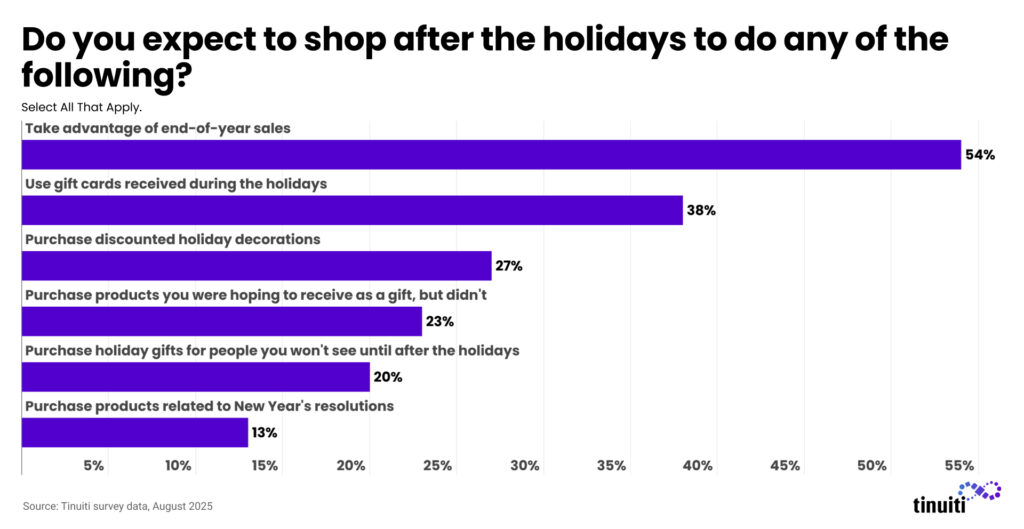
Self-gifting will be an important part of post-Christmas Day shopping, with 23% of holiday shoppers looking to purchase products they were hoping to receive as a gift, but didn’t. That share is 33% among holiday shoppers who expect to buy holiday gifts for themselves, compared to 18% who aren’t planning to buy gifts for themselves.
‘New Year, New Me’ categories stand to see a boost after the holidays are over, with 13% of holiday shoppers planning to make purchases related to New Year’s resolutions. Millennials are most likely to shop for resolution-related items, with 23% saying they’ll do so. Just 3% of baby boomers expect to do the same.
Check out our most recent Holiday Shopping Trends Report for more exclusive insights.