AI Search Has Changed The Rules of Growth. Here’s the New Operating Model.


AI search is fundamentally changing how consumers discover brands, evaluate options, and make purchase decisions. Brands who continue treating SEO as a channel optimization exercise risk losing visibility at the exact moments where AI increasingly shapes demand. Growth leaders who treat AI search as a core performance channel, not a side experiment, are already compounding brand visibility, demand, and revenue.
Below, we cover how we partner with brands to:
AI SEO is how you improve visibility and control how AI search surfaces talk about your brand. Strong AI SEO programs optimize for the signals Google AI Overviews, answer engines, and assistants look for when they assemble synthesized responses: clear definitions, step-by-step guidance, sourceable data, and a consistent entity story across your .com and the wider web.
In practice, classic SEO levers like intent mapping, crawlability, and E-E-A-T now sit alongside newer requirements: tightly structured content, robust schema, and topic architectures built for extractability, not just rankings. Instead of optimizing a single page for a single keyword, you’re designing a body of work that AI can safely quote, cross-check, and attribute in real time to reinforce topical authority and brand differentiation.
AI search has also changed how people express intent. Short, two-word queries like “marathon shoes” are expanding into full prompts that carry context about lifestyle, constraints, and pain points, for example, “find me the best marathon training shoes for long runs that help with shin splints and have a wide toe box.”
Strategizing for AI search visibility still requires getting the technicalities right so your content can be crawled, indexed, and retrieved, but the bigger shift is in how people ask questions. Queries are getting longer and carry more context about lifestyle, constraints, and preferences, which means semantic optimization and mapping out new conversational search journeys for each target audience should guide your strategy, not just keyword lists.
Traditional SEO strategies and measurement kept everything keyed to individual terms; AI SEO has to account for this richer context and the full conversations users have along their discovery path, measuring performance at the topic and category level instead of just the keyword list.
The fundamentals don’t change, but the surface area does. Visibility now spans rankings, AI Overview inclusion, and presence across non-Google answer engines. Workflows lean more on AI for research and QA, which speeds execution but requires governance, and the risk profile expands to include hallucinations, generic “AI-sounding” content, brand drift, and compliance exposure if oversight is weak.
SEO isn’t dead. In fact, it is quietly becoming more important as search behavior explodes across Google, LLMs, and assistants. As detailed in our own Guide to AI in Search, people are searching more than ever, but discovery now happens across Google, TikTok, Reddit, ChatGPT, Claude, and countless AI assistants.
Hence, the lines between “search” and “conversation” continue to blur. Even when users go straight to tools like ChatGPT, they’re still searching, just inside an interface where AI curates, summarizes, and cites information instead of simply listing links.
Get our guide to AI in Search to learn what’s required to maintain visibility in the new search landscape.

The bigger shift is the zero-click reality. Search volume is climbing while organic traffic declines. More than 60% of queries now end without a click as answers are pulled directly into the SERP via Knowledge Graphs, featured snippets, People Also Ask, and now, AI Overviews and AI Mode.
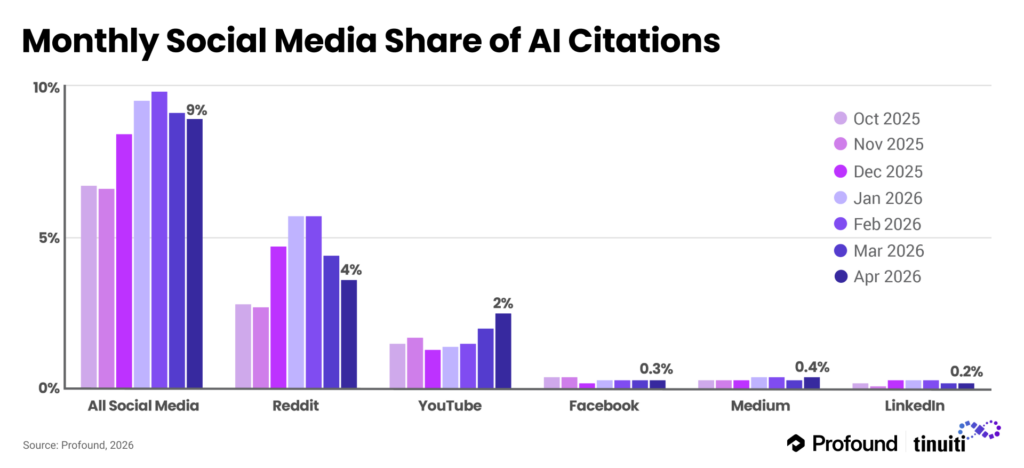
Our Q1 2026 AI Citation Trends Report showed social media climbing past 9% of all AI citations in January, with Reddit’s citation share growing at least 73% from October to January and more than doubling in some industries. The Q2 2026 edition updates that story: social’s average share in April remained about 33% higher than in October 2025.
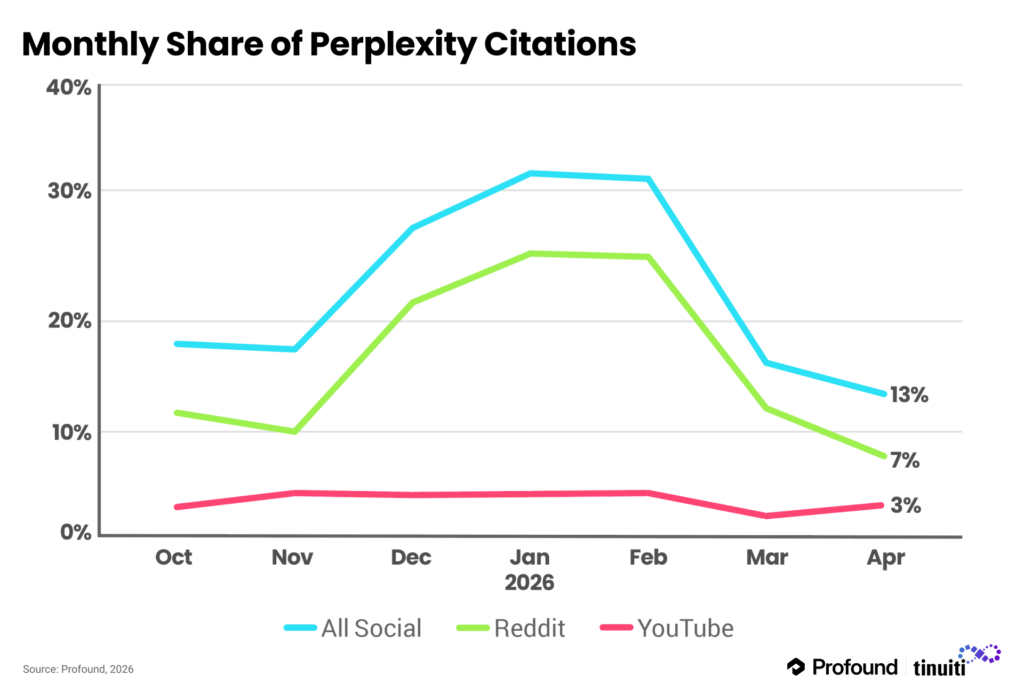
However, Perplexity’s social reliance dropped sharply, its Reddit share fell from 25% of all citations in February to just 7% in April, even as Google’s AI products leaned more heavily on YouTube and broadened their mix of social inputs.
In other words, AI Overviews and AI Mode are changing behavior and redistributing influence toward the brands and communities these systems see as most credible.
This means legacy dashboards built on traffic and CTR are increasingly misleading. We recommend tracking AI-era KPIs such as AI visibility rate, citation share of your domain, third-party mention percentage, sentiment themes, bot crawl activity, and AI search referrals.
The brands losing ground are the ones waiting to see “where AI search lands,” or waiting for ads in LLMs to do the heavy lifting, while competitors are already optimizing for how often and how prominently they appear in AI-generated answers and the ecosystems (like Reddit and YouTube) that feed them.
Zero-click searches are becoming the norm, with over 60% of queries resulting in no clicks. That’s not a dead end—its’ the new front page of the internet. Brands that master AI SEO will own the ‘top answer’ space inside AI Overviews and answer engines, where consumer trust is being built.
Simon Poulton, EVP of Innovation & Growth, Tinuiti
AI Overviews sit at the top of the SERP as generative layers that synthesize information from multiple sources, then link back to selected domains as supporting evidence. They’re designed for complex, multi-intent queries where users benefit from an explanation rather than a simple list of links, and they present answers in a multi-paragraph, expandable format that supports conversational follow-ups.
Users can now trigger AI mode within an AI overview to search further. Google has been slowly prioritizing the AI mode experience and creating more opportunities for users to find their way into AI mode. If users expand the AI overview, they will be shown a new ‘ask anything’ search box, which will push them into a conversational search journey in AI mode.
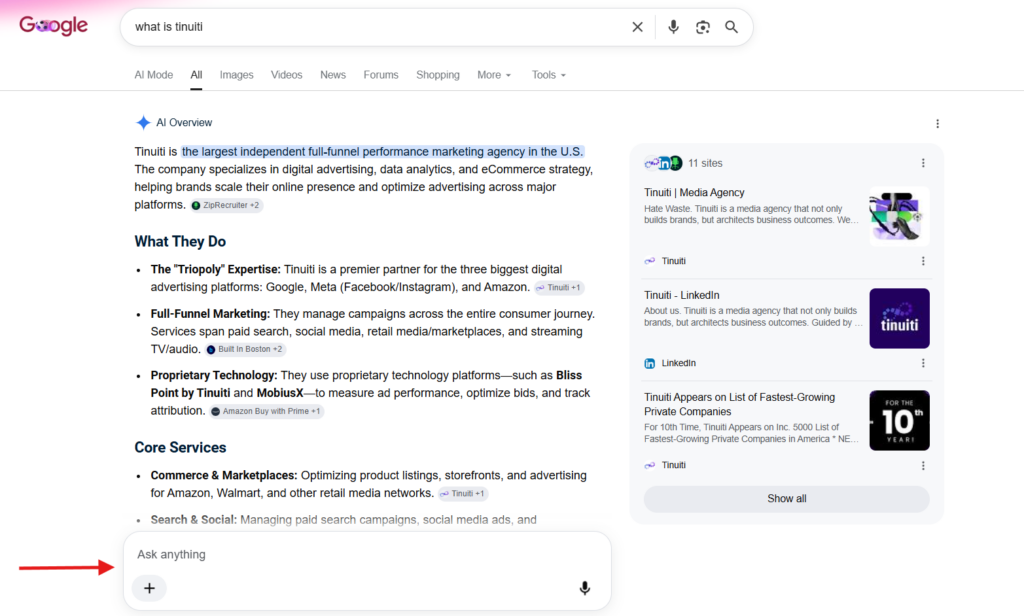
AI Overviews tend to appear when Google’s systems decide a query would benefit from a synthesized explanation rather than a simple list of links. They’re far more common on complex, multi-step, comparative, or exploratory prompts, think “build an AI SEO strategy for mid-market B2B SaaS” instead of a short head term like “AI SEO”, and on longer, question-style searches.
Intent is the main driver. Large-scale analyses of millions of SERPs show that nearly all AI Overviews appear on informational queries, with question-based and seven-plus-word searches triggering them at much higher rates than short or purely navigational terms. Non-branded queries are also more likely to surface an Overview than branded lookups, with some studies finding they’re roughly 1.9x more common for generic terms.
Vertical still matters. Google leans more heavily on diverse, authoritative sources in those spaces. By contrast, many short, transactional, and local queries still default to classic SERPs, ads, and map packs, with AI Mode and other AI features picking up more of the deeper follow-up questions.
From a content strategy standpoint, you don’t need to engineer every page for AI Overviews. The job is to identify the informational, comparative, and multi-part queries where generative responses actually dominate, and then build content that offers clear structure, evidence, and a distinct point of view so your brand is an obvious candidate for those AI answers.
Earning a place in AI Overviews starts with being a source Google can trust and ensuring your site content is retrievable. Trust building includes clear evidence (citations, data, examples), transparent authorship, visible editorial standards, and content that fully satisfies the underlying intent rather than skimming the surface. Structurally, pages that perform well tend to offer “building blocks” that models can reuse safely, such as concise definitions, step lists, FAQs, tables, pros/cons, and constraint statements that map cleanly to how-to or comparison style answers.
On-page language should avoid vague, universal claims in favor of scoped statements like “for mid-market B2B SaaS teams” or “for brands with multi-region catalogs,” which helps AI systems understand when your advice applies. Clearly delineating facts from opinion and weaving in up-to-date, well-sourced data reduces hallucination risk when models quote you. Google’s own “succeeding in AI Search” and “helpful, reliable, people-first content” guidance reinforces these fundamentals: create original, intent-aligned content that’s easy to crawl, technically sound, and genuinely useful to the specific audience you’re trying to reach.
AI search now extends well beyond Google’s AI experiences to answer engines, assistants, copilots, and research tools that lean heavily on entity graphs, documentation, and third-party signals.
Across all categories and AI platforms tracked in our AI Citation Trends Reports, social media’s share of AI citations rose from about 6% in October 2025 to roughly 9% in January 2026, driven in part by Reddit’s rapid rise, its share grew at least 73% across every industry studied and accounted for around 24% of all Perplexity citations at its peak. By Q2 2026, that pattern evolved: average social share in April remained roughly one-third higher than in October, but Perplexity sharply reduced its reliance on social and Reddit, while Google’s AI products leaned more heavily into YouTube and broadened their mix of social sources.
Those patterns underline a simple reality: AI systems rely on conversations around your brand online to generate answers so you have to prioritize more than your .com. Conversations and brand mentions in communities like Reddit and YouTube increasingly shape how models describe categories, compare options, and decide which brands are worth mentioning in answers. For AI SEO, that means your strategy has to account for the full ecosystem, including PR, social, reviews, forums, and partner content, not just classic on-site optimization.
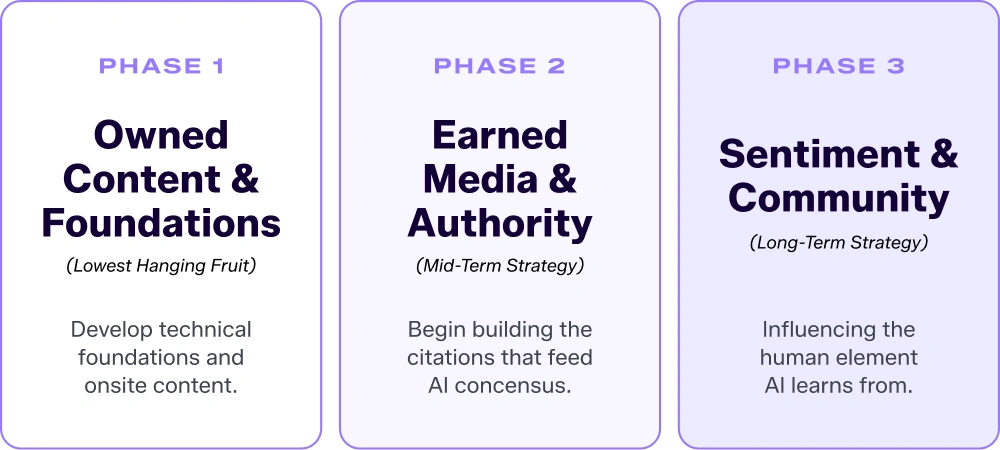
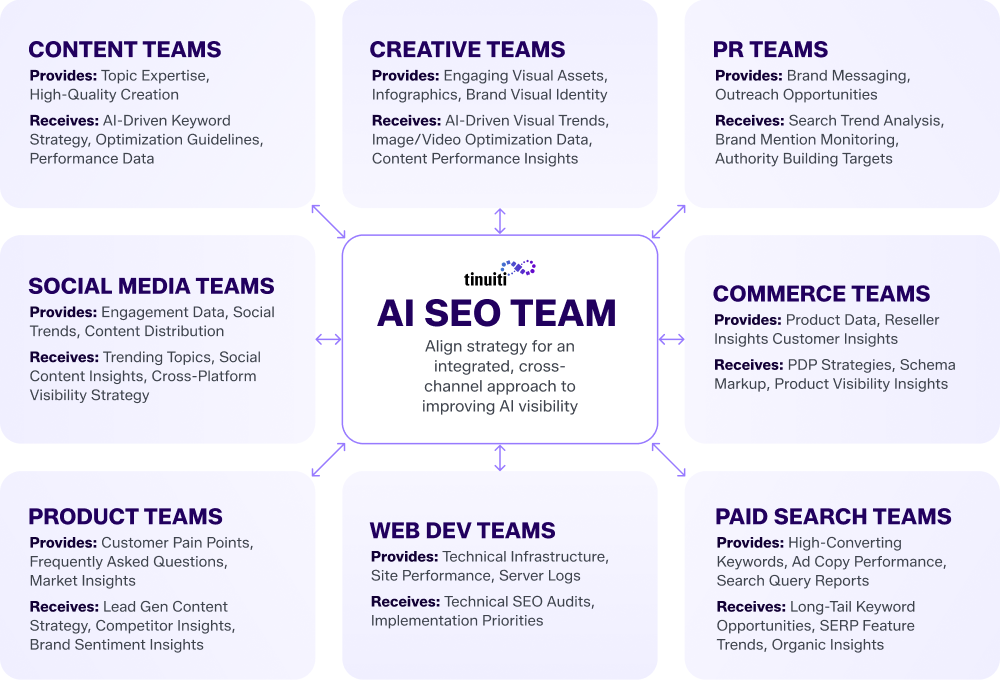
AI SEO works best when it’s treated as an operating system, not a standalone SEO program. In practice, that means SEO stops operating as a silo and starts acting as the strategic quarterback for brand authority helping to coordinate content, technical SEO, PR, social, and analytics around the same AI search insights so your brand shows up consistently wherever your audience is searching.
The operating system runs in three phases that build on each other:
Within each phase, the work follows a simple loop: Diagnose the current state, design improvements, deploy across channels, measure impact, and evolve based on the data.
Phase one is about ensuring your owned surfaces are impossible to misunderstand. That includes your .com, help center, documentation, blogs, PDPs, and any other properties you control.
The goal is for AI systems to recognize your owned content as the most accurate, complete answer for a defined set of problems before you ever worry about what others are saying.
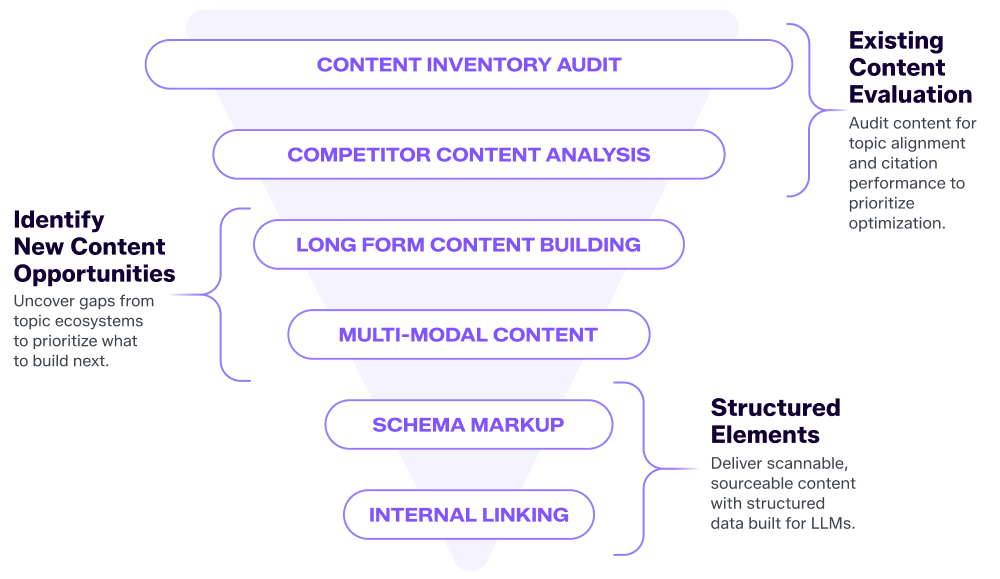
Once your own house is in order, the next phase focuses on earned authority, a.k.a. what credible third parties say about you. This is where PR, analysts, partners, retailers, affiliates, influencers and publishers come in.
Phase two is where you move from “we say this about ourselves” to “credible others say this about us,” which AI systems weigh heavily when constructing answers.
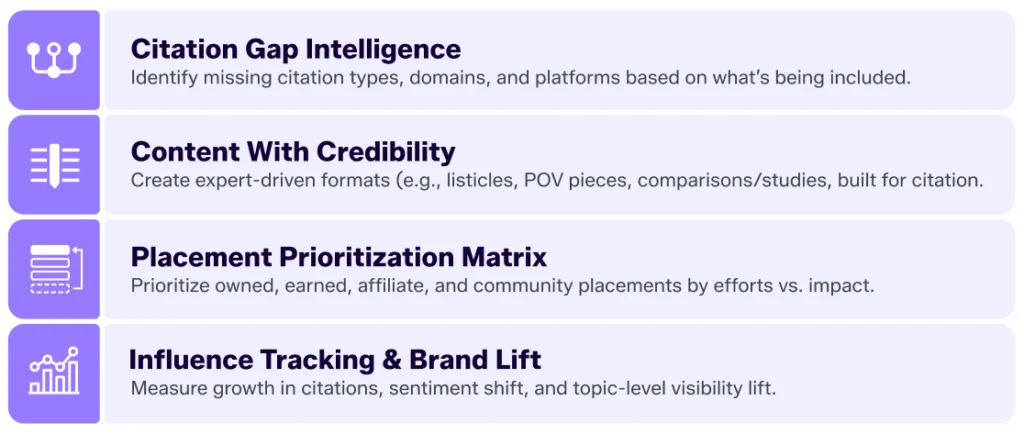
The third phase focuses on community and social signals, examining what real users say in public spaces such as Reddit, YouTube, TikTok, forums, and review sites. This is the layer that gives AI systems lived-experience context: which products people compare, what they love, and what they complain about.
This phase is where AI SEO and “social search” converge. The same conversations that drive discovery inside platforms are the ones AI tools increasingly mine to understand categories and compare options.
When buyers talk to AI assistants, they don’t think in keywords, they describe their situation. Prompts are longer, carry more context about constraints and preferences, and are framed as full questions or tasks (“find a cheaper alternative to COMPETITOR PRODUCT that ships in two days”) rather than shorthand phrases.
That makes traditional keyword volume an incomplete input for AI-era optimization. Volume still matters, but it has to be paired with prompt frequency (how often people actually ask a question in LLMs) and topic prevalence (how many adjacent prompts cluster around the same need) to see real demand. The same audience segment will often phrase the same underlying question differently in Google versus ChatGPT or Claude, for example, “best foundation dupes” as a search, versus “find a clean beauty dupe for this conventional foundation” as a prompt, which has implications for how you design content and entities to show up in both.
As prompts get longer and more conversational, the job shifts from finding single head terms to understanding the semantic patterns behind how different personas describe the same problem. That’s why prompt and topic mapping becomes a strategic workstream: it gives you the journeys to optimize for, not just the vocabulary.
At Tinuiti, building a prompt library is a core strategy track, not a side experiment. We start by mapping real buyer journeys into personas tied to AI query behavior by role, stage, and pain point, for example, new-to-category shoppers, cost-conscious buyers, “clean” or values-driven buyers, and repeat purchasers with replenishment needs. For each persona, we identify topics to track and then define prompts that reflect how those people actually talk: “what is the best eye makeup for beginners,” “what mascaras use clean ingredients,” or “what’s the best mascara for under 20 dollars,” rather than abstract keyword stems.
Those prompts are then mapped to buying stages, awareness, consideration, evaluation, and decision, so you can see how questions evolve from “what is…” to “which one is better for me?” over time. We test these prompts directly in live AI systems to understand three things: Where your brand already appears, where competitors are winning the answer space, and where no brand is yet visible and the field is open. The goal isn’t to outsource this work to generic AI tools, but to collaborate with your team on the highest-value personas, topics, and prompts, then manage them as a shared asset.
Once the prompt library is in place, we audit how often and how prominently your brand shows up in AI-generated answers. Using Profound and Tinuiti’s AI SEO operating model, we track which prompts cite your brand, which favor competitors, and which return answers with no clear brand at all, across platforms like ChatGPT, Google AI experiences, and other answer engines. Q1 2026 AI Citation Trends Report.
This visibility data becomes the backbone of the roadmap. Instead of prioritizing topics purely on keyword volume, we weight them by AI visibility gaps, revenue potential by persona and stage, and the strength of your existing content and entity signals. The output is a content and entity plan with clear business logic: which prompts and topics to cover first, what formats and schemas to use, and how to align future briefs with the questions buyers are already asking AI, so your brand is easier to find, understand, and trust in those environments.
Uncover the biggest shifts and what they mean for marketers.

AEO depends on two complementary types of content: non-commodity work that defines your perspective on the category, and more-commodity content that captures existing demand. Non-commodity content shapes how AI systems describe your space in the first place, while commodity content shows up where buyers are already asking specific, commercially relevant questions and need practical answers.
Non-commodity assets tend to look like strong POV pieces, definitional guides, and original research that name and frame the problem in ways competitors can’t easily copy. They provide unique, expert-led context that AI systems can reuse when explaining the market and create anchor concepts that can be tied back to your brand. Commodity content, by contrast, leans into detailed comparisons, buying guides, implementation advice, and troubleshooting content that help buyers move from short list to decision, and that are more likely to be cited in AI-mediated recommendations when people ask very specific, task-focused questions.
How you balance the two depends on category maturity and your competitive position. Emerging or rapidly evolving categories need more non-commodity, perspective-shaping work so models don’t default to legacy narratives; mature, crowded categories demand sharper, high-quality commodity content that differentiates through use cases, integration details, and outcomes rather than restating generic information. In both cases, AI assistance should be confined to research, outlining, and localization drafts, with humans owning the point of view, claims, and lived experience that keep your content out of the “generic AI” bucket and make it worth citing.
AI systems are more likely to skip vague, universally applicable content in favor of scoped, specific claims that come from clearly identifiable entities. When advice is framed for “everyone, everywhere,” with no clear boundaries on audience, constraints, or context, it’s harder for models to decide when that guidance is safe to reuse in a particular answer.
Entity clarity starts with consistent naming and unambiguous relationships between concepts. Your brand, products, authors, and core frameworks should be described the same way across your site, schema, profiles, and major third-party sources so AI systems can connect those signals into a stable understanding of who you are and what you’re credible for. Making yourself “safe to cite” then comes down to a few things: factual accuracy backed by sources, scoped statements that make clear when advice applies, and clear separation between evidence and opinion so models are less likely to misrepresent your position.
Answer-ready content is structured so LLMs can lift specific pieces into responses without guessing, reordering, or over-interpreting. That often means going a step beyond classic SEO formatting: short definition call-outs, numbered procedures, constraint statements (“when this doesn’t apply”), comparison tables with labeled rows and columns, and caveats that spell out trade-offs in plain language.
This doesn’t replace traditional SEO best practices, clear headings, scannable sections, and intent-aligned content are still required, but it adds an extra layer of extractability. Where classic SEO formatting might center on a single keyword and long narrative sections, answer-ready formatting breaks the page into reusable building blocks that map cleanly to common questions and follow-ups, reducing the chances that an AI system has to paraphrase or infer what you meant. The result is content that’s easier for both humans and AI to navigate: Readers get clearer structure, and models get safer, more precise snippets to cite.
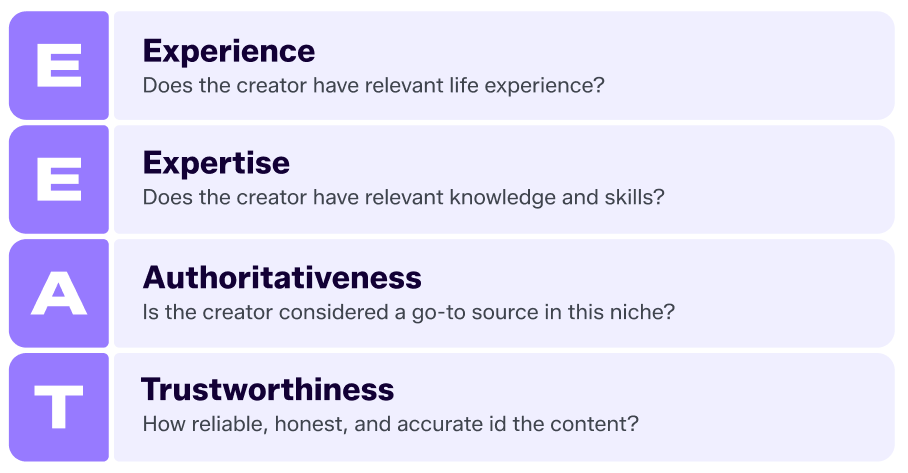
Google’s AI and content guidance continues to emphasize E-E-A-T (experience, expertise, authoritativeness, and trust) as the lens for evaluating helpful, reliable content, regardless of whether AI helped draft it. In the AI Optimization Guide, Google also calls out non-commodity content as the kind of material generative features prefer to surface. For AEO, that puts E-E-A-T and non-commodity content at the center of the strategy: together, they are the primary signals AI systems use to decide which sources to surface and cite when answers carry real-world consequences.
Experience shows up in concrete, non-generic details: firsthand workflows, screenshots from real environments, demos, and “what we tried and what didn’t” narratives that only practitioners can provide. These elements turn otherwise commodity content into non-commodity material by grounding guidance in lived reality instead of restating widely available information. Expertise is reinforced through named authors with relevant credentials, SME bylines on complex pieces, and visible editorial review chains that clarify who is accountable for the guidance, signals that help AI systems distinguish genuine subject-matter work from anonymous, template-driven pages.
Authoritativeness grows over time through citations, original research, and partnerships. Publishing proprietary data, case studies, and category frameworks creates the kind of external references AI systems increasingly pull into answers and elevates that content out of the commodity bucket. Trust is the layer that keeps all of this durable: transparent update cadences, correction policies, clear contact paths, and documented editorial standards signal to both users and AI evaluators that your content is maintained, accountable, and people-first.
At Tinuiti, that translates into topic clusters built around high-value AI search themes, content published under named human authors with clear bios, and a deliberate mix of original research and digital PR designed to earn third-party citations, so AI systems have both on-site and off-site evidence to treat the brand as a safe default source. The practical test we apply is simple: does each piece add non-commodity value (a unique angle, data set, or lived experience) on top of the baseline information, and does it clearly show the E-E-A-T signals that make it trustworthy enough to be quoted in AI answers?
Technical AEO is about giving AI systems a clean path to find, understand, and confidently attribute your content. The foundation rests on three pillars: crawlability, structured data, and entity consistency, which determine whether your best pages are even eligible for reuse in AI-driven search experiences.
Performance and rendering sit alongside these pillars as enablers rather than as a separate goal. Pages that expose key content in HTML, avoid heavy client-side blocking, and meet reasonable Core Web Vitals thresholds give AI systems a cleaner snapshot of what matters, reducing the risk that important information is missed or misinterpreted.
Structured data is how you label your content for machines, not just humans. Applying the right schema types (Organization, Product, Article, HowTo, FAQ) in line with Google’s structured data policies gives search and AI systems explicit cues about what each page represents and which elements are safe to reuse in rich and generative experiences. Beyond markup on individual pages, a consistent backbone, including sameAs links, stable IDs for your brand and products, clear authorship and date fields, helps models connect your site to profiles, reviews, and third-party coverage without guesswork.
Entity work is the discipline of making your brand, products, and concepts unambiguous wherever they appear. That means aligning naming and descriptions across your .com, documentation, app stores, social profiles, review sites, and major directories, then reinforcing those signals through authoritative profiles and well-maintained knowledge panels. When these references tell a consistent story, AI systems have a much easier time understanding who you are, what you’re relevant for, and when you’re a safe inclusion in an answer, especially in crowded B2B categories where brands can look interchangeable at a glance.
Even with a perfect schema and entities, AI still has to extract specific sentences or sections to form an answer. You make that easier by designing content in reusable building blocks: short definition call-outs, numbered procedures, “when this is a bad fit” caveats, and comparison tables with labeled rows and columns. Supporting visuals such as diagrams, annotated screenshots, and short clips with descriptive captions gives models extra context to lean on when they summarize flows or features.
This kind of formatting reduces ambiguity, which in turn reduces the need for a model to infer or improvise. The clearer your claims, boundaries, and structures are on the page, the more likely AI systems are to quote you accurately and attribute you as the source instead of paraphrasing you into something you wouldn’t say.
The strongest link and citation assets are still things only you can publish. Surveys, benchmarks, original research reports, proprietary tools, and robust templates give journalists and creators something to point to that feels genuinely new. When those assets are structured with:
…they become easy material not just for link roundups, but for AI systems to reference directly in answers.
Original research drives citations, which serve as a durable moat: Each time your data is referenced on a trusted site or in an AI answer, it reinforces your authority on that topic and nudges models to treat your content as a default source. That compounding effect is far more valuable than traditional volume-driven link building, where many links add little signal and may even create risk if they come from low-quality environments.
It’s also one of the most concrete ways to operationalize E-E-A-T. Our own AI in Search and quarterly AI Citation Trend reports are designed this way: we publish first-party findings and POV, package them in formats LLMs can crawl and parse, and put named experts behind the analysis so both human and AI systems can clearly attribute the insights to real practitioners. The combination of original data, expert commentary, and deliberate structuring is what we consistently recommend to our clients as we build our own authority in AI for SEO.
Get our guide to AI in Search to learn what’s required to maintain visibility in the new search landscape.
Answer Engine Optimization adds responsibilities that don’t map cleanly to traditional SEO alone. In addition to classic SEO ownership of crawlability, content, and measurement, teams now need dedicated accountability for prompt monitoring, answer-engine auditing, and entity strategy, functions that determine how AI systems see and describe your brand across platforms like Google’s AI features, ChatGPT, Perplexity, and others.
AEO-specific roles emerge around three questions:
Prompt and answer-engine owners manage the prompt library, monitor which questions matter by persona and buying stage, and track how often your brand, competitors, or no one appears in AI-generated answers. Entity strategy owners define how your brand, products, authors, and frameworks are named and connected across .com, schema, profiles, and key third-party sources so AI systems can confidently link those signals.
These responsibilities rarely have direct equivalents in legacy SEO org charts. In practice, they sit alongside existing SEO, content, and analytics functions but require explicit remit and approval gates, for example, who signs off on factual claims, structured data changes, and AI-facing content updates in YMYL or regulated categories. Without that clarity, AEO work risks stalling in legal review or fragmenting across teams in ways that make consistent measurement and governance impossible.
A simple way to think about it:
| Function | Core questions it owns |
| Prompt & answer owners | Which prompts we track, how often we appear, how answers are framed |
| Entity strategy | How the brand, products, and authors are named and connected |
| Technical & measurement | Whether content is discoverable, extractable, and properly tracked |
Most organizations are best served by keeping day-to-day storytelling and community participation in-house, while working with specialists on the more technical and fast-changing pieces of AEO. Internal teams are usually closest to brand voice, customer nuance, and regulatory context, which makes them the right owners for:
Those same teams also help define personas, approve prompts, and validate how AI-framed answers align with positioning, especially as social networks and forums increasingly provide the user-generated training data that AI systems mine when learning how to talk about your brand. Authentic, peer-to-peer discussion is no longer just PR or social proof; it is the corpus that teaches models how to compare options, describe your category, and decide when to mention you.
Specialist depth matters most in areas like prompt testing and monitoring at scale, cross-platform AI visibility analysis, entity and structured-data strategy, and the technical work required to keep sites crawlable and extractable as AI features evolve. Hybrid models, where agencies lead on AEO strategy, prompt and answer-engine analytics, and complex technical or measurement work, while internal teams execute briefs, maintain content, and run experiments.
The critical piece is governance. You need:
For Tinuiti, that scoreboard centers on AI-era KPIs such as AI Visibility Rate* and Citation Share, the percentage of AI citations that reference your domain or category assets, alongside traditional pipeline and revenue measures. When both internal teams and external partners are aligned to those metrics, the operating model stops being about “who owns SEO” and instead becomes about how every role contributes to winning more of the answer space that actually drives demand.
*AI Visibility Rate is the frequency and prominence with which your brand, product, or content appears directly within AI-driven search.
Choosing an AI SEO partner is less about who talks the most about AI and more about who can prove they run a disciplined, low-risk program. Beyond credentials, you want to see:
Smart questions to ask in a pitch or RFP include:
Non-branded organic growth, assisted revenue, and organic conversion rates remain core metrics for executives. Crawl and index health are still leading indicators of whether your technical foundation can support AI SEO ambitions.
These metrics ground conversations in durable value while AI search-specific KPIs are layered on top. They also help avoid overreacting to short-term SERP volatility driven by AI experiments.
Most brands are still measuring an AI world with pre-AI dashboards. Tinuiti has defined a set of AI-era KPIs that capture how often brands shape answers, not just receive clicks. These include AI visibility rate (how often your brand appears in AI answers to relevant prompts), citation share on your owned domains, mention percentage in third-party sources, sentiment, bot visits and crawl activity, and AI search referrals from platforms like ChatGPT, Perplexity, Google AI Mode, and more.
AI search also adds new lenses: tracking which queries trigger AI Overviews, how often you’re cited, and which landing pages are being referenced. You can benchmark “share of answers” against top competitors on must-win topics to see whether you’re actually present where decisions are being shaped.
These metrics reveal dynamics traditional rank reports can’t. We’ve seen scenarios where AI-referred traffic arrives in lower volumes but behaves like a warmer, more qualified cohort, driving disproportionately strong engagement and revenue relative to standard organic sessions. Likewise, our Q1 2026 research on AI Citation Trends shows that platforms like Perplexity derive roughly 31% of their citations from social content, while other models lean more heavily on classic web domains. This underscores why AI visibility measurement has to be platform-aware rather than averaged.
Intent matching, trust building, and ease of accessibility for AI agents are all necessary strategies to focus on as brands begin to drive AI search-specific KPI improvement.
Benjamin Grosse, Head of Partnerships and Growth, Profound
Experimentation spans content formats (definition-first vs. narrative-first, step blocks vs. longform) and technical variables (linking structures, schema variants, speed improvements). The key is to isolate changes and measure their impact on both rankings and AI Overview presence.
A predictable reporting rhythm, for example, monthly executive summaries, focuses on decisions unlocked, risk reduced, and outcomes improved, rather than raw metric dumps. That keeps AI SEO aligned with leadership priorities.
We used a similar playback for Rough Country, a leader in off-road parts and accessories, looking to adapt their playbook for AI search. To do so, we integrated Profound’s AI visibility data with GA4, set baselines for non-branded prompts, and then optimized content and structured data specifically for AI Overviews and answer engines. Within 90 days:
This mix of visibility, referral volume, and downstream performance is what makes AI SEO legible to a CFO, not just an interesting metric in an SEO dashboard.
Our AI SEO and generative engine optimization services connect content, technical SEO, and measurement under one roof. We help brands design AI SEO operating models that earn citations in AI Overviews and answer engines while driving measurable pipeline and revenue impact.
If you’re ready to operationalize AI SEO across your organization, our specialists can partner with you to build the strategy, workflows, and governance that make it sustainable.
AI SEO specialists and generative engine optimization services →

Senior Director of Innovation & Growth, Tinuiti
Jen Cornwell is Sr. Director of AI SEO Innovation at Tinuiti, helping brands navigate conversational search and large language models to grow organic visibility. With 10+ years of experience, she has led large SEO teams and been featured in outlets such as Search Engine Land, Ad Age, and Digiday. Originally from snowy Syracuse, NY, Jen now lives in San Diego, CA with her husband.