How Should B2B Companies Build an AI Search Strategy in 2027?


A B2B AI search/SEO strategy in 2026 means treating AI citation as its own workstream, budgeted and measured separately from traditional SEO, not folded into it. Start with a citation audit to see where your brand currently shows up in AI-generated answers, then restructure content around direct answers to real buyer questions instead of keyword targets.
The bigger shift most teams miss: Claude and ChatGPT, the two engines with the deepest public sourcing data, pull from almost entirely different source sets. The same holds true for the trio of Google AI engines, Perplexity, and Copilot. Without listing them all, the point is that “AI search” is really several strategies wearing one label. The goal isn’t ranking. It’s being one of the handful of sources an AI engine cites when a buyer asks who solves their problem, because 82% of B2B software buyers have already used an AI chatbot to source recommendations in the last 24 months, often before your sales team or your homepage enters the picture.
| What it is | A dedicated strategy for earning citation in AI-generated answers (ChatGPT, Claude, Perplexity, Google AI Mode), distinct from ranking in traditional search |
| When to use it | Any B2B company where buyers research before talking to sales, which by 2026 is functionally all of them |
| Biggest benefit | Influence at the shortlist stage, before a buyer has clicked a single link or filled out a form |
| Biggest drawback | The category has no shared measurement standard yet, so “we’re doing AI SEO” is easy to claim and hard to verify |
| Ideal company size | Most urgent for verticalized B2B SaaS with a defined competitive set, since narrow categories move fastest once one player owns a citation |
| Average timeline | Citation audits take 2-4 weeks; content restructured against must-win prompts shows movement in one to two quarters |
| Common KPIs | Citation rate, share of voice by prompt category, mention-to-citation gap, pipeline influenced |
AI SEO is the practice of structuring content so AI systems retrieve, ground, and cite it when answering a buyer’s question, rather than optimizing for keyword rankings a human might scroll through. The distinction matters because the two audiences read differently: a human skims a page, an AI system extracts a specific passage to quote or paraphrase. Content built for one doesn’t automatically work for the other.
Marketers must proactively feed AI accurate, valuable information so it can educate consumers and shape their opinions on a brand’s behalf.
Jen Cornwell, Sr Director AI SEO Innovation, Tinuiti
LLMs are not the same audience wearing different logos. The clearest data compares Claude and ChatGPT, where only 8% of the domains each one cites overlap, meaning 92% of what one engine surfaces never appears in the other. This number is on average across 600+ queries. Claude pulls heavily from Google’s organic results (64% SERP overlap) and from Brave’s ranking order (79.2% of Claude’s citations preserve Brave’s rank 1-10 order). ChatGPT’s overlap with Google is lower (37%) and it leans on forum and UGC content far more than Claude does (15.8% citation rate on Reddit versus 0.9% for Claude). Building one “AI search” plan and pointing it at every engine is the single most common mistake in this category right now.
Source: Profound, Zero Click, Oct 2025
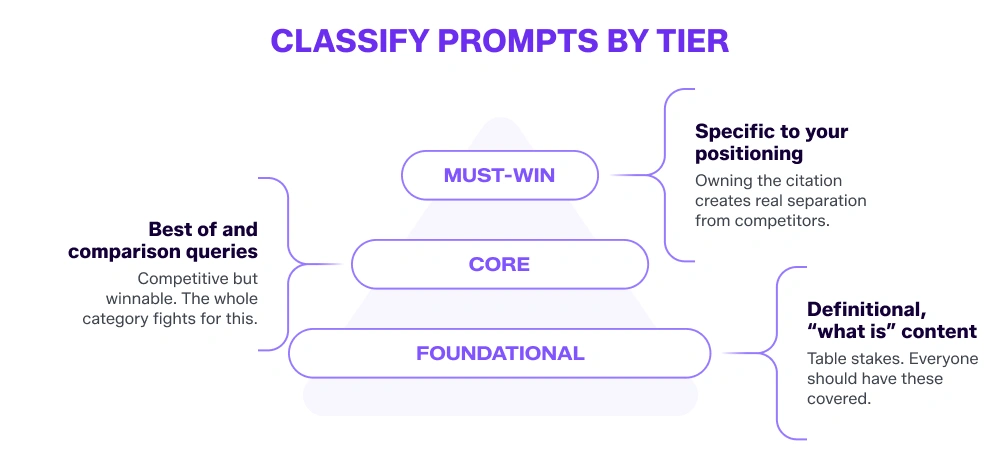
A must-win prompt is a buyer question specific enough to your positioning that owning the citation creates real separation from competitors, as opposed to a foundational prompt (broad definitional content everyone should have) or a core prompt (generic best-of and comparison queries where the whole category is fighting for the same citation).
How AI Chatbots Actually Influence the Buying Journey
Most teams assume AI chatbot influence is concentrated at the top of the funnel, is informational, and is low-stakes. The data says otherwise. According to Similarweb, chatbot influence breaks down into 27% research, 50% evaluation, and 22% decision, meaning the heaviest reliance on AI-sourced answers occurs exactly when buyers are narrowing a shortlist, not when they’re just starting to look around. Tinuiti’s Jen Cornwell has made the same point from a different angle: AI search isn’t replacing the traditional search journey, it’s adding a step to it.
That timing matters because of how buyers actually use shortlists once formed: 80% of AI-assisted buyers bought from their initial shortlist in three of their last five purchases. Miss the shortlist and you’re eliminated before the buyer knows they were considering you, full stop, no second chance later in the funnel.
Review sites and AI chatbots are now effectively tied as the two biggest influences on shortlist decisions, at 38% and 37% respectively. And the two aren’t separate levers: review citations inside AI-generated answers rose 1.8x, from 7% to 13%, as buyers move from discovery into evaluation. Your review profile isn’t just a trust signal for humans anymore. It’s an input AI engines pull from directly, more so the closer a buyer gets to deciding.
Test your brand against a realistic set of buyer prompts across each engine separately. Don’t blend Claude and ChatGPT results into one score. Given the 8% domain overlap, a blended number tells you nothing actionable about either engine.
Sort what you find into foundational (definitional, everyone needs these), core (comparison and best-of, competitive but winnable), and must-win (specific to your positioning, where real differentiation happens).
Claude cites listicle and comparison content at more than double ChatGPT’s rate for the same content type (36.4% versus 19.7% of top-cited content). ChatGPT leans harder on forum and UGC content (15.8% versus Claude’s 0.9%) and brand product pages (21.2% versus 17.6%). If your content library already leans toward best-of and comparison formats, that’s a structural advantage on Claude specifically, not a coincidence to ignore.
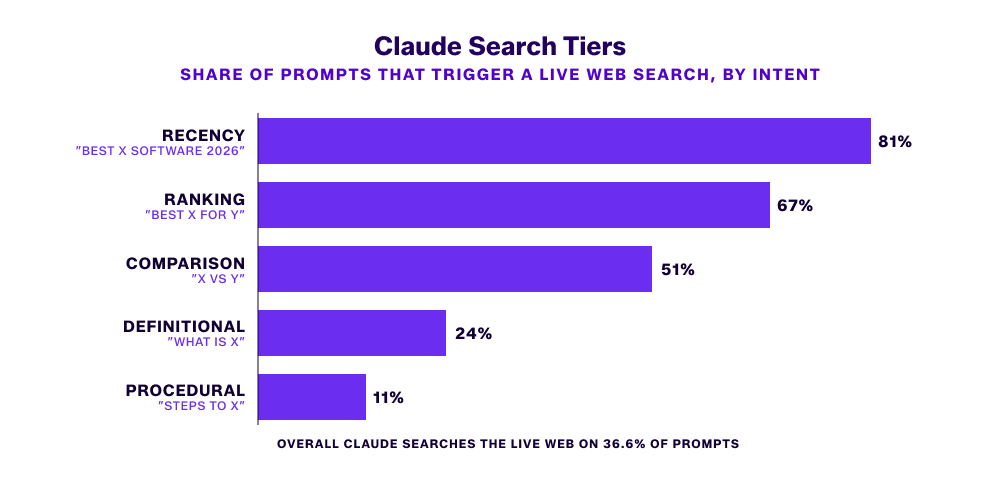
Claude only searches the live web 36.6% of the time, but the triggers are predictable: recency intent (“best [category] software 2026”) fires a search 81% of the time, ranking intent (“best…”) 67%, comparison intent (“X vs Y”) 51%, definitional intent (“what is…”) only 24%, and procedural intent (“steps to…”) just 11%. Recency and ranking content earns fresh citation far more reliably than evergreen definitional pages, which is a real argument for refreshing best-of and category-ranking content on a cadence instead of publishing it once and moving on.
Treat this like a media channel with its own reporting line, not a subsection of an SEO dashboard.
| Claude | ChatGPT | |
| Overlap with Google SERP | 64% | 37% |
| Primary secondary source | Brave rank (79.2% of citations preserve Brave’s order) | Broader mix, including forums |
| Forum/UGC citation rate | 0.9% | 15.8% |
| Listicle citation share | 36.4% | 19.7% |
| Brand product page share | 17.6% | 21.2% |
| Live search frequency | 36.6% of the time, intent-triggered | Higher, less selectively triggered |
The takeaway isn’t that one engine is “better” to optimize for. It’s that they reward different source types, which means one AI SEO content plan and one AI SEO budget line is under-building for whichever engine you didn’t design around.
Take a B2B SaaS company competing in a narrow, defined category, property management software, construction tech, whatever the vertical. Their Google organic already carries influence into Claude’s citations well beyond what it does for ChatGPT, simply because of the 64% SERP overlap. That means existing SEO investment isn’t wasted, it’s a head start Claude specifically rewards.
But it also means Brave rank becomes a free, checkable signal (at search.brave.com) that most B2B marketing teams have never once looked at, and Reddit-style community content, if that’s part of the current content mix, is doing almost nothing for Claude citation even if it’s earning ChatGPT citations. A team running one undifferentiated “AI search” line item would keep investing in both equally. A team that’s actually read the split budgets and measures them separately.
On Google’s side of the split, the pattern holds. An out-of-home advertising client of ours was still running traditional search tactics as the category shifted toward AI Overviews, and saw the predictable result, marked organic traffic declines and near-total absence from AI Overview results. The fix wasn’t more content volume, it was matching format to what AI systems actually prioritize: deep analysis of the non-branded questions generating AI Overviews in the category, then 52 new pieces of content built as natural-language, short-form FAQs against those specific gaps. Result: 32 AI Overviews conquered, a 12x increase in AI Overview inclusion, and a 38% increase in total year-over-year organic impressions.
“We already do SEO. Isn’t this the same thing with a new name?”
No. SEO optimizes for a ranking algorithm a human then scrolls through. AI SEO optimizes for an extraction step, an AI system pulling a specific passage to cite or paraphrase, often without the buyer ever seeing your URL. Good SEO content is a starting point, not a finish line, for AI SEO.
“Do we need a new budget line for this, or does it fit inside our existing content and SEO spend?”
The citation audit itself is low-cost and fast. The real cost shows up in content restructuring, and how much that costs depends entirely on how far your existing content already is from an extractable format. Teams with strong comparison and best-of content are closer than they think.
“Isn’t this too early? AI search traffic is still small compared to Google.”
Only 16% of brands are systematically tracking AI visibility right now, and CMOs already name measurement as their top challenge in this category. Being early to a citation position in a narrow vertical is exactly the kind of advantage that’s hard to unseat once a competitor locks it in first.
“How do we know if a vendor’s AI visibility data is any good?”
Ask which of the three measurement methods they use: active query simulation (synthetic prompts, where most tools sit today), passive panel (real user behavior, still rare in market), or platform-native reporting (newly available, first-party). Then ask whether their scores are directional or decision-grade, per the IAB’s new Measuring Visibility in the AI Era framework: decision-grade requires a weekly-or-faster testing cadence, majority platform coverage, and a documented reproducibility range, not just “results vary.”
If you can’t say with confidence whether your brand shows up when a buyer asks one of the popular AI engines who solves your category’s problem, start there before touching anything else. Run the citation audit per engine, don’t blend the scores, and check Brave rank while you’re at it since almost nobody does. Then match your content investment to what each engine actually rewards. To take two as an example: comparison and best-of formats for Claude, and broader source diversity, including community content, for ChatGPT. The teams treating this as one undifferentiated line item are going to lose shortlist position to the ones who read the split and budgeted for multiple strategies instead of one.

B2B Group Director, Tinuiti
Davis leads the B2B client pod at Tinuiti, where he helps SaaS and B2B brands like TikTok for Business, MetLife, Buildertrend, Dashlane, and more navigate the shift from last-click paid search to full-funnel measurement, trust building, and AI search visibility.