What Is Adaptive Commerce? Tinuiti’s Framework Explained


Shoppers rarely follow a predictable path to purchase, yet many brands still plan campaigns by channel, optimize for platform-specific metrics, or treat purchase as the end of the customer journey. This approach leaves valuable insights untapped, making it harder to understand what’s actually driving demand.
Adaptive Commerce puts purchase data at the center of the marketing strategy, connecting what shoppers buy to how brands allocate budgets, reach audiences, and drive growth. Here’s how Tinuiti’s framework actually works.
Adaptive Commerce is Tinuiti’s strategic framework that anchors the marketing ecosystem around point-of-purchase data, combining purchase and behavioral signals to adapt creative, audience modeling, media investment, and measurement. It connects direct-to-consumer (DTC) commerce, retail media, and marketplaces into one coordinated growth strategy.
The premise is straightforward: Purchase data should influence more than the next conversion campaign. It should also inform marketing decisions across the entire customer journey to help brands identify opportunities, allocate resources more effectively, and ultimately drive incremental growth.
Take customers who discover products on social media but complete their purchases through a major retailer. At first glance, retail ads may report strong returns, while social and streaming campaigns appear less effective. But those earlier interactions may have helped generate the demand in the first place. Without a comprehensive view of purchase behavior, the brand risks shifting budgets toward the final touchpoint rather than investments generating incremental sales.
Adaptive Commerce translates these insights into action. Purchase, inventory, and behavioral signals reveal where demand develops and what prevents conversion. Brands can respond by adjusting creative, audiences, budgets, or the retail experience, then evaluate subsequent transactions to determine what worked.
The concept of adapting to consumer behavior isn’t new, but its application has largely focused on individual aspects of the shopping experience, such as real-time pricing, personalized site search, and automated fulfillment. Walmart, for example, describes adaptive retail as bringing shopping to consumers according to their needs and preferences.
Tinuiti’s Adaptive Commerce framework addresses a broader question: How can purchase intelligence improve marketing decisions across every environment that influences demand? The answer calls for coordinated strategy, integrated data, and measurement that goes beyond channel-level attribution.
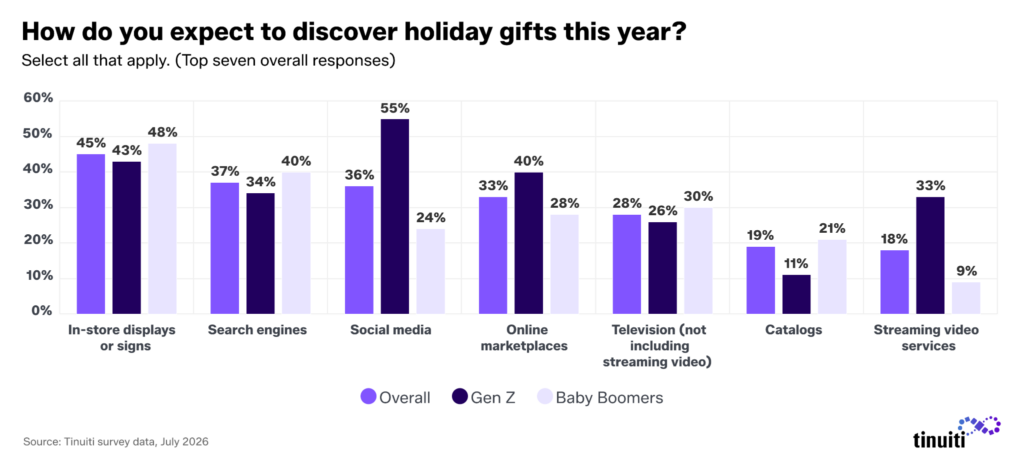
Search is now a behavior, not simply a channel. People search wherever questions arise, including social platforms, retailer sites, and AI tools. Brands need to adjust accordingly. Tinuiti’s 2026 Holiday Shopping Trends study, based on a survey of 1,000 U.S. holiday gift buyers, illustrates just how diverse shopping behavior has become:
Ecommerce accounted for 17.1% of U.S. retail sales in Q2 2026, according to the U.S. Census Bureau. Brick-and-mortar stores remain essential, even as online purchasing expands.
These findings challenge the assumption that channel performance can be understood independently of the broader shopping journey. A campaign that generates awareness on TikTok may ultimately drive purchases through Amazon or a physical retailer, but those sales won’t necessarily appear in the performance reports.
Brands need a way to understand how their investments work together, specifically which activities generate new demand or capture existing intent. Digital media can influence what shoppers ultimately purchase in-store, which makes it critical to connect online brand-building investments with sales at the physical shelf.
That’s where Adaptive Commerce comes in. By using purchase data to inform decisions across the marketing ecosystem, brands can identify emerging opportunities, coordinate investments, and adjust their strategies based on actual consumer behavior. That way, each purchase provides new information that can guide future marketing decisions.
Transactions, however, only tell part of the story. Purchase data reveals what consumers bought and where, but additional evidence is necessary to identify which marketing activities influenced those purchases. Combining behavioral insights with incrementality testing and other measurement approaches provides a more nuanced understanding.
The legacy funnel that we built strategies around doesn’t exist in the same way that it did previously. It’s not always awareness, consideration, and purchase in that direct flow. It’s someone discovering a product while they’re scrolling on TikTok, or they’re asking ChatGPT for gift ideas. Maybe they’re price checking [across] Amazon or Walmart before they buy… but every one of those moments is shoppable.
Jen Cornwell, Senior Director of AI SEO, Tinuiti
AI is introducing more ways for consumers to discover products, evaluate alternatives, and find deals. General-purpose AI tools and retailer-specific assistants don’t necessarily rely on the same information, so visibility in one environment doesn’t guarantee visibility in another.
Our 2026 Holiday Shopping Trends study found that:
However, growing adoption doesn’t necessarily mean consumers are ready to let AI complete their purchases. Our 2026 AI Trends Study found that 48% trust AI to recommend products, but only 20% trust it to buy them.
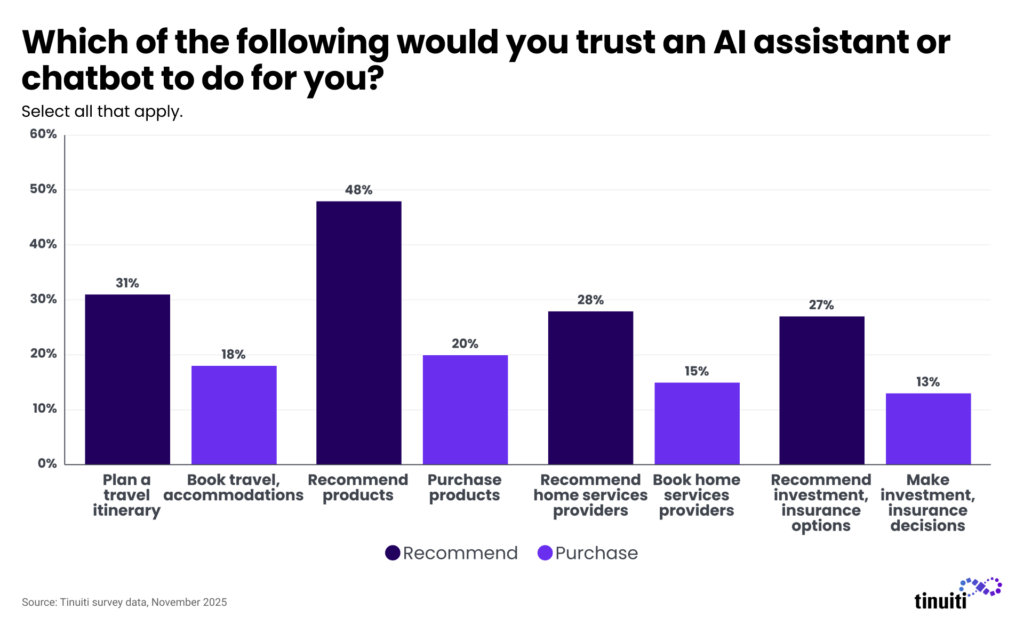
That makes discovery and consideration particularly important, even as agentic commerce introduces more autonomous shopping capabilities. And AI-assisted discovery is already influencing retail traffic and conversions: Adobe reported that AI-driven referral traffic to U.S. retail sites rose 693.4% during the 2025 holiday season and converted 31% better than other sources.
Adaptive Commerce helps connect these emerging discovery behaviors to purchase outcomes, enabling brands to refine their strategies as AI becomes a more prominent part of the shopping journey.
Our Q3 2026 AI Citation Trends Report, created in partnership with Profound, found that the top 100 ecommerce websites accounted for 12% of AI citations in July 2026. Amazon represented 14% of Microsoft Copilot citations, while Walmart accounted for 7%.
Since AI engines can corroborate product claims using retailer listings, reviews, Reddit, and publishers, brands need to consider how their products are represented across these sources, not just on their own websites.
That means developing product pages around actual shopper questions, providing specific and comparable attributes, maintaining accurate retailer listings, and monitoring customer reviews.
This is why it’s so important to understand how consumers search across different platforms. For example, if shoppers repeatedly ask AI assistants whether a product is compatible with a particular device, this can indicate gaps in available information. Marketers might respond by clarifying product specifications, updating retailer listings, or developing comparison-focused creative. They can then test whether those changes improve qualified traffic and sales.
For Adaptive Commerce, the opportunity extends beyond improving visibility in AI-generated recommendations. Prompts provide additional insight into consumer needs and purchase intent.
Commerce strategies have evolved to help brands connect channels, unify data, and create more consistent shopping experiences. While these approaches share common goals, each solves a different business problem:
| Approach | Core question | Primary owner | Main focus |
| Multichannel commerce | Are we selling in multiple places? | Channel teams | Storefronts and marketplaces |
| Omnichannel commerce | Does the experience feel consistent? | Ecommerce and CX | Customer journey |
| Unified commerce | Do channels share systems and data? | IT and operations | Commerce platform and transactions |
| Connected Commerce | Are retailers and channels linked? | Commerce and media teams | Cross-retailer reporting and activation |
| Adaptive retail | Does shopping adapt to consumer needs? | Retailers | Retail experience |
| Adaptive Commerce | Do purchase signals continuously improve decisions? | CMO and growth leadership | Creative, audiences, media, and measurement |
Adaptive Commerce builds on these existing models: A brand can use a unified commerce platform and deliver an omnichannel experience while applying Adaptive Commerce to decide where to invest and how to measure the results.
For Tinuiti, Adaptive Commerce represents an evolution of the Connected Commerce framework, expanding the ability to connect channels and retailers through shared data. The next step is putting that intelligence to work continuously, using purchase signals to inform marketing decisions as consumer behavior and business conditions evolve.
Tinuiti organizes Adaptive Commerce around a continuous, three-stage process:
This continuous cycle turns each interaction into new behavioral insights, revealing opportunities to refine marketing decisions and compound growth over time.
Let’s pretend a beauty brand notices first-time shoppers engage with ingredient comparisons but frequently leave retailer product pages. The team could identify a segment seeking reassurance about suitability, update their product content, and apply the same insight to social creative and retail media. Marketers could then examine changes in product-page engagement, conversion, new-to-brand sales, and repeat purchase. If results vary by retailer, the brand can adjust its next activation accordingly.
The value of the flywheel lies in applying what each cycle reveals to the next set of decisions. Retail transactions can uncover consumer needs that shape upper-funnel creative, while brand media can create demand that later appears in retailer search, sales, and repeat purchasing. Combining these signals creates more opportunities to improve acquisition, basket size, and retention, provided marketers can effectively measure the impact of their investments.
Even the most effective campaign can burn budget if the advertised product is out of stock, loses the Buy Box, or generates insufficient margin. That’s why Adaptive Commerce intentionally brings operational intelligence into media planning.
We support this approach through Bliss Point, our proprietary commerce intelligence and measurement technology.
Its Retail Operations & Readiness capabilities enable brands to incorporate real-time inventory guardrails, Buy Box status, and SKU-level margins into media execution. These signals help identify when to pause advertising on unavailable or low-margin products, redirect spending toward more profitable opportunities, and avoid investing in demand they can’t fulfill.
Integrating supply chain intelligence and media strategy also helps ensure that marketing investments support profitable growth rather than simply driving traffic or attributed sales.
Measurement tech that shows what’s driving growth – and exposes what’s holding your campaigns back.

Adaptive Commerce calls for measurement that connects demand creation with business outcomes. Tinuiti’s framework examines five stages, each with a different question:
| Stage | Question | Example signals |
| Influence | Are we creating future demand? | Reach quality, video completion, search lift, share of voice |
| Discovery | Are we capturing and shaping intent? | Search volume, CTR, traffic share |
| Consideration | Are we removing friction? | Product page engagement, review interaction, comparisons |
| Purchase | Are we converting demand efficiently? | Incrementality, new-to-brand, conversion rate, ROAS, AOV |
| Loyalty | Are we increasing long-term value? | Repeat purchase, LTV, subscriptions, churn |
The goal is to understand how marketing activities contribute to outcomes across these stages. A streaming campaign might lift branded search, which improves retail sales and, eventually, repeat purchases. Isolated dashboards rarely reveal the complete picture, and incrementality testing can help determine whether those investments generated additional sales rather than simply receiving credit for purchases that would have happened anyway.
Platform-reported return on ad spend (ROAS) is useful but doesn’t establish whether ads caused additional sales. The key is understanding the difference between two outcomes:
That distinction helps reveal whether a budget is generating new demand or simply claiming credit for existing demand. Holdout experiments and media mix modeling (MMM), especially when calibrated to experiments, can help estimate the difference.
A campaign with strong ROAS isn’t necessarily the best place to invest. It may already be reaching the bulk of its potential customers, while another channel offers more opportunity for growth. By combining incrementality testing with MMM, brands can better understand which investments generate additional returns and where to allocate their budgets.
For example, one Tinuiti apparel client used MMM-to-incrementality validation across ecommerce and Amazon to help inform a strategy that delivered an 11.4% conversion lift and 7.8% revenue lift. These results illustrate the value of measuring impact on multiple channels.
Measurement becomes more actionable when brands can actually apply insights across their existing tech stack. Bliss Point’s open, interoperable architecture connects client data, AI agents, retail cleanrooms, and activation platforms without demanding a system overhaul.
Through capabilities such as Bliss Point MCP, we connect data and workflows across tools like Skai and Pacvue, helping brands translate intelligence into coordinated media decisions while retaining control of their data. This approach helps marketers move from identifying incremental growth opportunities to acting on them across channels and retailers.
Bliss Point also helps brands use media mix modeling (MMM) to make more informed budget decisions throughout the year, rather than relying on periodic analyses of past performance.
By analyzing fresh data alongside diminishing returns, teams can identify where additional investment is likely to generate the greatest incremental impact across channels. This enables more dynamic budget allocation, allowing marketers to adjust their spending as opportunities emerge rather than waiting for the next planning cycle.
Consumers move between search, social, streaming, and retail environments throughout the shopping journey, but marketing budgets are often managed separately. This creates a disconnect between where demand originates and purchases happen. A surge in retailer searches, for example, might signal an opportunity to increase investment, but only if inventory, margins, and expected incremental returns support the decision.
Adaptive Commerce addresses this challenge by using shared insights to coordinate media investments across channels. Our recent guide to unlocking the compounding effect of search and social illustrates how these investments can reinforce one another: in a YouTube pilot conducted between Q4 2025 and Q1 2026, one client saw branded search cost per acquisition decline 11%, click-through rate increase 1.5%, and cost per lead fall 5%. The results highlight the potential for video advertising to support performance beyond its immediate engagement metrics.
The same principle applies to retail media. Advertising on Amazon, Walmart, and Target can capture demand generated through social, streaming, and other channels.
Putting this into practice requires clear rules for reallocating budgets. Tinuiti’s commerce media services help brands coordinate these investments around broader business objectives. With a more comprehensive view of performance, brands can adjust their spending as demand changes without sacrificing efficiency.
Advertising can’t generate profitable growth if the product is unavailable, uncompetitive, or poorly presented. Brands need to consider inventory, margins, Buy Box status, reviews, and product content before determining their retail media investments.
For example, a product approaching a stockout may warrant reduced ad spend, while a competitor’s stockout could create an opportunity to increase investment. Similarly, a campaign driving qualified shoppers to a listing with lousy reviews, missing images, or unavailable sizes may appear to have a targeting issue when the real problem lies with the product page.
These decisions all require coordination between media and retail operations teams. During our recent Adaptive Q4 Playbook panel, Amanda Dinan emphasized product-level inventory and weekly product page audits as practical inputs to media planning. ASIN-level inventory and margins, Buy Box status, product content, and review ratings can all help teams identify when to increase spending, pull back, or address operational issues before adjusting bids.
Putting Adaptive Commerce into practice requires technology that brings commerce intelligence, media performance, and operational data together to inform decisions across the customer journey. Bliss Point supports this through four components:
Bliss Point’s open architecture is designed to work with existing technology rather than replace it. By connecting intelligence, measurement, and execution, it helps translate purchase signals into coordinated decisions across the marketing ecosystem.
poppi illustrates the value of connecting digital advertising with retail purchase data to understand how marketing investments influence sales. Back when the prebiotic soda brand launched, the initial assumption was that its cola flavor would resonate most strongly with shoppers. But our team’s analysis of purchase behavior revealed a different opportunity.
By examining which products were attracting first-time customers, we found that fruit flavors were driving the strongest new-customer acquisition. These findings challenged poppi’s original creative strategy and provided a clearer picture of what shoppers actually wanted.
Armed with these insights, poppi shifted its product detail pages (PDPs), advertising creative, and messaging to emphasize fruit flavors. The changes helped improve conversion, demonstrating how purchase data can inform future marketing decisions, from the products brands promote to the audiences they prioritize. It also helped inform budget allocation by showing how advertising on one platform was associated with purchases through another.
The results were significant:
While poppi’s overall sales growth reflects broader business performance, the retailer-specific results illustrate the value of measuring media influence beyond the channel where an ad appears.
Adaptive Commerce starts with four critical questions:
Answering requires coordinated decisions across brand, performance, commerce, operations, and analytics. Tinuiti brings those capabilities together through its Adaptive Commerce framework, Bliss Point technology, and incrementality-driven measurement, while platform relationships with Amazon, Walmart, Target, and Google also create opportunities to evaluate emerging capabilities through alpha, beta, and co-build programs.
The objective is to turn purchase intelligence into decisions that improve total business performance. With Adaptive Commerce, every purchase becomes an opportunity to inform the next investment.
Turn shopper and purchase signals into measurable growth across DTC, retail media, and marketplaces.
Explore Tinuiti’s Adaptive Commerce framework. Or talk to our team about your commerce strategy.

Copywriter, Tinuiti
Rachel is a content marketer and writer with over a decade of experience. She specializes in developing original, story-driven content for B2B brands on AI and other technical topics. She is based in Charleston, SC and enjoys yoga, travel, and creative writing.