Amazon Ads Strategy: Sponsored Ads Setup, Optimization, Scaling


Amazon ads are no longer just a knob you turn to hit a target ACoS—they’re a capital allocation decision that should balance short-term efficiency with long-term, margin-aware growth. Winning brands treat Amazon as a full-funnel, measurement-led program, not a siloed performance channel.
In this guide, you’ll learn how to:
Amazon ads sit at the intersection of demand capture and brand-building, which means they can either defend your share of attention or architect the next stage of your business growth. For years, most programs were steered almost entirely by advertising cost of sales (ACoS) and return on ad spend (ROAS), optimizing for short-term ad efficiency with little consideration for incremental revenue, customer lifetime value, or brand equity.
The most sophisticated brands are now layering Amazon Marketing Cloud’s (AMC) Long-Term Value (LTV) insights on top of ROAS to understand which audiences, formats, and journeys are profitable not just this week, but over the full customer lifecycle. By combining AMC path-to-conversion and cohort views with LTV, they can see which campaigns create high-value, repeat buyers and which only drive one-and-done shoppers—shaping bidding, budgeting, and creative around customers who matter most to the P&L.
Our Bliss Point Marketing Operating System ingests omnichannel data so we can see how Amazon ads and other media work together to drive immediate revenue and long-term brand equity, and make channel and budget calls with confidence instead of guessing. We also publish our own read on the market each quarter in our Digital Ads Benchmark Report, pulling from the scale of Amazon spend we manage across brands, so you’re not just looking at your own numbers in isolation; you’re seeing where the category is actually moving.
Customer long-term value delivers critical insight into the drivers of brand loyalty. With this information, we can make smarter investment decisions and apply those insights to optimize our advertising strategies for lasting impact.
Laura Pulgarin, Senior Manager of Commerce at Tinuiti
A smart Amazon advertising strategy starts with the core performance formats, Sponsored Products and Sponsored Brands, supported by Amazon DSP once the program is ready to move beyond on-site search. Sponsored Products are the workhorse for harvesting demand, surfacing your ASINs when shoppers conduct a relevant search, view similar products, and defending your branded search terms and product detail pages from competitors.
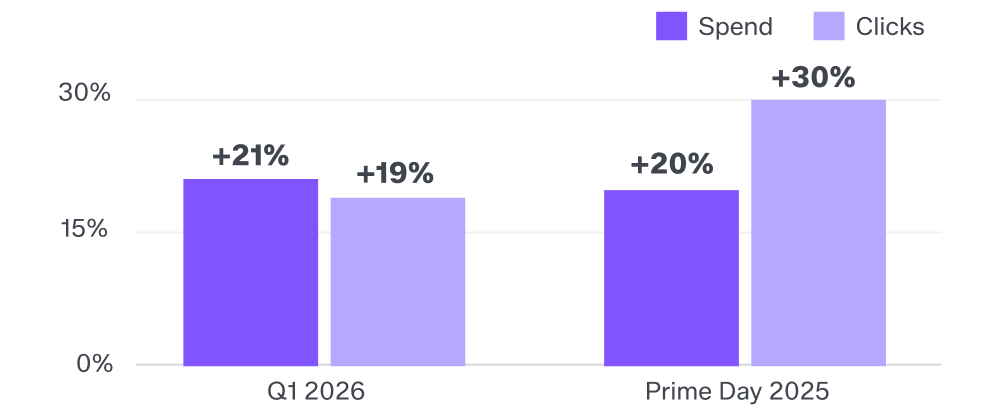
In Q1 2026, Amazon Sponsored Products spending was up 21% year-over-year, driven by a 19% increase in clicks. During 2025’s 4-day Prime Day event, Sponsored Products spend rose 20% year over year, and clicks rose 30%.
Sponsored Brands sit higher in the funnel, pairing custom headlines, brand logos, and Store destinations to build top-of-search consideration while expanding new-to-brand reach across category and competitor searches. Amazon DSP then extends this strategy off-site, bridging Amazon and non-Amazon touchpoints with display, video, and audio that support retargeting, cross-sell, and conquesting across a broader media footprint.
Success by format looks different: Sponsored Products are optimized for efficiency and scale (conversion rate, ACoS, Total Advertising Cost of Sale (TACoS), and share of voice. Sponsored Brands prioritize brand search growth, store engagement, and new-to-brand metrics tied to building future demand. Amazon DSP leans into reach, frequency, audience quality, and view-through performance, especially when paired with clean incrementality measurement and LTV lenses that quantify the long-term impact of mid- and upper-funnel media.
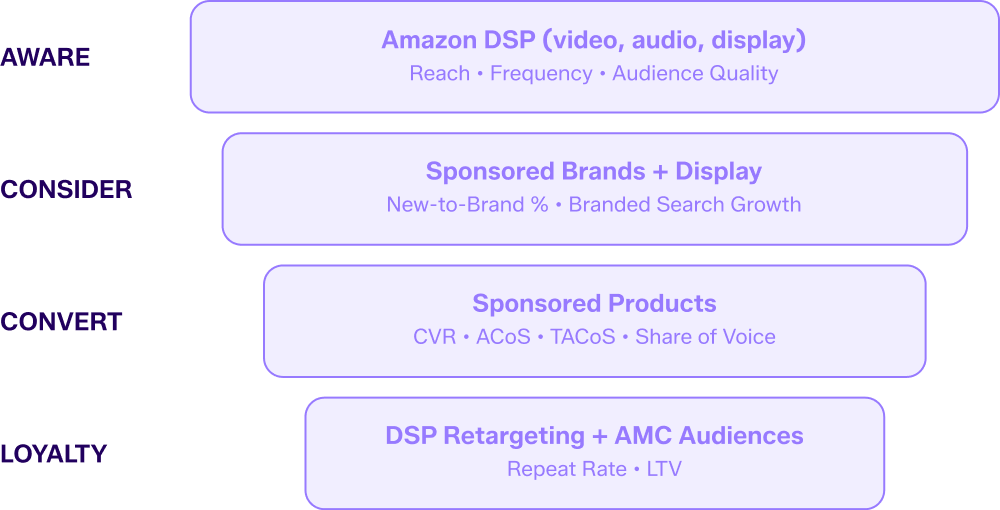
The key is format mix. Too many brands over-index on Sponsored Products because they are easy to justify in last-click models. High-performing programs deliberately balance harvest (Sponsored Products), consideration and brand-building (Sponsored Brands), and full-funnel audience development and retargeting (Amazon DSP), ensuring each format contributes to both immediate revenue and durable, margin-aware growth.
At a certain maturity, Sponsored Ads alone cannot cover the full customer journey. Amazon demand side platform (DSP) extends your reach beyond Amazon’s owned properties into video, display, and audio inventory, enabling you to build audiences, tell richer stories, and re-engage shoppers wherever they spend time.
DSP is the right next step when you want to:
From our perspective at Tinuiti, DSP works best when connected to a clear measurement backbone, in which Amazon Marketing Cloud (AMC), attribution, and Bliss Point insights can quantify the incremental value of off-Amazon media to Amazon and non-Amazon revenue.
Measurement tech that shows what’s driving growth—and exposes what’s holding it back.

Amazon ads sit closer to the retail P&L than almost any other digital channel, which means success depends less on whether you are a Seller or Vendor and more on how tightly your retail and advertising teams are aligned. Unlike search, social, or CTV, Amazon decisions about bids, budgets, and formats are directly shaped by pricing, margin, inventory, and retailer relationships (areas typically owned by sales, ecommerce, and finance).
In practice, that creates a cross-functional operating model:
When these groups run in silos, Amazon campaigns often chase ACOS or ROAS without regard for margin, inventory, or long-term brand dynamics. When they are coordinated, bid and budget decisions are informed by contribution margin, inventory posture, and product lifecycle stage, so “good” performance is defined in business terms, not just platform metrics.
Mature organizations formalize this governance early, determining who owns retail readiness, who owns media, who owns measurement, and which partner is accountable for connecting Amazon ads to total business outcomes. Tinuiti’s Bliss Point Operating System unifies those viewpoints, so Amazon strategies across categories and business models roll up to a shared P&L and brand equity ambition rather than competing scorecards.
Campaign architecture is where Amazon PPC either scales cleanly or turns into an unmanageable tangle. The goal is for anyone to be able to look at your portfolios and immediately understand what the dollars are doing for the business.
Tinuiti teams typically organize Amazon campaigns along four consistent dimensions:
This structure makes it easy to see, for example, how much you are investing in branded vs. competitive search, or how DSP retargeting vs. awareness budgets are contributing to overall performance. It also simplifies reporting by tactic and funnel stage, and ensures finance can connect each budget line to a clear strategic intent rather than a flat, undifferentiated list of campaigns.
Within that framework, teams can still layer in margin tiers and product lifecycle stages (launch, evergreen, clearance) where needed. For instance, giving high-margin hero SKUs more aggressive bids and dedicated structures, while long-tail SKUs sit in more efficient, discovery-focused campaigns. The key is consistency: When brand, product, ad type, and tactic are all encoded into the architecture, Amazon ads become easier to scale, manage, and align with business goals.
Good naming conventions turn Amazon ads from a black box into a transparent system. Each campaign name should encode the essentials: region, ad type, product or category, goal, and target theme (like branded, nonbrand, competitor).
This consistency pays off in reporting. Weekly business reviews can quickly surface where growth spend is scaling, which defensive efforts are protecting share, and how campaigns align to broader brand priorities. It also ensures that as teams or agencies change, your taxonomy endures, which is critical for trend analysis and for plugging Amazon data into Bliss Point’s unified measurement environment.
As Amazon ad budgets scale into seven and eight figures, the core risk shifts from “are we visible?” to “are we deploying capital in the right places, at the right pace, without breaking the model?” Guardrails turn your financial strategy into specific rules that keep spend productive while algorithms keep learning.
Start by anchoring portfolio-level caps to strategic intents—defense, conquest, new launches, and retargeting—then layer campaign-level budgets and pacing rules beneath them. Finance can instantly see how much risk sits in each bucket, while operators still have room to move dollars within those bounds as performance evolves.
For high-volatility moments like Prime Day and Q4, design “kill switch” playbooks in advance: what metric thresholds trigger a pause or bid cut, who signs off, and how quickly changes must go live. Those playbooks should cover both overspend scenarios (ACoS spikes, ROAS collapses, inventory stress) and underspend scenarios (missing impression share or leaving profitable demand uncaptured).
Centralized vs. decentralized budgets is a deliberate design choice, not an accident. Centralizing at the portfolio level maximizes financial control and maintains strategic ratios; decentralizing at the campaign or product level accelerates testing and category-level response time. Most mature programs blend both: tight, centralized guardrails for core revenue drivers, with constrained “sandbox” budgets reserved for experimentation.
Tinuiti teams typically encode these guardrails into operational runbooks and automated alerting, so anomalies—CPC spikes, budget burn ahead of plan, or unexplained margin compression—surface before waste compounds. Layering Bliss Point’s incrementality and MMM outputs on top, then helps triage which alerts actually threaten profit, ensuring the team fixes what matters most first
Every click you buy is a bet on your listing. Titles, bullets, images, A+ content, reviews, and pricing all directly influence conversion rate, which in turn affects CPC efficiency, ACoS, and how often your ads win impressions.
Before you scale Amazon ads, audit top-spend ASINs against category norms:
Strong retail readiness gives your campaigns more room to bid, because each incremental lift in conversion turns the same media spend into more revenue.
In 2026, that audit has to account for a new layer: agentic commerce.
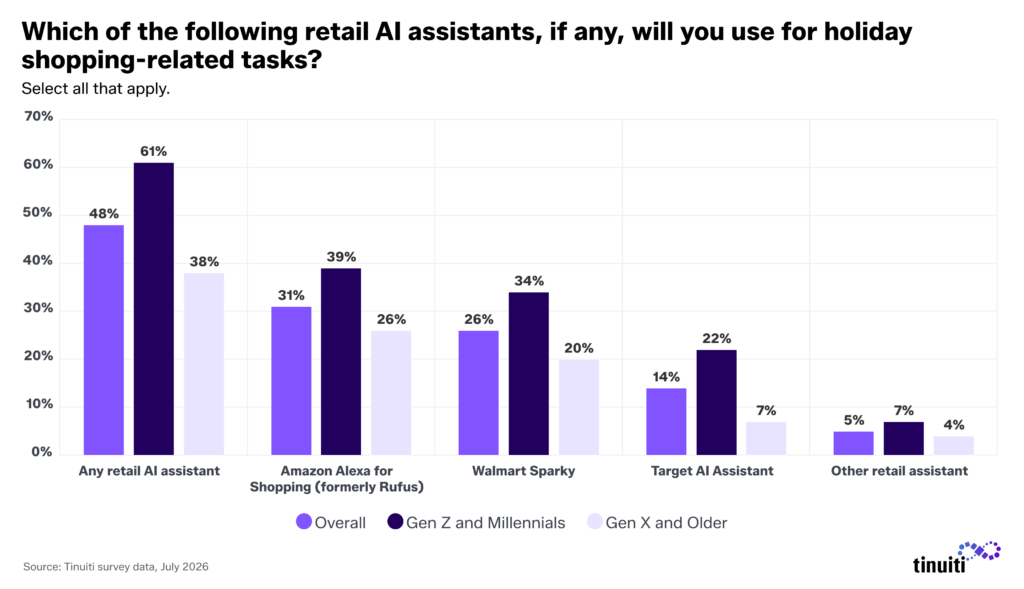
Alexa for Shopping and other shopping agents are increasingly acting as the “front door” to Amazon, answering natural-language queries, building carts, and making product recommendations on the shopper’s behalf. When a customer says “Alexa, reorder shampoo” or asks “What’s the best sunscreen for sensitive skin?”, the agent is relying on your product data—titles, attributes, ratings, and content quality—to decide which ASINs to surface.
Tinuiti’s recommendations on Amazon agentic commerce highlight a few practical listing implications:
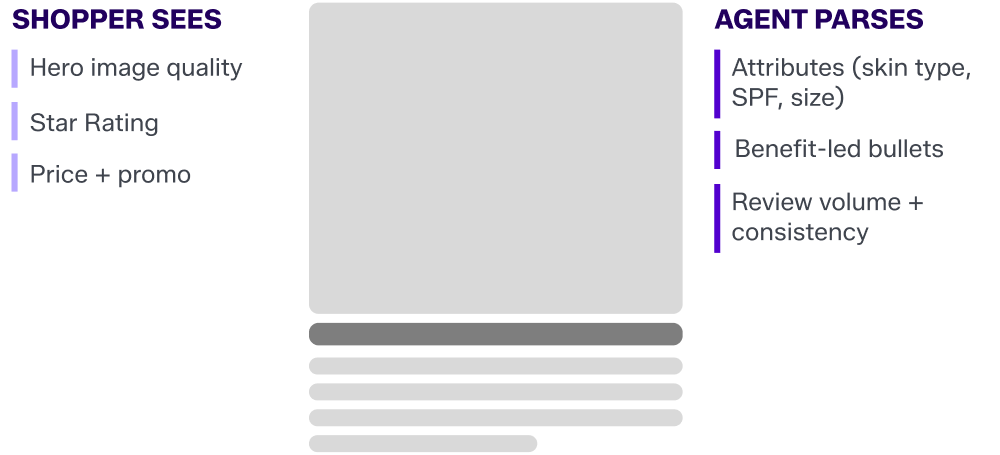
When you optimize listings with both human shoppers and AI agents in mind you’re not just improving on-page conversion; you’re increasing the odds that your ASINs are selected and recommended more often, which ultimately makes every Amazon ad click cheaper and more productive.
Your Amazon Store is the destination where brand narrative and merchandising converge. Build Store journeys for hero collections, comparison paths, bundles, and seasonal stories that match how shoppers actually browse your category.
Connect Sponsored Brands campaigns to these Store experiences instead of scattering traffic across isolated product detail pages. Store analytics offer insight into click paths, engagement, and drop-off points that standard campaign dashboards can’t show, making them a critical input for both creative optimization and broader commerce operations.
Auto and manual campaigns should work together, not compete for the same budget. Auto campaigns are the discovery engine, surfacing new search terms and product placements that reveal how shoppers actually find your products.
Manual campaigns then “lock in” what works, using exact, phrase, and broad match types to control spend on the highest-value queries and placements. Establish a recurring cadence for moving terms from search term reports into manual structures, and avoid over-allocating budget to auto campaigns until enough data has accrued to make quality decisions.
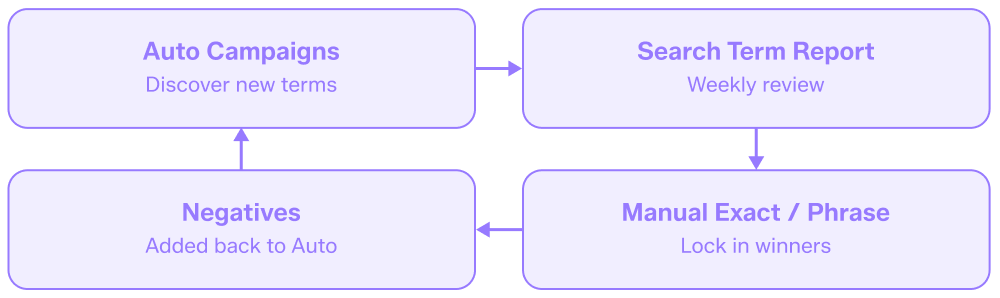
A healthy keyword model spans branded, category, competitor, and long-tail queries, each mapped to appropriate match types. Branded terms often sit in exact- and phrase-match campaigns optimized for efficiency, while broader category terms benefit from a mix of phrase match for scale plus a set of must-win exact-match terms to protect priority placements. Broad match today behaves less like a scale lever and more like an extension of Auto targeting, best used for discovery rather than predictable efficiency.
Negative keyword strategies deserve as much attention as the keywords targeted. Use campaign-level keyword negation to define clear intent boundaries, and ad group-level negatives for fine-grained control within structures. A structured “negatives and harvest” routine prevents internal cannibalization and keeps budgets focused on the highest-intent searches for your brand.
Product targeting unlocks new ways to win category share. Target specific ASINs when you have a clear right-to-win (better price, reviews, or differentiation), while category and refined subcategory targeting help you reach broader audiences exploring similar items.
Layer audiences on top of product and keyword strategies—such as in-market or lifestyle segments—so your bids reflect both context and intent. This is where Amazon ads start behaving more like a full-funnel program, especially when combined with DSP audiences and measured holistically through Bliss Point.
Many Amazon programs over-rely on ACoS as the primary steering metric. While useful, ACoS alone can mislead, especially when it encourages underinvestment in growth-driving campaigns.
Introduce TACoS to show how Amazon ads affect total channel revenue, and align both ACoS and TACoS to contribution margin rather than top-line sales. Likewise, tracking New-to-Brand sales across Sponsored Brands and ADSP will provide insight into your media’s effectiveness at driving new, incremental customers. Separating “growth spend” from “efficiency spend” in reports allows leadership to see which budgets are designed to expand category share versus those meant to defend profitability. Bliss Point then extends this view beyond Amazon, showing how these investments affect both online and offline revenue.
Effective bid optimization focuses on a few levers that matter most: base bids, placement multipliers, and rules tied to margin and conversion probability. Incorporate margin, category conversion rate, and repeat purchase behavior into your bid logic to avoid paying more for clicks than you can sustainably monetize.
Automated bidding strategies can accelerate optimization, but they need human oversight to protect profitability and brand positioning. Leaders should ask not just “What are we bidding?” but “Why are we bidding this?”—and expect clear answers grounded in both platform data and broader measurement insights.
Initial base target-level bids set the context of a given impression and its potential cost. Bid modifiers let you flex a base bids up based on where, to whom, and under what conditions an ad is served, rather than setting one bid per keyword or ASIN and hoping it works everywhere.
Layering audiences on top of product and keyword strategies allows your bids to reflect both context and intent. This is where Amazon ads start behaving more like a full-funnel program, especially when combined with DSP strategies and measured holistically through Bliss Point.
AMC audience modifiers can help bridge the gap between DSP and search based strategies. Always test a new audience at a lower base bid modifier to show proof of performance vs base campaign metrics and test scaleability.
Budget allocation is where strategy meets reality. Define portfolio splits for defense, conquest, retargeting, and new launches, and adjust those ratios seasonally while preserving enough stability for algorithms to learn.
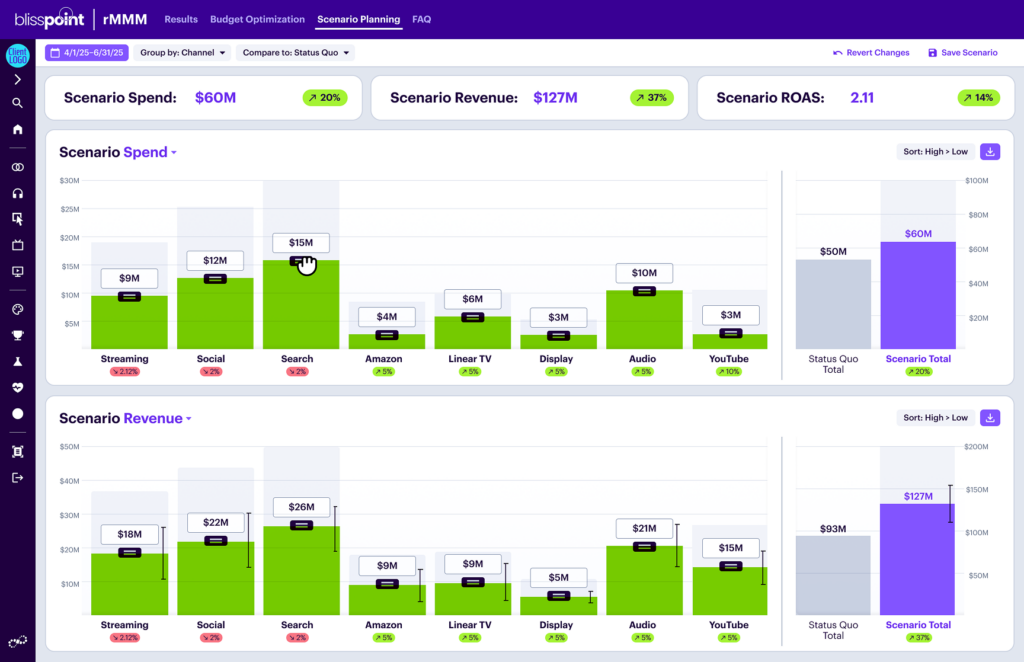
During peak periods, underspending can be as damaging as overspending, as you forfeit profitable share to competitors. Use historical performance and scenario modeling—supported by tools like Rapid MMM within Bliss Point—to plan in advance how budgets will flex across Amazon ads and other channels as demand surges.
Sponsored Brands are most powerful when they mirror a funnel, not just a keyword list. Map campaigns to goals and choose destinations accordingly: Stores for exploration, custom landing pages for curated journeys, and product pages for bottom-funnel intent.
Sequence messaging so shoppers see a consistent story across queries and stages, avoiding redundant or conflicting headlines. Diagnose “leaks” where impressions and clicks do not translate into Store engagement or add-to-carts, and fix them through more relevant headlines, videos, or destinations.
For more advanced programs, Sponsored Brands are planned in lockstep with finance and measurement teams: funnels are designed not just to drive clicks, but to shift the mix toward higher-margin SKUs, bundles, or repeat-friendly products. Over time, AMC data can show which Sponsored Brands funnels produce the highest long-term value per acquired customer, so future creative briefs and landing page strategies maximize that LTV, not just short-term ROAS.
In crowded search results, Sponsored Brands Video has only a few seconds to win attention. Lead with a clear problem, product proof, or differentiator in the opening frames, and tailor creative variants for category browsers, competitor searchers, and branded queries.
Follow Amazon’s creative acceptance policies to reduce rejection risk and launch delays, and build production guardrails into your workflow so videos ship on time and in compliance. Tinuiti’s creative teams often use performance data and Bliss Point’s Creative Insights to refine concepts and iterate toward higher-impact video assets.
To justify investment in Sponsored Brands, focus on metrics that link to business outcomes: new-to-brand percentage, branded search growth, and long-term revenue impact. Click-through rate and video views have value as diagnostic signals, but they should not be the sole success criteria.
Where full AMC access is not yet in place, create proxy frameworks that infer brand lift from patterns in search, repeat purchase, and halo effects on non-advertised ASINs. As your measurement stack matures, shift more weight to clean-room and MMM-based insights to separate incremental impact from baseline demand. When those brand metrics are fed into a broader model they help quantify how Sponsored Brands contributes to total revenue and brand health, so you can defend brand-building budgets with the same rigor as performance spend.
Deciding who enters each retargeting pool should be intentional. Not every page view is equal: shoppers who viewed high-margin hero SKUs, added to cart, or engaged deeply with your Store often deserve more aggressive and persistent DSP coverage than low-intent bounces. Building these tiers into your audiences helps you invest more behind the shoppers most likely to generate profitable repeat behavior.
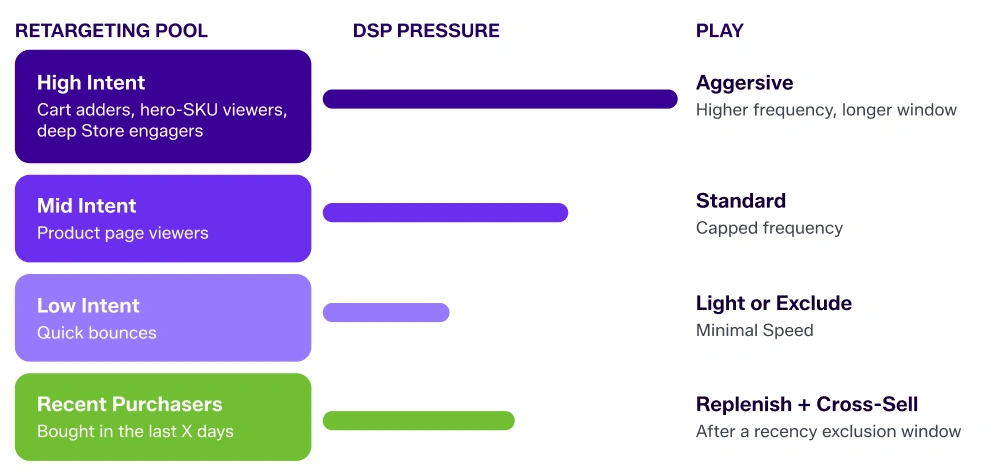
Amazon DSP enables durable, cross-channel retargeting cycles that protect the consideration phase and extend well beyond the Amazon SERP. Use views remarketing to stay top of mind with shoppers who viewed across Amazon properties, streaming media, and third-party inventory, but didn’t purchase, and purchase remarketing to drive replenishment and cross-sell without overwhelming customers.
Set frequency and recency caps to balance visibility and experience, and carefully exclude recent purchasers where appropriate. This protects brand perception while still capturing incremental revenue and LTV that generic search campaigns or Sponsored Products alone might miss.
Beyond retargeting, Amazon DSP is your primary tool for mid-funnel expansion and prospecting. Audience expansion, contextual placements, and product- and category-based targeting let you reach new shoppers who are in-market or in-category, even before they type a purchase-ready query into Amazon.
These campaigns should be held to incrementality-aware KPIs, not just last-click ROAS, since their job is often to introduce and educate rather than close immediately. Use DSP to complement, not cannibalize, Sponsored Products—filling mid-funnel gaps where shoppers are browsing content, watching streaming video, or comparing brands across environments.
To keep prospecting honest, define in advance what “good” looks like: incremental new-to-brand buyers, lift in branded search, or contribution to high-LTV cohorts identified in Bliss Point, rather than just surface-level ROAS. That way, when you scale mid-funnel DSP, you are deliberately expanding your future revenue base instead of simply bidding against yourself at the last click. Bliss Point’s Always-On Incrementality helps ensure prospecting dollars are growing the pie, not just reshuffling existing demand.
Display and video environments require different creative than search results. When shoppers are not in active search mode, lead with clear value propositions, strong visuals, and storytelling cues that quickly establish relevance and differentiate your brand.
Contrast on-Amazon and off-Amazon placements within DSP, adjusting messaging, format, and design for each context. For example, short, benefit-led messages in streaming video vs. more detailed proof points in display units. When DSP campaigns underperform, diagnose whether the issue lies in audience selection, reach and frequency, creative, or landing experience before cutting budgets; each lever can dramatically change results.
Amazon’s native dashboards excel at reporting clicks, conversions, and attributed revenue by campaign and format, and tools like Amazon Marketing Cloud now help address many structural questions around path-to-conversion, overlap, and halo within the Amazon ecosystem. The remaining limitations are more fundamental: Amazon’s view of “new-to-brand” only reflects purchases within Amazon, not whether a shopper is actually new to your brand across other channels, and there is no native, robust solution for measuring how non-Amazon media influences Amazon sales—Amazon Attribution alone is not sufficient for true cross-channel incrementality.
To make Amazon measurement actionable for executives, build a cadence where daily metrics are used for health checks, weekly reviews focus on tactical optimizations, and monthly or quarterly reviews focus on strategic shifts. This discipline prevents overreaction to short-term noise while still catching meaningful changes in shopper behavior, competitive dynamics, and cross-channel performance when combined with a broader measurement stack.
Amazon Attribution links paid social, paid search, influencer, and email efforts to Amazon sales, closing the loop between off-Amazon media and on-Amazon outcomes. Before deploying tags, standardize naming conventions, creative IDs, and campaign mappings so reports are actually readable and consistent with your broader measurement stack.
Use Attribution data as a directional signal. Combining it with lift tests and MMM insights from Bliss Point allows brands to understand how off-Amazon channels and Amazon ads work together to drive total business results.
AMC introduces clean-room analytics that let you explore path-to-conversion, reach and frequency, audience overlap, and new-to-brand at a much deeper level than standard reporting. With the right queries and governance, leaders can answer questions about how different formats and audiences work together over time.
Many of these insights can be actioned upon by creating AMC Audiences, custom audience segments that can be built directly from AMC data. These audiences can be deployed across ADSP campaigns, as well as Sponsored Product and Brand search campaigns.
The real value comes when AMC insights are operationalized—feeding back into audience definitions, flighting, and creative strategy rather than just populating executive decks. Here, Bliss Point and AMC complement each other: one looks across channels and outcomes, the other dives deep into Amazon’s ecosystem, together giving brands a holistic view of performance.
Without a disciplined testing roadmap, Amazon ads tests tend to “find” winners that were just noise or seasonality. Treat experimentation like a product roadmap rather than a collection of ad hoc ideas. Each test should ladder up to a clear question about structure, audiences, or creative that ties back to growth or margin.
Start with high-leverage foundations before micro-optimizations. First, test account structure and targeting (for example, consolidating overly fragmented campaigns or redefining match-type strategy). Then, test creative angles and landing destinations. Finally, refine offer mechanics such as discounts, bundles, or Subscribe & Save positioning. This ordering ensures you are not optimizing copy on top of a broken structure.
Define minimum viable test parameters upfront, budget, time-in-market, and guardrails for volatility, so sample sizes are large enough to detect real differences. Hold key variables constant: if you are testing a new targeting model, keep creative and bids stable; if you are testing creative, lock targeting and budgets. Bliss Point’s Always-On Incrementality and Rapid MMM capabilities then help validate whether observed lifts are truly incremental, rather than just a redistribution of conversions from other campaigns or channels.
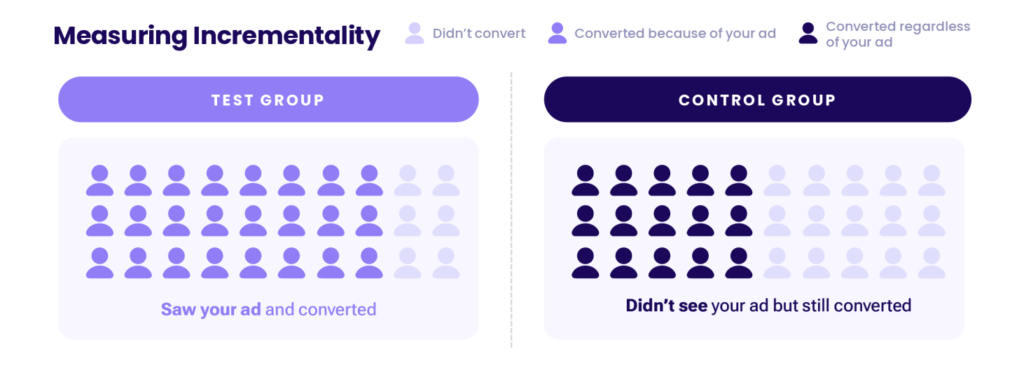
For more strategic questions, such as whether to shift budget from Sponsored Products into Sponsored Brands Video or Amazon DSP, design structured incrementality tests with explicit control and exposed groups. This is where Bliss Point’s causal inference framework becomes critical, quantifying the holistic impact of those shifts on Amazon and non-Amazon revenue rather than relying on platform-reported ROAS alone.
The most sophisticated Amazon programs run on a defined optimization operating system rather than sporadic cleanups. At the weekly level, teams should review search term reports, adjust bids and placement multipliers, pressure-test pacing against spend and revenue plans, and rotate in new creative where early signals support it. These actions keep your Amazon PPC machine aligned with live shopper behavior and competitive pressure.
Monthly, zoom out to structural and audience-level insights: audit campaign and portfolio architecture, expand or prune keyword coverage, analyze placement and device performance, and evaluate new-to-brand trends by format. This is also the right cadence to review interim findings from Bliss Point’s Rapid MMM and Always-On Incrementality, shifting budgets toward combinations of formats and audiences that consistently drive incremental profit, not just attributed sales.
Quarterly, step back even further to make strategic calls: re-evaluate your defense vs. conquest vs. retargeting vs. launch-budget mix; reconsider your use of DSP and refresh AMC-driven audiences based on updated path-to-purchase analyses; and recalibrate your executive KPIs. These quarterly reviews connect Amazon ads decisions to the broader media plan and Brand Equity trends that Bliss Point surfaces across online DTC, retail channels, and offline sales.
When experimentation and optimization follow this layered cadence, Amazon ads become a living operating system that constantly reallocates spend toward the most incrementally valuable opportunities. Instead of chasing short-term ACoS wins, leaders can see how each test and optimization decision moves the holistic business outcome they truly care about: profitable, sustainable growth.
Policy missteps slow growth. Establish an internal pre-submission checklist that bakes Amazon’s creative acceptance rules into every brief and asset review, especially in sensitive or regulated categories.
Know the most common rejection triggers for each format and document them so learnings persist as teams change. This reduces launch delays and protects momentum during key selling windows.
As privacy norms evolve, audience strategies must remain firmly within platform rules. When multiple agencies or retailers touch the same account, define governance for who can launch what, under which audience strategies, and how compliance is monitored.
Good documentation is the antidote to policy debt—a buildup of warnings, suppressed listings, and partial restrictions that quietly erode performance.
Account health should be reviewed proactively, not just when ads stop serving. Monitor for early signs of strain (rising suppression, escalating policy flags, inconsistent approvals) and define clear escalation paths with Amazon support.
Incorporate account health reviews into your regular operating cadence alongside performance metrics, ensuring that growth does not come at the cost of long-term stability.
In mature organizations, Amazon is not a side project—it is a cross-functional program with clear owners, shared KPIs, and defined handoffs. The core disciplines are retail readiness, media buying, creative, analytics, and finance, and high-performing teams are explicit about where each sits and how they collaborate.
A common pattern: brand or ecommerce teams own category strategy, pricing, and product roadmaps; operations teams own inventory and retail readiness; a specialized partner like Tinuiti owns media, measurement, and experimentation; and finance defines the guardrails for margin and payback. This structure lets brands protect their category vision and P&L while Tinuiti focuses on architecting business outcomes across Amazon ads and the rest of the media mix.
What separates advanced programs is not just who owns what, but how decisions are made. Weekly and monthly forums should bring these functions together around a single Amazon view: what changed in shopper behavior, what the tests showed, how Bliss Point’s insights are shifting optimal spend levels, and what that implies for upcoming launches and inventory.
The right reporting architecture gives every stakeholder the same underlying truth in views tailored to their decisions. Operators need a line of sight into search terms, bids, placements, and ASIN-level contribution; executives need to see how Amazon advertising impacts contribution margin, incrementality, and total enterprise growth.
Start by standardizing core definitions (revenue, contribution margin, “incremental,” “new-to-brand,” “growth spend,” “efficiency spend”) and codify them in a shared data dictionary. This prevents endless debates over whose numbers are “right” and allows Bliss Point to function as the unified source of truth that reconciles Amazon performance with DTC, wholesale, and offline channels.
From there, design two primary layers:
When these layers are connected, leadership can adjust budget at the channel or format level with confidence, knowing operators can see exactly how to execute and validate the impact.
Automation should extend your team’s judgment rather than replace it. Rule-based tasks like budget pacing, bid floor and ceiling enforcement, anomaly detection, and taxonomy checks are ideal candidates for automation, freeing humans to focus on strategy and creative problem-solving.
Recent Amazon releases reinforce this direction. The Amazon Ads MCP Server gives AI agents standardized, natural-language access to Amazon Ads APIs, turning complex workflows like campaign creation and reporting into structured tools and skills. Ads Agent does something similar for Amazon DSP, using conversational prompts to automate time-consuming steps in planning and launching DSP campaigns. These capabilities can dramatically reduce manual effort—but they still need human strategy, guardrails, and measurement to decide what should be automated and why.
Human oversight remains essential for decisions that require context: Which audiences to prioritize, how aggressively to lean into conquesting, when to loosen or tighten ROAS targets, and how to respond to competitive moves or macro shifts. Bliss Point’s real-time analysis and always-on incrementality help inform these calls by showing where additional automated “optimization” would actually erode long-term profit or brand health, even if short-term ROAS looks attractive.
On the data side, API access and integrations allow sophisticated brands to stream Amazon signals into their CDPs, BI tools, and measurement layer. This unlocks more advanced use cases, such as connecting AMC insights with cross-channel MMM or feeding creative performance data into centralized asset libraries, but it only works with strong internal data governance and clear ownership between the brand and partners like Tinuiti.
The first month is about diagnosis and stabilization—getting out of “we don’t know what we don’t know” and into a clean, controllable baseline. Start with a full audit of account structure, portfolio logic, and naming conventions, then fix obvious retail readiness gaps on your top-spend and top-potential ASINs.
In parallel, confirm that baseline measurement is configured correctly: conversion tracking, core dashboards, and profit/margin inputs that finance trusts. Quick wins in this window typically come from negative keyword build-out, match-type hygiene, and simple conversion-rate lifts that increase revenue from existing traffic without increasing spend.
With the foundation in place, the focus shifts to systematic optimization and controlled expansion. Establish a recurring search-term harvesting routine, rationalize overlapping campaigns, and launch creative variants across Sponsored Brands to better align with different intents.
This is also when to implement Amazon Attribution tagging for key off-Amazon campaigns and design your first incrementality test, so early expansion is grounded in causal insight, not just surface-level ROAS. Review budget allocation against actual margin data and start shifting spend toward the most profitable combinations of formats, audiences, and ASINs—using Bliss Point outputs where available to understand cross-channel impact.
In the final phase, move from “better optimization” to “smarter growth.” Turn on AMC (where available), run your first path-to-conversion and audience overlap analyses, and use those insights to refresh your targeting, sequencing, and funnel design.
Define clear criteria for scaling into—or deeper into—Amazon DSP, based on incrementality, LTV, and contribution margin, not just impression share. At the same time, formalize an executive reporting cadence that ties Amazon performance directly to holistic business impact, powered by Bliss Point’s Rapid MMM and Brand Equity outputs. At this point, the 90-day roadmap becomes your ongoing operating system, not a one-time reset.
| Phase | Primary Objective | Example Actions |
| First 30 Days | Diagnose and Stabilize | Audit structure and naming; fix top ASIN retail readiness; clean negatives and match types; validate tracking and baseline profit inputs. |
| Days 31 Through 60 | Optimize and Expand | Implement harvest routine; launch SB/SD creative variants; deploy Amazon Attribution; run first incrementality test; reallocate budget by margin. |
| Days 61 Through 90 | Align to Full-Funnel Growth | Activate AMC; analyze paths and overlap; refresh audiences; define DSP scale criteria; publish executive view tied to contribution margin and holistic impact. |
Amazon ads are no longer a channel you can optimize in isolation. To truly architect business outcomes, your strategy must connect Sponsored Ads, DSP, creative, and measurement into a single, accountable system.
Tinuiti’s Amazon advertising teams help brands build profitable, full-funnel programs that unify brand and performance, eliminate waste, and unlock new levels of growth.

Copywriter, Tinuiti
Jenn Wheatley is a senior content strategist and copywriter who turns complex marketing data into clear, actionable stories. She develops research-backed reports and thought leadership that help brands navigate critical business decisions. Based in Utah, she enjoys cooking, strength training, and traveling with her family.