Back-to-School Is Now a Second Q4. What Our Latest Consumer Research Means for Advertisers


Back-to-school has evolved into one of the year’s most important retail moments, changing how brands need to think about media investment, consumer journeys and measurement. Tinuiti provides fresh data from our June 2026 survey of 1,040 US parents to guide your marketing strategy based on which channels are driving discovery, where retail media budgets overlap, and what shoppers are responding to.
Tinuiti’s proprietary parent research, paired with its commerce media and full-funnel measurement capabilities, gives brands a data-backed way to plan the season instead of guessing.
Back-to-school has effectively become a second Q4: A compressed, high-stakes retail window where the sharpest audience, channel, and budget decisions capture demand that competitors miss. Our 2026 Back-to-School Study shows 70% of purchases occur in July and August, leaving marketers a limited run-up to build awareness, drive consideration, and close sales.
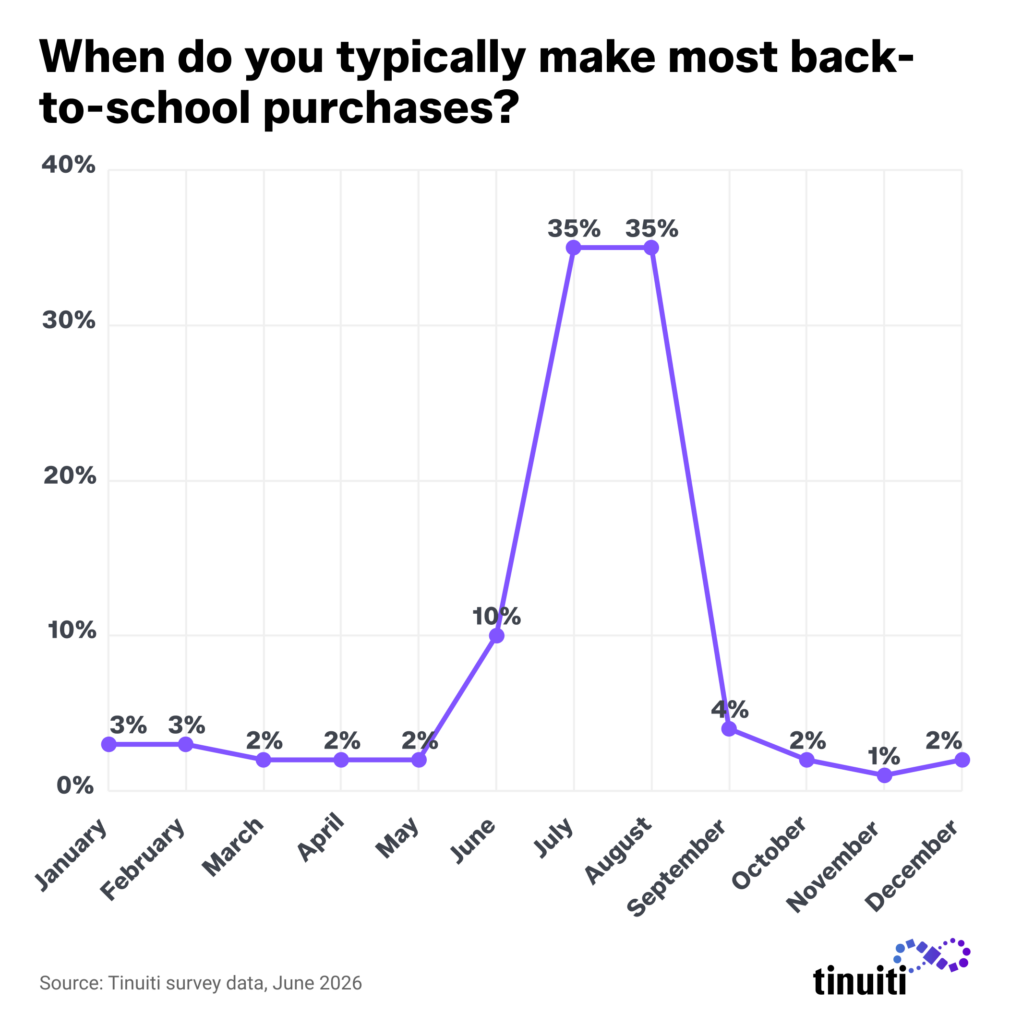
That compression changes how media should be planned. Premium placements across paid search, retail media, and social get more competitive as every brand in a category activates during the same narrow window.
Retailer visibility becomes something closer to a zero-sum fight during peak weeks. Brands that delay activation don’t get a second chance to build the remarketing pools and lookalike audiences that typically take weeks to mature. A late start means entering the highest-intent stretch of the season with an underdeveloped audience base, which is precisely the kind of blind spot rapid, always-on measurement is designed to catch before it costs a season’s worth of budget.
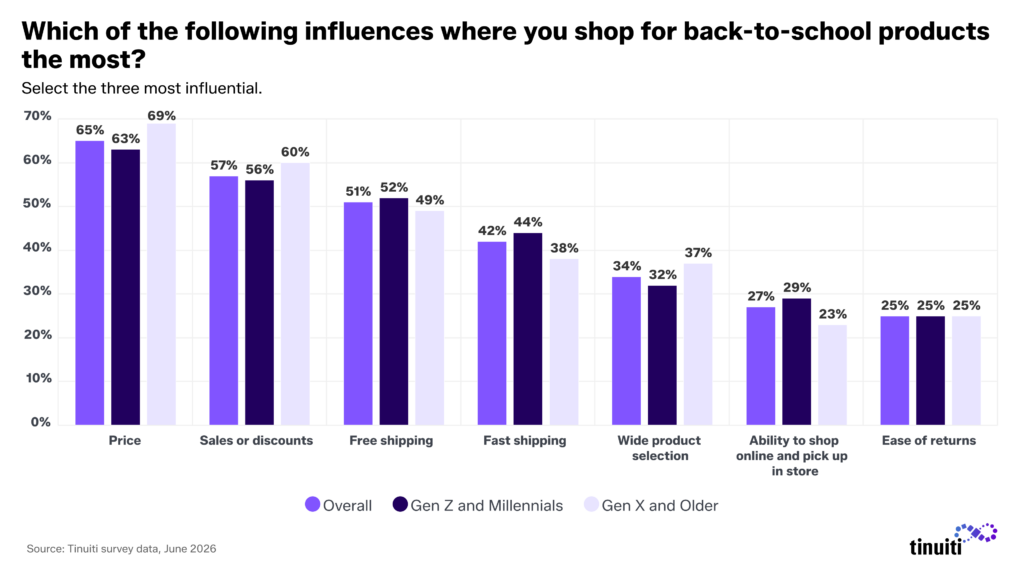
Price dominates this season more than any other purchase factor. Our data shows that 65% of parents rank price among their top three shopping influences (ahead of sales and discounts at 57%, and free shipping at 51%).
As such, price-forward messaging needs to lead, with promotional and shipping incentives functioning as secondary reinforcement.
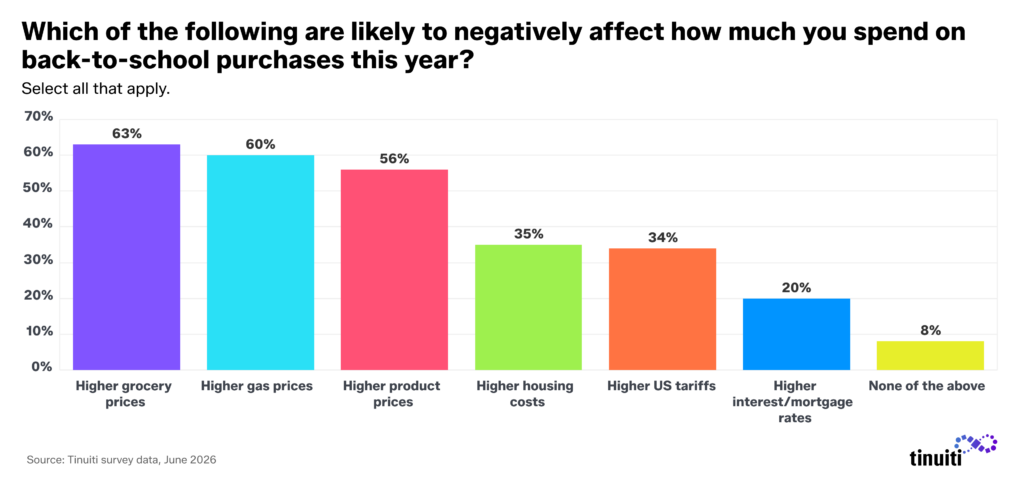
Economic friction is compounding price sensitivity from multiple directions: 63% of parents say higher grocery prices are likely to negatively affect their back-to-school spending, 60% cite rising gas prices, and 56% point to general product price increases.
A quarter of all parents say they aren’t confident they’ll be able to afford everything their kids need this year, a share that climbs to 36% among parents managing four or more school-age children. Despite that financial strain, 59% of parents still plan to spend more per child than last year, while only 11% expect to spend less.
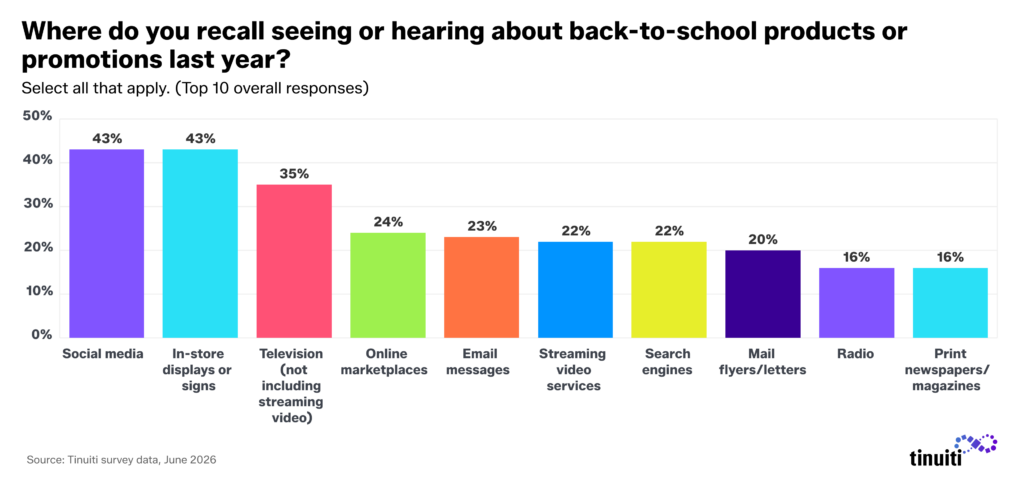
Social media and in-store displays or signage tie as the top discovery source for back-to-school products and promotions, each cited by 43% of parents, ahead of traditional television at 35%.
AI tools have also become a mainstream part of the shopping journey. Only 32% of parents say they won’t use any AI tool this back-to-school season, meaning the majority plan to lean on platforms like ChatGPT and Gemini to find deals, compare products, and summarize reviews. Add in students influencing purchases before parents ever complete a transaction, and shoppers are moving repeatedly between inspiration and checkout rather than following a single linear path.
How parents plan to discover, research, and stock up on supplies for the upcoming school year.

So what does all of this actually mean for marketers? It means “back-to-school shoppers” are not one audience. They’re several distinct groups with different priorities, shopping timelines, and decision-makers. The more clearly you define those groups, the easier it becomes to match your messaging, offers, and channel mix to what each one is actually looking for.
That matters because a single, catch-all campaign tends to flatten the season. It treats a parent shopping for pencils the same as a family buying a dorm setup, or a teacher stretching a classroom budget the same as a teen influenced by TikTok trends. The opportunity here is to plan around the real purchase context, not just the retail calendar.
A practical way to think about that segmentation is to break shoppers into a few core groups:
When you plan around these segments instead of a single broad audience, you stop building one generalized back-to-school campaign and start building clearer paths for different shoppers. That usually leads to better creative, better media efficiency, and a shopping experience that feels more useful to the people you’re trying to reach.
Search is where shoppers turn when they already know they need something but haven’t yet picked a brand. During back-to-school, that often sounds like “third grade supply list,” “best backpack for middle schoolers,” or “laptop under $500 for college.” If campaigns only cover brand and generic terms, they miss this decision-making stage completely.
For search and shopping:
Tinuiti’s paid search teams typically pair these tactics with tight alignment to inventory and margins, so bids follow where the brand can realistically fulfill demand. That discipline matters even more in a short season where each day of performance counts.
Get our guide to AI in Search to learn what’s required to maintain visibility in the new search landscape.

Paid social is one of the clearest ways to shape discovery before a parent is actively searching for a product. Our data shows that Facebook is the most-cited platform for back-to-school shopping inspiration at 58%, followed by YouTube at 46%, with Instagram and TikTok tied at 39%. Preferences also shift by generation, with younger parents leaning more toward Instagram and TikTok while older parents over-index on Facebook.
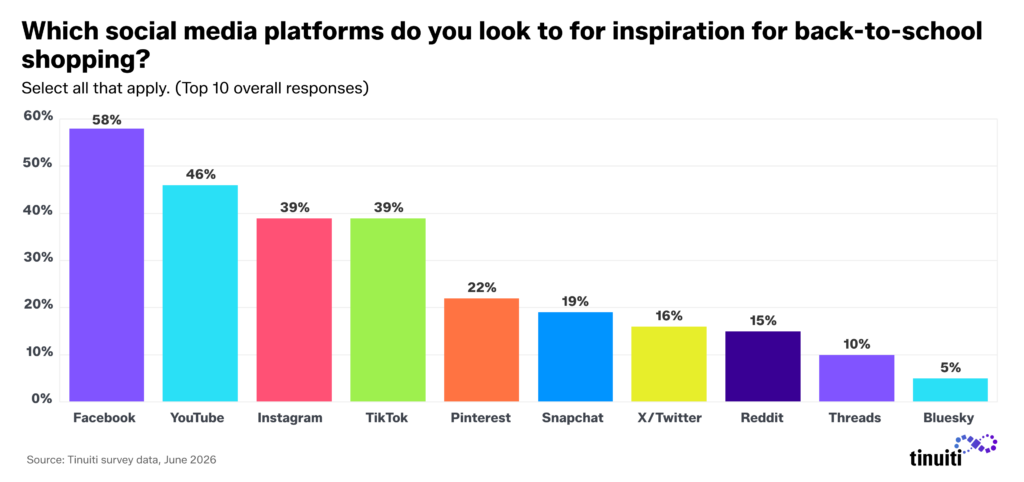
So what should marketers do with that? The first takeaway is that paid social should not be planned as one campaign with minor creative swaps. This is a season where platform choice, audience strategy, and message all need to work together. A parent looking for practical ideas on Facebook is often in a different mindset than a student discovering dorm décor trends on TikTok or Instagram. If the same asset is running everywhere with the same hook, the campaign is likely missing the real reason people are on each platform in the first place.
A better approach is to assign each platform a role in the plan:
The second takeaway is that creative should match the job of the ad. Back-to-school paid social usually works best when brands build around a few repeatable creative angles instead of one generic seasonal message. Some of the most useful angles include:
This is also a strong channel for sequencing. A prospect might first see a creator-led video or a broad seasonal message, then later be retargeted with a more product-specific ad, and finally receive a conversion-focused message tied to shipping deadlines, bundle savings, or limited-time promotions. That kind of progression is often more effective than asking every ad to do every job at once.
Finally, marketers should leave room for creative testing throughout the season. Back-to-school moves quickly, and what resonates in early July may not be the same message that works in late August. Early-season creative can lean more inspirational or organizational, while later creative often needs to be more urgent and practical. Testing hooks, offer framing, formats, and creator styles throughout the campaign helps keep performance from flattening at the exact moment competition gets tougher.
Another useful reminder: Paid social should not be evaluated only on last-click conversions during back-to-school. This is a discovery-heavy season, and social often does important work earlier in the journey. If a shopper sees a product on Instagram, researches it later on Google, and ultimately purchases through Amazon, social still played a role in creating demand. That’s one reason why full-funnel measurement is essential for truly gauging the success of your efforts, especially during seasonal retail moments where influence happens long before checkout.
Measurement tech that shows what’s driving growth—and what’s holding it back.

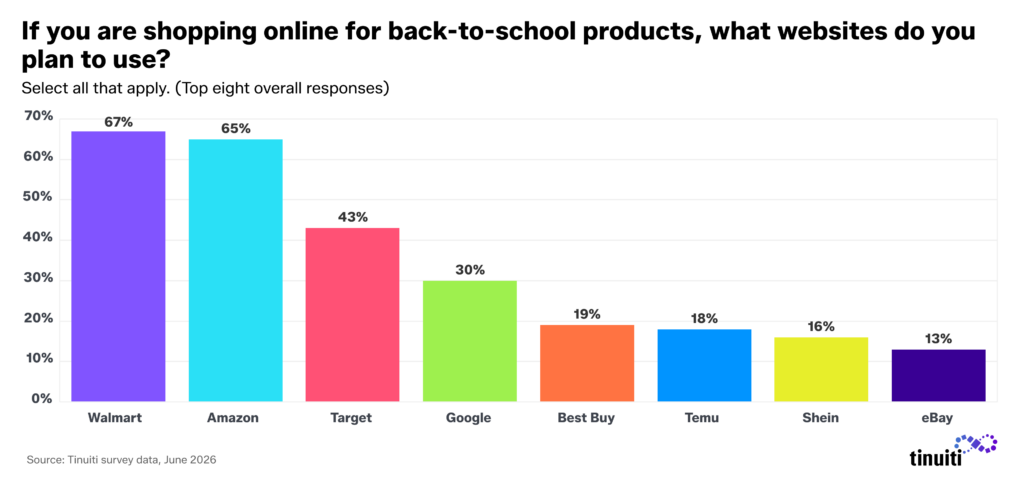
Retail media is where parents make decisions once they’re in a buying mindset. Walmart and Amazon are the two most popular online destinations for back-to-school shopping, selected by 67% and 65% of parents respectively; nearly half will use both. That overlap matters.
To get more out of retail media:
Parents aren’t just seeing back-to-school ads in feeds and stores. Streaming platforms play a growing role in discovery. When weighed against its competitors, YouTube came out as the top streaming destination for back-to-school product discovery, with Netflix and Amazon Prime Video close behind.
If your media plan already includes TV or streaming:
Tinuiti’s streaming and TV measurement work emphasizes that kind of cross-channel view, which helps brands understand when audio and video are adding something new to the mix versus simply touching the same audience again.
Back-to-school demand doesn’t turn on and off around a single date. Most purchases happen in July and August, but many parents keep buying even after the school year starts. A budget curve that peaks for one week and then cuts off misses that reality.
Actual budget allocation should flex based on category, retailer mix, and historical pacing data. Weekly or even faster readouts matter more than in a typical planning cycle, which is why rapid media mix modeling (MMM) exists as a distinct tool rather than a slower quarterly model. A season this short can’t wait a month to find out a channel underperformed.
Here’s a simple pacing framework to start from:
| Focus | Timing | Focus |
| Foundation | 10–14 weeks out | Audience building, creative testing, retailer catalog and feed alignment |
| Discovery | 6–10 weeks out | Broad-reach social, expanded search coverage, CTV/streaming activation |
| Peak Conversion | 2–6 weeks out | Retail media intensification, shopping feed protection, core promotions |
| Last-Minute Tail | Through September | Convenience and fast-shipping messaging, remaining-inventory pushes |
These phases are guidelines, not rules. Some categories (like core supplies) may peak earlier; college tech may peak later. The important thing is to make pacing a conscious decision. Weekly performance reviews, even if brief, help catch underperforming channels early and reallocate spend while there’s still time to adjust.
Back-to-school is one of the clearest examples of why retail data shouldn’t live in a vacuum. Retail media performs best when it’s treated as part of a single plan instead of separate budgets split by retailer.
Here are a few ways to make commerce media work harder:
When retailer first-party data and performance learnings are shared across channels like this, brands stop running three or four disconnected campaigns and start running one connected one. During a season as compressed as back-to-school, that coordination is often the difference between a campaign that feels efficient and one that feels wasteful.
It’s tempting to declare back-to-school a success based on platform dashboards alone, especially when demand is naturally high. But topline ROAS doesn’t answer the real question: how much did the advertising actually change outcomes?
For a more honest read:
Tinuiti’s Incrementality Lab is built around exactly this comparison, testing users who saw an ad against those who didn’t, rather than trusting platform dashboards at face value. For teams building this discipline from scratch, the Incrementality Playbook breaks down individual-based versus geography-based testing approaches.
Given how compressed this season is, the cadence of decision-making matters as much as the framework itself. Weekly cross-functional check-ins during the peak conversion window allow budget and creative shifts to happen in near-real time rather than waiting for a standard monthly reporting cycle that, in a season this short, may not surface a problem until the opportunity to fix it has already passed.
Handled well, back-to-school can be more than a single-season win. The audiences you build, the creative that resonates, and the measurement discipline you hone all carry forward into fall and holiday.
Thinking about this season as a testbed for Q4 changes the stakes. Every learning about channel mix, audience segments, and offers gives you a head start on the next peak. Brands that invest in back-to-school with that mindset come into Q4 with better data, stronger creative, and a clearer sense of what their shoppers want.
Ready to see where your back-to-school media plan has gaps? Request a Back-to-School Media Audit and put Tinuiti’s proprietary shopper data to work in your next planning cycle.

Copywriter, Tinuiti
Jenn Wheatley is a senior content strategist and copywriter who turns complex marketing data into clear, actionable stories. She develops research-backed reports and thought leadership that help brands navigate critical business decisions. Based in Utah, she enjoys cooking, strength training, and traveling with her family.