Offsite Retail Media: Turning First-Party Data Into Full-Funnel Growth


Every retail media budget eventually hits the same wall: Only so many shoppers are actively searching a retailer’s site at any given moment. Spend past that point, and you’ren’t reaching more buyers; you’re just paying more to reach the same ones. Offsite retail media promises a way past that wall, but it raises strategic questions most brands still haven’t fully answered.
Retailer first-party data can identify relevant audiences across the open web, including people who haven’t started a shopping session. However, separating incremental demand creation from media that simply reaches shoppers who were already likely to convert is harder to measure accurately.
In the recorded webinar below, Tinuiti’s retail media experts unpack how offsite fits into a full-funnel retail media strategy. Watch for the distinction between using offsite to generate measurable new demand and using it as an unstructured extension of onsite spend—a difference that affects how brands allocate budget, evaluate performance, and plan the full customer journey.
That distinction, using offsite to create measurable new demand versus treating it as an unstructured extension of onsite spend, runs through everything below: What offsite actually is, where onsite still wins, and how we prove offsite earned its budget.
Retailer first-party data can help brands find shoppers long before they search, browse, or add a product to cart. But finding the shopper is only half the job. The harder question is whether offsite retail media creates enough new demand to change the business outcome, rather than adding another touchpoint to a path already headed toward conversion.
Offsite retail media is advertising built on a retailer’s first-party shopper data but delivered outside that retailer’s site or app, across channels like CTV, social, digital audio, and the open web. Instead of waiting for a shopper to start searching, it uses what the retailer already knows about that shopper, including purchase history, loyalty activity, and browse behavior, to reach them earlier, before intent is explicit.
The opportunity is growing quickly. eMarketer projects offsite spend will rise from $6.54 billion in 2023 to $20.77 billion between 2023 and 2027, increasing from 15.8% to roughly 25.4% of total retail media investment.
But spend growth isn’t the story brands should take to a budget meeting. The real question is whether offsite creates demand that wouldn’t have existed otherwise and whether that demand gives onsite media a better opportunity to convert.
If you’re not in that space, most likely a competitor is. We want to make sure we’re following our consumer through their shopping journey instead of just meeting them on the retailer site.
Raquel Kozlowski, Senior Director, Innovation & Growth, Tinuiti
Onsite retail media is built to capture shoppers who are already searching or browsing on a retailer’s site. That makes it essential at the point of purchase. Still, it also gives onsite a ceiling: it can’t reach qualified customers before they arrive, and increased spend can eventually produce diminishing returns within finite inventory.
Offsite extends the plan beyond that ceiling. Retailer first-party data can reach category buyers, lapsed customers, and competitive shoppers across CTV, social, audio, and the open web, building familiarity before the retailer visit. Its value isn’t simply added reach; offsite earns its budget when it creates incremental demand that makes onsite media more effective at conversion.

Onsite and offsite are different jobs within one retail-media system. The planning challenge isn’t deciding which one wins. It is assigning each dollar a role, then proving the combination delivers more incremental value than either channel could produce in isolation.
The operating question: What should offsite do that onsite can’t?
| Business need | Offsite retail media can | How onsite converts the value created |
| Build familiarity among qualified shoppers | Reach retailer-defined audiences across CTV, social, audio, and the open web | Capture branded and category demand once shoppers search or browse |
| Re-engage lapsed or competitive buyers | Create earlier consideration with relevant audience signals and creative | Convert returning shoppers with high-intent placements |
| Scale a constrained onsite program | Add qualified reach without forcing more spend into finite onsite inventory | Protect digital-shelf presence where intent is highest |
| Prove full-funnel value | Measure attention, brand lift, incremental sales, and profit contribution | Validate conversion, ROAS, CPA, and new-to-brand outcomes |
Onsite retail media is built for the moment of decision. Sponsored search, category page placements, and PDP units sit directly in the path to purchase, intercepting shoppers who are already searching for a product or actively browsing a category. At that point, intent is high, and the job of onsite media is to help the shopper choose you instead of a competitor, not to convince them they need the category in the first place.
When Tinuiti architects onsite investment, we treat it as defense of the digital shelf. Onsite campaigns are calibrated to win share of voice in key queries, secure premium real estate on category pages, and make PDPs work harder through ratings, reviews, and creative that reduces friction. It’s where we focus on capture: Pulling demand that already exists through to conversion as efficiently as possible.
Offsite retail media operates earlier in the journey. While onsite captures demand, offsite creates it by using retailer first-party data to find lapsed buyers, in-category shoppers, and competitor buyers across CTV, social, and the open web long before they open the retailer’s app or type a search term.
If you only show up onsite, you’re entering the conversation at checkout, negotiating for a sale after a competitor has already shaped the shopper’s preferences somewhere else online. When we design onsite and offsite as one connected portfolio, rather than two separate budget lines, offsite becomes the engine that builds familiarity and intent. Onsite becomes the mechanism that harvests it, closing the gap between “I’ve heard of this brand” and “I’m choosing this brand at the point of purchase.”
Once shoppers land on the retailer site, you want them to already have your brand and product in mind.
Raquel Kozlowski, Senior Director, Innovation & Growth, Tinuiti
Open-web reach isn’t hard to buy. But shopper intelligence is.
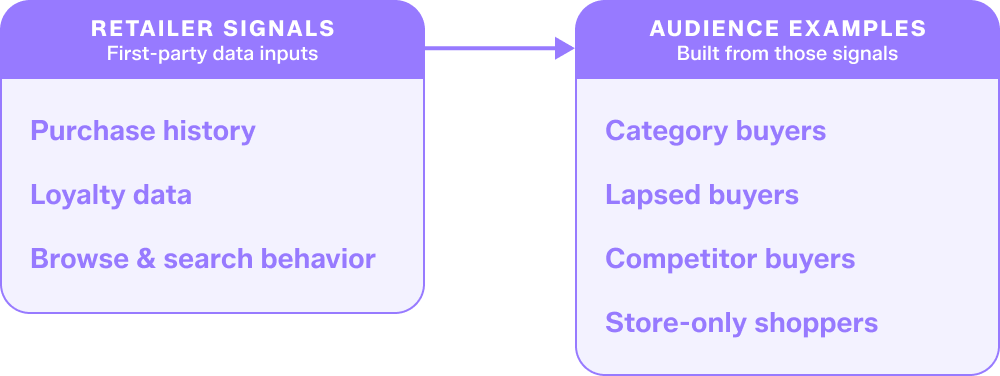
Most brands don’t bother testing whether the audience behind an impression is any good, and that’s where the money leaks out. What sets offsite retail media apart is the data underneath it: Purchase history, loyalty activity, browse and search behavior, and sometimes transaction data straight from the retailer. That’s what Tinuiti uses to build real audiences, instead of another programmatic buy guessing who you are based on demographics.
Having the data isn’t the same as having a strategy. You still need a way to turn those signals into actual creative decisions, channel choices, and measurement that tells you what worked. Skip that step, and you end up with retailer audiences sitting in one platform, media decisions happening in another, and reports that can’t tell you whether anything you did actually moved the needle.
The audience types this data supports include category buyers, lapsed buyers, competitive brand buyers, new-to-category shoppers, high-value households, and store-only buyers who need a nudge back online. Which segment matters depends on what stage of the funnel you’re trying to influence. Getting that match right, audience to channel, is usually where offsite budget either pays off or quietly disappears.
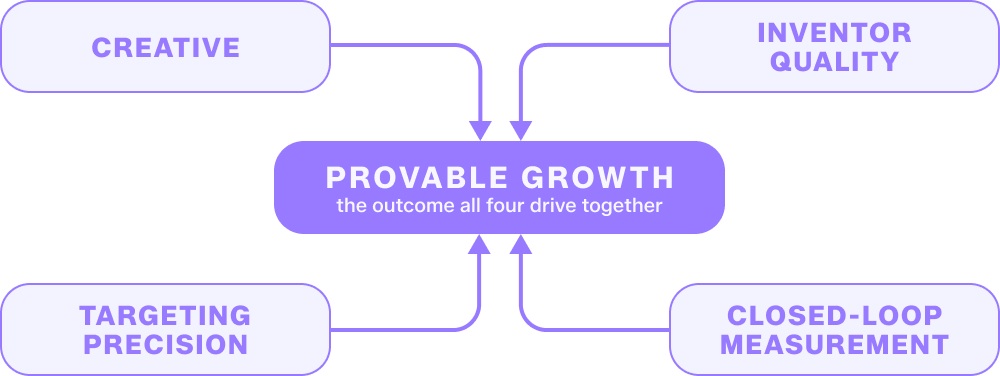
Most offsite budgets fail at the execution layer, not the strategy layer. The four pillars below are where Tinuiti’s teams have seen the difference between spend that compounds and spend that just shows up. Every pillar exists for one reason: to make sure no offsite dollar works without the others holding it accountable. The goal is to ensure the full system can show that an offsite dollar changed something meaningful for the business.
Guiding question: Can this creative earn attention before purchase intent exists?
Offsite placements compete with everything else in a shopper’s feed, stream, or browsing session. The creative needs to establish product relevance quickly, then make the next step feel intuitive. Product carousels, vertical video, and commerce-native formats can do that well when they show the product clearly and connect naturally to the retailer experience.
Adaptive commerce formats can also reduce the production burden. Through supply-side partners such as TripleLift, brands can bring existing product detail page assets—product imagery, copy, ratings, and, where available, “Add to Cart” functionality—into display or CTV placements. This helps give shoppers enough useful information to vet the product prior to reaching the retailer.
Guiding question: Are we paying for reach, or for attention that can influence a decision?
Cheap inventory can make a CPM report look efficient while delivering too little viewability or attention to affect demand. Offsite plans should prioritize premium, viewable, brand-safe environments and exclude made-for-advertising sites and high-invalid-traffic placements before launch.
The measurement standard should match the placement’s job. CTV and open-web display often support familiarity and consideration before a shopper is ready to search, so don’t evaluate them solely against the immediate ROAS benchmark used for onsite sponsored search. Look instead at attention, brand lift, qualified site or retailer traffic, and incremental sales over an appropriate time frame. If the inventory can’t create a measurable shift in any of those outcomes, low CPMs do not make it a good investment.
Guiding question: Does the audience reflect real shopping behavior?
Retailer first-party data can move brands beyond broad demographic targeting by reaching category buyers, lapsed customers, competitive-brand buyers, high-value households, or store-only shoppers ready for digital reactivation. Publisher context, content genre, platform behavior, and time of day can add further relevance when they support the underlying shopper signal.
But “first-party data” isn’t a guarantee of performance. Segments can be stale, audience definitions can be too broad, and lookalike logic can obscure who you’re actually reaching. Validate audience quality through meaningful downstream outcomes: Incremental new-to-brand customers, retailer traffic, sales lift, conversion quality, or profit contribution. Otherwise, a campaign can look well-targeted while still spending against people unlikely to change their buying behavior.
Guiding question: Can the business see the outcome without giving the channel credit it did not earn?
Platform reporting can show delivery, clicks, and conversions inside its own environment. Offsite retail media needs a broader view that connects exposure to online, marketplace, and, where available, in-store sales. That’s how brands can determine whether offsite activity generated incremental demand or simply received credit for a purchase that was likely to happen anyway.
Use the measurement approach that fits the decision at hand. Brand lift and attention studies can evaluate whether upper-funnel media changed awareness or consideration. Matched-market testing, geo experiments, holdouts, and exposed-versus-control analysis can isolate causal impact on sales. Media mix modeling can then help teams understand the combined contribution of offsite, onsite, and other channels over time.
A measurement plan should be in place before spend scales. Without it, brands can accumulate impressions, clicks, and platform-reported ROAS without a defensible answer to the only question that matters: did the next offsite dollar create growth?
Measurement tech that shows what’s driving growth—and exposes what’s holding it back.

Tinuiti’s Bliss Point operating system integrates incrementality-informed MMM with media activation. By pairing Rapid MMM with always-on incrementality testing, Tinuiti can distinguish platform-reported performance from the incremental lift media actually creates and use those insights to guide budget decisions faster and with greater confidence. For offsite retail media, that means audience strategy informs creative; the media plan reflects each channel’s job; and measurement shows whether investment is contributing to incremental business outcomes rather than simply performing in a platform dashboard.
DSP display, CTV/OTT, social extensions, and retargeting each play a different role in the funnel, and each leans on a different mix of retailer data and publisher signals.
In Tinuiti’s planning sessions, we map those roles explicitly: Which channels create demand among lapsed and competitor buyers, which shape consideration with commerce-native formats, and which capture and re-capture demand once a shopper has already engaged. The table below lines up data source, funnel job, best use case, and measurement approach so offsite doesn’t become “whatever inventory is available,” but a deliberately architected portfolio.
| Channel | Primary Data Source | Funnel Role | Best Use Case | Measurement Approach |
| DSP Display (open web) | Retailer first-party + publisher context | Awareness/consideration | Reaching lapsed and competitor buyers before they search | Viewability, attention, brand lift |
| CTV / OTT | Retailer first-party + content genre | Consideration/conversion | Shoppable, adaptive commerce formats (e.g., Product Spotlight) | Attention, brand recall, ROAS |
| Social Extensions | Retailer first-party + platform signals | Consideration | Category buyer and new-to-category reach at scale | Engagement, CTR, ROAS |
| Retargeting | Retailer first-party (browse/search) | Conversion | Re-engaging shoppers who browsed but didn’t purchase | ROAS, CPA |
Think of the table as a portfolio design tool, not a glossary. Start by assigning each channel a clear job in the funnel and then match audience precision and budget to that job. From there, resist the urge to hold every offsite placement to the same short-term ROAS target you use for onsite sponsored search. CTV and open-web display that are built to create demand need a measurement framework that captures demand creation over time through attention, brand lift, and incremental sales.
Find out what’s coming in 2026 and beyond, and what marketers can do to be ready.

In one native SKU and adaptive commerce activation, Tinuiti didn’t start with a blank canvas; we started with what the brand already had. Our teams pulled existing product detail page assets (images, copy, ratings) directly into a native, commerce-forward ad format instead of commissioning net-new creative. That single architectural decision, applying the creative pillar through smarter use of PDP assets, drove a 135% increase in ROAS, a 61% improvement in CPA efficiency, and a 2.7x higher click-through rate versus the client’s prior static offsite approach.
It’s a clear example of creative as a performance lever, not just a production line item. More importantly, those efficiency gains meant the brand entered onsite peak season with a shopper base that already had a reason to choose them. That’s the outcome a performance number alone can’t capture.
We see the same pattern on CTV when the inventory and targeting pillars are applied together. In a Product Spotlight CTV campaign, Tinuiti paired premium DIY and home-improvement content genres with a high-impact, shoppable CTV format built to behave more like a mini PDP than a traditional TV spot.
The results challenge the idea that CTV is purely upper-funnel: 94% viewer attention on the featured product, 77% brand recall, a 49-point lift in positive brand perception, and ROAS north of 1.0 on inventory most brands still treat as “brand-only.” When creative, inventory quality, and retailer-powered targeting are aligned, CTV becomes a measurable commerce channel, not just a reach play.
We’re using first-party data from retailers to decrease wasted spend and get in front of customers we know are interested in a brand or product. We’re not just guessing.
Raquel Kozlowski, Senior Director, Innovation & Growth, Tinuiti
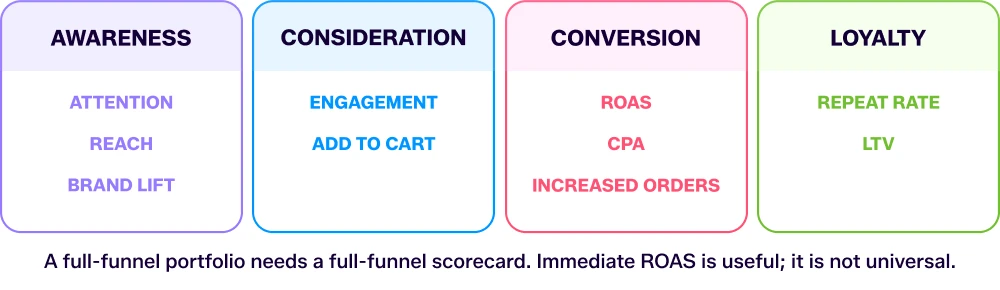
“What was the ROAS?” isn’t a sufficient first question for offsite retail media. Start with the business decision the investment needs to inform: Should we expand a channel? Shift spend? Protect a retailer relationship? Build demand for a priority category?
The metric follows the job. Awareness programs require evidence that qualified shoppers saw and responded to the message. Consideration programs should show whether shoppers moved toward product engagement. Conversion activity should earn its budget through ROAS, CPA, new-to-brand contribution, and cost per incremental order. The common thread isn’t a universal KPI; it is a clear line from media activity to a decision the business can make.
When we map KPIs to channel jobs this way, and feed those results into Bliss Point’s incrementality-informed MMM, offsite stops being “expensive awareness”. It becomes a measurable contributor to each stage of the purchase journey.
Actionable data is non-negotiable for brands focused on growth and sales. Without performance reporting, we lack the levers to optimize and continue driving stronger performance.
Raquel Kozlowski, Senior Director, Innovation & Growth, Tinuiti
The second layer is proving that offsite dollars are creating outcomes that wouldn’t have happened anyway. Incrementality is the foundation of Tinuiti’s measurement work: we use persistent, always-on experiments across channels like CTV, OLV, and streaming audio to isolate causal lift, comparing exposed users or markets against carefully designed control groups. Holdout tests, geo-split designs, and exposed-versus-control analysis are standard patterns in our Incrementality Lab, and we integrate the lift we measure directly into Bliss Point’s MMM models.
That’s also where capabilities like Rapid MMM (rMMM) and Geo MMM come into play. Incrementality-informed modeling lets us strip out platform bias and organic demand, and quantify the true growth each offsite investment creates across brand sites, marketplaces, and retail stores. Once offsite media is tied to incremental revenue and profit, it stops being a line item you explain away and becomes a budget decision you can defend to finance.
The question isn’t whether to add offsite. It is whether your plan can prove what it changed.
Offsite retail media earns its place when it gives the rest of the retail-media portfolio more room to work: building familiarity before search, reaching qualified shoppers before they reach the retailer, and improving the likelihood that onsite investment converts when intent arrives. More impressions are not automatically more growth. More reach becomes growth only when the audience is right, the creative creates a reason to care, the inventory protects the investment, and measurement can isolate the business impact.
That’s why we treat offsite retail media as part of one connected operating system. Retailer data informs the audience; creative and channel roles determine how the message shows up; onsite and offsite investment work together; and incrementality-led measurement shows what produced net-new value. The result is a media plan built to create immediate and lasting growth.
Want to know whether your offsite dollars are creating incremental demand or merely adding impressions? Explore Tinuiti’s retail media and measurement capabilities or watch the webinar discussion.

Copywriter, Tinuiti
Jenn Wheatley is a senior content strategist and copywriter who turns complex marketing data into clear, actionable stories. She develops research-backed reports and thought leadership that help brands navigate critical business decisions. Based in Utah, she enjoys cooking, strength training, and traveling with her family.