Social Commerce Can Create Demand Fast. Is Your Business Ready to Fulfill It?


Brands often underfund social commerce for the same reason they misjudge upper-funnel media: They can see the checkout, but not always the influence that created it.
A shopper may discover a product through a creator video, compare it on a retailer site, then purchase through a loyalty program or subscription they already trust. When measurement credits only the final transaction, the social channel that created demand appears less valuable than it was and the next budget decision starts from the wrong premise.
The measurement gap has an operational counterpart. A product can gain traction in a feed before inventory, fulfillment, product pages, or customer support are ready for the resulting demand. The brand is no longer merely missing a social commerce opportunity; it’s paying to bring in shoppers it cannot serve.
Social commerce is becoming a retail channel, with content, operations, media, and measurement shaping the same customer outcome. Brands that connect those decisions around a shared commerce goal are better positioned to turn attention into durable growth. This article examines how to build that kind of social commerce strategy.
Social commerce began by making discovery more shoppable. Now, it’s changing how brands plan assortment, creator programs, fulfillment, and measurement.
The strategic shift goes beyond in-app checkout. Social can create demand, accelerate consideration, and influence revenue across DTC, marketplaces, and retail partners, even when the platform itself does not capture the final transaction. That makes social commerce less of a channel tactic and more of a retail capability.
A social commerce strategy therefore cannot begin and end with platform media. Brands need a clear view of the product behind the content, the shopping paths customers are likely to choose, and the business outcome the activity is meant to create. As platforms add Shops, affiliate programs, product tags, and in-app checkout, content and conversion are moving closer together, but an effective strategy still has to connect the full commerce system.
We recently convened experts from Tinuiti, Spotlight Media, and WorkMagic to examine that shift: how consumers discover, validate, and buy across social, DTC, marketplaces, and retail partners. Their discussion points to a more demanding version of social commerce, one where media, product experience, operations, and measurement need to work from the same commercial plan.
TikTok Shop is the clearest example of the category’s evolution. In 2023, low-price products and platform subsidies helped consumers get comfortable buying without leaving the feed. In 2024, subsidies began to fade while shoppers became more accustomed to native checkout. By 2025 and into 2026, household brands and higher-value products were entering the channel with more confidence.
That doesn’t mean every category or price point belongs on TikTok Shop, but price alone is becoming a less useful measure of fit.
“TikTok Shop can be a really good fit for clients across all price points.”
Cole Harrison, Director of Innovation & Growth, Tinuiti
The stronger question is whether a product can earn attention, demonstrate value quickly, and move through the operational system behind it. A visually compelling $300 appliance may have a more natural place in creator-led content than a $20 product with no clear story to tell.
In our recent webinar on the topic, Sam Habibi of Spotlight Media identified roughly $30-50 as a common starting range for beauty and personal-care brands on TikTok Shop, while emphasizing that category, product, shipping, and brand maturity all affect the right approach. But brands should treat those ranges as starting hypotheses and not a universal rule. The webinar panel also recommended testing bundles after individual SKUs establish demand, particularly when the products form a clear routine, for example: a lip liner and lip oil, rather than combining unrelated items solely to raise average order value.
Learn more about building a TikTok Shop strategy.
Retail readiness is often reduced to inventory and fulfillment. Those matter, but they are only part of the job.
A retail-ready brand has three things in place:
Jessica Allen, Senior Strategist of Retail Operations at Tinuiti, describes readiness as whether the entire brand experience can hold up under demand, not merely whether an ad can drive a click. “Making sure that whenever you start this media conversation or this social conversation, that you’re ready to fulfill at the best possible standard.”
That includes the details shoppers may never articulate until they go wrong: an incomplete product page, a packaging mismatch between creator content and the delivered product, slow shipping, unclear variation options, or a support experience that fails the moment a product becomes visible.
Your team should build retail readiness into the strategy before the first creator brief goes out. It is expensive to discover it after a viral post has created demand.
Retail readiness cannot sit solely with operations or ecommerce. In social commerce, demand creation, product experience, fulfillment, paid media, and measurement affect one another in real time.
Brands need a shared view across the audience and content creating demand, the operational system fulfilling it, the media extending it, and the measurement determining whether it generated incremental value.
Tinuiti’s Bliss Point Marketing Operating System connects those decisions across Audience, Creative, Media, and Measurement, helping brands manage social commerce as a business system rather than another platform to optimize in isolation.
Measurement tech that shows what’s driving growth—and exposes what’s holding it back.

The right social commerce channel depends on the product, the customer’s decision process, and the role the channel needs to play. Brands shouldn’t attempt to replicate the same playbook everywhere because each channel needs a specific approach to be most successful.
Platform infrastructure also changes frequently, so teams should validate availability and requirements through each platform’s current documentation:
A note on platform fit: Platform capabilities and seller requirements change frequently. The examples below are planning considerations, not universal prescriptions. Validate current eligibility, features, product requirements, and category fit through each platform’s documentation before committing budget or inventory.
| Platform | Best-fit role | Strong use cases | What to plan for |
| TikTok Shop | Discovery through native checkout | Demo-friendly, creator-friendly, impulse-to-consideration products | Creator engine, fulfillment, Shop operations, product selection |
| Instagram Shopping | Visual merchandising and retargeting | Beauty, fashion, home, lifestyle products | Catalog quality, product tags, Reels/Stories integration, audience sequencing |
| Facebook Shops | Broad discovery through shared commerce infrastructure | Brands seeking wide demographic reach and community-led product discovery | Shared Commerce Manager setup, catalog consistency, audience strategy |
| Pinterest Shopping | Planning-led, high-intent discovery | Home, style, gifting, events, projects, and considered purchases | Feed health, product Pins, search relevance, seasonal planning |
| YouTube Shopping | Education, validation, and product demonstration | Products that need tutorials, reviews, comparisons, or proof | Creator partnerships, shoppable long-form and short-form content |
| Snapchat | Visualization-led discovery | Beauty, apparel, home, and products where try-on or spatial context reduces hesitation | AR experience, catalog readiness, younger-audience relevance |
TikTok Shop is most often suited to products that can be demonstrated, discussed, and purchased with minimal friction. That can mean a live shopping event, a product-tagged video, an affiliate creator post, or a Shop-tab discovery journey.
TikTok’s paid-media recovery reinforces its relevance in the social commerce mix. Our Q2 2026 Digital Ads Benchmark Report found that Tinuiti advertisers increased TikTok ad spend 31% year over year, and among brands active on both TikTok and Meta, median TikTok investment equaled 26% of Meta spend. That growth does not make TikTok the default choice for every retailer, but it does make operational readiness, creator strategy, and measurement more urgent for brands with a genuine product-audience fit.
The channel rewards velocity, but velocity is not the strategy. Brands need enough inventory to support the products they choose to push, a creator program that can generate fresh angles, and a fulfillment process that can meet expectations after a spike. And most importantly, your brand needs to make sure the value of your product is clear to the viewer so they are interested in purchasing your product.
Instagram’s product-tagging and commerce tools can support visually led merchandising and retargeting. Whether it is the right commerce priority depends on the category, the customer journey, and the quality of the brand’s catalog and creative. Product tags in Reels, Stories, and posts can move shoppers from inspiration to product detail, while catalog infrastructure supports more persistent merchandising. (See Instagram’s business resources and Meta’s commerce guidance for current capabilities.)
The media mix is moving with the format. In Q2 2026, Reels accounted for 35% of Instagram ad impressions among Tinuiti advertisers, its highest share to date, while Feed accounted for 26%. Instagram spending rose 17% year over year as impressions increased 17% and CPM remained flat. For brands investing in creator storytelling or product demonstration, Reels should be a core format in the creative plan rather than a resized Feed asset.
Download our Digital Ads Benchmark Report for a deep-dive on data across Google, Meta, Amazon, and more.

The key here is not simply tagging every product. Brands must make sure product information, imagery, and landing paths carry the same story as the creative that earned attention in the first place.
Facebook and Instagram share the same broader Commerce Manager infrastructure, but they can serve different audience behaviors. Facebook can be particularly useful for brands seeking wide demographic reach, community-oriented discovery, or a complement to Instagram’s more visually concentrated environment.
Treat the two platforms as connected but not interchangeable. Shared catalog infrastructure is useful; shared creative assumptions are less so.
Facebook’s Q2 performance makes the trade-off clear. Tinuiti advertisers increased Facebook spend 7% year over year, signaling that the platform continues to warrant investment for brands with a defined role for its broad reach and community-oriented discovery. But that additional spend bought less scale: impressions fell 5% year over year as CPM rose 13%.
In other words, brands were paying more to reach fewer people. That does not make Facebook a channel to abandon. It makes it a channel to fund with intent. Before increasing investment, define what Facebook is expected to do for your brand. Whether that’s to reach audiences that are harder to find elsewhere, support consideration, or move shoppers closer to purchase—then measure whether it is delivering incremental business value beyond a platform-level efficiency report.
Pinterest is particularly valuable when the purchase journey starts with a project, a life moment, or a visual idea rather than a fixed product search. For home, style, gifting, and event-driven categories, shoppers often arrive early in the decision process to collect inspiration, compare options, and shape what they may eventually buy.
To earn that consideration, brands need to treat Pinterest as a commerce environment rather than a passive awareness channel. That means maintaining an accurate, complete product feed; aligning product titles and descriptions with how shoppers search; planning creative around seasonal intent; and making sure the path from Pin to product page carries the same promise. Pinterest’s shopping tools are built around Product Pins, where accurate product details, including price and availability, help shoppers move from inspiration toward purchase.
Pinterest ad spend declined 8% year over year in Q2, following unusually strong growth in the prior-year period and as some advertisers shifted investment back to TikTok. The movement is useful context, but not a verdict on the platform’s commerce role. For brands with planning-led purchase journeys and the operational discipline to meet shopper intent, Pinterest can still provide a differentiated place to influence consideration before shoppers settle on a product or retailer.
YouTube Shopping supports product tagging alongside eligible video content. For brands with a longer consideration cycle, tutorials, comparisons, reviews, and creator demonstrations can give shoppers the product proof they need before buying. YouTube’s Shopping guidance outlines current eligibility and functionality.
The opportunity is bigger than the initial moment of conversion. Unlike more ephemeral social formats, a strong creator video can continue surfacing when shoppers search for answers, product comparisons, or real-world demonstrations long after it is published.
“If you partner with a creator… and they post a video about your brand today, that video could be searched for years to come… The value of YouTube is it is the gift that keeps on giving. A creator video made today could provide value to that brand for years and years down the road.”
Crystal Duncan, Executive Vice President, Shared Services at Tinuiti
For categories with a longer consideration cycle, shoppable video should reduce uncertainty rather than force an impulse conversion the category does not support. The strongest programs align creator content to the questions shoppers are already researching and then make the path from validation to purchase as seamless as possible.
For categories where product fit or appearance is part of the decision, brands can test visualization-led formats such as AR. Measure value against a concrete barrier such as uncertainty about shade, fit, or in-room appearance, rather than assuming it from engagement alone. Snapchat’s AR formats can give shoppers a sense of fit, appearance, or context before they buy.
The channel is most valuable when the experience solves a real decision barrier. An AR lens that merely decorates the product may create engagement; an AR experience that helps a shopper picture the product in use can contribute to a more credible commerce journey.
Social commerce can create demand quickly. That’s its upside as well as the source of its operational risk.
A product can receive an unexpected creator mention, an affiliate video can gain traction, or a paid launch can outperform forecasts. Teams need the ability to distinguish between a short-lived spike and a signal worth scaling.
There’s no universal social-commerce price point. The product, category, creative, checkout incentive, and customer familiarity all matter.
The webinar discussion pointed to $30-50 as a common starting range for beauty and personal-care brands on TikTok Shop, especially when free shipping is part of the shopper proposition. It also highlighted that bundles can approach $100 after individual products have established demand.
The larger lesson from this isn’t “price everything between $30 and $50.” It’s that brands need to match their social-selling strategy to how consumers evaluate the product. A low-cost beauty item may benefit from broad creator sampling and a fast checkout path. A higher-priced appliance or home product may need fewer but deeper creator relationships, more demonstrations per sample, and stronger proof of value.
“If you have a product that is very content friendly and it’s really easy to showcase, the product itself can be the hook for the video.”
Sam Habibi, Co-Founder, Spotlight Media
Social commerce can create demand faster than most retail planning cycles are built to absorb. A creator post, paid amplification, or LIVE moment can move a product from discovery to checkout in hours before inventory, fulfillment, and customer-service teams have time to adjust.
That is why fast fulfillment is not an operations afterthought. It protects the experience shoppers were promised, helps preserve seller standing on the platform, and determines whether a brand can keep capitalizing on the commerce moment it created. TikTok Shop is structured around selling through shoppable video, LIVE, creator partnerships, and integrated product listings; brands should validate its current seller and fulfillment requirements in Seller Center before setting a launch plan.
The webinar panel pointed to two-business-day shipping expectations as a common stress test for 3PL systems, particularly when creator-led demand exceeds forecast. Before making a product the focus of a social commerce campaign, bring ecommerce, operations, and media together to pressure-test five questions:
The breakdown rarely begins when a product goes viral. It begins when the brand treats virality as a media win before confirming it can deliver the product experience that made shoppers click in the first place.
A viral moment can produce useful learning. It can also cause teams to mistake organic demand for paid-media efficiency, double a budget at the wrong time, or forecast future demand from a spike that will not repeat.
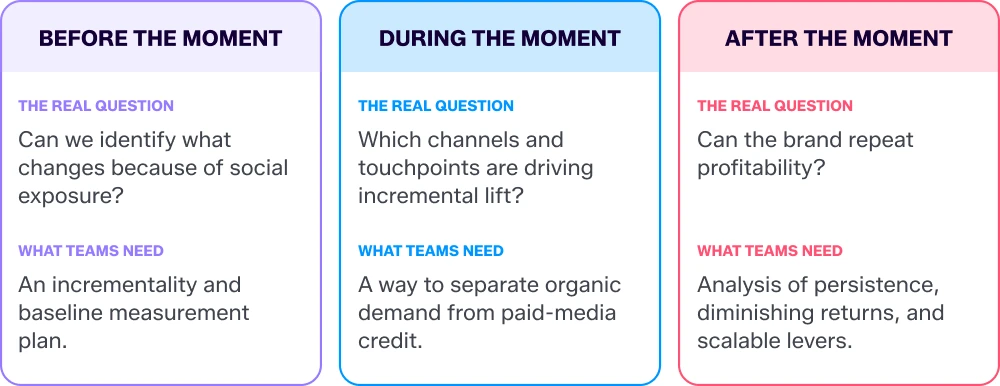
Lauren Lauth, VP of Measurement at WorkMagic, recommends treating virality a three-phase measurement exercise: what the brand establishes before the moment, how it monitors and responds during the moment, and what it evaluates after demand settles.
“The brands that usually win in these cases are the ones that stay grounded. They aren’t suddenly just doubling budgets because something popped off for 48 hours.”
Lauren Lauth, VP of Measurement, WorkMagic
That discipline protects more than the budget attached to a single high-attention moment. It gives teams a way to separate organic demand from paid-media impact, decide whether an in-the-moment investment is warranted, and understand whether the result created incremental value once the spike has passed.
For finance and senior leadership, that changes social commerce from an unpredictable source of buzz into a measurable part of the commerce portfolio, one that can be assessed with the same rigor as every other growth investment.
Social commerce works best when the product gives people something worth showing. Creators can introduce the product, demonstrate it, and make it feel relevant. The brand needs to ensure the product, packaging, and offer give them material to work with.
A creator has only a few seconds to establish why a shopper should stop scrolling. A distinctive package, a satisfying texture or application, a visible transformation, or a product with an obvious use case can create that opening. When the product experience is visually clear, the content can move naturally from “what is this?” to “I can see myself using it.”
That is one reason products with a strong routine or demonstration element often travel well in social commerce. A serum being applied, a snack assembled into a lunch idea, or a storage product solving a visible problem gives the audience an immediate entry point. The package, product, and use case become part of the story.
As Sam Habibi put it during the webinar, these details are “ammunition for creators.” Brands can’t script every post when they seed products to hundreds of affiliates, but they can ensure creators receive a product that is easy to unpack, understand, demonstrate, and recommend in their own voice.
Bundling follows the same logic. A lip liner and lip oil can become a lip set because the products belong to the same routine and create an intuitive story for content. A box of unrelated products may lift average order value in a spreadsheet, but it gives neither the creator nor the shopper a compelling reason to care. In social commerce, the best bundle makes the product easier to explain, not merely more expensive to buy.
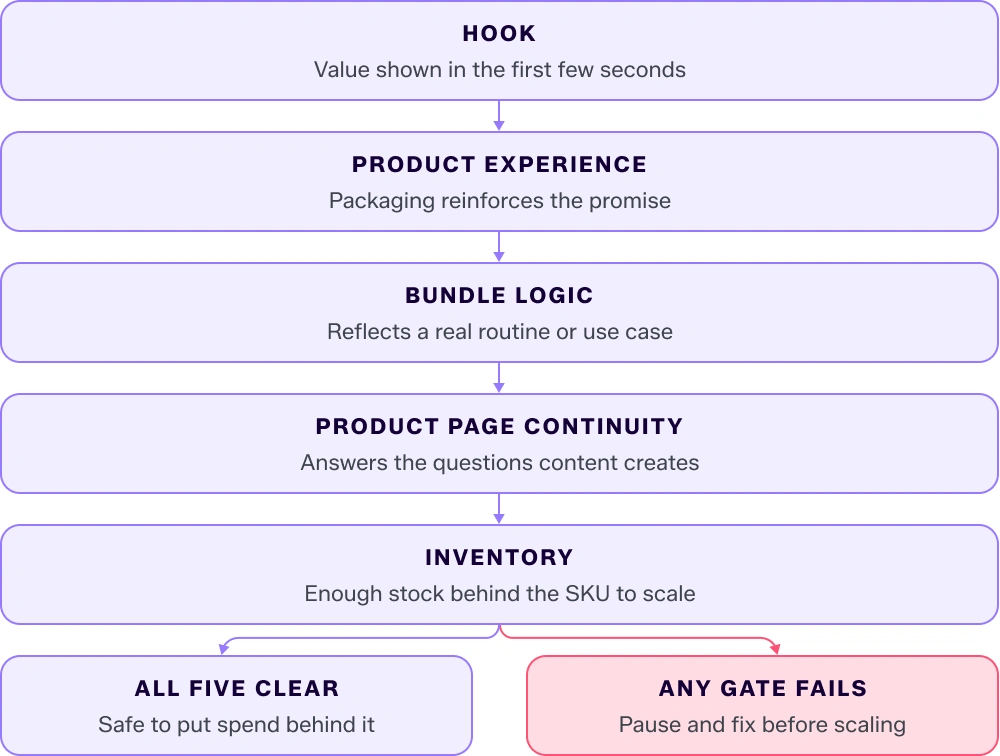
Before committing paid spend or creator investment behind a product, pressure-test the content and commerce experience together:
A social commerce interaction and a social commerce transaction are often not the same thing. A shopper may discover a product on TikTok, save it, see a creator use it again, then buy from a brand’s site, Amazon, Sephora, Ulta, Target, or the retailer where they already have loyalty points and trust the fulfillment experience.
That is the measurement problem retail brands need to solve. If reporting only credits the platform where checkout occurred, it can miss the role social played in creating the demand in the first place.
Halo effect measures the value a channel creates when it influences a sale completed somewhere else. Consider a beauty shopper who sees a TikTok Shop ad, becomes interested, and then buys at Sephora to compare shades, use loyalty points, or pick up another item. TikTok may have shaped the purchase decision, even though it receives no direct checkout credit.
Despite this, platform reporting is still useful because it shows the transactions a platform can observe. But it can’t provide the complete view on its own. It may undercount discovery-led influence across retail destinations; and during an organic spike, it can over-credit paid media for demand the media did not create.
“Halo is not a bonus metric. It’s a foundation to understanding real performance.”
Lauren Lauth, VP of Measurement, WorkMagic
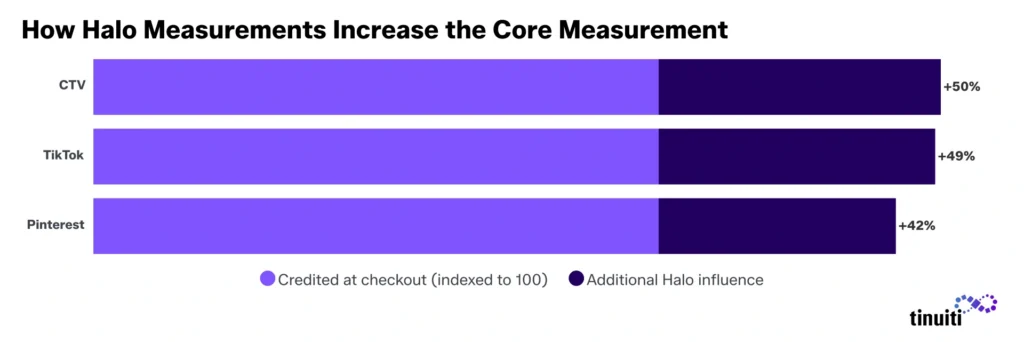
Our webinar dove into WorkMagic geo-lift-test data showing average halo effects of roughly 50% for CTV, 49% for TikTok, and 42% for Pinterest. Those averages will vary by category, retailer mix, and customer behavior. The larger point is that discovery channels can influence purchase decisions well before a shopper selects a checkout destination.
For retail brands, that changes the question from “What did social sell directly?” to “What business did social help create across every place the customer can buy?” Measuring that broader impact helps teams avoid underfunding channels that are building demand and make more defensible investment decisions across social, commerce, and retail media. Tinuiti’s Holistic ROAS framework is built around that full-picture view, including cross-channel and retail impact that direct-response reporting can miss.
The size of the halo effect depends on the category and the shopper’s decision process.
| Category | What may drive a shopper elsewhere | Measurement implication |
| Beauty | Shade matching, product texture, ingredients, loyalty benefits | Evaluate social’s role across retailer and DTC sales, not just in-app checkout |
| Nutrition | Ingredient research, subscriptions, Amazon habits | Watch for delayed or alternate-destination conversions |
| Fashion | Fast, low-friction checkout can keep more conversions in platform | Platform sales may capture more of the journey, but still need incrementality validation |
| Home and higher-consideration products | Research, reviews, comparisons, financing, retailer trust | Treat content and social search as inputs to a longer conversion path |
The point is not to assume a halo effect will appear in every campaign. The point is to avoid assuming that platform ROAS represents the entire commercial result.
The data on everything shaping the apparel customer journey.

Comfrt, a loungewear brand, wanted to understand whether increasing its TikTok investment would create meaningful incremental demand—not simply more orders that TikTok could claim within Shops. The webinar shared findings from a WorkMagic geo-incrementality test designed to answer that question.
The test found that TikTok Shop ads drove a 15% lift in total online orders. But the most important result sat outside TikTok Shop: 68% of incremental conversions occurred on Comfrt’s Shopify store rather than within Shops.
TikTok Shop reporting alone would have captured only a fraction of the demand the campaign created. The geo-incrementality test showed that TikTok was influencing purchase behavior beyond its native checkout environment, including among shoppers who chose to complete their order directly with Comfrt.
This is the practical value of incrementality. It gives brands a clearer basis for deciding which channels merit additional investment, which sales destinations need protection, and how social commerce fits into the full customer journey.
Social commerce doesn’t end when a shopper leaves a social platform. Someone may discover a product through a creator post, validate it through retail search or a marketplace, and complete the purchase through the retailer that offers the right loyalty program, availability, delivery promise, or checkout experience.
Retail media social is the discipline of connecting those moments. It brings social discovery together with retailer signals, preferred checkout destinations, and the wider commerce ecosystem so a brand can understand not only where an order happened, but what helped create it.
The framework shared by Lauren Lauth during our webinar offers a useful way to think about social commerce measurement in three layers:
This is where retail media networks and social strategy meet. Social may be the first exposure; retail search or marketplace research may provide validation; and the final transaction may land wherever the shopper has the most trust or convenience. A Shop can be the checkout destination for demand created on-platform, or it can capture demand generated by paid social, CTV, search, or creator content elsewhere. Measurement needs to account for both directions.
Begin with the business question before selecting metrics to decide what social commerce needs to accomplish.
The KPI should follow the assignment. For direct-response activations, platform revenue, CPA, and conversion rate may be useful. For discovery- or creator-led programs, a more complete view may include incremental orders, new-to-brand customers, retailer sales, brand lift, engagement quality, and halo effect.
Most platform reporting can tell you what happened within its own walls. To manage social commerce as part of the business, brands need measurement that traces how demand travels across social, DTC, retailers, and marketplaces, and distinguishes incremental growth from revenue a platform merely captured. Tinuiti’s approach brings together shoppable media, social activation, retail media, and incrementality-focused measurement to support those decisions.
For a broader view of how retail media is evolving, see Tinuiti’s analysis of retail media trends.
The waste is predictable: brands chase reach before confirming they can fulfill demand, give creators a product story worth telling, or measure what the investment actually changed. When those questions are answered after launch, teams often pay twice: once for the media and again for the operational or measurement gaps it exposes.
A stronger social commerce strategy begins before the creator brief, Shop launch, or paid-media budget. Pressure-test these six questions first:
Social commerce is the work of building demand, serving it well, and understanding its value across every place a customer might buy. Without a unified view of those decisions, brands risk overfunding what a platform can claim while underinvesting in the channels and experiences creating real business impact.
Tinuiti’s Bliss Point Marketing Operating System brings Audience, Creative, Media, and Measurement into one decision framework, helping brands connect social, commerce media, and measurement around the business outcome.
Explore Tinuiti’s social and commerce media capabilities, or watch the full webinar discussion on retail readiness, creator strategy, and halo-effect measurement.

Copywriter, Tinuiti
Jenn Wheatley is a senior content strategist and copywriter who turns complex marketing data into clear, actionable stories. She develops research-backed reports and thought leadership that help brands navigate critical business decisions. Based in Utah, she enjoys cooking, strength training, and traveling with her family.