The Real Beauty Marketing Challenge: Turning Discovery Into a Routine


Beauty marketing doesn’t stop once a shopper discovers a product. It has to carry them through the questions that follow: Is this product right for me? Can I trust the reviews? Where should I buy it? Will I come back for it?
That’s harder than it sounds. A beauty shopper may see a creator demo on social media, query Google for ingredient information, read reviews on a retailer site, test a shade in store, and purchase wherever the price, loyalty program, availability, or delivery experience works best.
Beauty brands don’t grow by winning isolated channels. They grow by making a clear, credible product promise that travels from discovery to shelf to repeat purchase.
Tinuiti’s 2026 Beauty Marketing Study surveyed 1,000 U.S. beauty shoppers to understand how consumers discover, evaluate, buy, and repurchase products. This guide translates those findings into five connected business decisions: How to build a credible product promise, carry it across discovery, remove friction from purchase, create repeat value after the first order, and measure the incremental growth the full system produces
Our research points to five realities changing how beauty brands grow. Together, they make the case for a connected growth system that treats discovery, product education, commerce, retention, and measurement as interdependent parts of the customer experience.
Beauty growth starts with the product’s role in the customer’s life. Is it solving a persistent concern, supporting a daily ritual, helping someone create a look, feel more confident, or explore something new? The answer should shape the promise the brand makes and the proof, creative, retail experience, and customer education that brings that to life.
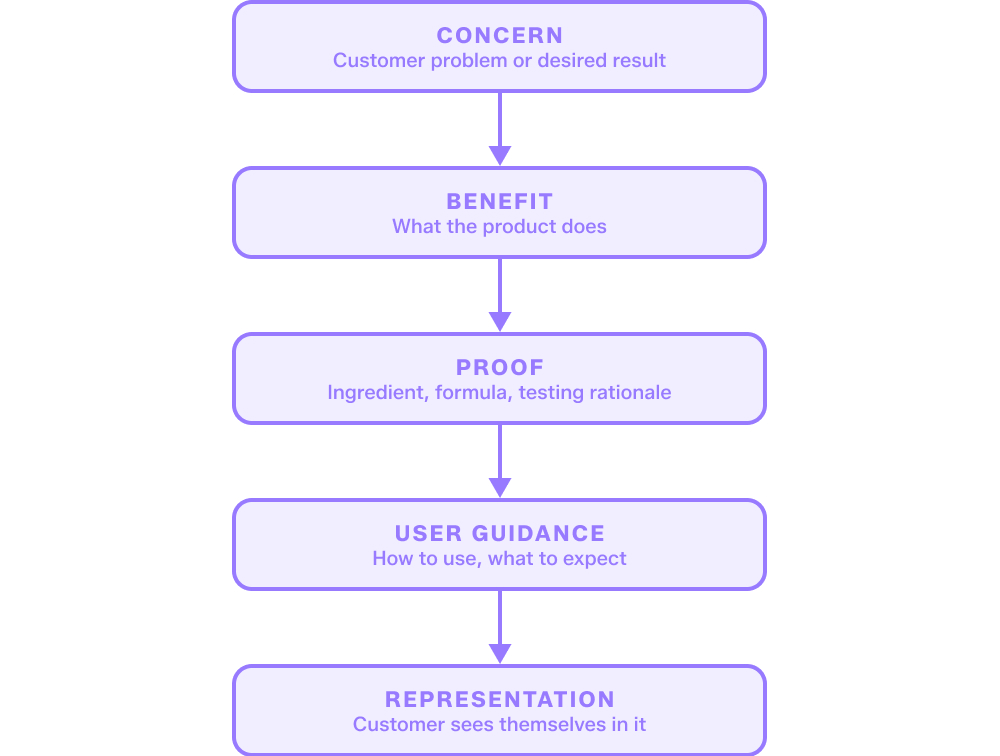
A credible product promise gives shoppers a clear answer to four questions:
For skincare, the answer may sit in a clear concern-and-routine story. For makeup, it may come from shade confidence, visible performance, or artistry. For fragrance, it may be sensorial distinction, self-expression, or a memorable sampling experience. The category matters because the proof shoppers need changes with the purchase.
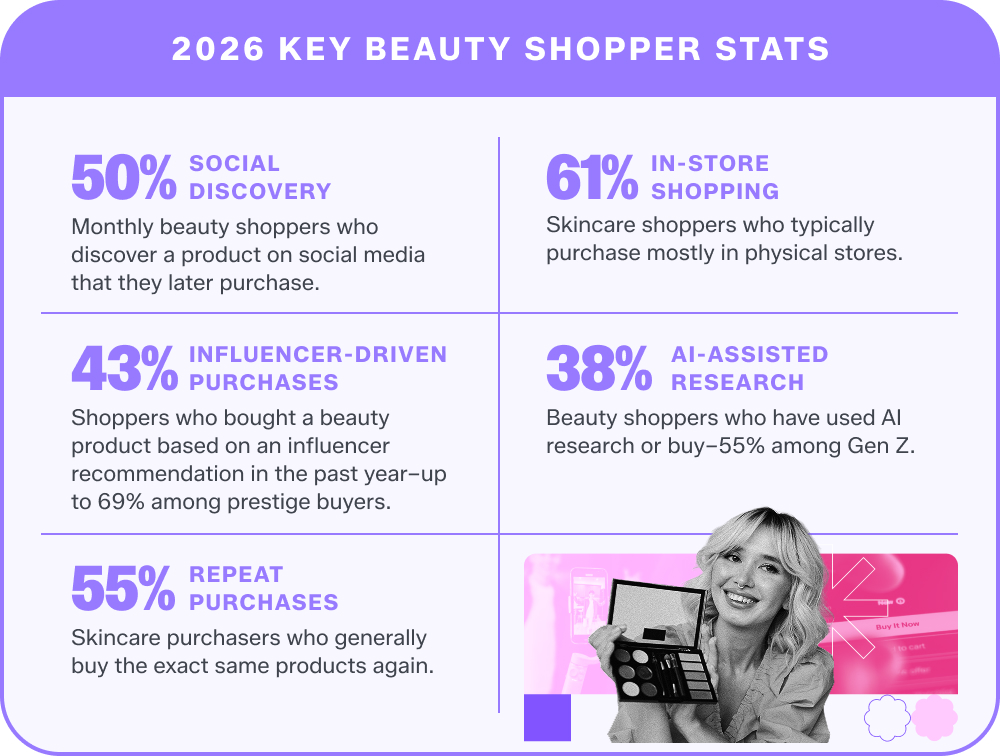
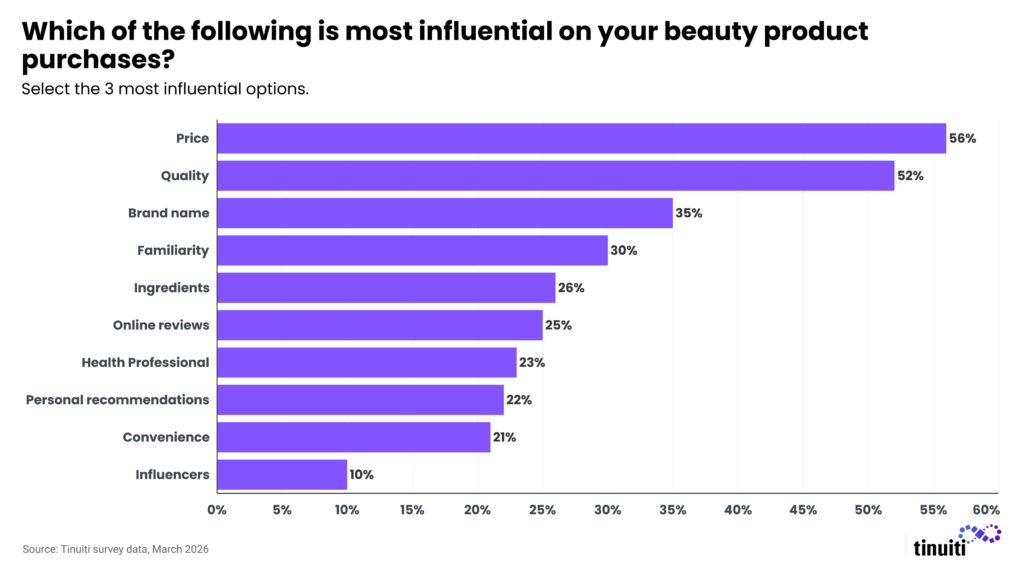
Tinuiti’s study found that brand name matters to 35% of beauty shoppers, while familiarity influences 30%. That doesn’t mean beauty brands should chase awareness for its own sake. It means familiarity becomes valuable when shoppers can connect it to something credible: a product benefit, a routine, an expert perspective, a creator demonstration, or an in-store experience.
Beauty categories don’t ask shoppers to make the same decision. Skincare buyers may need reassurance around efficacy, compatibility, and routine fit. Makeup shoppers often need shade proof, tutorials, real-skin demonstrations, and permission to experiment. Fragrance relies more heavily on sensory storytelling and sampling. Hair care can combine repeatable routine behavior with openness to a better solution.
Our study found that 55% of skincare purchasers generally buy the exact same products, while only 19% tend to look for new brands. Fragrance shoppers are more open to discovery: 26% said they tend to seek new brands, the highest share of the categories studied.
That should change the marketing plan. A skincare hero product may need to reduce switching risk, explain how it fits into a routine, and create a clear path to replenishment. A fragrance brand may need to make the product feel distinctive and worth sampling. Makeup brands need to remove shade uncertainty and show performance on real skin, not just in polished campaign imagery.
There isn’t one “beauty consumer.” The category, concern, price point, purchase frequency, and willingness to experiment should shape the creative, retail experience, offer, and retention strategy.
The beauty customer journey often begins with a concern: acne, dryness, hyperpigmentation, hair damage, sensitivity, shade matching, aging, or simply the desire to feel more put together. The marketing challenge is to translate that concern into a message that is useful, credible, and compliant.
Beauty shoppers don’t make decisions only by age, income, or platform preference. They buy because they’re trying to solve something, achieve something, or feel something.
A shopper looking for barrier repair needs different education than someone choosing makeup for an event. Someone building a simple routine needs different guidance than a seasoned skincare enthusiast comparing active ingredients. Brands that organize creative around these jobs have a clearer path to relevance than brands that rely on broad demographics alone.
Useful beauty segments often begin with a customer need:
The product promise needs to meet shoppers where they are in that decision. A new shopper may need the basics: What the product is, who it’s for, and how to use it. A returning shopper may need a reason to replenish, add a complementary product, or try a higher-value routine.
Beauty claims can’t be treated as a copywriting flourish. They shape customer trust, creator guidance, retail listings, and compliance risk.
The FDA’s cosmetics labeling guidance helps distinguish cosmetic claims from drug-like claims in the U.S. A product may improve the appearance of skin without treating or preventing a medical condition. That distinction should stay consistent across product pages, packaging, paid media, retailer listings, and creator briefs.
The strongest claims strategy starts with a clear evidence hierarchy:
The line between compelling and risky is especially important for acne, eczema-adjacent concerns, sun protection, sensitivity, and “clinical” language. Tinuiti’s guide to cosmetics advertising provides a deeper look at how brands can make their marketing work harder without letting the promise outrun the proof.
Terms like “clean,” “clinical,” “derm-tested,” and “non-toxic” can invite more scrutiny than confidence when brands can’t explain what they mean. Specificity works harder. Explain the product standard, the evidence, or the benefit rather than asking customers to infer it.
Beauty marketing earns trust when it builds a real reason-to-believe stack:
This also applies to inclusivity. Shade ranges, hair-type representation, model selection, accessibility of product education, and community feedback should influence the product and creative system.
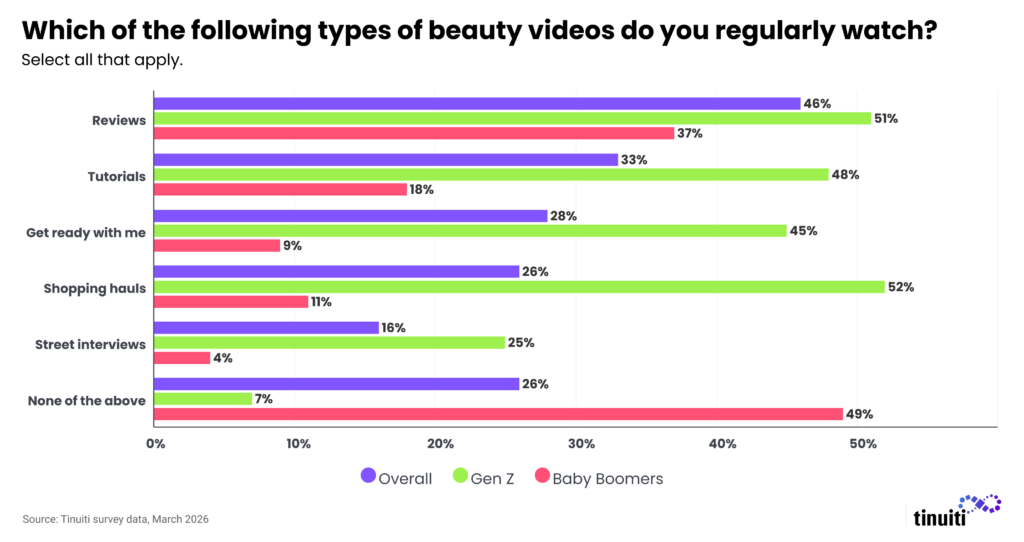
Beauty content works when it makes the product easier to understand. A polished product reveal might earn attention, but a strong tutorial, real-skin demo, routine explainer, or wear test can do more: it answers the question that keeps a shopper from buying.
Beauty content should give each format a defined job.
| Content job | Useful formats | Customer question |
| Discovery | Creator hooks, GRWM, product reveals, trend participation | Why should I notice this? |
| Education | Tutorials, routines, ingredient explainers, comparisons | What does it do, and how do I use it? |
| Proof | Wear tests, reviews, real-skin demonstrations, substantiated before-and-after content | Why should I believe it? |
| Conversion | Product-page video, bundles, shade support, retail-specific assets | Why should I buy now and here? |
| Retention | Replenishment reminders, regimen education, cross-sell content | What should I try next? |
Our study found that 32% of beauty shoppers have posted a photo or video using or reviewing a beauty product. Which is why brands need a content system that can recognize strong customer proof, obtain the right permissions, and adapt it for paid media, product pages, email, and retailer environments.
“Launching a new product line means every impression has to work harder. Tinuiti and Meta helped us build a creative mix that connected the right messaging with the right audiences—and we saw results where it matters most: Amazon sales during our test window rose significantly.”
Sarah McLaren, Head of Personal Care at OLLY
Read the full case study here.
Beauty search behavior is often a proxy for uncertainty. Shoppers search when they need product proof, routine guidance, ingredient clarity, or reassurance that a product fits their concern.
That creates several high-value intent areas:
A beauty SEO strategy should connect editorial content, DTC product pages, retailer listings, and creator assets. A shopper who searches “niacinamide for sensitive skin” should not encounter one explanation in organic search, a different promise in paid social, and a third, incomplete version on the product page.
Get our guide to AI in Search to learn what’s required to maintain visibility in the new search landscape.

A UGC program becomes harder to manage as it grows. More creators mean more reach, but they also mean more opportunities for inaccurate usage instructions, off-brand framing, unsubstantiated claims, poor disclosures, and unrecyclable content.
A scalable creator program should define:
Influencer marketing can move beauty shoppers from discovery to purchase: 43% of shoppers in our study said they bought a beauty product based on an influencer recommendation during the previous year. That rises to 59% among shoppers who discover beauty products through social and 69% among shoppers who expect to spend most of their beauty budget on prestige brands.
Those numbers support investment in creators. They don’t support indiscriminate creator spending. The right portfolio matches the creator, product, customer, claim, and channel to a clear job, whether that’s building awareness, explaining a routine, demonstrating product performance, driving qualified traffic, or creating reusable assets for paid media.
A creator portfolio should give the business a mix of reach, credibility, education, and conversion.
Build your influencer program around roles, not follower count:
Creators can make beauty marketing feel personal. They cannot make disclosure obligations optional.
The FTC’s endorsement guidance requires clear disclosure of material relationships between brands and endorsers. In the UK, the Advertising Standards Authority’s social-media guidance is particularly relevant when branded content could be mistaken for unaffiliated editorial content.
Clear disclosure does not make content less authentic. It makes the relationship honest. Mature beauty programs build disclosure, review, and escalation processes into creator operations early, before content volume makes governance difficult.
Paid media can amplify a beauty brand’s proof. It can’t make up for a vague product story, weak retailer listing, missing shade support, or product page that doesn’t answer the question the ad created.
“We’ve all been there: an ad for a makeup brand follows you across Instagram and Facebook for a year until you finally ‘crack’ and buy it. But here’s the kicker: you never actually searched for it. The discovery came to you. If your marketing strategy starts and ends with a search bar, you’re missing the bigger picture.”
Michelle Merklin, VP of Search at Tinuiti
Beauty shoppers use search at multiple points in the journey. Amazon and Walmart are tied as the websites or apps beauty shoppers are most likely to visit first for online product search, at 22% each. Amazon edges Walmart as the online beauty-purchase destination shoppers are most likely to use, 29% to 26%.
Beauty brands should map the role of search and marketplace media to customer intent:
The relevant question is not “How much should we spend on Amazon?” It is “What decision does Amazon help the customer make, and what evidence must be present when they get there?”
Social is a major discovery engine with half of monthly beauty shoppers discovering products on social media they later buy; Facebook leads beauty discovery overall, while TikTok leads among Gen Z respondents. That doesn’t mean every brand needs the same channel mix. The job is to place the right creative where a customer needs it most.
Creative testing should help teams learn why an asset worked. Test one meaningful variable at a time: the opening hook, concern, proof point, spokesperson, format, offer, or landing experience. When teams change all of those elements at once, they may get a winner, but they won’t know what made it win.
Tinuiti’s social media services help brands connect paid media and creative testing to the broader commerce and customer experience.
Get the full guide for the data and platform-by-platform breakdown to make this new reality work in your favor.

Beauty creative testing should be designed to reveal why an asset works, not just whether it worked.
A useful test matrix may vary:
Keep the variables disciplined. If a team changes the hook, creator, offer, audience, placement, and landing page at once, it learns very little from the result.
The best beauty teams create a feedback loop between organic winners, creator content, paid testing, retail questions, customer service themes, and product reviews. That is how creative becomes a source of business intelligence rather than a stream of assets.
This approach is exactly what powered OLLY Body’s recent Meta Creative Excellence Campaign of the Year nomination. By isolating creative as the single variable in a controlled split test, the brand proved that Reels-native, trend-informed assets could outperform business-as-usual creative — without touching targeting or budget.
Beauty buyers do not think in channel silos. Instead, they think in terms of trust, access, price, speed, and experience.
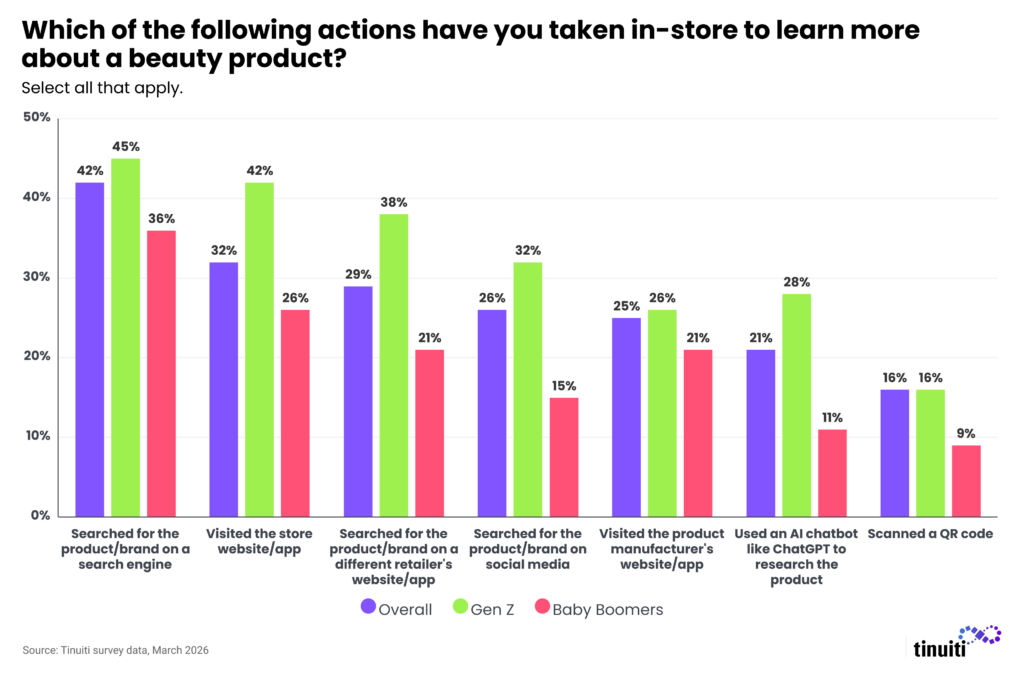
Our study found that 61% of skincare shoppers typically purchase mostly in store. It also found that 42% of beauty shoppers search online while evaluating a product in store. The store and the screen are often part of the same decision.
Retail readiness is the point where brand marketing becomes operational. For a beauty brand, this includes:
DTC and retail should not compete for the same customer with the same offer. A healthier model gives each channel a role:
| Channel | Useful role | What to protect |
| DTC | Education, first-party relationship, regimen building, subscriptions, exclusives | Customer data, product education, post-purchase experience |
| Specialty retail | Discovery, sampling, trust, expert support, physical trial | Retail presentation, education, availability |
| Amazon and marketplaces | Search capture, convenience, replenishment, review-led evaluation | Listing quality, price discipline, inventory, review health |
| Social commerce | Creator-led discovery, product demonstrations, selected conversion moments | Product selection, fulfillment, content quality, measurement |
Retail readiness is where strategy becomes operational. Brands need accurate product pages, consistent claims, reviews, packaging that matches creator content, enough inventory behind promoted SKUs, and a support experience that holds up when demand spikes.
Sampling can remove a real barrier: shade uncertainty, fragrance discovery, routine fit, or hesitation around a new product. But samples don’t create growth on their own.
Measure what happens after trial:
A social post, retail event, or sampling program may create attention quickly. The follow-up experience determines whether that attention turns into a customer relationship.
A launch can generate attention quickly. It takes much longer to create a product customers understand, trust, buy, and work into their routine.
A strong beauty launch follows a practical sequence:
Shade launches need additional care. Shoppers need easy-to-understand shade names, swatches in consistent and varied lighting, real-skin representation, comparison guidance, and inventory behind the shades most likely to be in demand.
Post-launch, collect the questions shoppers ask, the demonstrations that convert, the reviews that reveal friction, and the product combinations customers build naturally. Use those insights to improve paid creative, product pages, retailer listings, creator briefs, FAQs, and the next round of product development.
Post-launch strategy begins with the questions the launch created.
Use those answers to build evergreen product education, update retailer assets, improve FAQs, refine creator briefs, and decide whether to expand the line or protect the hero SKU. A launch is not successful because it creates a spike. It is successful when it creates a repeatable reason for the brand to grow.
Trust is a growth issue. In beauty, a claim that exceeds the available proof can damage credibility, trigger retailer or platform problems, and create inconsistency across the product experience.
Build a claims-review process into the workflow before content gets scaled across creators, paid media, retail listings, product pages, email, and packaging.
Use a simple checklist:
The FDA’s cosmetics labeling guidance, EU Cosmetics Regulation 1223/2009, and ISO 22716 can help brands understand the regulatory and quality context that may apply across markets. Brands should rely on legal and regulatory experts for product-specific guidance.
Tinuiti’s Cosmetics Advertising Guide provides additional perspective on building compliant, high-performing beauty marketing.
Beauty shoppers evaluate product attributes beyond performance. In Tinuiti’s 2026 Beauty Marketing Study, respondents were most likely to say that non-toxic formulations and animal-cruelty-free ingredients or processes were very important. Broad sustainability language still creates skepticism when a brand cannot show the proof behind it.
A better approach is evidence-first storytelling:
Trust compounds when a brand tells the truth at the level of detail the customer needs. It erodes quickly when marketing asks the customer to fill in the proof.
Beauty growth is rarely visible in one dashboard. The customer may discover through social, buy through retail, replenish through Amazon, and become more valuable through a regimen that no single platform can fully see.
Beauty brands need a scorecard that shows whether marketing is creating a more valuable customer relationship.
Useful measures include:
Platform reporting helps teams optimize activity within the platform. It can’t always show whether a sale would have happened anyway, whether another channel created the demand, or whether the customer became more valuable after the first purchase.
That’s why beauty brands need to triangulate platform signals, retail and DTC trends, customer cohorts, creative insights, and incrementality testing. The goal isn’t more reporting. It’s knowing which decision the data should change: scale a creator model, shift media, protect a hero SKU, improve retail readiness, adjust a regimen offer, or stop funding activity that isn’t producing value.
A connected operating model can help with this. Tinuiti brings audience, creative, media, and measurement together so teams can see how decisions across the customer journey contribute to business outcomes, not only how individual channels perform in isolation. Through the Bliss Point Marketing Operating System, those signals can inform faster, more accountable decisions about where growth is actually being created and where investment may be going to waste.
Measurement tech that shows what’s driving growth—and exposes what’s holding it back.

Beauty LTV is built through usefulness. A shopper who buys a cleanser may need help understanding when to add a treatment, moisturizer, SPF, or makeup product. A skincare buyer who has a good first experience may need a replenishment reminder before they run out. A makeup shopper may respond to a complementary shade, tool, or seasonal look.
LTV programs should connect:
Beauty discovery is expanding across social, retailer sites, physical stores, creator content, and AI tools. The response isn’t to chase every new surface. It’s to make product information, proof, and brand experience consistent enough to travel wherever customers look.
AI is becoming another place where shoppers research beauty products before they buy. Our data found that 38% of beauty shoppers have used AI to research or purchase beauty products, rising to 51% of millennials and 55% of Gen Z shoppers.
That makes product information a visibility and trust issue. Benefits, ingredients, use guidance, shade or variation details, availability, reviews, and category context need to be accurate, specific, and consistent across brand sites, retailer listings, and other customer-facing sources. If a shopper, or an AI tool, can’t understand what the product does, who it’s for, and how it fits into a routine, the brand is less likely to be part of the recommendation set.
Social commerce can shorten the distance between a creator demonstration and a purchase. Thirty percent of monthly beauty shoppers purchase through TikTok Shop regularly or occasionally, rising to 39% among Gen Z beauty shoppers.
But a creator-product link doesn’t make a social commerce strategy. Brands need the right products in stock, accurate product pages, retail-ready offers, fulfillment that can handle demand, and measurement that shows whether the activity created incremental demand or simply shifted an existing sale to a different checkout path.
Community gives beauty brands a direct view of whether the product promise holds up after purchase. Reviews, routine questions, customer-service themes, creator feedback, and UGC can reveal where shoppers need clearer education, where the product experience falls short, and what customers value enough to recommend on their own.
That feedback should shape the business: update product pages when the same question keeps appearing, improve creator briefs when customers misunderstand usage, adjust packaging or instructions when friction shows up repeatedly, and build retention content around the routines customers are already creating.
For beauty brands, the takeaway isn’t to manufacture a community presence on platforms like Reddit or chase every conversation. It’s to make it easier for real customers and credible advocates to share useful, specific product experiences wherever beauty discussions already happen. That means showing up thoughtfully when the brand can contribute, supporting customer education, and treating reviews, forums, creator content, and community questions as part of reputation management.
“The citation opportunity lives in whether the authentic conversations happening in your category contain useful, self-contained answers… Fostering real community in spaces like Reddit—finding your brand ambassadors, participating genuinely, making it easy for satisfied customers to talk—is community building and reputation management. That’s the work that earns citations.”
Jen Cornwell, Sr. Director of AI SEO Innovation at Tinuiti
Beauty growth becomes more durable when the brand’s product promise, discovery strategy, purchase experience, retention programs, and measurement model are designed to reinforce one another.
That means giving shoppers a clear reason to choose the product, carrying the same proof across creators, media, search, retail, and product experiences, removing friction when they are ready to buy, and helping the first purchase become a routine. It also means measuring the combined contribution of those investments.
Tinuiti brings brand, creators, commerce, media, and measurement together so every part of the customer journey works toward the same growth goal. Through this connected approeach, teams can move faster on the decisions that improve customer value: where to invest, what product proof to scale, which retail experiences to fix, and how to create growth that is both immediate and lasting.
Explore Tinuiti’s beauty marketing services to learn how we help brands build connected growth systems around the customer journey.

Copywriter, Tinuiti
Jenn Wheatley is a senior content strategist and copywriter who turns complex marketing data into clear, actionable stories. She develops research-backed reports and thought leadership that help brands navigate critical business decisions. Based in Utah, she enjoys cooking, strength training, and traveling with her family.