Prime Day 2026: Record Sales Meet Shifting Consumer Baskets

This article was originally published on July 1, 2026 and updated on July 16, 2026 to include additional data analysis.
Prime Day 2026 is officially in the books, and it left brands with plenty to unpack. Let’s look at this year’s event through three major questions that define Prime Day.
Yes and no. On one hand, Adobe reported that total online spending hit a record-breaking $26.4 billion, a 9.3% increase YoY. On the other hand, there were several signs of belt tightening from consumers. According to Numerator, average order value and household spending declined 11% and 8%, respectively, relative to 2025. Additionally, Adobe reported that Buy Now, Pay Later sales hit $2B in 2026, a 9.5% increase vs last year.
The revenue growth reflects consumers continuing to shop, but these additional signals show that macro-economic conditions are driving a more aggressive savings approach than last year.
There were several themes this year that lined up with last year’s event: Strong Day 1 followed by lulls in purchase intent, especially during Day 3, and consumers prioritizing everyday essentials. Brands need to put more intention behind what assortment to participate in Prime Day and how to align discounts to meet customer’s expectations.
Ken Magner, Commerce Sr. Strategist, Tinuiti
The shift up to June proved to be a double-edged sword. For instance, while Tinuiti apparel clients experienced growth YoY, many did not achieve Amazon’s sales expectations for the category. Our team hypothesized that there may have been weakened demand due to the close proximity to Father’s Day which, in itself, is a major demand driver for apparel.
Likewise, pulling Prime Day up to coincide with the start of the World Cup may have been an attempt by Amazon to dovetail demand for new TVs and accessories. Numerator reported that 14% of shoppers made a CE purchase this year vs. 33% in 2025. So, that strategy did not appear to pan out either. All that said, the event still delivered more revenue than last year – so retaining the June timing for next year is certainly a possibility.
The timing of Prime Day proved suboptimal for men’s apparel, arriving just days after Father’s Day. While this compressed timeline actually boosted early lead-in deals, the overall event fell short of expectations. Looking forward, we are closely watching to see if any “halo effect” materializes.
June Carlin, Director Retail Operations, Tinuiti
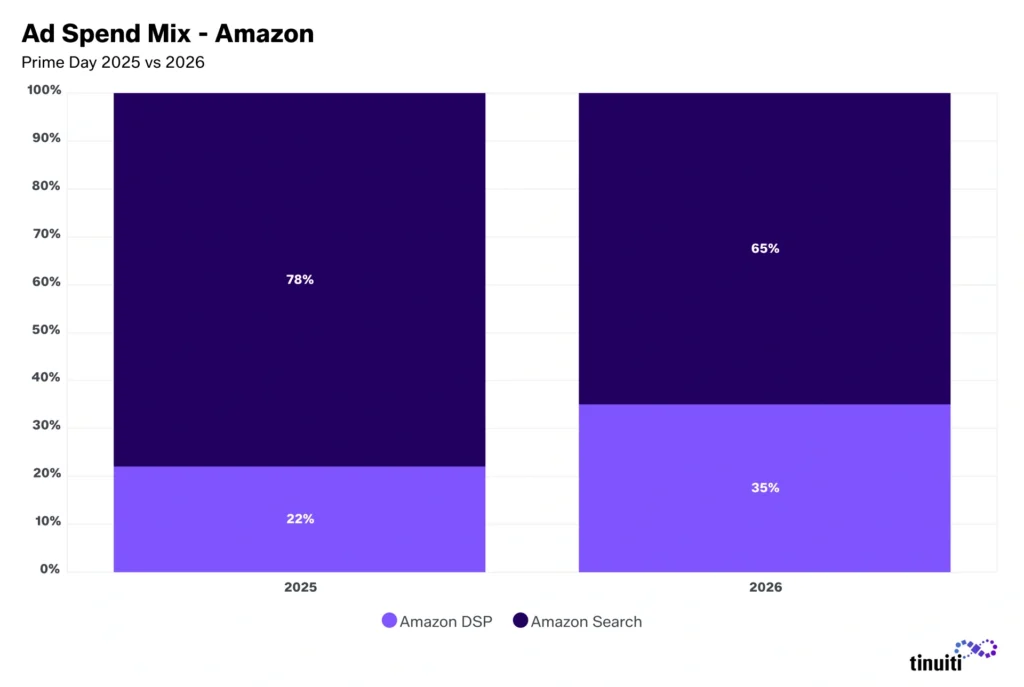
They certainly did. Total ad spend across Amazon search and ADSP for Tinuiti’s clients rose 19% YoY, propelled by a 59% surge in ADSP spending, which comprised 35% of Prime Week spend.
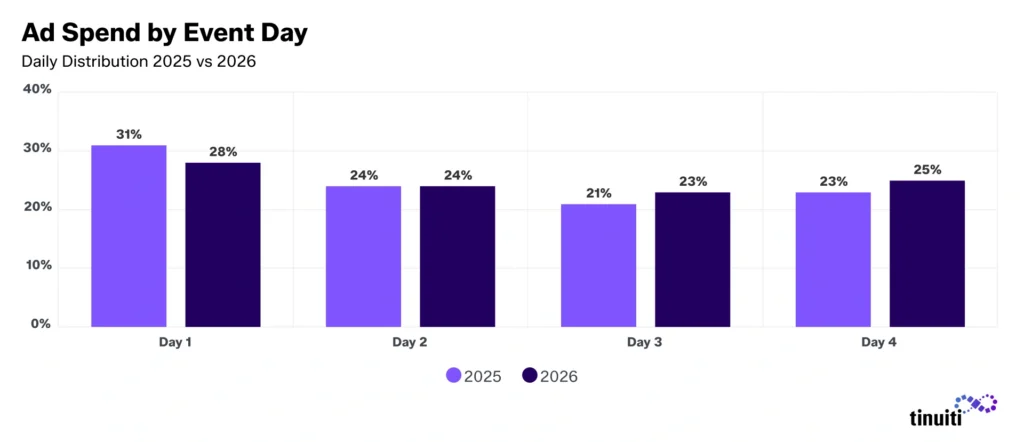
Ad spend was distributed more evenly than in 2025. Day 1 spend dropped to 28% (from 31% in 2025), while Days 3-4 grew the most. This shift likely reflects lighter Day 1 traffic suppressing early spend capacity and pushing budgets later, rather than an intentional strategy.
Tinuiti’s VP of Research, Andy Taylor, provides a deeper look at the impact of Prime Day’s 2026 timing.
Amazon’s move to shift Prime Day from its typical July timing to late June had a huge impact on quarterly growth for advertisers. Removing the days of Prime Day 2026 and the same dates from 2025, Sponsored Products spending would have still grown 23% year over year, but that’s much lower than the 38% growth observed for the entire quarter for Tinuiti advertisers.
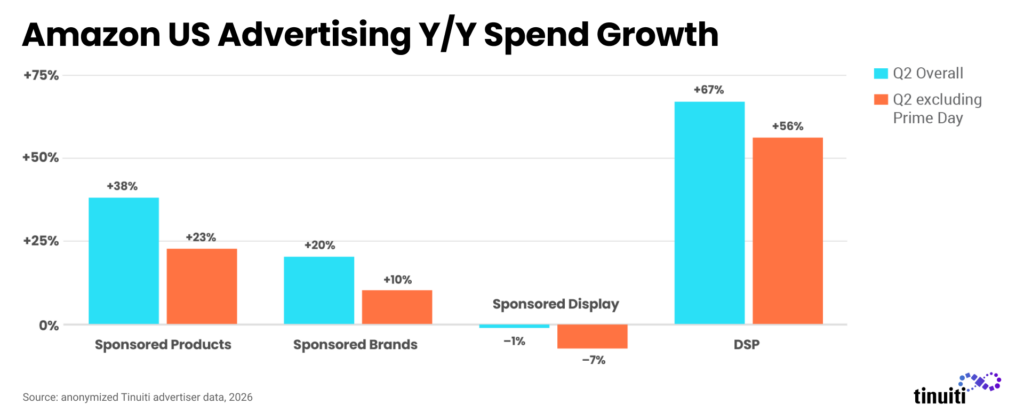
Q2 spending growth for the Amazon DSP, Sponsored Brands, and Sponsored Display was also much stronger thanks to the added boost of a June Prime Day.
Prime Day 2026 ad spending also significantly outpaced Prime Day 2025 across most Amazon advertising products. The lone exception was Sponsored Display, which has been deprioritized by many advertisers in favor of the Amazon DSP’s targeting and measurement capabilities.
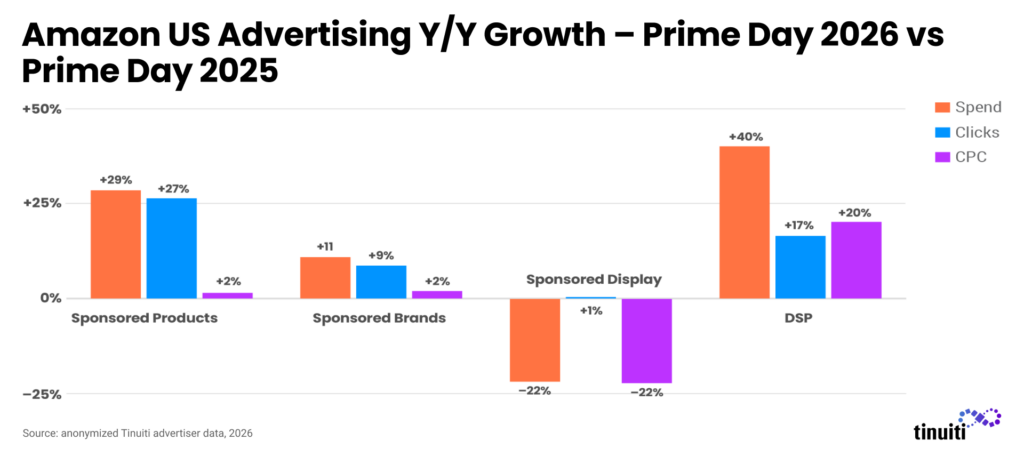
Much like the quarterly trends of the last few years, Amazon DSP spending rose much faster than Ad Console campaign types comparing Prime Day 2026 to Prime Day 2025.
For the DSP in particular, spending typically ramps up in advance of Prime Day as advertisers look to warm up audiences. In 2026, DSP spending jumped meaningfully in the middle of June, peaking on the final day of Prime Day (June 26) at more than 300% the daily spend observed on the first day of the quarter.
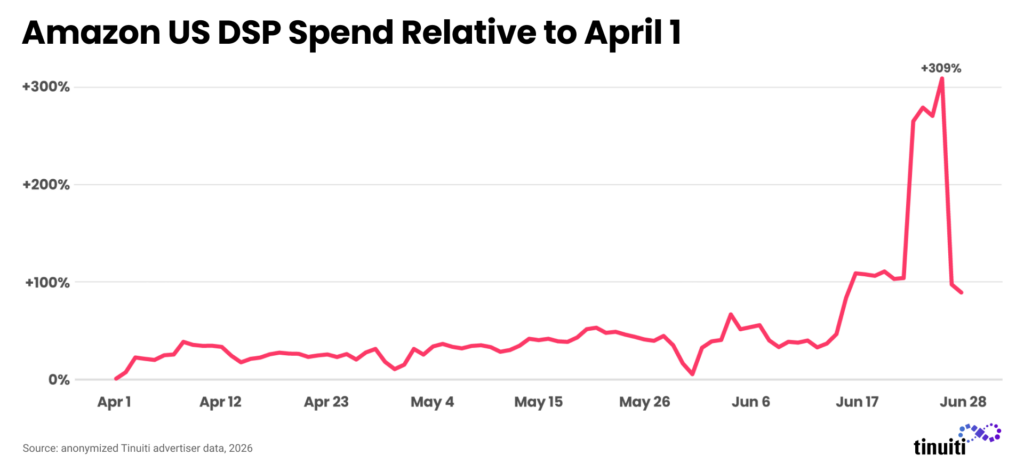
Ad investment remained elevated compared to the beginning of the quarter throughout the weekend after Prime Day as advertisers retargeted Prime Day shoppers.
Amazon advertisers obviously ramp up their spending before, during, and after the event largely to drive more sales volume. Looking at sales attributed to Amazon Sponsored Products, the Amazon format most focused on directly attributed sales for advertisers, sales revenue on the first day of the event was more than 300% higher than the daily average in Q2 prior to Prime Day.
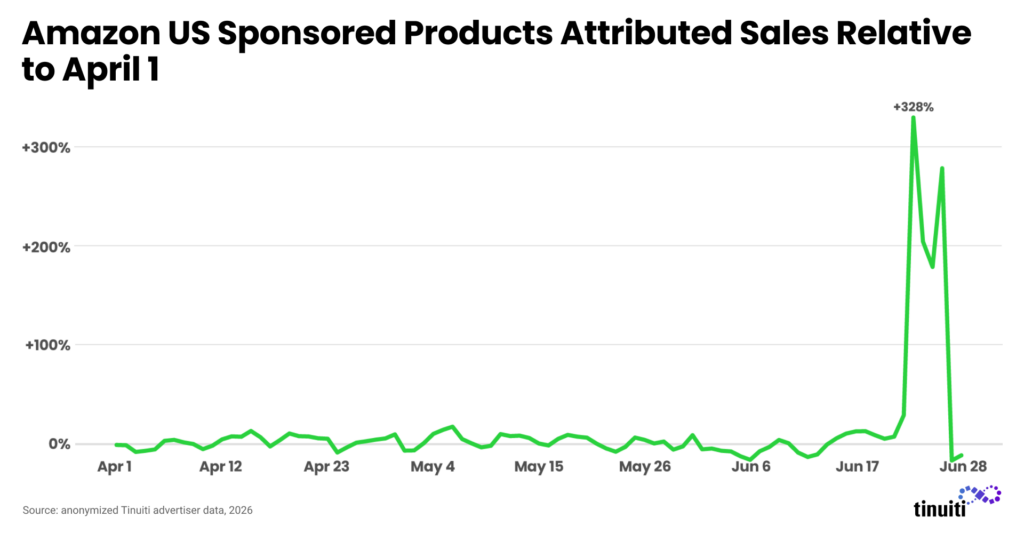
Sales volume slowed in days two and three before bumping back up in the final 24 hours of the event, as shoppers once again held off until the end to make some purchases, a trend that’s been accentuated by the four-day duration Amazon adopted last year.
Breaking Sponsored Products sales down by day, the first 24 hours are still crucial for advertisers as they accounted for the most total volume of any day. However, the share of total Prime Day sales attributed to day one slipped from 34% in 2025 down to 31% in 2026.
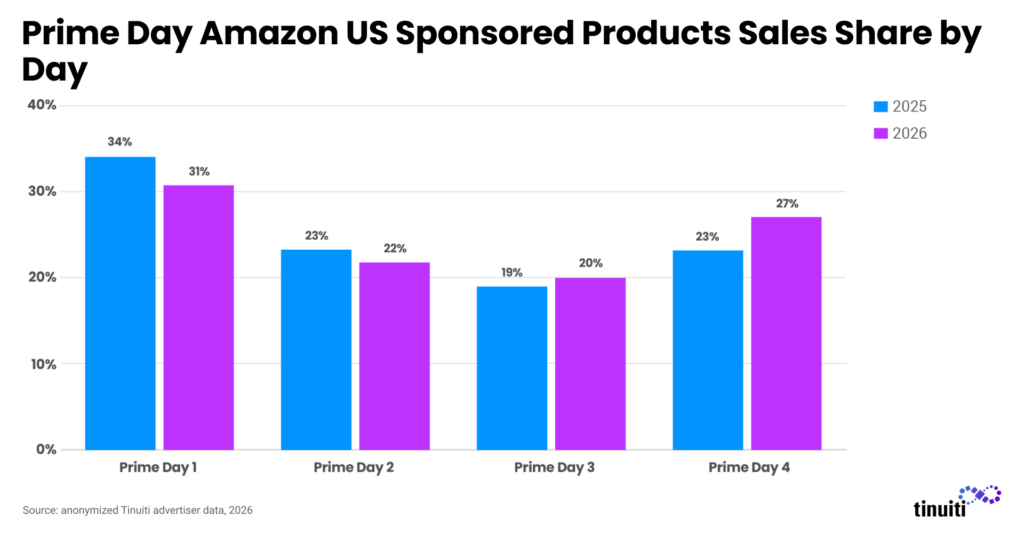
The day that saw the biggest sales share increase was the last day, rising from 23% of sales to 27%, and advertisers need to stay active throughout the event in order to maintain a presence for those shoppers who wait to make purchases.
Looking ahead, it’s likely that advertisers will see softer year-over-year growth in the third quarter as they lap the July timing of Prime Day 2025 now that Prime Day 2026 is already in the rearview.
Keep on the lookout for our annual holiday prep webinar, coming your way in late August.

Senior Innovation & Growth Director, Amazon, Tinuiti
Joe O’Connor is Tinuiti’s Senior Director of Innovation & Growth for the Amazon channel. He spends most of his time at the frontier of where Amazon advertising is heading—currently building out Tinuiti’s Amazon Marketing Cloud (AMC) practice and rethinking product discovery for an AI-first Amazon. With 7.5 years at Amazon Advertising before joining Tinuiti in 2023, Joe helps Tinuiti navigate the fast pace of retail media. He lives in Seattle.