Agentic Commerce: How AI Shopping Agents Change Checkout and Growth


Agentic commerce is when an AI agent researches, evaluates, and purchases products on behalf of a user. This can also include brokers making deals on behalf of users, such as with Direct Offers. Instead of a person manually browsing pages and comparing options, the user expresses intent (“find me a vitamin C serum that works for sensitive skin under $40”) and an agent orchestrates the entire journey across merchants and channels.
The core shift is from user-driven browsing to agent-driven procurement. Storefront-as-interface gives way to agent-as-interface.
Mastercard highlights two big consumer benefits: better personalization and less effort. Because agents remember preferences, budgets, and past purchases, they can act like always-on personal shoppers—skipping endless scrolling, surfacing relevant options more quickly, and even handling routine replenishment tasks for everyday items once a user has opted in.
“Autonomous” is a gradient, not a switch; the authority consumers grant an agent depends on category, context, and trust in both the brand and the platform. McKinsey estimates that by 2030, agentic commerce could orchestrate roughly $900 billion to $1 trillion in US B2C retail revenue and between $3 trillion and $5 trillion globally, even before factoring in services or B2B.
“Consumers will increasingly rely on AI assistants that act on their behalf. These agents will become the primary intermediary between brands and their customers. Instead of speaking directly to a consumer, marketers will need to design for Agent-to-Agent interactions, a shift as profound as the rise of search.”
Simon Poulton, EVP of Innovation and Growth
Get our guide to AI in Search to learn what’s required to maintain visibility in the new search landscape.

Agentic commerce plays out across three primary modes of autonomy:
Most real-world activity today is still at level 1, with early experiments in level 2 through features like “buy for me” and conditional price alerts. Level 3 remains mostly hypothetical at scale—constrained by user trust, regulation, and the immaturity of consent and control user experience.
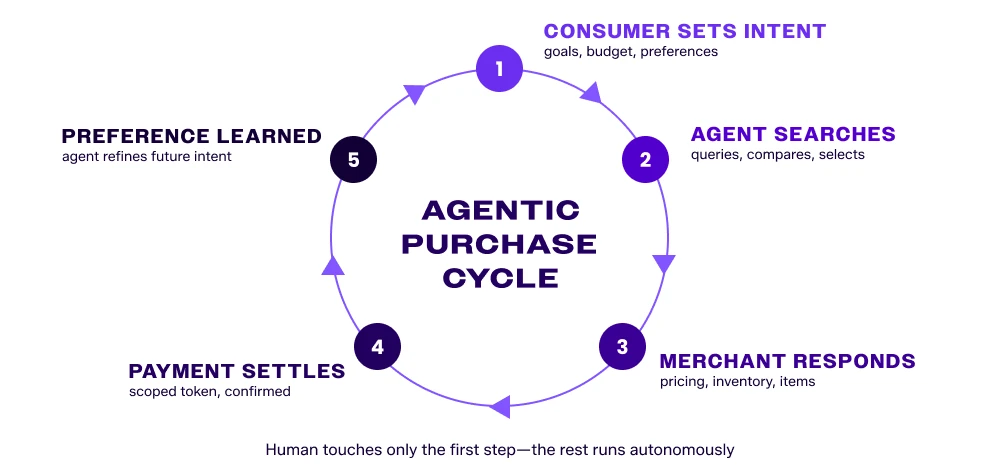
Recommendation engines rank and surface options; agentic systems can actually execute decisions and complete transactions. Traditional conversational commerce usually lives within a single store, whereas agentic commerce can operate across merchants, channels, and even protocols. Google’s recently introduced Universal Cart helps illustrate that shift: it works across retailers, and Google surfaces such as Search and Gemini, allowing shoppers to save products from different merchants in a single persistent cart while Google handles tasks like price tracking, discount discovery, and compatibility checks in the background.
This creates a new gatekeeper dynamic: the first customer in the funnel is increasingly an AI agent rather than a human browser. Winning that recommendation slot means winning the agent’s logic and constraints before you ever win the human click.
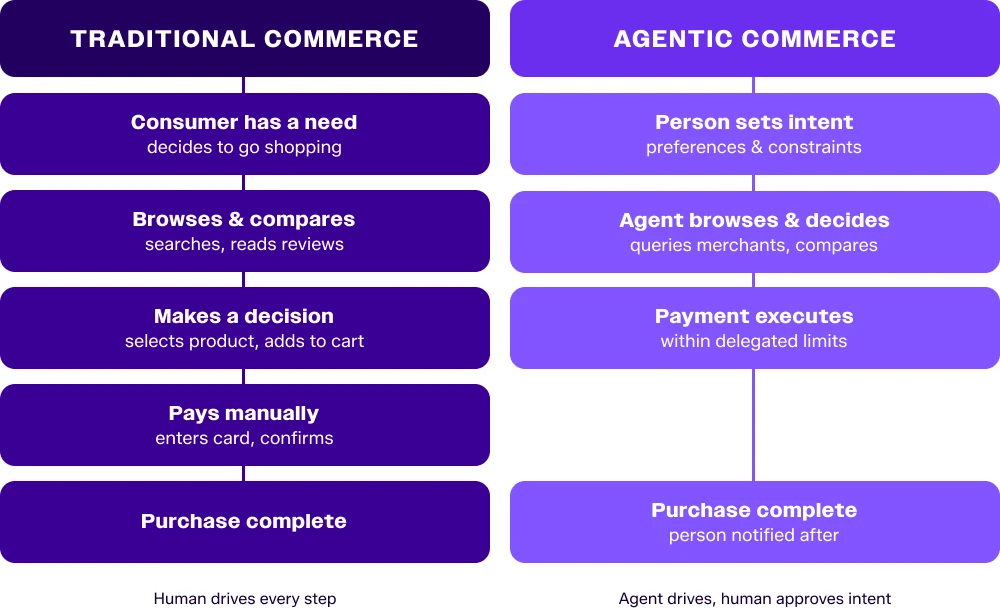
Agentic commerce comes together across three interconnected layers:
At a practical level, brands need to optimize differently for each layer: shaping demand through upstream brand preference, feeding clean, structured catalog data into merchant surfaces, and working with payment partners that can support tokenized, agent-driven flows.
| Layer | What it does | What brands need to get right |
| Agent | Captures intent and executes recommendations/purchases | Clear use cases, differentiated proof points, and brand preference before the comparison step |
| Merchant | Exposes catalog, pricing, policies, and inventory | Clean structured data, verifiable claims, unambiguous policies, and real-time availability |
| Payments | Moves money safely within delegated limits | Partners that support scoped tokens, “undo” flows, and agent-specific risk controls |
The Agentic Commerce Protocol (ACP), developed by OpenAI and Stripe, defines an open standard for how agents and merchants communicate about product selection, pricing, and payments. Google’s Universal Commerce Protocol (UCP) plays a similar role for Gemini-powered agents, tying into Google Pay and Merchant Center to coordinate conditional and delegated transactions. Importantly, UCP is no longer just a Google-led initiative: Amazon, Meta, Microsoft, Salesforce, and Stripe joined the UCP Tech Council in April 2026, alongside founding members Google, Shopify, Etsy, Target, and Wayfair, signaling that major commerce, payments, and platform players are aligning around a shared standard for how AI agents handle discovery, cart building, checkout, and post-purchase interactions.
Here is what our EVP of Innovation, Simon Poulton, had to say when Google launched UCP in early 2026.
Beyond ACP and UCP, the payment rails are also being rebuilt for agents. Google’s AP2, for example, is an open, payment-agnostic protocol backed by networks like Mastercard, PayPal, and American Express to let agents make verifiable, auditable purchases on behalf of users using cryptographically signed mandates. McKinsey points out that this forces the risk stack to evolve from “stopping bots” to authenticating the right agents, extending KYC/AML concepts into “know your agent” so delegated spend can be trusted.
Protocols matter more than any single demo because they reduce the need for one-off integrations, enable interoperability across agents and merchants, and are a prerequisite for agentic commerce to scale beyond walled-garden experiments. For commerce leaders, the strategic decision is to determine how to support them in ways that preserve brand and customer ownership.
Delegated payments rely on scoped tokens that encode exactly what an agent is allowed to do:
In practice, that means small, low-risk purchases can be fully automated, while higher-risk transactions trigger additional consent or verification steps.
Consumer-facing controls such as brand preferences, budget caps, easy “undo” flows, and receipts that clearly explain why an agent made a given recommendation are not just compliance checkboxes. They are the growth lever that determines how far users are willing to move from assistive to semi-autonomous and, eventually, fully delegated modes.
One of the earliest at-scale examples of agentic checkout came from Walmart’s integration with ChatGPT, branded as “Buy It in ChatGPT,” which allowed users to discover products, build carts, and check out directly within the chat interface. Shoppers could ask for recipe suggestions or shopping lists, then turn those into Walmart orders without leaving the conversation, with ChatGPT acting as the intermediary agent that assembled the basket and passed it to Walmart for fulfillment.
The experience confirmed that conversational discovery, plus embedded checkout, can reduce friction in theory, but real-world results were mixed. Reporting in early 2026 indicated that OpenAI was scaling back Instant Checkout after seeing low conversion and accuracy issues, and Walmart is now shifting to a model where its own Sparky assistant plugs into ChatGPT and Gemini so Walmart retains control of the checkout and fulfillment experience. In practice, that means ChatGPT is increasingly focused on product discovery, comparison, and list-building, handing users off to retailer sites or native agents for the final transaction instead of owning the full checkout flow end-to-end.
The initial pilot surfaced important limitations: not every item in Walmart’s catalog was easily purchasable through the integration, journeys often felt more experimental than habitual, and the handoff between the agent experience and Walmart’s underlying ecommerce systems could still introduce friction. Those lessons—what worked, what broke, and where trust or UX issues appeared—are now informing second-generation agentic commerce experiments across platforms that are trying to move from novelty to repeatable, retailer-aligned behavior.
Retailer-owned agents are quickly becoming the most visible faces of agentic commerce. Amazon recently fused Rufus and Alexa+ and launched Alexa for Shopping, a more deeply integrated AI assistant that’s embedded directly into the Amazon search bar and available across the Amazon Shopping app, website, and Echo Show devices. Alexa for Shopping merges Rufus’s product expertise with Alexa’s personalization, allowing customers to ask complex questions, compare products, track up to a year of price history, and even have the agent buy items from Amazon and other online stores using features like “Buy for Me.”
Walmart’s Sparky is evolving in parallel as a retailer-specific agent that the company is now plugging into ecosystems such as ChatGPT and Gemini, while keeping transactions on Walmart’s own rails. Other retailers, including Wayfair, are experimenting with domain-specific agents that help shoppers translate vague intents (“design a cozy living room”) into structured baskets while staying inside a branded experience.
On the Google side, UCP-enabled “AI Mode” experiments point toward conditional commerce as a bridge between search and full autonomy. Shoppers can express standing intent and let an agent track price, eligibility, and availability on their behalf, turning what used to be passive wishlists into action-able commitments.
Google is also layering Direct Offers into AI Mode, a Google Ads pilot that lets retailers surface exclusive deals, like a special 20% off discount or free shipping, directly in the AI results when Google’s systems detect high purchase intent. Advertisers configure offers in their Shopping or Performance Max campaigns, and Google’s AI decides when and where to show them alongside the conversational experience, using context and real-time intent signals rather than traditional keyword auctions.
At scale, this creates a new intent database: thousands of latent commitments and high-intent sessions that only turn into transactions when conditions are met or when an offer is surfaced at the right moment. Over time, that kind of granular, agent-captured intent and offer response data is likely to influence bidding strategies, retail media targeting, and inventory planning, because it gives brands a clearer view into when price, promotion, or simple convenience is actually moving the needle in AI-mediated journeys.
There is also a separate but related track: browsers becoming agents themselves. Products like Perplexity’s Comet and Chrome’s Gemini integration point to a future in which the browser can navigate sites, compare options, and perform actions across domains on the user’s behalf. Instead of sending an API call to a single retailer, the agent can “browse” multiple sites, read product pages, and synthesize results into a single recommendation.
This browser-first model is still early, but it matters strategically because it threatens to disintermediate both marketplaces and brand sites if it becomes a primary shopping surface. The early legal fights show how contested this open-web model already is. In late 2025 and early 2026, Amazon sued Perplexity over its Comet shopping agent and later won a preliminary injunction blocking Comet from accessing password-protected parts of Amazon’s site to make purchases on users’ behalf, arguing that the tool violated the Computer Fraud and Abuse Act and Amazon’s terms by disguising automated activity as human browsing. Perplexity has appealed and continues to argue that consumers should be able to use whatever AI assistant they want, but the case underscores how marketplaces may use contracts and computer-fraud law—not just robots.txt—to limit agentic browsing as a viable path for agentic commerce.
In an agentic funnel, the core question shifts from “How do I win the click?” to “How do I win the agent’s recommendation slot?” Agents need structured attributes, clear use-case language, and verifiable claims they can reason about, not keyword-stuffed copy or generic lifestyle messaging.
IBM connects agentic commerce directly to what they call an “AI-first” approach to product content, arguing that machine-readable data, standardized attributes, and rich metadata are now prerequisites for being discoverable by agents. In their view, brands are moving from classic SEO to a kind of generative engine optimization, where the goal is to be correctly interpreted, summarized, and recommended by AI systems rather than just ranked for human-only search results.
Content that agents can extract cleanly tends to outperform unstructured storytelling. This is where AI-first SEO and services like Tinuiti’s AI SEO practice become crucial: optimizing not just for human readers, but for the agents and crawlers that will summarize you down to a handful of sentences.
In an agent-led world, your catalog is effectively your ad unit. Agents rely on:
On the Google side, that scope is expanding fast. Google has introduced conversational attributes in Merchant Center with optional fields such as product FAQs, use cases, compatible accessories, and substitutes, that are designed specifically to help AI systems and conversational agents understand how products relate to one another and answer natural-language questions more accurately. These attributes let brands encode the kinds of nuance that used to live only on PDPs or in human conversations (like which accessories work together or what to recommend if an item is out of stock) directly into the feed itself, which is a major shift in what “feed completeness” means.
Brands that invest in clean, consistent product data, populate emerging fields like conversational attributes, and build robust feed operations will see outsized benefits as agents climb the autonomy spectrum. Our commerce media and commerce operations teams are already treating feed health, catalog governance, and conversational attributes as front-line growth levers in this shift, because in an agentic future the feed is no longer just a list of ads—it is effectively the source code for how agents discover, evaluate, and buy products.
When the agent is effectively your first customer, traditional brand storytelling gets compressed. What survives summarization are concrete proof points such as certifications, guarantees, benchmarks, service commitments, and specifics of differentiation, while much of the emotional framing is stripped away.
McKinsey argues that this shift goes beyond UI tweaks into business-model territory, with brands needing to treat “agent experience” as seriously as customer experience—designing catalogs, APIs, and policies explicitly around how agents ingest, score, and act on them. In their view, traditional SEO gives way to something closer to “AX optimization,” where aligning with agent data structures and decision logic matters more than ranking a web page in a human-driven SERP.
That doesn’t make brand building less important; it makes it more upstream. Agents like Alexa for Shopping factor in user preferences, shopping history, and cross-surface interactions when making recommendations, so prior exposure and satisfaction influence how often your brand appears in its answers. The job for marketers is to seed those proof points and preferences across media so that when the agent builds its shortlist, you’re already in the consideration set.
Attribution becomes more complicated as agents mediate more of the journey. Teams will need to answer a new question: Was the agent the decision-maker, the assistant, or just the rails? If Alexa for Shopping or a browser-based agent closes the sale, you still need to know whether your retail media, search, or upper-funnel spend actually influenced its recommendation logic.
Incrementality measurement also gets harder and more important. This is where platforms like Bliss Point by Tinuiti—our marketing operations system—become foundational for understanding how agent surfaces interact with traditional media and what actually drives incremental lift. Expect budgets over 2026–2027 to shift from purely buying placements toward funding structured data, feed distribution, and agent-surface presence.
Measurement tech that shows what’s driving growth—and exposes what’s holding it back.

A lot of what’s currently marketed as “agentic commerce” is still assistive AI with a payment link attached or a rebranded comparison tool. IBM’s research suggests we’re already partway down that road. About 45% of consumers say they’re using AI for at least one aspect of their shopping journey today, from interpreting reviews to hunting for deals.
At the same time, both IBM and Mastercard are clear that fully autonomous, end-to-end agentic journeys will take time to mature, which is why most near-term value will come from assistive and tightly scoped semi-autonomous flows rather than handing agents a blank check.
The gap between aspiration and reality remains wide: Our own research shows while roughly half of consumers say they trust AI to recommend products, only a much smaller share are comfortable letting an AI complete a transaction on their behalf, which is why most successful implementations today sit firmly in assistive or tightly scoped semi-autonomous modes.
Patterns to watch: vendors promising end-to-end agents that turn out to be scripts layered on existing ecommerce APIs, and demos that skip over consent, controls, and exception handling. The honest read is bullish long-term, but near-term reality requires a clear-eyed view of where autonomy actually exists and where humans remain firmly in the loop.
“While we have often spoken about novel surfaces as we consider the future of advertising, this is inherently one-sided and non-interactive. The moment we’re observing is a transition toward interfaces. AI-enabled platforms are enabling novel media consumption habits and truly enabling consumers to interact in a way that has not been possible before.”
Simon Poulton, EVP of Innovation and Growth
As dominant agent surfaces like Alexa for Shopping, Gemini, or browser agents own more of the funnel, brand storefronts risk becoming backends. Retail media networks face a similar challenge: if an external agent brokers the purchase, there may be fewer traditional ad slots to sell inside the walled garden.
When an AI agent is the one clicking “buy,” buyers and sellers are separated by an extra layer of abstraction, creating a real trust gap around who’s responsible if something goes wrong, whether it is the brand, the platform, or the agent itself. That’s why the mainstream iPhone moment for agentic commerce is likely to happen first within trusted walled gardens like Amazon, Google, and Walmart, where consumers already have strong recourse, familiar policies, and a track record of resolving problems before they start handing over real spending power to an AI.
We’re already seeing divergent strategies: Amazon is consolidating its AI capabilities into Alexa for Shopping and keeping tight control over how external agents can interact with its marketplace, while Walmart is pushing Sparky into third-party agents like ChatGPT and Gemini to expand distribution while maintaining control over the transaction rails. Every commerce leader needs to quantify their exposure if discovery collapses to one or two agent platforms.
Trust is the limiting reagent for agentic growth. Consumers need a clear consent UX with plain-language explanations of what the agent can do, explicit confirmation for higher-risk actions, and symmetry between how easy it is to buy and how easy it is to cancel or return.
New fraud vectors emerge in agentic flows: bot-driven carting at scale, agent identity spoofing, promo abuse, and return fraud that exploits automated decisions. Frameworks like NIST’s AI Risk Management Framework give brands a starting point for governance, but commerce teams will still need domain-specific monitoring for agent-related chargebacks, disputes, and policy exceptions.
Not every category will move at the same speed. Repeat purchases, low-regret items, and highly structured commodities are natural early candidates for semi-autonomous or fully delegated experiences.
Discretionary, emotional, and fit-dependent categories like apparel, furniture, and high-consideration electronics will move more slowly because the cost of a bad recommendation is higher and harder to explain away. Over time, as agents like Alexa for Shopping build richer models of individual preferences and fit, more of these categories will inch up the autonomy spectrum.
Start with a structured-data audit on the top 20% of SKUs that drive 80% of your revenue. Identify where feature copy needs to be rewritten as concrete, verifiable claims, and where policies (shipping, returns, warranties) need to be expressed in a way agents can consistently parse.
Fix “inventory truth” issues before you lean into agent surfaces, because agents amplify the cost of bad data; a single mismatch between promise and reality can degrade trust with both the user and the platform. Tinuiti’s commerce operations practice is well-positioned to run these audits and prioritize fixes based on revenue impact.
A 90-day pilot helps you learn fast without over-committing:
Agentic commerce is not a marketing-only project. Ownership spans commerce, product, data, CX, legal, finance, and payments, with clear roles and escalation paths. Vendor strategy decisions such as which payment partners can support delegated flows and which catalog syndication channels to prioritize, should be made in a cross-functional forum.
Governance needs an explicit cadence: monthly model evaluations, quarterly controls reviews, and ongoing monitoring of complaints, chargebacks, and policy exceptions tied specifically to agent-mediated journeys. Our integrated media-plus-measurement model, powered by Bliss Point, is designed to make those decisions with shared data rather than siloed dashboards.
From launch, treat agentic commerce like a new channel with its own scorecard:
| Metric | What it tells you |
| Agent-mediated revenue | Direct value of the new agent surfaces today |
| Attach rate | How well the agent bundles and cross-sells |
| Return rate (agent vs. human) | Whether guidance improves fit and satisfaction |
| Customer effort score | Whether the agent experience actually reduces effort |
| Chargebacks and “undo” actions | Early signals of trust or safety issues |
| Policy exception rate | Operational friction and model-policy misalignment |
These metrics become the backbone of a test-and-learn roadmap: if agent-driven journeys show lower effort and better fit quality at comparable or higher Return on Ad Spend (ROAS), leadership has the proof they need to scale investment.
Agentic commerce will not be a single switch; it will be a multi-year shift in how shoppers express intent and how brands are discovered, evaluated, and purchased. Alexa for Shopping is an early, high-visibility example of what happens when media, measurement, and machine-readable catalog data all converge in a single agent.
Tinuiti is a media agency that not only builds brands, but also architects business outcomes. As agentic commerce reshapes discovery, evaluation, and conversion, we help brands achieve immediate and lasting growth while ending waste. Powered by the Bliss Point Marketing Operating System, the ultimate brand and performance unifier, we help clients align media, measurement, and commerce strategy so they can navigate an agent-led future with more confidence and accountability.

Copywriter, Tinuiti
Jenn Wheatley is a senior content strategist and copywriter who turns complex marketing data into clear, actionable stories. She develops research-backed reports and thought leadership that help brands navigate critical business decisions. Based in Utah, she enjoys cooking, strength training, and traveling with her family.