Food and Beverage Marketing Strategy: Win Shelf, Search, and Repeat


Food and beverage brands do not just compete on taste anymore—they compete on search results, shelf visibility, creator feeds, and whether they can prove every dollar of marketing is moving real product. The brands that win are the ones that treat retail, marketplaces, and media as a single integrated growth system rather than as disconnected channels.
The Skinny: Food and beverage (F&B) brands win when they treat shelf, search, and media as a single connected system and measure everything by penetration, velocity, repeat, and margin. The bullets below are the TL;DR for leaders who need to see the strategy at a glance.
High-performing food and beverage marketing strategies start with a tight definition of what success looks like at the shelf and in the cart. The most effective teams anchor their plans on four core outcomes: household penetration, velocity, repeat rate, and margin mix, then build media and trade strategies backward from those goals based on common questions:
The Four Outcomes That Matter Most for F&B Growth
| Outcome | Core question | Example signal |
| Household penetration | Are we getting into more homes, and with which SKUs? | % of households buying in the last 13 weeks |
| Velocity | Are units per store per week moving as retailers expect? | Units per store per week vs. plan or last year |
| Repeat rate | Are first-time buyers coming back in 30, 60, or 90 days? | % of buyers with 2+ purchases in 90 days |
| Margin mix | Are we shifting to higher-margin SKUs without killing volume? | Gross margin by SKU/pack vs. volume contribution |
Strong F&B marketers also define an intentional brand vs. performance split by stage (launch, scale, defend) so they do not overinvest in lower-funnel channels before they have sufficient awareness or household reach. They apply portfolio thinking across hero SKUs, innovation pipelines, and seasonal plays, ensuring support levels reflect each product’s role in the P&L rather than being spread evenly.
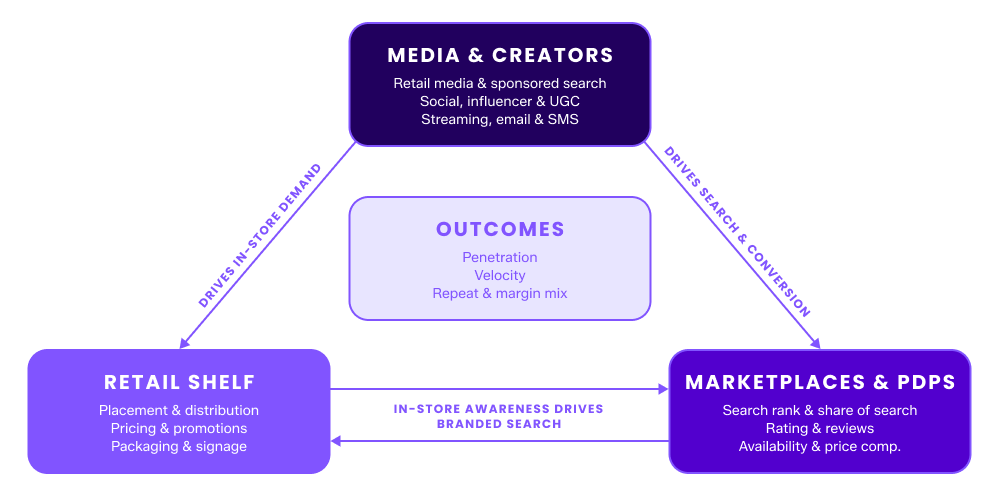
Most generic marketing playbooks underestimate how tightly shelf and search are connected in the food and beverage industry. Retail placement, ratings, and reviews influence marketplace search ranking, while marketplace demand signals influence retailer line reviews and endcap opportunities.
Get our guide to AI in Search to learn what’s required to maintain visibility in the new search landscape.

Sampling, coupons, and introductory pricing all cut into margin, but repeat is where lifetime value is created. The brands that scale build strategies around taste, availability, and habit loops (for example, “weekday lunch staple” or “Friday night treat”) that encourage routine purchases rather than one-off novelty purchases. Finally, regulation and trust are not legal overhead; they are growth levers that determine whether retailers, platforms, and consumers believe your claims and are willing to support your expansion.
Before they sign off on the next campaign, F&B executives usually want clear, quantified answers to a familiar set of questions.
If your food and beverage marketing plan cannot answer these questions in advance with realistic scenarios and measurement plans, it will struggle to secure sustained investment.
For F&B, demographics alone rarely predict purchase behavior; occasions and need-states do. Advanced brands segment around when and why consumers eat and drink, such as breakfast, on-the-go, indulgence, “health reset,” or social sharing moments.
They also map need states such as convenience, price protection, clean ingredients, performance, and sustainability to specific SKUs and channels. Channel behavior matters, too. Grocery loyalists, marketplace-first shoppers, and DTC subscribers often respond to different offers and media. To operationalize these insights, leading marketers mine retailer loyalty panels, onsite search terms, social listening, and review content to understand real-world behavior rather than relying on assumed personas.
On a crowded shelf or a fast-moving feed, great food brand marketing chooses one primary competitive axis and sticks to it. That axis might be taste leadership, functional benefits (such as energy or gut health), ingredient purity, or cultural identity. Importantly, the competitive set is defined by occasion (“afternoon energy”) rather than narrow product type (“energy bar”), which is how consumers actually compare options.
In practice, that means mapping the key occasions when your brand shows up (like weekday breakfast, on-the-go snacking, and evening indulgence) against the need states your consumers care about (such as convenience, clean ingredients, and value). The chart below is a simple way to visualize those intersections before you decide who you are really competing with on the shelf and in the cart.
From there, marketers build a clear message hierarchy: a primary promise, supporting reasons to believe, and concrete proof assets. They also map objections that block trials, such as “too sweet,” “too processed,” or “overpriced”, and create specific proof points across pack, PDP, ads, and creator content to close those gaps.
Occasion-First Segmentation for Food and Beverage Examples
| Occasion / Need-state | Convenience | Clean ingredients | Value & price protection |
| Weekday breakfast | Ready-in-minutes breakfast options for rushed weekday mornings. | Low-sugar, high-protein breakfasts made with recognizable ingredients. | Family-friendly formats that stretch across the week without constant rebuys. |
| On-the-go snacking | Single-serve snacks that fit in bags, lunchboxes, and cup holders. | Better-for-you grab-and-go snacks with simple, transparent labels. | Multipacks and value sizes that make everyday snacking feel affordable. |
| Evening indulgence | Easy “treat yourself” options that require little prep after a long day. | Desserts and treats that feel indulgent but use simpler ingredients. | Shareable formats and promo-ready packs designed for movie nights and gatherings. |
Words like “healthy,” “natural,” “organic,” “sugar-free,” and “high protein” carry both marketing upside and regulatory risk. Following guidance like the FDA’s Food Labeling Guide, USDA organic labeling rules, and FTC endorsement standards helps brands avoid ambiguous or misleading statements that could trigger complaints or enforcement action.
Smart F&B marketers define evidence standards: which claims can be fully substantiated, which should be softened, and which are off-limits. They then enforce consistency across packaging, ads, product detail pages, influencer scripts, and customer support, so consumers do not encounter conflicting information across different channels. This consistency builds a trust halo that supports premium pricing and long-term loyalty.
In most channels, you have a three-second window to earn a click, a cart add, or a shelf pick-up. Applying the “front label headline” principle to every touchpoint forces clarity: one strong benefit, clearly communicated, with supporting sensory language around flavor, texture, and use moments.
Some brands lead with founder or heritage narratives, while others lean into ingredient science or performance outcomes; the right choice depends on your category, price point, and audience. The most effective campaigns test both story types and let real performance data determine which narrative framework scales.
For many F&B brands, packaging is the highest-ROI media channel because every unit shipped is an impression at the shelf, in the pantry, and on social when consumers share it. A strong visual system, consisting of elements such as color blocking, appetite appeal, and a clear typographic hierarchy, helps shoppers recognize and reach for your product quickly while signaling quality, freshness, or indulgence in a split second.
Teams design for both physical shelf readability and mobile thumbnail or PDP clarity, ensuring key benefits, flavors, and pack sizes are legible across formats. Smart packaging elements like QR codes can extend the story into sourcing information, nutrition and allergen details, recipes, traceability, and loyalty capture without cluttering the label, effectively turning every package into a persistent digital touchpoint
Regulated label elements (ingredients, nutrition facts, allergen statements, and required warnings) create design constraints that change across markets. For example, alcohol and organic products have additional rules around how claims can be framed and where disclosures must appear.
Leading brands build “compliance by design” into their workflows: they define claim guardrails up front, bake influencer disclosures and review integrity into briefs, and formalize cross-functional governance with marketing, regulatory, legal, and QA all owning final sign-off. This reduces relabeling costs, protects distribution, and helps avoid reputation-damaging corrections.
Food and beverage brands face heightened scrutiny when marketing to children and families, especially around sugar, high-fat products, and “better-for-you” positioning. WHO has called for stronger policies to protect children from the harmful impact of certain food marketing, thereby making audience targeting and creative choices a material reputational risk.
Sustainability and wellness claims also demand real substantiation, whether you are talking about sourcing, recyclability, or carbon impact. Leading brands invest in transparency through ingredient-sourcing explanations, third-party certifications, and public FAQs to proactively answer questions before criticism goes viral. They also build crisis plans that outline how to respond quickly to claim challenges, recalls, or social backlash.
A modern food and beverage marketing plan treats grocery, club, convenience, and specialty channels differently because their shopper missions and economics differ. Grocery might be the backbone of household penetration, club the engine of basket size, convenience the driver of impulse trial, and specialty the showcase for brand equity.
Trade spend planning aligns everyday low prices (EDLP) vs. hi-lo pricing, feature/display, coupons, and retailer media with each channel’s role. Marketers track velocity as distribution multiplied by turns and margin, then identify where marketing can truly move the number versus where they are constrained by shelf positioning or supply.
In-store execution remains one of the most powerful levers for trial, especially when sampling, demos, endcaps, and smart cross-merchandising are paired with consistent storytelling. An in-store sign that mirrors your pack headline and marketplace copy reinforces recognition and reduces the work the shopper has to do to understand the product.
Limited-time offers and seasonal sets can create urgency without training shoppers to wait for discounts when structured carefully and not overshadowing core SKUs. Successful teams coordinate these efforts with media so that shoppers see the same creative on their phones and on shelves within the same week.
On Amazon and other marketplaces, your product detail page is the new endcap—and often the first and only “shelf” a shopper ever sees. Above-the-fold space should make your promise, flavor or benefit, pack size, and primary use cases unmistakable, supported by ratings, reviews, and trust badges that remove hesitation in a few seconds. Image sequences can then do the heavy lifting, showcasing ingredients, nutrition panels, lifestyle occasions, close-up product shots, and simple comparison charts to pre-empt common questions and reduce returns.
Search ranking is influenced by relevance, conversion, availability, and price competitiveness, so optimized titles, bullet points, and backend keywords are as important as strong creative. Food and beverage leaders build keyword sets around both branded terms and occasion or need-state terms (for example, “high-protein breakfast,” “after-school snack,” “weeknight dinner shortcut”) so they show up when shoppers have a problem, not just when they already know the brand. Sponsored Products and brand defense campaigns ensure you protect your own branded search terms, while selective competitive conquesting and category-level keywords help you win share from shoppers still deciding what to buy.
Conversion optimization does not stop at copy and images. Availability, pack architecture, Subscribe & Save offers, and pricing ladders (single unit vs. multipack vs. bulk) all influence whether shoppers convert and how much they spend in a single session. The most mature teams tie marketplace performance directly into their broader measurement stack, such as feeding sales, search, and review data into MMM and incrementality testing, so they can see how marketplace investments interact with retail media, social, and streaming to drive total category growth, not just isolated ROAS.
Retailer media networks offer sponsored search, onsite display, offsite retargeting, and CRM placements that connect directly to basket-level outcomes. Effective F&B marketers build keyword strategies around occasions and need-states, not just product descriptors, so their ads appear when shoppers are in the right mindset.
Measurement relies on incrementality tests, holdout groups, and metrics such as new-to-brand rate and repeat rate, rather than on surface-level ROAS. By integrating retailer media insights with broader MMM and platform data, brands can see how these investments interact with other channels to drive total category share.
The most effective social content for food and beverage brands feels like entertainment or inspiration first and advertising second. “Make it with me” recipes, taste tests, pantry swaps, “what I eat in a day,” and honest review content all showcase products in context, while letting flavor, texture, and occasions do the selling instead of heavy-handed branding.
To scale this, brands build UGC flywheels with prompts, challenges, and remixable templates, and then give creators toolkits to keep content on-brand yet authentic. At Tinuiti, we often pair this with structured testing across Meta, TikTok, and other social platforms—rotating hooks, formats, and lengths to see which combinations actually drive add‑to‑carts, saves, and search lift, not just views.
Community-building through ambassadors, micro‑creators, and local partnerships deepens loyalty and provides a steady stream of creative content to iterate on. The most advanced F&B brands then plug social content performance into their broader measurement stack—using MMM and incrementality testing to understand how social storytelling contributes to penetration, velocity, and in‑store lift over time.
A strong influencer marketing strategy in F&B starts with a clear brief: which claims are allowed, which implications to avoid, and what FTC disclosures are required in captions and videos. That structure protects both the brand and the creator, while making review by legal and regulatory teams more efficient and reducing the risk of takedowns or enforcement as FTC scrutiny of influencer content increases.
Tinuiti’s approach pairs that governance with performance rigor: creators are selected and briefed against specific brand and business objectives, then their content is tested and scaled based on incremental lift, not just engagement. Whitelisting and boosting top-performing creator content through paid social extends reach while preserving authenticity, and incrementality testing shows which influencer, format, or message is actually driving new-to-brand buyers and in-store lift.
At the same time, brands must guard against the pitfalls of incentivized reviews and platform policy violations by clearly separating genuine reviews from compensated endorsements and by following FTC guidance on endorsements and reviews in every market where they operate. That means standardizing disclosure language, monitoring posts for compliance, and building consequences into contracts, because regulators hold brands responsible for what influencers say on their behalf.
Social commerce features like TikTok Shop and Instagram checkout blur the line between inspiration and purchase, especially for food and beverage, where cravings are often impulse-driven. F&B brands that win here treat inventory, fulfillment, and returns readiness as part of their marketing strategy, not just operations, so that when a video goes viral, the product is actually in stock and shoppable without friction.
Offer architecture matters: some audiences respond best to first-order incentives; others to bundle savings, cross-sells with complementary SKUs, or free-shipping thresholds that push baskets toward retailer or marketplace economics. Our teams use platform tests and incrementality frameworks to compare different social commerce offers, creative hooks, and placements—then scale the combinations that drive both immediate orders and downstream in-store or DTC lift.
Measurement needs to capture both content-driven demand lift (views, saves, and clicks that later convert through retail or marketplace channels) and last-click sales so teams do not undervalue upper- and mid-funnel content that primes shoppers for future purchases. That is where our ability to connect social platform data, retailer and marketplace sales, and MMM or incrementality testing under one roof is especially valuable for F&B brands that sell across multiple channels.
Measurement tech that shows what’s driving growth—and exposes what’s holding it back.

Successful food and beverage product launches are designed around velocity curves, not just PR hits or flashy creative. Pre-launch efforts often include retailer line reviews, distribution commitments, and forecast alignment, as well as email and SMS waitlists, sampling, and creator seeding to build real demand before the product hits shelves or PDPs.
Launch week then coordinates packaging and PDP updates, retailer media, paid social, earned media, and social proof to create a unified burst of attention and availability within the same 7–14-day window. Teams define clear velocity and repeat targets by retailer and format—then use early sell-through, search demand, and review volume as fast feedback signals to dial up support, fix friction (like unclear flavor naming), or pull back before inventory or promo spend gets ahead of reality.
Limited-time offerings, seasonal flavors, and co-branded products can be powerful tools for attracting attention and generating excitement among retailers, but only if they do not cannibalize core SKUs or confuse the brand’s identity. Scarcity mechanics should create urgency and news value while keeping flagship products and core occasions at the center of the story, rather than training shoppers to “only buy when there’s a new drop.”
Co-branding works best when there is clear audience overlap, credible product fit, and shared distribution advantages (for example, pairing a strong DTC brand with a legacy retail staple). Advanced brands treat these plays as structured tests, measuring incrementality by modeling what would likely have happened without the novelty—looking at penetration, trade-up, and repeat signals—to decide which LTOs deserve a second run, a permanent slot, or a graceful sunset.
Pricing and promotions can easily become a crutch during innovation cycles, masking product or positioning issues instead of solving them. Smart F&B marketers distinguish between tightly scoped trial pricing and everyday pricing that supports long-term premium or value positioning.
Pack size becomes a strategic lever: minis or single-serves for low-risk trial, multipacks and larger formats for repeat and value, and club or family sizes for heavy users. Aligning these choices with retailer trade calendars, retailer media, and realistic supply forecasts helps avoid promo addiction, margin erosion, and out-of-stock issues that erode trust with both shoppers and buyers.
Measuring F&B marketing requires metrics that reflect how food is actually bought and consumed, not just how often people see an ad. That typically includes penetration, repeat rate, household purchase frequency, velocity, distribution gains, new-to-brand rate, share of search, share of shelf, and promo lift versus baseline.
Penetration, new-to-brand rate, and distribution gains tell you whether your marketing is unlocking new households or just squeezing more out of existing buyers. Velocity, share of shelf, and share of search show whether you are earning your space with retailers and platforms by driving units where you already sit. Repeat rate, household purchase frequency, and promo lift relative to baseline reveal whether the trial is becoming a habit or is being propped up by discounts.
Creative performance is then evaluated not just on engagement but on its relationship to these real business outcomes. Instead of asking which ad had the highest click-through rate, leaders look at which messages, formats, and creators correlate with higher penetration, stronger new-to-brand rates, or better repeat in specific retailers or markets. This shift forces teams to prioritize assets that drive sustained velocity and repeat because they can see which creative is actually moving units, not just generating views.
Get ad spend benchmarks for top channels, from marketplaces to social media.
To prove that marketing is driving incremental growth, F&B leaders rely on structured tests and advanced modeling—not just last-click reports. Retailer media tests with holdouts or geo-matched markets, brand lift studies, and always-on incrementality testing help separate true impact from noise by showing what happens in comparable stores, markets, or audiences that do not see the campaign.
You can see this in action with Poppi, the prebiotic soda brand. Partnering with Tinuiti and data platform Crisp, Poppi linked digital campaigns on Amazon, Instacart, TikTok, and Meta to store‑level retail sales and found that TikTok ads increased in‑store purchase rates by up to 80% in targeted areas, while Amazon Streaming and online video helped drive double‑digit lifts in in‑store conversion. By combining media spend, Amazon Marketing Cloud insights, and daily SKU‑ and ZIP‑code‑level retail data, Poppi was able to identify which channels and creatives truly moved cans off shelves—and reinvest with confidence.
In practice, that can look like pausing spend in a matched set of stores, shifting budget between markets, or turning specific tactics on and off, then reading changes in penetration, velocity, and new-to-brand rate instead of just ROAS. For always-on brands, incrementality testing becomes part of the operating rhythm: a rolling series of small, focused tests that constantly sharpen where each dollar does the most work.
Media mix modeling (MMM) provides a holistic view of channel contributions over time, including offline media and upper-funnel tactics that are not captured in platform reports. Platform attribution, meanwhile, offers more granular but often biased signals at the campaign or creative level. Sophisticated teams reconcile the two—using MMM and geo- or retailer-level tests to set the high-level budget framework, then using platform and experiment data to decide which audiences, creatives, and retailers to lean into within that framework.
This integrated approach supports confident reinvestment in the campaigns and channels that truly move product because finance and marketing work from a shared, causal view of how media, retail, and marketplace investments drive incremental units and share.
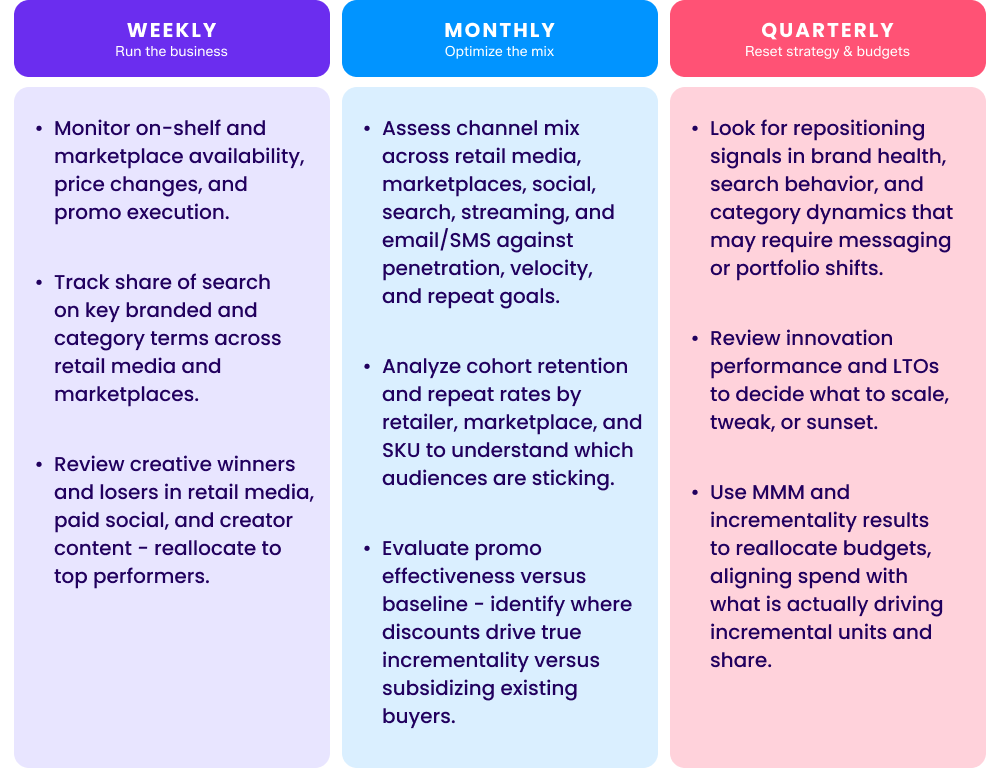
The most mature food and beverage marketing organizations run on a clear operating cadence. Weekly reviews assess availability, pricing, search share, and creative winners, enabling teams to make quick tactical adjustments.
Monthly, teams step back to evaluate channel mix, cohort retention, and promo effectiveness. Quarterly, they assess repositioning signals, innovation pipeline performance, and budget reallocation rules based on MMM and incrementality findings. This drumbeat keeps strategy grounded in what is actually happening at the shelf and in the cart.
A clear operating cadence keeps food and beverage marketing grounded in what is actually happening at the shelf and in the cart, instead of chasing one-off campaign reports. The timeline below shows how leading F&B teams stagger decisions weekly, monthly, and quarterly so they can move fast on tactics without constantly rewriting strategy.
Food and beverage brands that connect insights, creative, retail execution, and measurement under one roof are the ones that consistently win share at the shelf and in search. At Tinuiti, we bring integrated F&B expertise across retail media, marketplaces, social, influencer, email/SMS, and streaming, powered by Bliss Point by Tinuiti’s measurement technology to reveal what truly drives incremental growth.
If you are ready to build a food and beverage marketing strategy that actually moves product, not just impressions, explore how our full-funnel team can help.
Full-funnel marketing for food and beverage brands →

Copywriter, Tinuiti
Jenn Wheatley is a senior content strategist and copywriter who turns complex marketing data into clear, actionable stories. She develops research-backed reports and thought leadership that help brands navigate critical business decisions. Based in Utah, she enjoys cooking, strength training, and traveling with her family.