Amazon Rufus AI: Optimization Strategies for 2026


The Skinny: Amazon Rufus AI is reshaping how shoppers discover products on Amazon, and brands that adapt their content strategy now will be best positioned for growth in 2026 and beyond. This post walks through why Rufus matters and practical steps to optimize your Amazon listings for this new, AI-powered discovery experience.
AI has already changed how people search, shop, and evaluate brands across the open web, and that same shift is accelerating inside retail marketplaces like Amazon. Instead of relying only on short, keyword-based searches, shoppers increasingly ask natural-language questions and expect personalized, context-aware answers that feel more like a conversation than a search query. In that environment, brand sentiment, citations, and AI-driven recommendations become just as important as traditional click-based traffic and rankings because AI systems can surface or summarize your brand without requiring a click-through at all.
“Congrats everyone, you are now an agentic marketer… Amazon has several agents within the Amazon ads platform whether that’s creative or the campaign build. We’ve got your Rufus, your Marty, your Sparky.”
Elizabeth Marsten
AI didn’t kill search; it exposed the waste in how we measured it, shifting focus from raw clicks to how often brands show up as the answer inside AI interfaces. For Amazon sellers, Rufus is the clearest signal yet that ecommerce discovery is moving from “find products” to “get tailored advice,” and product detail pages need to evolve accordingly.
Get our guide to AI in Search to learn what’s required to maintain visibility in the new search landscape.
Rufus is Amazon’s generative AI shopping assistant that sits directly inside the shopping experience and helps users find, compare, and refine product choices using conversational language. Rather than returning a simple list of blue links, Rufus can explain trade-offs, surface product attributes that matter for a specific use case, and guide the shopper through multiple follow-up questions until they land on a confident choice. That makes the quality and completeness of your product data, reviews, and on-page content central to whether your brand shows up when customers ask nuanced questions.
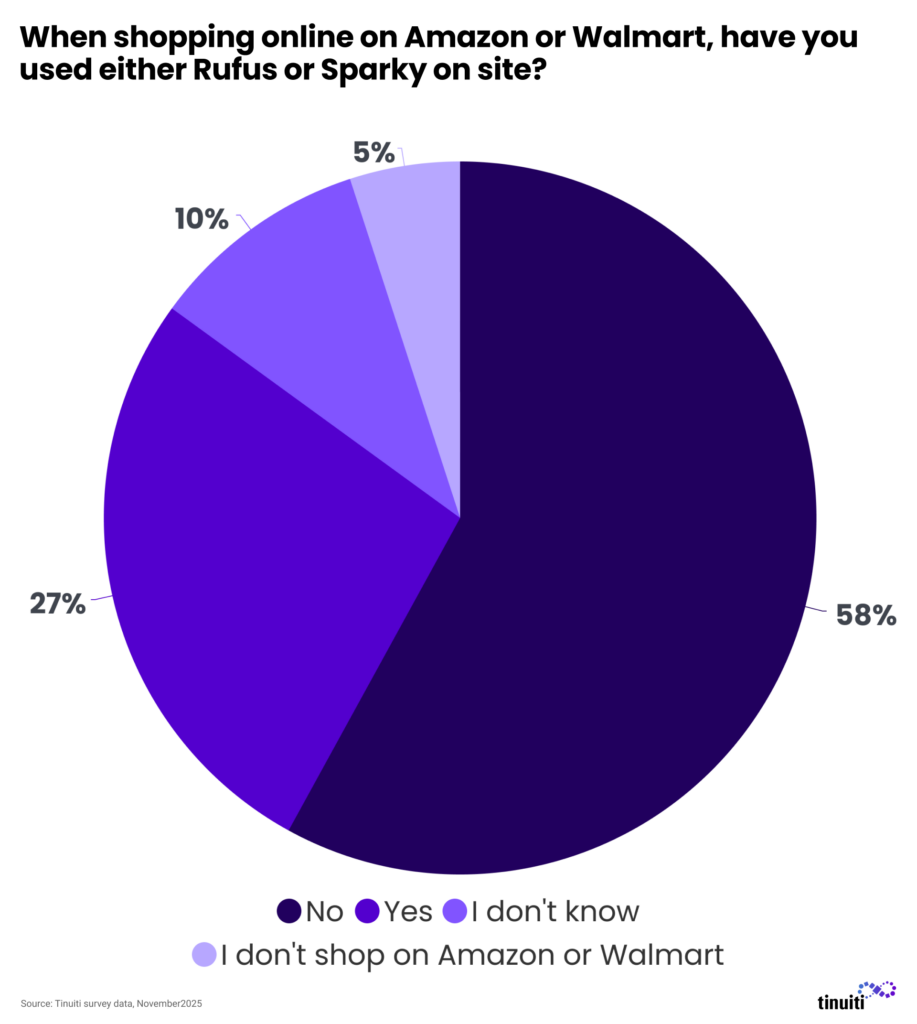
Early adoption data shows that shoppers, especially younger ones, are already embracing AI assistants during their Amazon journeys. In Tinuiti’s research, roughly a quarter of respondents reported using Rufus or Walmart’s Sparky while shopping on Amazon or Walmart, while a majority have not yet engaged with these assistants, and a smaller segment isn’t sure whether they have (Tinuiti survey data, November 2025).
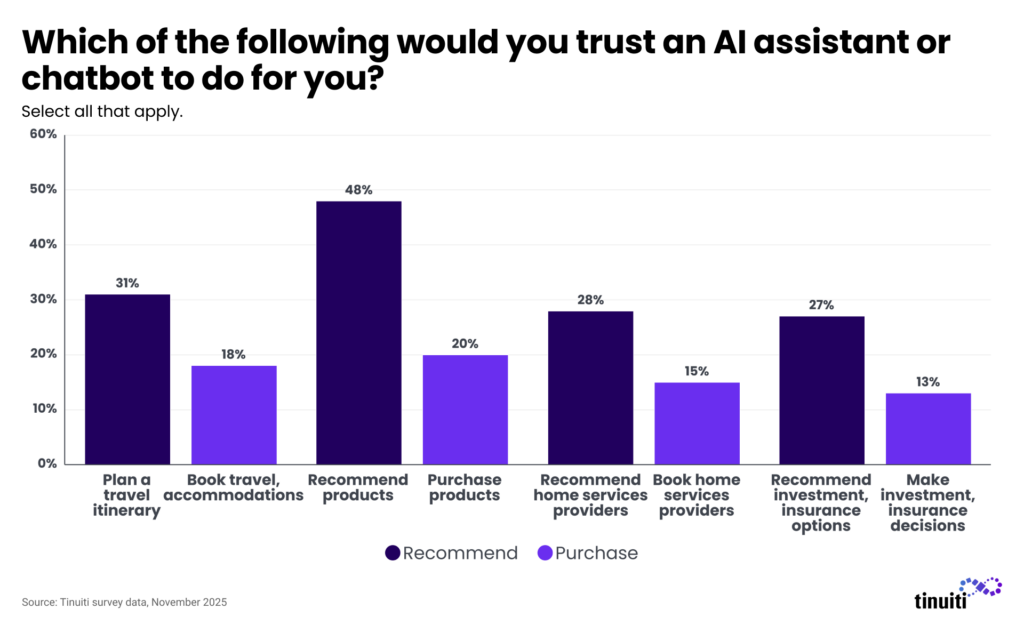
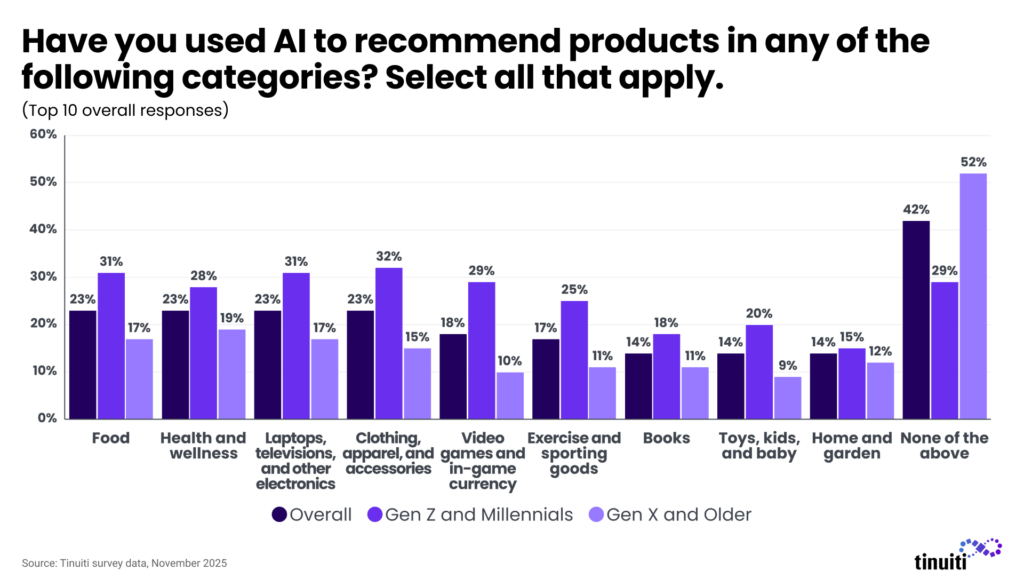
At the same time, nearly half (48%) of respondents say they would trust an AI assistant or chatbot to recommend products—the most common use case cited—highlighting how quickly AI is becoming a trusted layer in the decision process (Tinuiti survey data, November 2025). Younger shoppers over-index on this behavior, leading adoption across categories from food and health to electronics and clothing (Tinuiti survey data, November 2025).
“AI, there’s a lot happening, but focus on those initiatives that don’t require massive human habit changes. That is the thing that I think we kind of like get twisted up about… Just because AI or the functionality is available doesn’t mean that people are just going to do it. So you have to go for that framework of convenience to build the usage, the trust, and then be realistic about things really are.”
Elizabeth Marsten
From a capability standpoint, Rufus goes beyond generic AI chatbots because it can tap into Amazon’s deep product catalog, customer reviews, behavioral signals, and a shopper’s own activity. That lets it tailor recommendations in plain language while understanding category nuance, price sensitivity, and even brand preferences that matter for a given shopper.
For example, a user can ask, “I need a carry-on suitcase that fits under most airline seats and is durable enough for weekly business travel,” and Rufus can respond with a short, curated list that emphasizes under-seat dimensions, durability, warranty, and reviews from frequent travelers rather than simply matching generic luggage keywords.
Rufus also personalizes recommendations in ways that generic AI chatbots can’t. The same query, “What are the most comfortable slippers?”, can produce entirely different results depending on a shopper’s purchase history and browsing behavior. A work account with a track record of value-focused purchases might see mass-appeal options under $20, while a personal account that has historically chosen premium wool slippers surfaces $100+ products that better reflect that shopper’s preferences. This level of personalization means that optimizing for Rufus isn’t just about having the “right” answer once—it’s about making sure your product can be the right answer for multiple shopper profiles and contexts.
As shoppers become more comfortable with this style of agentic interaction, their queries are shifting from 2–3-word searches to long-form instructions and constraints. Research on AI Overviews shows just how dramatic that shift can be: while single-word queries trigger AI summaries only around 15% of the time, 10-word conversational queries trigger them roughly 68% of the time, with steep increases once prompts reach seven words or more (SE Ranking Analysis, June 2025).
Instead of “golf gifts,” a user might ask, “Help me find a gift for my father-in-law who is an avid golfer, mid-handicap, and already owns the basics.” Rufus is built to parse this complexity, identify what actually matters (handicap, experience level, novelty, budget), and then narrow down options in a way that would be difficult to replicate with static filters alone (SE Ranking Analysis, June 2025).
Rufus is also part of a broader move toward agentic commerce, where AI assistants don’t just answer questions; they help track prices, manage lists, and eventually execute purchases on a shopper’s behalf based on pre-set preferences. Agentic commerce is already emerging across channels, with AI assistants executing tasks, comparing options, and even autonomously completing purchases and browsing tasks.
According to Amazon’s Q4 2025 earnings call, Rufus is now available to 300 million active customers and is already driving roughly $12 billion in incremental annualized sales, underscoring its role as a meaningful driver of Amazon’s growth rather than an experimental feature. Rufus represents Amazon’s move in the same direction as other agentic experiences, turning passive search into active, AI-led decisioning that can streamline everything from replenishment to complex, multi-product purchases.
“I know we’re all talking about agent commerce, very excited about, but it’s not a thing yet… aspirational, that is where agent commerce sits today, right? So it’s that complete discovery, research, buy it for me, payment processing, shipping, fulfillment, and the ability to process returns. That is fully autonomous aspirational agent commerce at this time.”
Elizabeth Marsten
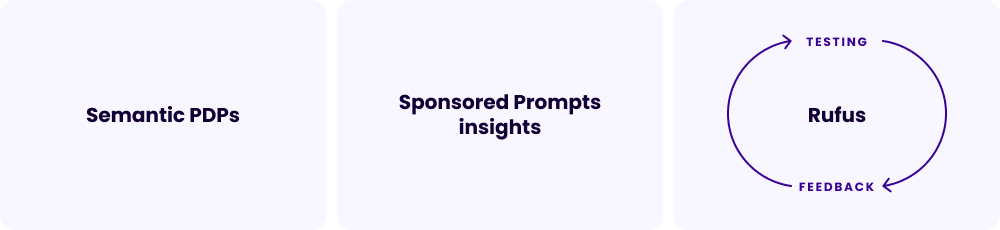
To succeed in a Rufus-first world, brands need to think beyond traditional keyword matching and optimize for conversational relevance, semantic understanding, and AI confidence. At a high level, there are three key pillars:
These pillars build on each other. First, you make your PDPs “AI answer-ready” by systematically capturing the details and scenarios that matter most to your shoppers, echoing how Tinuiti approaches AI SEO across other answer engines and AI interfaces. Then, you use Sponsored Prompts data and your own tests in Rufus to identify which questions your products already rank for and where you need to refine content or structure to show up more often.
Before you overhaul your content, you need a clear view of how your brand shows up in AI-powered experiences today. That includes both sentiment, how shoppers talk about you, and visibility, how often your products are recommended or cited when Rufus fields category-level questions. A structured baseline makes it easier to prioritize which products, categories, and themes deserve immediate optimization.Tools like Profound can help quantify this landscape by aggregating how often your brand appears in AI results, the context in which you’re mentioned, and the surrounding sentiment. Through Profound, Tinuiti tracks how often brands are cited across major AI platforms and features, treating citations as the new backlinks and AI visibility as the new “rank” for organic authority. By bringing that mindset into Rufus, you can treat Amazon PDPs as source material for an AI assistant, not just a standard search listing, and identify which ASINs punch above or below their weight in Rufus-driven sessions.
Once you understand which listings are already resonating in Rufus and which ones lag, you can sequence your optimization roadmap. High-visibility, high-revenue ASINs that already appear frequently in relevant prompts may only need light semantic tuning and better answer formatting. Underperforming ASINs, on the other hand, might require deeper work: enriching product attributes, clarifying who the product is for, and addressing common sources of confusion from reviews or Q&A that could be making Rufus less confident in recommending them.
Rufus is designed to understand and respond to natural, conversational language, which means your PDPs need to anticipate the kinds of questions and constraints shoppers actually bring to the table. Instead of thinking only in terms of “target keywords,” think in terms of the questions a shopper might ask a knowledgeable associate in-store and make sure your content clearly addresses those scenarios. Your goal is to make the page feel like a rich, structured knowledge base that an AI assistant can easily draw from.
1. Solve for constraints, not just keywords
Shoppers frequently frame their needs as “Can I…?” or “Will this work if…?” questions. To support how Rufus parses prompts:
When Rufus parses your PDP, these constraint-based statements help it align your product with nuanced, real-world contexts instead of just generic keywords.
2. Define the ideal buyer and edge cases
Rufus needs to know who your product is for—and who it isn’t. Strengthen this signal by:
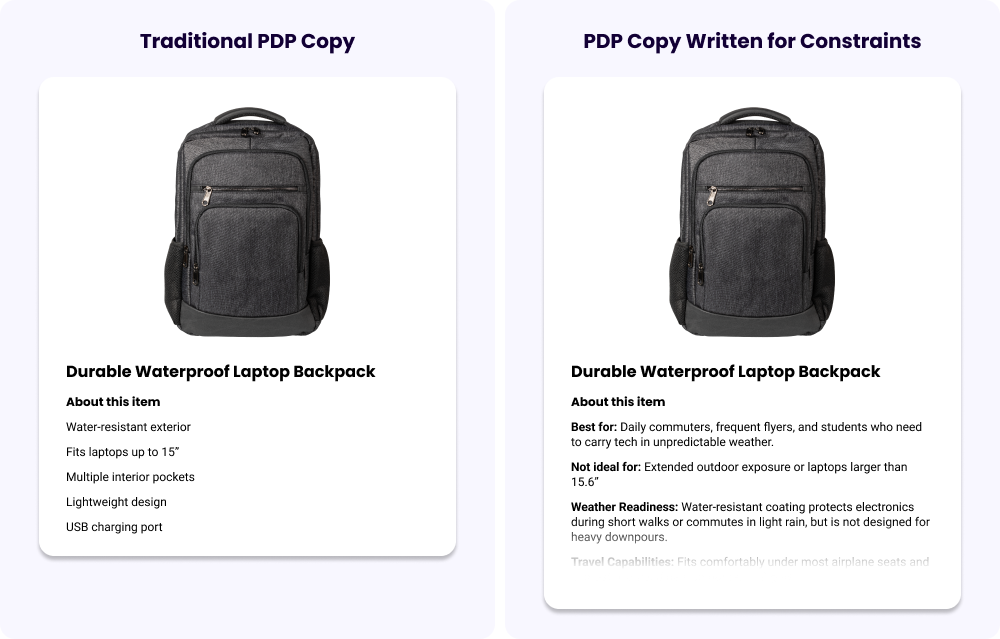
In the laptop backpack example, moving from a basic spec list to “Best for daily commuters, frequent flyers, and students” plus “Not ideal for extended outdoor exposure or laptops larger than 15.6” makes it far easier for Rufus to match buyer and product correctly.
3. Highlight lifestyle compatibility in everyday language
Lifestyle fit often decides whether a product feels “right” to a shopper. Help Rufus see that fit by:
These details give Rufus context to answer long-form prompts that mention specific environments, timelines, or routines.
4. Build a product knowledge base on your PDP
Think of each PDP as a structured knowledge base Rufus can mine. That means:
Treating your PDPs this way echoes a broader AI SEO principle: make your content the definitive “answer” in your niche so AI systems like Rufus can confidently recommend it.
Sponsored Prompts is Amazon’s new ad format that surfaces sponsored products directly within Rufus conversations in response to qualifying prompts. While still in beta and largely automated for enrollment and placement, Sponsored Prompts give brands a way to secure paid, high-intent visibility when shoppers ask detailed, purchase-ready questions. Even with limited controls today, they are an important complement to organic Rufus visibility.
Currently, advertisers are typically auto-enrolled, and placements are determined algorithmically based on relevance, past performance, and bidding signals rather than manual prompt targeting. You can’t yet specify the exact prompts you want to appear for, but strong natural language optimization on your PDP, coupled with healthy Sponsored Products investment, can improve your odds of being featured when Rufus is answering prompts that align with your category and value proposition. Think of Sponsored Prompts as a way to amplify well-optimized content rather than as a standalone lever.
Because Sponsored Prompts appear in already-high, granular shopper intent, it’s smart to anchor your strategy in the most valuable and competitive conversational spaces in your category. Focus on prompts that signal clear buying intent and differentiated needs, like “best hypoallergenic dog food for small breeds with sensitive stomachs” or “gaming monitor for competitive FPS under $300”. Then work backward to ensure your PDP content and bidding strategy align. That combination of semantic relevance and performance data gives Amazon’s systems more reasons to surface your products when those prompts occur.
As Rufus and Sponsored Prompts scale, measurement becomes critical. Amazon’s “Prompts” report in the Ads console is a key data source because it shows which shopper questions are actually triggering your products, how often you appear, and what performance looks like for each prompt.
Step 1: Pull the Prompts report
Use a simple, repeatable workflow:
You’ll see a table of prompts, associated ASINs, impressions, clicks, and other metrics. Early on, many brands see relatively low CTRs and conversion rates compared to standard Sponsored Products, which is why impressions are often the most useful leading indicator to watch.
Step 2: Focus on the right KPIs for Rufus
Instead of treating this like a standard ad report, use it to answer a few specific questions:
In one anonymized beauty example, a single ASIN captured nearly 30% of all Sponsored Prompt impressions, and the top prompts were highly specific ingredient questions such as “Does [Brand] have a mascara with lash primer?” and “Does [Brand] have a lip balm that is vegan?”, clear signals about what shoppers care about most.
Step 3: Feed insights back into PDP and bidding strategy
The Prompts report should directly inform both content and media decisions:
Over time, this creates a feedback loop: prompts and data reveal how Rufus “thinks” about your products, and your PDP and bidding updates give it better material to work with, improving both organic and sponsored visibility within the assistant.
Rufus is not just another Amazon feature; it is a clear sign that e-commerce discovery is becoming conversational, contextual, and increasingly mediated by AI assistants.
Brands that optimize their PDPs for natural language understanding, monitor their AI visibility and sentiment, and strategically leverage Sponsored Prompts and prompts-level reporting will be best positioned to win in this new landscape. As shopper queries grow longer and AI agents shoulder more of the decision-making, the brands that invest in AI-ready content and measurement today will be the ones Rufus is most confident recommending tomorrow.
If you want to understand how your brand is showing up across AI experiences beyond Amazon, and where you have room to grow, Tinuiti’s latest AI Citation Trends report breaks down which domains win visibility across major AI platforms and what that means for your strategy. It’s a practical next step for brands that not only want to optimize for Rufus today, but also build a durable edge in AI-driven discovery across the broader ecosystem.
Dig into the charts by category, benchmark your brand, and share the data with your team.