Retail Media Trends and Outlook for 2026


The Skinny: Retail media has evolved into a multi-billion dollar cornerstone of commerce, shifting from simple search tactics to a full-funnel ecosystem that integrates first-party data across CTV, social, and advanced in-store “store mode” app experiences. Driven by AI orchestration and shoppable media, the landscape is moving toward a “love growth, hate waste” philosophy that prioritizes incremental sales and closed-loop attribution.
Retail media has evolved from a niche tactic into a core pillar of commerce media. It is now the connective tissue among onsite search, display, CTV, social, and in-store experiences, all powered by retailer first-party data and closed-loop attribution. As third-party signals erode and competition for shoppers’ attention intensifies, retail media networks are uniquely positioned to connect media spending to real sales, not just clicks or views.
The past year reinforced how quickly that landscape is shifting. In-store is no longer just about endcaps and screens; “store mode” in retailer apps is turning phones into the most valuable inventory in the building, guiding shoppers with real-time offers, navigation, and scan-and-go checkout. At the same time, preparations for global tentpoles like the 2026 World Cup are accelerating upgrades in TV hardware and expanding shoppable CTV opportunities in the living room. Against that backdrop, brands are grappling with a new wave of AI-driven tools, emerging media networks in categories such as financial services and travel, and a dense web of partnerships among platforms that blur traditional channel lines.
The dollars tell the same story. US retail media ad spend is projected to surpass 60 billion dollars in 2025 and approach 70 billion in 2026, growing faster than the broader digital ad market. Tinuiti’s Q4 2025 Digital Ads Benchmark Report (DABR) shows advertisers ramping up investment in Amazon and Walmart, with Sponsored Products, DSP, streaming video, and offsite display all seeing strong momentum.
For marketers who love growth and hate waste, the challenge now is clear: move beyond surface-level ROAS, use advanced measurement to understand what is truly incremental, and treat retail media as a full-funnel, accountable system that can continuously redirect budget from noise to proven drivers of business outcomes.
Marketers are drawn to retail media because it solves problems that traditional digital channels struggle with: reaching high-intent shoppers, accessing durable first-party data, and measuring outcomes via closed-loop attribution. RMNs offer audience segmentation based on real purchase behavior, enabling brands to target by category, basket composition, loyalty, and more.
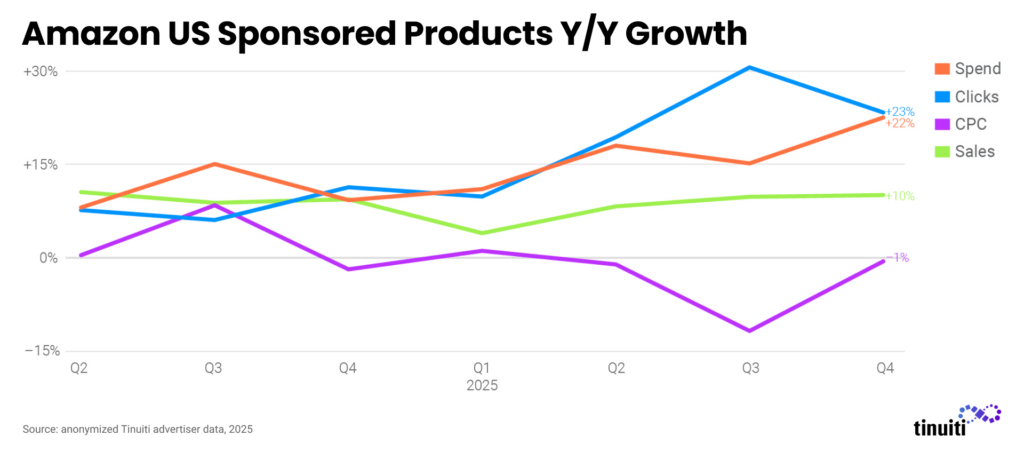
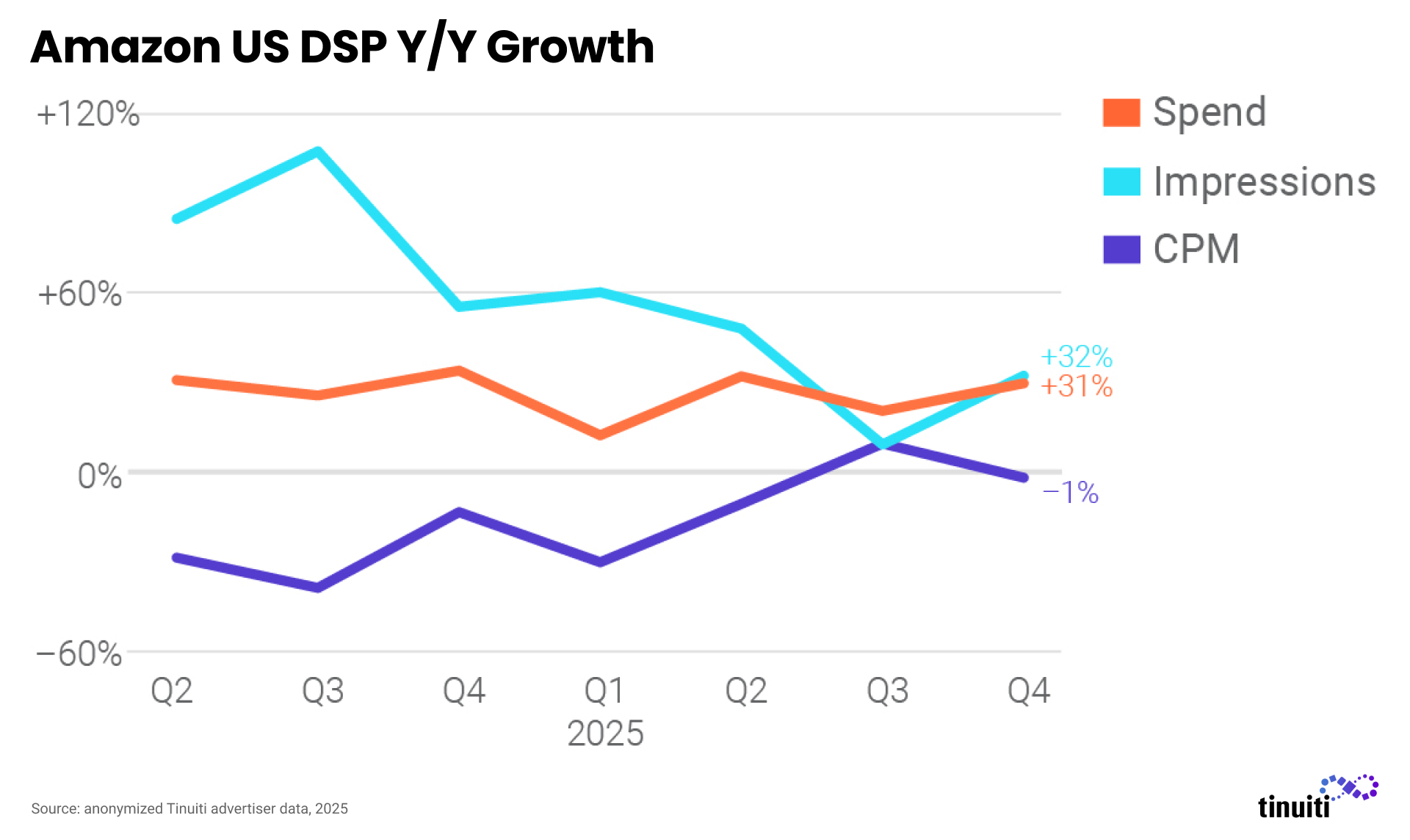
Investment momentum is clear in DABR data. Clicks on Amazon Sponsored Products rose 23% year over year in Q4 2025, while CPCs declined 1%, driving strong efficiency alongside growth. Advertisers active on Amazon DSP increased spend 31% year over year, as impressions climbed 32% and CPMs fell 1%, demonstrating the appeal of premium, data-rich display and video inventory on and off Amazon. On Walmart, Sponsored Products spend grew 14% year over year in Q4 2025—decelerating from 48% in Q3 but cycling against a massive 53% surge in Q4 2024, keeping two-year growth robust.
Retail media is also aligned with how people actually shop. Nearly every category now has a meaningful digital touchpoint, even when the final purchase happens in-store. During peak periods, Amazon Sponsored Products sales for the median retailer rose by more than 30% on key days like Cyber Monday, reinforcing RMNs’ ability to capture demand at the moment of decision. For brands, that means fewer wasted impressions and more opportunities to meet shoppers where purchase intent is highest.
Finally, marketers are seeking truth in measurement. Retail media’s closed-loop attribution lets them trace exposure through to online and in-store sales, and increasingly to incrementality. That’s the essence of a love growth, hate waste mindset: invest where you can see real, incremental impact, and pull back where spend isn’t moving the business forward.
Subscribe to our Paid Media Newsletter for weekly updates on media and advertising.

The next chapter of retail media is defined by AI, interoperability, and full-funnel activation. These eight trends will shape where growth concentrates and where waste gets exposed.
AI is transforming retail media buying from manual tuning into orchestrated, self-optimizing systems. Self-service platforms are rolling out AI-powered tools that automate audience building, bidding, creative testing, and budget reallocation, helping marketers move faster without losing control. On Amazon alone, advertisers are increasingly embracing automated campaigns and DSP optimizations to find the best mix of placements, formats, and audiences.
At Tinuiti’s Amazon & Retail Media Summit, multiple sessions focused on how AI is reshaping Amazon DSP and search, including how Performance+ and Amazon Marketing Cloud (AMC) are evolving measurement and optimization.
The takeaway: AI isn’t just about efficiency; it’s about making smarter decisions with every impression. When brands connect AI-curated campaigns with independent measurement, they can quickly shift budget toward the combinations that produce incremental growth and away from tactics that only look good in siloed dashboards.
On the shopper side, AI is quietly rewriting discovery. In the first session, Elizabeth broke the AI commerce landscape into three buckets:
Agentic commerce sits firmly in that aspirational bucket today, but early tests in conversational search, store-mode experiences, and agent-assisted planning are already changing how shoppers move from research to purchase.
In that environment, merchandising and messaging must be designed for both humans and machines. Product content, reviews, and structured data all influence how AI systems evaluate and rank items. For marketers, this raises the bar: if your data is incomplete, your reviews are thin, or your creative doesn’t match AI-detected intent, you risk being filtered out before a shopper ever sees your brand. A Love Growth. Hate Waste. approach means investing in the content and data that help AI make better recommendations, rather than overspending on ads that point to weak product experiences.
Just because the AI functionality exists doesn’t mean people are going to suddenly change their habits. You have to start with convenience, build usage and trust, and be realistic about where we really are.
-Elizabeth Marsten, Vice President of Innovation & Growth, Commerce Media
Shoppable connected TV (CTV) is becoming a cornerstone of full-funnel retail media. As Prime Video and other streamers scale ad-supported tiers, retailers and brands are weaving in commerce-enabled formats that let viewers scan, click, or save offers directly on-screen.
Tinuiti’s DABR shows streaming video ad spend outside YouTube rising 13% year over year in Q4 2025, with impressions up 14%, driven in part by the rapid expansion of Prime Video ads.
Prime Video investment alone grew 31% from Q3 to Q4 2025, with year-over-year spending up 127%. Pair that with retailer sales data, and you get a powerful combination: upper-funnel storytelling with commerce-grade measurement. That’s growth you can quantify. And growth as an antidote to opaque TV buys that soak up budget without clear attribution.
Programmatic is increasingly how retail media scales. Brands are accessing retail audiences and inventory through demand side platforms (DSPs), treating retail media as part of their broader display and video strategy rather than a standalone silo. On Amazon, DSP now accounts for 40% of total Amazon ad budgets for advertisers active in both Ad Console and DSP, underscoring its role as a core channel, not an experimental add-on.

This shift offers new levers: frequency management across channels, consistent creative frameworks, and more granular control over where commerce signals are applied. But it also raises measurement expectations. Without advanced analytics, it’s easy to double-count conversions or over-value lower-funnel touches. A strategy that champions growth and reduces waste requires tying programmatic retail media back to incrementality by identifying where DSP is generating net new demand and where it may simply be intercepting buyers late in the journey.
As more RMNs emerge, brands are demanding interoperability: common standards, cleaner data feeds, and easier integration with their existing analytics stacks. Retailers are responding by improving taxonomy consistency, enhancing reporting APIs, and partnering with measurement platforms to allow for cross-network comparisons. Interoperability is the bridge between “a bunch of separate dashboards” and a single, coherent view of how retail media drives business outcomes.
This becomes even more critical as new networks emerge beyond traditional retail, from quick-serve restaurants and health & wellness to travel, financial, and even in-car environments, each bringing its own data, inventory, and measurement quirks. Without interoperable standards, it’s nearly impossible to compare performance and avoid over-investing in the loudest new entrant instead of the most effective one.
Retail media is no longer just “media”; it is a core source of marketing intelligence. Marketers want to know how performance varies by retailer, format, and audience, and to feed those learnings back into planning across search, social, and CTV. When RMNs enable that kind of interoperability, brands can consolidate insights, reduce redundant tests, and reallocate spend more quickly from low-yield networks to those that demonstrably drive growth.
It’s going to get weird. Amazon and Microsoft, Walmart and Google—these partnerships are going to change how data flows and how media gets bought, and you have to be ready for that.
-Elizabeth Marsten, Vice President of Innovation & Growth, Commerce Media
Offsite retail media, using retailer data to target audiences off the retailer’s owned properties, is gaining share as brands seek reach plus relevance. Tinuiti’s DABR shows that 60% of Walmart self-serve display spend in Q4 2025 went to offsite inventory, even though onsite placements commanded a higher CPM and a larger share of spend relative to impressions. Offsite impressions accounted for the majority of volume, giving brands more scale at efficient prices.
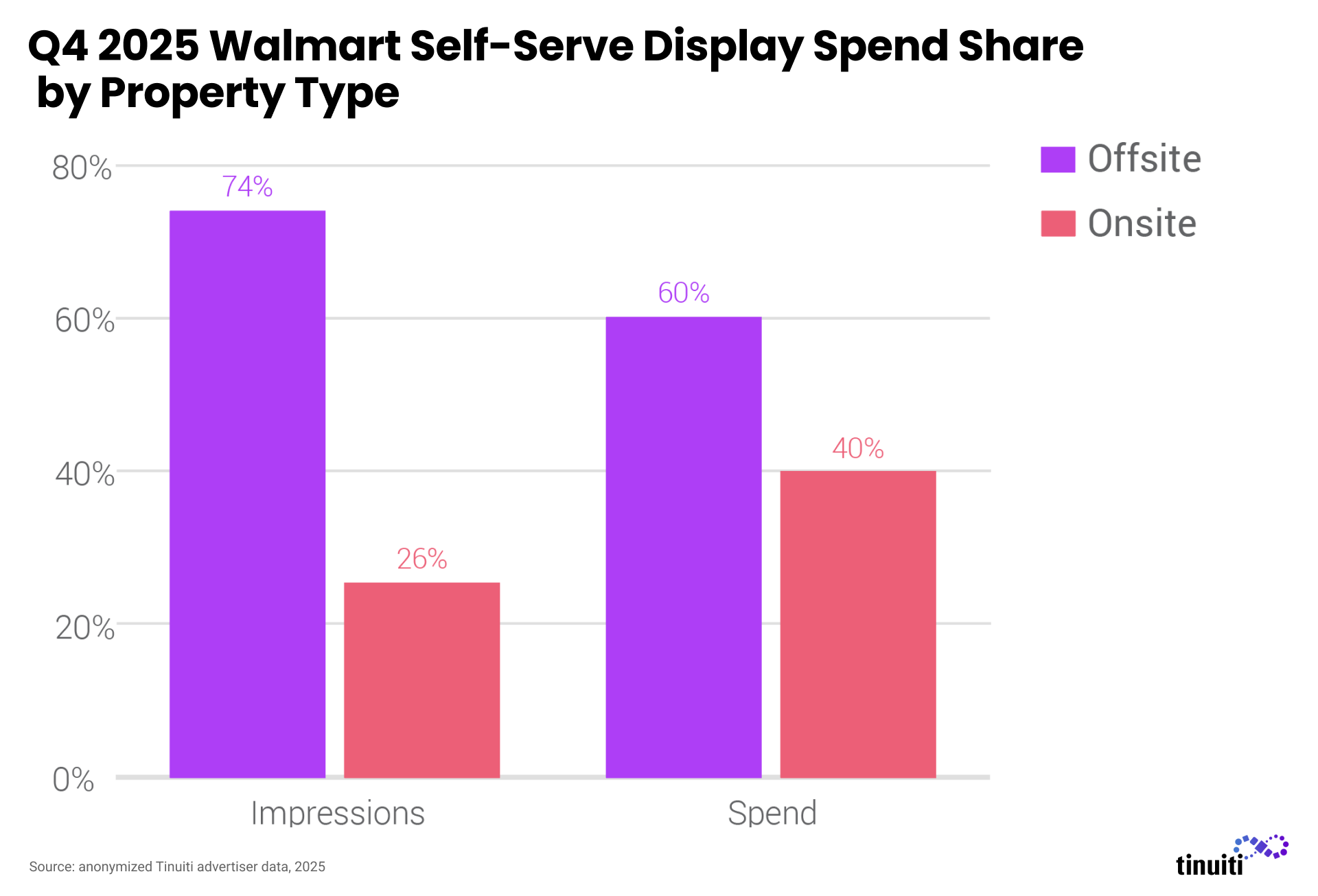
This offsite expansion supports a true full-funnel approach: reaching high-intent audiences as they browse the open web, watch streaming video, or scroll social, while still measuring outcomes through retailer sales. The opportunity and risk is in balance. Brands that understand the incremental contribution of off-site placements can lean into combinations that drive net-new sales, while dialing back tactics that merely re-target shoppers who were already likely to convert.
As retail media matures, standard dashboards aren’t enough. Brands want advanced measurement: cross-channel attribution, incrementality testing, competitive benchmarking, and the ability to customize models around their specific growth objectives. They also want in-store activity to be measured with the same rigor as digital media, from digital shelf and endcap displays to audio and QR-enabled signage.
Tinuiti’s Bliss Point technology is built for this level of accountability. By ingesting impression-level data from RMNs, layering in retailer and first-party sales, and modeling cross-channel impact, Bliss Point helps brands identify which investments are truly driving incremental growth and which are over-credited. This is where love growth, hate waste moves from slogan to system: continuous budget reallocation based on what the data proves, not what individual platforms report.
Measurement tech that shows what’s driving growth – and exposes what’s holding your campaigns back.

In-store media is evolving from static signage into a measurable, data-driven extension of retail media networks. Retailers are rolling out digital screens, smart shelves, and audio inventory that can be targeted using the same first-party data that powers onsite and offsite campaigns. At the same time, “research online, purchase offline” behavior continues to grow, which means in-store media must be planned alongside digital touchpoints, not as a standalone shopper tactic.
In the session, Elizabeth emphasized that the most meaningful in-store innovation isn’t just more screens, it’s “store mode” inside retailer apps. Experiences from Sam’s Club, Target, and Walmart show how geo-fenced, in-store modes can surface aisle-level navigation, personalized offers, and even scan-and-go checkout in real time, effectively turning the phone into the most valuable retail media surface in the building. For marketers, that means coordinating in-store media plans with app experiences and ensuring product data and promotions are clean enough to power these journeys without frustrating shoppers.
For brands, the opportunity is to design coordinated journeys: use onsite and offsite media to drive store visits and consideration, then rely on in-store placements and store-mode experiences to reinforce messaging at the shelf and capture final-mile decisions. The key is measuring in-store exposure and app interactions against sales and connecting those outcomes to your broader retail media mix. When in-store is folded into the same closed-loop, incrementality-driven measurement framework, it stops being a black box and becomes another lever in a pro-growth system.
We talk a lot about digital endcaps and all the screens you see when you walk in, at checkout, even out in the parking lot. But I still believe the nearest best place to be is in ‘store mode’ inside the mobile app.
-Elizabeth Marsten, Vice President of Innovation & Growth, Commerce Media
In a landscape this dynamic, retail media strategy can’t be a checklist; it has to be a disciplined, measurement-driven system. The most successful brands are aligning goals, data, and activation under a single full-funnel commerce media vision.
Effective retail media programs start with sharp, SMART goals (specific, measurable, achievable, relevant, and time-bound). Instead of defaulting to generic ROAS targets, leading brands define success in terms of incremental revenue, share of search, category penetration, or new-to-brand acquisition.
Having clear objectives changes the mix of formats and partners you choose. For instance, growth-stage brands might lean more heavily into upper-funnel display and shoppable CTV to build awareness, while mature brands emphasize Sponsored Products and DSP to maximize profitability and defend share. In both cases, goal clarity makes it easier to identify what’s actually fueling growth versus what’s inflating vanity metrics.​
Before scaling retail media, brands need an honest assessment of their data reality. What first-party data do you have? How often is it updated? How far back does it go? Is it clean enough to power audience segmentation and advanced attribution?
Equally important is understanding the data you get back from each RMN and how it flows into your analytics stack. Brands that invest in data hygiene, identity resolution, and governance early are better positioned to unlock AI-driven optimization, agentic commerce opportunities, and cross-retailer measurement later. Without that groundwork, it’s easy to overspend in channels that “look good” on paper while missing deeper signals about where growth is really coming from.
Retail media ROI depends on more than platform reports. Brands need analytics capabilities that can answer questions like: How does this RMN perform relative to others? How does retail media interact with search, social, and CTV? What’s the incremental lift versus baseline demand?
The DABR shows that performance can vary widely by platform—YouTube, Prime Video, and retail DSPs all play distinct roles across the funnel. To navigate that complexity, marketers are combining experimentation (geo-splits, audience holdouts), media mix modeling, and multi-touch attribution with independent platforms like Bliss Point. That combination enables them to make confident decisions about where to trim waste and where to double down.
Retail media is no longer limited to onsite search results and banner ads. RMNs can now activate a mix of touchpoints such as onsite display, in-store screens, direct mail, coupons, audio, and even geofenced messaging, under a unified strategy. The opportunity is to design journeys that reflect how people actually shop: researching online, buying in store, and then being retargeted with relevant offers.
For example, brands can use onsite Sponsored Products to capture active demand, Walmart display to extend reach offsite, and in-store retail media to influence last-mile decisions. When these elements are planned together and linked through closed-loop measurement, marketers gain a more complete view of campaign effectiveness and more levers to reduce waste, whether that means pruning underperforming formats or shifting budget into higher-impact combinations.
Even sophisticated teams can struggle to keep pace with changing RMN offerings, privacy rules, and measurement methodologies. An independent partner provides the connective tissue: aligning strategy across networks, centralizing reporting, and pushing platforms to deliver the data needed for serious measurement.
Tinuiti’s combination of channel-specific expertise, DABR insights, and Bliss Point measurement is designed for brands that want to make retail media their growth engine. By applying a love growth, hate waste lens, Tinuiti helps brands continuously redirect spend from low-yield impressions into media that consistently drives incremental revenue, share, and profitability.
Get ad spend benchmarks for top channels, from marketplaces to social media.
Retail media remains one of the fastest-growing segments in digital advertising. US retail media spend is expected to exceed $60B in 2025 and approach $70B in 2026, outpacing overall digital ad growth as more brands treat RMNs as essential performance channels. Within that, Tinuiti’s DABR shows strong momentum for Amazon Sponsored Products (23% click growth and 22% sales growth in Q4 2025) and Walmart Sponsored Products (14% spend growth despite tough comps), as well as rapid expansion in Amazon DSP and offsite display. Growth is particularly strong in commerce-linked formats such as search, DSP, and CTV, where first-party data and closed-loop measurement give marketers clearer proof of impact.
Marketers use retail media across the full funnel: upper-funnel display and CTV to generate demand, mid-funnel offsite and audience campaigns to nurture interest, and lower-funnel sponsored search and product ads to capture ready-to-buy shoppers. For many brands, RMNs sit at the intersection of media and shopper marketing, combining shopper insights, trade investment, and performance budgets under a single commerce media strategy.
Tinuiti’s clients increasingly treat Amazon and Walmart as test-and-learn laboratories where they experiment with creative, pricing, and assortment, then scale what works across channels. The most advanced brands integrate retail media with search, social, and streaming video, using unified measurement to optimize for overall business outcomes rather than channel-by-channel ROAS.
Sponsored product and search ads remain the workhorses of retail media. On Amazon and Walmart, Sponsored Products account for the vast majority of search ad spend, reflecting their role in capturing high-intent shoppers on product detail and category pages. Sponsored Brands, video units, and onsite display complement these placements by building brand equity and driving exploration. Offsite display and audience campaigns are growing quickly as brands tap retailer data to reach shoppers across the open web, social platforms, and streaming video. Shoppable CTV, in-store digital screens, and audio are newer but rapidly scaling formats that connect storytelling to measurable sales, particularly when activated through DSPs and measured via retail sales data.
Most marketers start with platform analytics such as impressions, clicks, sales, and return on ad spend, but quickly layer on more advanced methods to get a truthful picture. Incrementality tests (such as geo-splits and audience holdouts) help distinguish net new sales from those that would have happened anyway, while media mix models and multi-touch attribution reveal how retail media interacts with search, social, and CTV.
Tinuiti’s Bliss Point technology unifies these approaches by connecting impression-level exposure with sales across channels to estimate incremental lift by network, format, and audience. That level of measurement enables brands to live the love growth, hate waste philosophy, systematically shifting budget toward tactics that contribute measurable incremental growth and away from those that simply absorb spend.