Tracking AI Platform Citation Patterns in 2026: Three Key Findings


When I sit down with CMOs right now, the first question I usually get is some version of, “Where does AI get its answers from?” and, “Does my brand show up there?” That’s what our Q1 2026 AI Citation Trends Report is built to answer.
Together with our partners at Profound, we tracked mid- to lower-funnel prompts across seven AI platforms and nine commercial categories to see which domains are being cited, how often, and how that mix is evolving over time. What we found reinforces something we see consistently in Tinuiti’s client work: there isn’t a single “most important” source in AI search. However, there are clear patterns across platforms and verticals that marketers can use to make much smarter decisions about content, distribution, and measurement.
When we talk about “AI SEO” with CMOs, we define it as understanding how AI platforms select and weight sources, then positioning your brand so those systems can confidently use you in their answers. That sounds straightforward until you look under the hood and see how differently the major assistants behave.
Get our guide to AI in Search to learn what’s required to maintain visibility in the new search landscape.
To cut through the noise, we partnered with Profound and built a standardized testbed: mid- to lower-funnel prompts with commercial intent, run across seven AI platforms (ChatGPT, Perplexity, Google AI Mode, AI Overviews, Gemini, Copilot, and Meta AI) in nine verticals. The goal was to see how citation patterns shift over time and where those shifts are large enough to change how a performance-minded marketer should act right now.
Across four months of data, three themes stood out more than any individual chart: social’s growing but uneven influence, the widening gaps between how different AI platforms (and even Google’s own surfaces) cite the web, and the outsized role Amazon still plays in ecommerce despite aggressively limiting crawler access. Together, these patterns explain why there is no universal “top source” for brands in AI search and why your strategy has to start with your category, your buyers, and the specific assistants they rely on most.
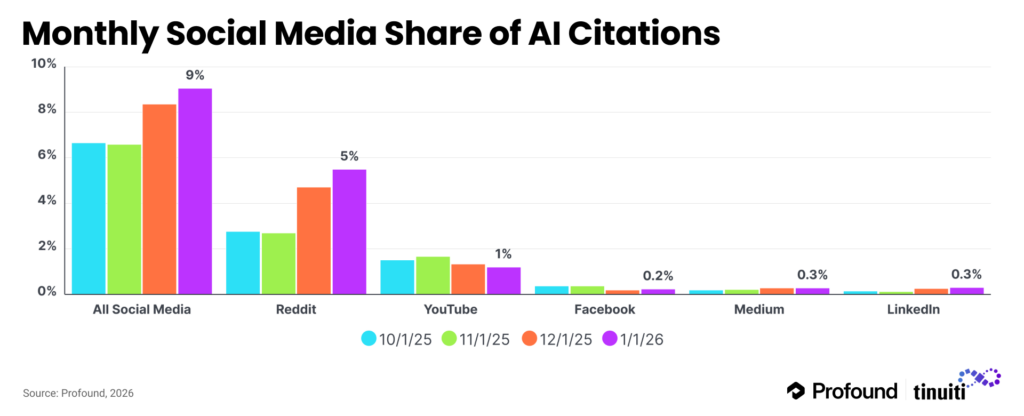
Across all categories and AI platforms we tracked, social media’s share of citations climbed from 6% in October to 9% in January, and that lift came almost entirely from Reddit. Reddit’s share of all citations nearly doubled in that window, from about 2% to 5%, while YouTube held flat around 1% and other social platforms stayed below 1% each.
Look only at the aggregate chart, and you’d assume every brand needs a Reddit strategy yesterday. But when we unpack the data and combine it with our audit work, a very different story emerges: AI systems aren’t rewarding brands on Reddit, they’re rewarding long-running, high-signal conversations that happen to live on Reddit.
From our analysis and external work, such as Profound’s deep dive into ChatGPT, roughly 99% of Reddit citations point to individual threads with substantive discussion, rather than subreddits, profiles, or brand-authored content. Large-language models (LLMs) can’t have opinions, so when you ask “What’s the best moisturizer for sensitive skin?” they lean on places where humans have already argued about “best” in public: listicles, detailed reviews, and multi-comment threads where people describe what worked, what failed, and why.
If you zoom in on Google’s AI products, you start to see why “Reddit is important” doesn’t translate into a single playbook. In January, Google AI Overviews sent about 13% of its citations to social media, AI Mode sent around 9%, and Gemini relied on social media much more sparingly at roughly 3%.
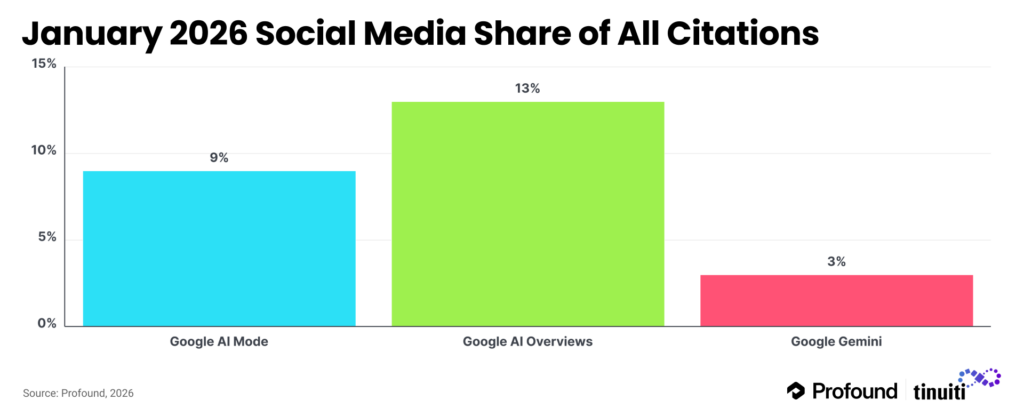
Even within that social slice, each surface has its own inner circle. Reddit dominates the mix for AI Overviews and AI Mode, accounting for roughly 44% and 40% of their social citations, respectively. Gemini tells a different story: only about 5% of its social citations come from Reddit, while Medium carries far more weight, accounting for about 28% of social citations, compared with 6% in AI Mode and 4% in AI Overviews.
The takeaway for brands is that “showing up on Reddit” isn’t inherently a Google AI strategy – it’s a strategy for specific surfaces and audiences. If your buyers are more likely to encounter you through AI Overviews or AI Mode, a Reddit-driven conversation can be incredibly influential. If they’re heavy Gemini users, investing in deeper, expert-driven editorial content on sites like Medium may do more to shape what those users see than another subreddit thread ever will.
Clients often come to us with a single “Google AI” line item in their roadmap, as if Gemini, AI Mode, and AI Overviews are three skins on the same system. The Q1 data shows that’s no longer a safe assumption; these experiences cite the web differently, evolve at different speeds, and reward different distribution choices.
Zoom out to the diversity of sources, and the gap widens. In November, AI Mode cited 57% more unique domains than AI Overviews and Gemini cited 47% fewer; by January, AI Mode was at 243% of Overviews’ unique domains, and Gemini had swung to 112%. That shift wasn’t because AI Mode and Gemini exploded; it was because the total number of tracked AI Overviews citations dropped by almost half over the period, changing how deep tools like Profound can see into that surface.
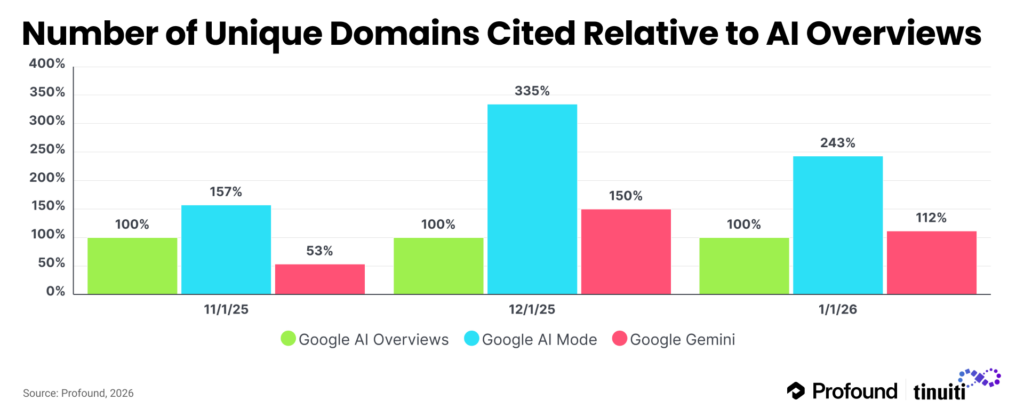
Strategically, this is where Tinuiti’s “cluster” thinking comes in. We treat Google’s AI surfaces as a family that shares technical foundations but diverges in distribution bias:
Rather than writing three separate strategies, we help brands build a single core AI visibility framework with a clean information architecture, structured mid-funnel content, and multi-source coverage. We then layer on surface-specific tests informed by citation data.
The e-commerce charts in this report look subtle at first glance, but become unsettling once you understand the story behind them. Amazon remains the single most cited e-commerce domain in our dataset, responsible for just over 2% of all citations for commercial-intent prompts in January, despite systematically blocking nearly 50 AI-related user agents, including all three of OpenAI’s crawlers and Google-Extended.
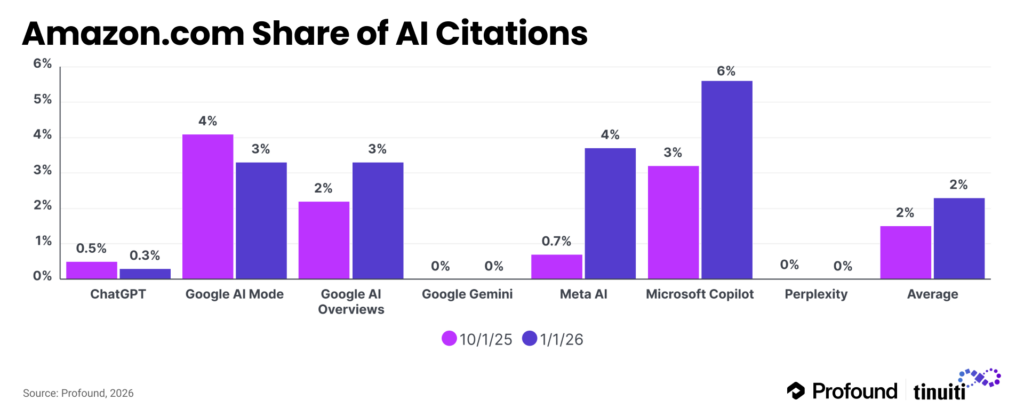
Because Amazon still allows Googlebot, its share in Google AI Mode and AI Overviews hovers around 3%, and it maintains a commanding lead over other retailers in those experiences. In Gemini, where Google-Extended matters more, Amazon is effectively absent. On ChatGPT, Amazon’s share dropped from roughly 0.5% to 0.3% as its bot restrictions tightened and Walmart filled the gap.
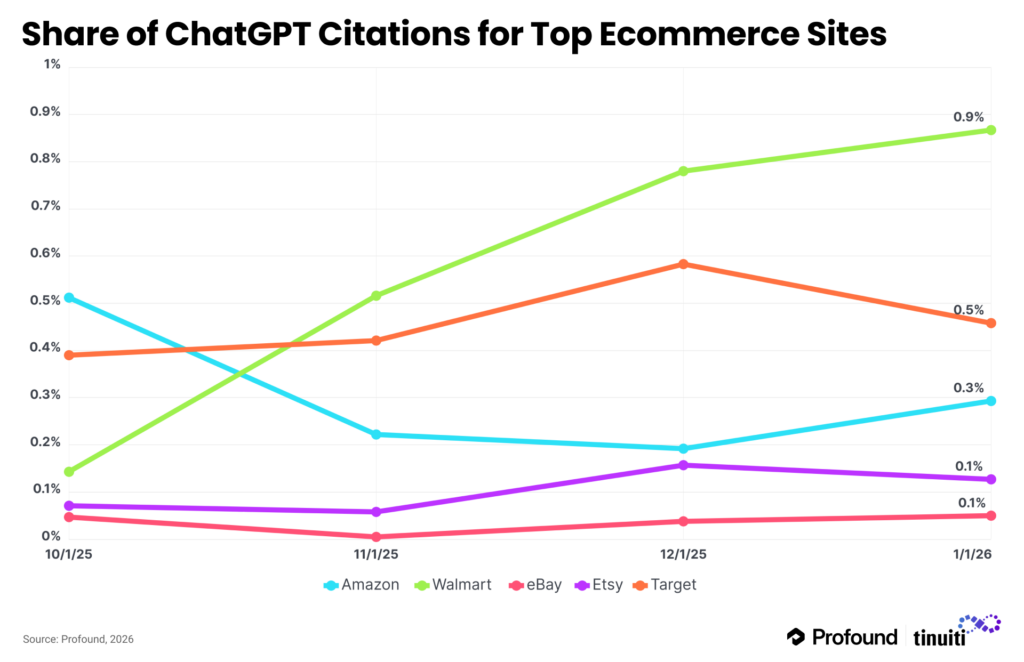
From a Tinuiti perspective, this is agentic commerce in real time. By closing the door on certain crawlers, Amazon is betting that keeping its catalog out of competing AI agents’ hands is worth the short-term loss of citations and delegated shopping flows. That stance doesn’t just affect Amazon; it changes which marketplaces the assistants can safely recommend, opening a window for players like Walmart, Target, and category-specific retailers to become the default “where to buy” answer in some environments.
For mid-sized e-commerce brands, the takeaway is not “copy Amazon and block everything.” It’s to get very explicit about which agents you want in your data, which retailer PDPs reliably surface in those agents’ answers, and how you structure product content so it can be cited even if the assistant can’t see your Amazon listing.
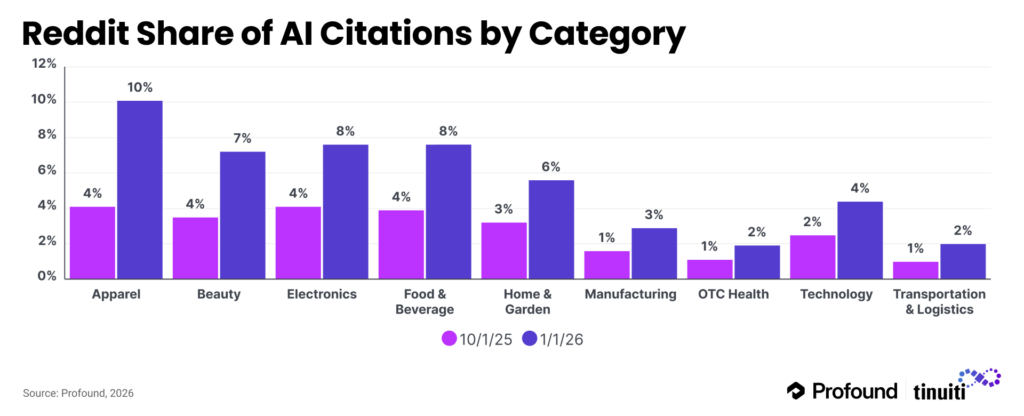
The vertical deltas here matter more than the global growth rate. Apparel AI citations hit roughly 10% Reddit share in January, transportation and logistics barely reached 2%, with other verticals scattered in between on very different trajectories. If you’re in OTC health or B2B manufacturing and you treat “Reddit grew 73%” as your north star, you’re calibrating your strategy to someone else’s category.
At Tinuiti, this is where we push clients to slow down and ask:
For some beauty and consumer tech brands, the answer is yes, and we build multi-quarter Reddit and social listening programs around that reality. For others, the smarter move is to lean into “opinion-rich” formats like YouTube, influencer reviews, and Medium-style explainers that already carry more weight in the AI surfaces their customers actually use.
The biggest risk I see right now isn’t that brands are ignoring AI search. It’s that they’re reacting to headlines instead of running a disciplined program. Our AI visibility programs plug into the same Love Growth, Hate Waste. framework that underpins our media planning, Tinuiti Audience Planning System (T.A.P.S.) process, and Bliss Point by Tinuiti measurement suite. When we build an AI visibility roadmap with clients, we usually start with three concrete steps:
Using Profound and Tinuiti’s own AI visibility dashboards, we benchmark how often your brand is cited across key prompts, which domains carry your story (brand, retailer, publisher, social), and how that compares to your competitive set. That gives us a measurable baseline we can connect to business outcomes using Bliss Point tools like Rapid MMM and incrementality, rather than treating citations as vanity metrics.
Rather than chasing every AI product, we map platforms to audiences and roles in the funnel: for example, Google’s AI surfaces in high-reach discovery and refinement layers, ChatGPT and Perplexity serve as deeper research companions, and retailer or marketplace experiences serve as commerce adjacencies. That “next best customer” mindset mirrors how Tinuiti plans media more broadly – go where the incremental audience and influence actually are, not just where the headlines are.
From there, we build focused experiments: improving coverage for a specific cluster of prompts, shifting content mix toward sources a given assistant leans on (e.g., YouTube, credible reviews, or retailer PDPs), and then reading the impact through both citation share and downstream KPIs like branded search, retailer conversion, and assisted revenue. Because Bliss Point centralizes measurement across channels, we can see whether a lift in AI citations is actually contributing to your overall media efficiency and revenue, not just your share of screenshots.
This approach keeps AI SEO grounded in the same disciplined, test-and-learn operating model we use for media and creative: start with data, tie every optimization back to the customer journey, and use unified measurement to decide what deserves more investment and what doesn’t.

Senior Director of Innovation & Growth, Tinuiti
Jen Cornwell is Sr. Director of AI SEO Innovation at Tinuiti, helping brands navigate conversational search and large language models to grow organic visibility. With 10+ years of experience, she has led large SEO teams and been featured in outlets such as Search Engine Land, Ad Age, and Digiday. Originally from snowy Syracuse, NY, Jen now lives in San Diego, CA with her husband.
The findings in this article only scratch the surface of what we’re seeing across seven AI platforms, nine verticals, and thousands of prompts. If you want to dig into the charts by category, benchmark your brand, or share the data with your team, download the full Q1 2026 AI Citation Trends Report.