Building a Super Bowl Marketing Strategy That’s a Runaway Win

The Super Bowl isn’t just the priciest media buy on the calendar; it’s one of the clearest tests of whether your marketing can turn culture into real, compounding growth. For C-suite leaders, the question isn’t simply “can we afford it?” It’s “can we turn this into a repeatable asset instead of a one-night gamble?”
This guide is built for marketers asking exactly that. It breaks down how to approach Super Bowl marketing from deciding if you’re ready, to choosing between national and more accessible plays, to building the creative, cross-channel, and measurement systems that ensure the investment pays off. Along the way, you’ll see how brands like e.l.f., eos, Instacart, Poppi, and Ramp have applied these principles in different ways.
“The greatest risk for brands is not considering where the Super Bowl fits into their larger brand journey. Marketers must pivot from asking if they can afford a spot to whether they should.
A winning strategy replaces the gamble of a single ad with a measurable, 360-degree approach that capitalizes on the full window of audience engagement.”
– Rachel Costanzo Senior Director of Media Investment at Tinuiti
Most classic Super Bowl playbooks were built for a different era: a single, linear feed, a short list of big sponsors, and a single “Monday morning watercooler” conversation. In that world, one great 30-second spot could reasonably carry the whole investment.
That world is gone. Today, the game spans streaming apps, alternative broadcasts, social feeds, gaming, and sports betting experiences. Viewers are just as locked into their phones as they are to the big screen, checking bets, scrolling reactions, and replaying ads on demand.
What’s more, the window for capturing attention no longer starts and stops with the whistle. Social and search activity spikes before and after the game, as brands release teasers early and highlight clips circulate for days.
In that context, the riskiest move for a leadership team is clinging to a narrow definition of being in the Super Bowl: a single national TV spot plus a token social post. There are now multiple ways to show up, each with its own risk–return profile:
“The Super Bowl is no longer an exclusive club reserved for the Fortune 100. Today, brands of all sizes and budgets should consider how to lean into the cultural momentum of the game.
The fragmented media landscape has a wealth of opportunities for performance-driven brands to build a curated approach that aligns with their specific KPIs.”
– Rachel Costanzo Senior Director of Media Investment at Tinuiti
Once you recognize that the Super Bowl is an ecosystem, not just a three-hour broadcast, the national TV spot becomes one option in a much bigger toolkit. It’s still the most visible play, and it’s also where the stakes are highest. Which is why it deserves its own strategy rather than defaulting to “we should be there because everyone else is.”
National Super Bowl spots are limited and usually sold well in advance, often during the spring upfronts. The cost of a national 30-second Super Bowl LIX spot went as high as $8+ million, excluding production, digital, and cross-channel investments required to support it. For many brands, the Super Bowl is the single largest line item in their annual media plan.
That’s why brands like Poppi started planning their Super Bowl presence in May prior, building a runway that included NFL playoff TV, streaming, and retail media to ensure the spot sat atop a broader system rather than standing alone.
“If you want to buy a national Super Bowl unit, you need to be participating in the upfronts. Planning the Super Bowl out further in advance and centering other efforts around the spot is significantly less stressful, more measurable, and leads to a noticeably stronger performance than deciding to do a spot at the last minute.”
– Kenny Bianchi Director, Client Partner, Tinuiti
The Super Bowl remains one of the rare moments when nearly a third of the population is watching at once, across linear, streaming, and second screens. The 2025 showdown between the Eagles and Chiefs reached 126 million viewers across FOX, Tubi, FOX Deportes, Telemundo, and NFL properties, with Kendrick Lamar’s halftime performance drawing an estimated 131.2 million viewers.
Audience nuance still matters:
On a stage where every brand brings its best, a Super Bowl spot has to do more than land a joke. It needs a clear story, emotional weight, and a strong connection back to the product or brand truth.
Winning Super Bowl creative usually:
“To truly earn your place in the Super Bowl moment, creative must be more than just a ‘fun ad’. It must be a synergistic blend of high-impact brand storytelling and platform authenticity. Success comes from developing a ‘true brand creative’ that is playful, emotive, and anchored in your product truth, while resisting the urge to simply ‘copy-paste’ that spot across the ecosystem.
The most effective campaigns recognize that while high-craft production signals seriousness, the real magic happens when you marry community, culture, and creativity to ensure your message feels organic and endemic to wherever your audience discovers it.”
– Laura Ross Director, Client Partner, Tinuiti
Once you view the Super Bowl as an ecosystem rather than a single ad, the question becomes how to participate—not whether to show up at all. This matrix outlines the most common Super Bowl marketing strategies, mapped by budget, objectives, and tactics.
| Strategy type | Budget level | Best for | Primary objective | Key tactics |
|---|---|---|---|---|
| National in-game spot | High | Established or scaled brands with a strong foundation and broad goals. | Mass awareness and cultural impact. | 15–60s national spot, full surround media plan, MMM support to read impact across channels. |
| Surround-moment TV (pre/post & local) | Medium | Brands wanting TV presence without national in-game pricing (e.g., eos-style launches). | Awareness in priority markets. | Pre- and post-game units, local linear buys in key DMAs, supported by streaming and paid social. |
| Digital & streaming-led | Low–medium | Performance-oriented or digitally native brands. | Awareness plus measurable engagement / traffic. | CTV in-and-around the game, YouTube against highlights and recaps, OTT sponsorships and high-impact digital units. |
| Social, creator & CRM-led | Low–medium | Smaller budgets, niche audiences, or brands testing into the moment. | Engagement, list growth, and conversion. | Real-time social campaigns, creator watch-parties, email “stock up for the game” pushes, and retargeting flows. |
“The most impactful campaigns are a result of ‘surround sound.’ You want everything to work in concert, like an orchestra. The Super Bowl is the drums—it’s loud and amazing—but how much better do those drums sound when there is also a guitar, a piano, and strings? You need that harmony and synergy across the entire ecosystem to make the most noise and cut through in the biggest way.”
–Meg Crowley Group Director, Client Partner, Tinuiti
The brands that succeed in Super Bowl marketing treat the spot as part of a full-funnel marketing plan, not a one-off. Here’s a simple way to structure that system.

1. Tease (weeks before kickoff)
2. Game day
3. Post-game burst
4. Sustain (weeks after)
If you want a real example of how Super Bowl ad campaigns are built, our resident Streaming expert, Harry Browne, breaks it down for your below:
A national in-game spot is only one way to participate in Super Bowl marketing, and for many brands, it’s not the right strategy. What matters is finding the level of involvement that aligns with your budget, your stage of growth, and how clearly you can tie the spend to business outcomes.
That’s where “surround the moment” strategies come in. Instead of anchoring everything on a single 30-second spot, you can use a mix of local linear, streaming, social, creator, email, and retail media plays to tap into the Super Bowl moment at a fraction of the cost. All while still building a clear path from awareness to conversion.
Bob Avelino explains more:
Beyond the main national broadcast:
Buying local linear TV in key DMAs instead of a national spot can significantly reduce costs while focusing on the markets that matter most to your business. For eos, for example, a local linear buy with pre-game and in-game units, supported by streaming, YouTube, and paid social, allowed the brand to spotlight its new body wash line without paying national-spot prices.
Find out what’s coming in 2026 and beyond, and what marketers can do to be ready

Most viewers will check their phones during the game for scores, bets, texts, and social feeds. That creates an opening for:
Creators and affiliates can extend your reach into specific communities:
Super Bowl generates days of commentary beyond the ads themselves. Innovative brands look for:
Not every touchpoint has to be flashy:
For a brand like Poppi, sending email reminders to customers to “order sodas for the game” ahead of time can be a simple yet effective way to tie tentpole awareness to directly measurable sales.
Not everyone watches on linear. Many fans rely on:
Advertising against this content—before, during, and after the game—can be an efficient way to tap into Super Bowl attention, especially for digitally native or younger audiences.
Whatever mix of tactics you choose, retargeting is how you turn initial Super Bowl marketing impressions into revenue:
“Success in the Super Bowl ecosystem is no longer defined by a 30-second national spot; it’s about the strategic intersection of content and timing. Whether through digital takeovers, local broadcasts, or streaming-only packages, brands can activate across the entire event timeline. These levers allow brands to capture the cultural spotlight through a tailored fit without the national broadcast price tag.“
–Rachel Costanzo Senior Director, Media Strategy & Operations, Tinuiti
These aren’t backup options; they’re smart, right-sized Super Bowl marketing strategies that match where your brand is and how much risk you’re willing to take on.
Not every brand should be investing in Super Bowl marketing this year. Being honest about that is one of the most important C-suite calls you can make.
The following readiness framework outlines how different brand situations should approach the Super Bowl and the non-negotiable foundations required before moving forward.
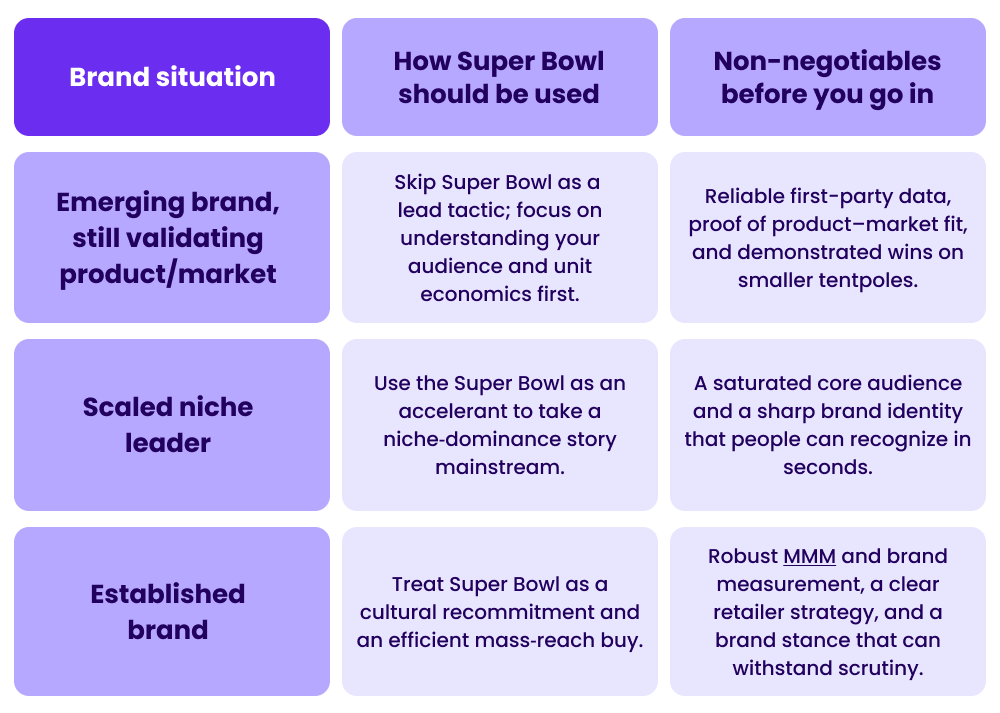
Two hard truths sit under this:
“The Super Bowl is not something I would ever recommend for a brand-new company just starting out. It is an incredible way to take a brand to the next level, but only once that brand has already done a good job building success with its core audience.
You have to ‘lay the logs’ and saturate your niche first so that when you finally light the match at the Super Bowl, the fire actually takes off. If a brand doesn’t even know who their audience is yet, they have years to go before this is the right move.“
–Meg Crowley Group Director, Client Partner, Tinuiti
Poppi followed a similarly disciplined arc. The brand didn’t wake up and decide to buy a Super Bowl spot; planning began during the prior May upfronts, with a TV ramp-up through the NFL playoffs and a clear view of how the game-day moment would sit atop retail and streaming integrations. If your team can’t sketch that kind of runway, your best move may be to build the foundation now and treat the Super Bowl as a future accelerator rather than a near-term fix.
Subscribe to our Paid Media Newsletter for weekly updates on media and advertising.

Super Bowl viewers reward sharp, on-brand creative, while exposing anything that isn’t. Two principles matter most: platform fit and funnel match.
Your creative has to feel native to where it runs:
For leadership, this comes down to a budgeting decision. If the idea doesn’t fit the channel, you end up paying for impressions that are far less likely to drive meaningful brand impact.
“We encourage brands to throw out the ‘all or nothing’ playbook of the past.’ Today, the Super Bowl is approachable for all brands because the content waterfalls into every channel. It’s less about being in the game itself and more about knowing your audience and finding the right pathway to be interwoven with the cultural moment.”
–Rachel Costanzo Senior Director, Media Strategy & Operations, Tinuiti
Match your story to where the customer is in the journey:
Two common failure modes are worth flagging:
“The biggest misses happen when brands deviate too far from the ethos of who they are just to jump onto a trend that isn’t authentic to them. In a ‘sea of sameness’ where so many ads look alike, you lose the ability to stand out if your creative doesn’t tie back to your brand truth. You have to know who you are and why you’re unique well in advance of the ad buy, or you risk eroding your ability to actually connect with the audience.”
–Meg Crowley Group Director, Client Partner, Tinuiti
The Super Bowl magnifies both what’s working and what isn’t. It will reward a brand that knows exactly what it stands for and can translate that into a clear, memorable story, and it will just as quickly expose any confusion or drift in the narrative.
It’s not the moment to reinvent your brand identity or chase a trend that doesn’t fit. It’s the moment to show up as the sharpest version of your brand, grounded in the brand’s identity, aligned with your audience, and crystal clear about why your brand deserves a place in the conversation.
For Super Bowl marketing to be investable, you need more than buzz; you need a clear framework for how success will be defined, tracked, and reported back to the business. That starts with setting expectations at the leadership level, so everyone is aligned on what good looks like before the spot ever airs.
Stakeholders often imagine instant website crashes or overnight sell-outs as the sign that a Super Bowl campaign worked. Those spikes still happen, but they’re no longer the norm, and they’re not the best way to judge success.
In practice, the healthiest outcomes look more like a structural step up: brand and business metrics settle at a higher floor after the halo fades.
“Any media spend can be wasted if you aren’t measuring it correctly. The biggest risk is committing to a high-impact moment without a strong measurement solution in place to track the actual impact of that spend. Without that framework, you’ll never know your actual return, and you’re essentially just throwing money into the void.”
– Laura Ross Director, Client Partner, Tinuiti
A practical Super Bowl scorecard includes:
Track shifts in aided and unaided awareness, familiarity, and purchase consideration. Poppi, for example, saw almost a 13-point lift in brand awareness over two months after its Super Bowl spot, which is exceptional for an established brand.
Many Super Bowl programs are primarily brand plays, but Poppi’s near-1x ROAS on its 60-second spot shows that, with the right cross-channel architecture, even an eight-figure line item can defend itself on short-term revenue.
For brands like e.l.f., EMV is often where the real upside sits—PR coverage, influencer content, and organic social can add up to value that exceeds paid media when community, talent, and culture all align.
The most crucial question: what does your new normal look like? After e.l.f.’s first Super Bowl activation, the brand saw 57 billion global impressions, #1 brand sentiment among 2023 Big Game spots, and a 64% week-over-week lift in purchase consideration. Power Grip Primer sales jump from one sold every 8 seconds to one every 3.5 seconds, with a halo effect across the business.
To make Super Bowl marketing accountable, you need to plan how it will be read before you spend:
“We use Tinuiti’s MMM tools—specifically Rapid MMM for online sales, Geo MMM for in-store tracking, and Equity MMM for brand recognition—to see exactly which channels are driving the highest impact.
Planning the Super Bowl further in advance and centering other efforts around the spot using this data makes the investment significantly less stressful and far more trackable. It allows us to create a feedback loop where we can confidently prove that a major bet, like an $11 million spot, actually delivered a noticeably stronger performance, achieving a 1x ROAS alongside a massive 13-point jump in brand awareness.”
– Kenny Bianchi Director, Client Partner, Tinuiti
Poppi’s 2025 campaign is a good example of this discipline: the team used MMM to calibrate channel investments, and the data clearly showed both short-term ROAS and long-term awareness lift.
Measurement tech that shows what’s driving growth—and exposes what’s holding it back.

When Tinuiti works with executive teams on Super Bowl strategy, the conversation usually centers on a few core questions.

The Super Bowl remains one of the last true monocultural moments. It is a chance to put your brand in front of an audience you can’t replicate anywhere else.
But the real advantage doesn’t come from buying 30 second spots; it comes from treating the game as the center of a strategy that’s grounded in the basics you’ve just worked through: knowing whether you’re ready, choosing the right level of participation, building surround-sound media, getting the creative and timing right, and wiring the whole thing into your measurement stack.
When those pieces are in place, the Super Bowl stops being a high-stakes one-off and starts functioning like any other smart growth investment: it has a clear role in your multi-year plan, defined success ranges, and a path from awareness to revenue that your finance team can see and your board can understand.
That’s the core shift this playbook is designed to make: The shift away from “Do we dare?” to “How do we use this moment, at the right scale, to drive durable results for the brand?”
Contact us today to learn how our experts can partner with you to shape and execute a comprehensive marketing strategy that wins before, during, and long after the final whistle.

Copywriter, Tinuiti
Jenn Wheatley is a senior content strategist and copywriter who turns complex marketing data into clear, actionable stories. She develops research-backed reports and thought leadership that help brands navigate critical business decisions. Based in Utah, she enjoys cooking, strength training, and traveling with her family.