Search Is Everywhere Now. So Is the Ad Inventory.


Search everywhere optimization is the practice of building brand visibility wherever buying decisions actually get researched, not only on a search results page. It treats TikTok, Reddit, Pinterest, YouTube, AI assistants, and retail marketplace search as search surfaces in their own right, each with both its own ranking inputs and its own ad auction.
The earned half is classic SEO work: the text a brand supplies, the engagement it earns, and the account standing behind both, repeated six ways instead of one. The paid half is newer and less settled. Nearly every one of them now sells keyword-targeted search advertising with match types, negative keywords, and search term reports. Three years ago most of that inventory didn’t exist.
A useful search strategy beyond Google maps the territory before it picks tactics. People search TikTok for a recipe, Reddit for a recommendation, Pinterest for a vibe, and Google when they’re ready to act.
When we look at the data, compiled in our guide to Search Without Borders, we see that fifteen years ago the average consumer reported seeing two ads before a purchase, today it’s six, and ten for B2B buyers. Average purchase size runs 9% higher when a shopper encounters a brand across four or more platforms.
Google leads, but never alone. Adobe Express asked 807 US consumers in early 2026 which ones they found most helpful for search. Google led at 85%, followed by Reddit at 29%, ChatGPT at 26%, YouTube at 24%, and TikTok at 16%. The totals reach 180%. People named several platforms each, because that’s how they search.
Reddit and Pinterest both capture demand before it attaches to a brand name, and each does it differently.
Reddit’s position is more structural than the survey suggests. Research Tinuiti conducted with Reddit found that “reddit” ranks as the seventh most-searched term on Google in the US, and that more than 200 million unique pieces of Reddit content are clicked from Google search in a single quarter. People append the word to queries because they want a human perspective the open web stopped providing.
Pinterest tells a similar story from a different angle. Its FY2025 Form 10-K describes the company as “an AI-powered visual search and discovery platform, positioned at the intersection of search, social, and commerce,” and discloses that over 90% of searches there are unbranded.
Pinterest reported more than 80 billion monthly searches in its Q4 2025 results. That is people arriving with a need and no brand attached to it, and every one of those queries is contested.
On-platform search at Amazon and Walmart runs its own auction against its own queries, and treating it as a lower-funnel silo doesn’t describe what shoppers are actually doing there. Tinuiti’s commerce media practice plans it alongside the search and social lines rather than after them.
| Surface | Stage of Search Journey | Mode of Search | Earned Lever | Keyword-Targeted Ads |
| TikTok | Mid to low | Research and visualization | Titles, captions, on-screen text | Yes, since September 2024 |
| Upper to mid | Research and reviews | Subreddit presence and comments | Yes, feed and conversation | |
| Mid | Visualization and inspiration | Pin descriptions and boards | Yes, with match types | |
| YouTube | Mid | Research and how-to | Titles, chapters, transcripts | Yes, through Video campaigns |
| Google and Bing | Mid to low | Research and transactional | Technical health and structured data | Yes |
| Amazon and Walmart | Low | Product and transactional | Listing attributes and reviews | Yes, on-platform |
Search algorithms on all six read the same three inputs: the text a brand supplies, the engagement that text earns, and the standing of the account behind it. What changes is the name each one gives them and the weight it assigns them.
The site’s own technical SEO remains table stakes underneath all of it. Crawlability, structured data, and entity consistency are the three pillars Tinuiti’s AI SEO services work from. Together they are what make a brand legible to the crawlers feeding search engines and AI answers alike. Fragmented discovery doesn’t make that work less important. It makes the site the one place a brand still controls outright.
One process change matters more than any single tactic: run keyword research per platform rather than once on Google. The words people type into TikTok aren’t the words they type into a search engine, and the words they use on Reddit are unique as well.
That work pays out in AI answers too. Tinuiti’s AI visibility program for Rough Country, an off-road parts brand, reached 22% share of voice across 180 mid-funnel prompts inside 90 days and grew ChatGPT referrals 71%.
Copy is the input a brand controls completely, and each one reads a different slice of it.
The measurable outcome is in-platform search impressions, tracked separately rather than blended.
Engagement is the input a brand shapes through format and timing rather than metadata, and it separates a well-optimized post from a well-performing one.
Paid distribution seeds the engagement that organic ranking then reads. Where early velocity determines reach, buying the first thousand views is a ranking tactic, not just a media buy.
Account standing is why a smaller, focused account routinely outranks a larger, unfocused one. Topical consistency teaches the algorithm what the account is for.
The specifics vary: Reddit gates participation through account age, karma, and standing within individual subreddits. Pinterest rewards claimed websites and verified merchant status. Amazon reads Brand Registry enrollment, seller rating, and Featured Offer position. Google Business Profile completeness governs local search.
AI answers read the same pages, profiles, and threads a brand has already optimized. Reddit Answers, Pinterest visual search, TikTok’s smart refinements, Google AI Mode, and Meta’s AI overlays all live inside apps a brand may already be buying, reshaping how people navigate within each one. None of them is a destination that needs its own budget line.
Earning visibility in those answers is a discipline of its own, whether it’s sold as generative engine optimization or answer engine optimization, and AI search optimization covers the operating model in depth. Tinuiti sequences the work in three phases: own what you say, shape what experts say, influence what the community says.
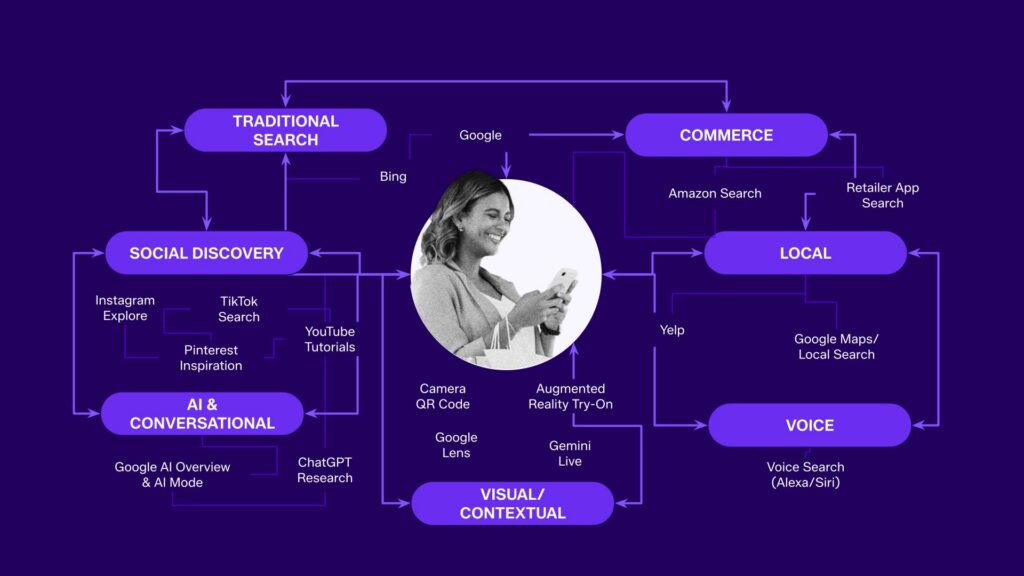
What matters for a media plan is narrower: everything feeding those phases is already on the map above.
Tinuiti’s Q3 2026 AI Citation Trends Report, built with Profound across six AI platforms and nine commercial categories, shows how that plays out. Reddit drove both the climb and the retreat in social’s share of AI citations, running at 4% in July 2026 against a 6% peak, while Instagram has climbed from 1% to 8% of AI Mode’s social citations since late 2025.
Roughly 99% of Reddit citations point to individual threads rather than subreddits, profiles, or brand-authored content. A brand can’t publish its way into Reddit visibility. It’s the earned half’s lesson arriving one layer up: the text that gets cited is written by other people, and participation is the only way to influence it.
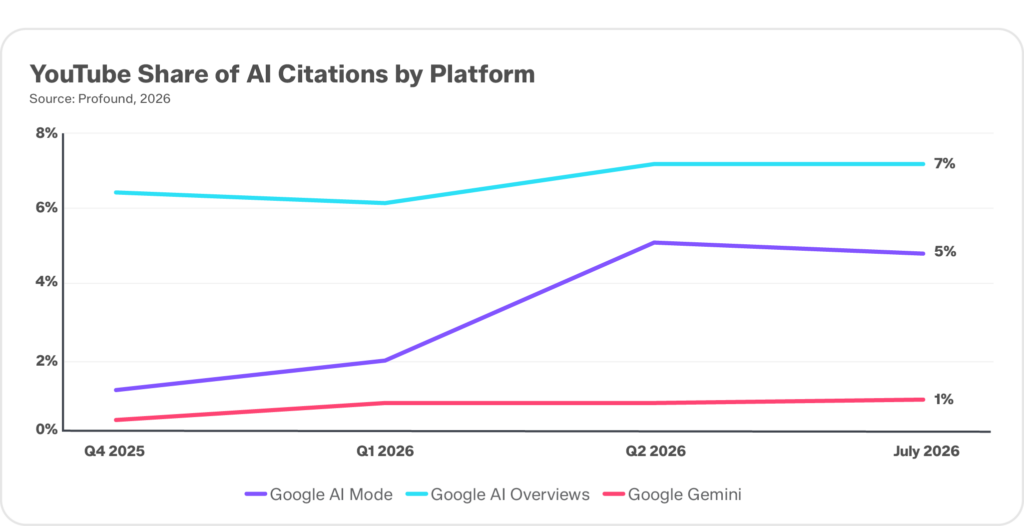
YouTube’s share of AI Mode citations rose from roughly 1% at the end of 2025 to 5% by July 2026, while its share of AI Overviews sits at 7%. Google is also citing itself more, largely through Business Profiles carrying price, photos, and reviews, which makes the Google Business Profile work described earlier a citation surface rather than a listing.
In July 2026, Google Search Console introduced platform properties, letting brands connect owned social and video profiles to see which search terms lead people to those posts.
If your whole strategy hinges on owning citations on one platform, you’re building on sand. Breadth wins. Show up across the surfaces both consumers and AI models trust, and you’ve got something durable.
Jen Cornwell, Senior Director of Innovation & Growth, Tinuiti
Citation share moves faster than any media plan can react to. Reddit’s share of ChatGPT Search citations collapsed over four days in August 2026 with no confirmed cause, and its share of Perplexity citations drained away over months while a scraping lawsuit moved through the courts. Neither was something a brand could have optimized its way out of. Breadth is the only hedge available, which is why the surfaces on the map matter more than any single answer engine.
Every row in the table above sells keyword-targeted advertising against its own search queries, with mechanics a search marketer already knows: match types, negatives, search term reports, and an auction.