What Are the Top Retail Media Networks In 2026?


The Skinny:
When I first wrote about this space in early 2021, retail media was already gaining momentum across big-box and specialty retailers–and it has only accelerated since then. In the years since, cookie deprecation, privacy regulation, and rising performance expectations have pushed even more brand dollars into networks that can pair first-party data with closed-loop measurement. At the same time, the field has expanded well beyond classic retailers, with travel, financial services, and other loyalty-rich categories launching their own commerce media offerings.
While there are now well over 200 retail media networks operating worldwide, most advertiser budgets remain heavily concentrated among a short list of leaders. In the U.S., Amazon and Walmart together account for roughly 80 percent of all retail media ad spending, reflecting both their scale and the maturity of their offerings. Around them, however, the number of credible networks has climbed quickly, and many have rolled out self-service tools and more sophisticated targeting that make buying and optimizing retail media far more efficient than it was just a few years ago.
With so many options, the real challenge is not whether to invest in retail media but where to invest, which makes it critical to ground your decisions in a clear definition of what a retail ad network is and what it should do for your brand.
A retail media network (RMN) is an advertising platform owned by a retailer, such as Amazon, Walmart Connect, or Target’s Roundel, that enables brands to purchase ads on the retailer’s website, app, off-site inventory, or in-store digital media. These networks use the retailer’s first-party shopper data to target ads to specific audiences, typically at or near the point of purchase, which tends to drive higher conversion rates than broader digital advertising. Major networks like Amazon, Walmart, and Target dominate in scale, while specialty and category retailers like Home Depot, CVS, and Ulta are growing their share in highly contextual environments and with loyalty-rich audiences.
Retail media networks give marketers access to a portfolio of placements across the shopper journey, from on-site search ads and sponsored product tiles to on-site display and brand pages, to off-site programmatic and social extensions, and increasingly in-store screens and audio. The common thread is the use of the retailer’s first-party data, which becomes more valuable as third-party cookies fade and brands look for durable, privacy-compliant ways to reach and measure audiences.
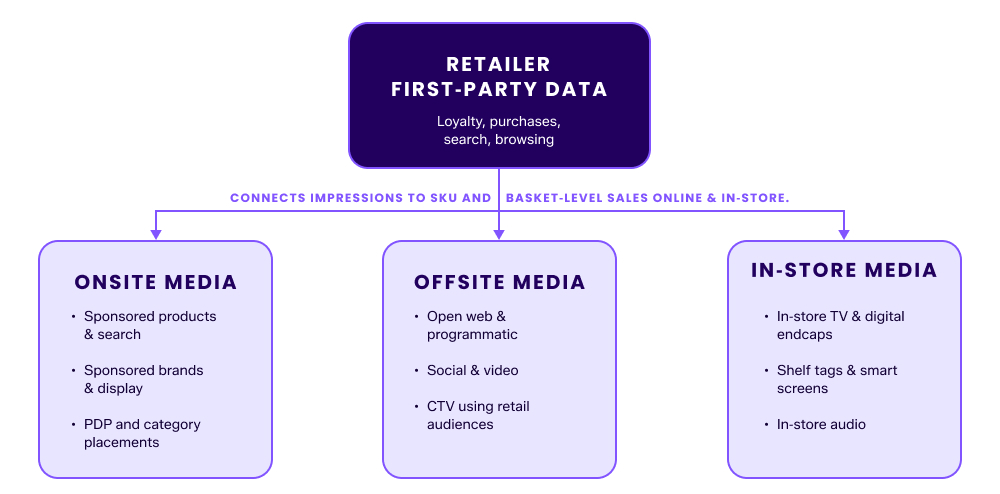
One of the biggest advantages of RMNs is their closed-loop measurement: the ability to connect ad exposure to SKU-level sales and basket behavior, often across both ecommerce and in-store transactions. Instead of relying on proxy metrics, advertisers can see how different placements, audiences, and creatives actually change what people buy, and then feed those learnings back into planning.At a practical level, RMNs function as both media channels and data partners: they determine where your ad can show up, who sees it, and what sales or outcomes can be attributed back to it. When you evaluate which retail advertising networks belong in your mix, you are really choosing whose audiences, data, and measurement you want to build around. The ads themselves can appear in a variety of formats and locations to support different goals, including in prominent placements on search results pages, product pages, category pages, browse pages, onsite, in-store, off-site, and more.
You have probably heard “commerce media” used almost interchangeably with “retail media,” but they are not the same thing. Retail media is a subset of commerce media, specifically the media sold by retailers on or off their owned properties using their first-party data.
Commerce media is the larger umbrella that includes any advertising or data solution tied to a transaction or shopper behavior, even when the company selling the media is not a classic retailer. That can include non-endemic advertising (using a retailer’s first-party data to drive traffic to a DTC site or lead form) and sectors such as travel, hospitality, and financial services, where loyalty programs and booking data create highly targetable audiences. Examples include Marriott’s media network, Riott Media, United Airlines’ Kinectiv, or media offerings from major banks, all of which let brands tap into years of loyalty and behavioral data through curated placements, not just store-shelf adjacencies.
Connected commerce is a related but often fuzzier term that describes the connective tissue among media, data, and fulfillment across channels and partners. In practice, that can mean stitching together retail media, search, social, CTV, and in-store experiences into a single orchestrated journey, tied to unified measurement and incrementality rather than channel-by-channel reporting. It is also where many brands are still in “R&D mode,” given the complexity of stitching identity, logistics, and returns across multiple platforms.
Imagine you are in a grocery store and see a tower display for a new cereal right as you decide what to buy; retail media networks recreate that moment digitally and extend it both off-site and in-store. Instead of only buying a physical endcap, brands can buy sponsored spots at the top of search results, hero banners on category pages, display or video on PDPs, and in-store screens or audio that reach shoppers while they are actively considering what to put in their carts.
At a basic level, RMNs work by letting advertisers purchase media across a retailer’s digital and physical properties, all powered by that retailer’s exclusive first-party customer data. They turn ecommerce sites, apps, and stores into high-performing ad environments, connecting brands with audiences who are in a shopping mindset rather than passively scrolling.
Under the hood, most RMNs share the same structure: a first-party data and identity foundation, activation across onsite, offsite, and in-store surfaces, and closed-loop measurement that links exposure back to actual sales. The table below breaks down those layers and what they mean for marketers.
| Layer | Element | What it does | Why it matters |
| Foundations | First-party data foundation | Uses loyalty, purchase history, search, and browsing behavior to build precise audience segments. | Enables privacy-compliant targeting without third-party cookies and powers all RMN activation. |
| Foundations | Closed-loop identity | Connects media exposure to shopper IDs across ecommerce and in-store environments. | Makes it possible to tie campaigns to real transactions at the SKU and basket level. |
| Activation | On-site media | Serves sponsored products, brands, display, and video on the retailer’s site or app via PPC auctions/CPMs. | Primary performance workhorse that captures high intent at the point of sale. |
| Activation | Off-site media | Activates retailer audiences across open web, social, and CTV via DSPs and partner integrations. | Scales reach beyond finite onsite inventory and supports upper-funnel awareness and new HHs. |
| Activation | In-store media | Delivers ads via in-store TV, smart screens, digital shelf tags, and audio, tied to loyalty IDs. | Connects physical-world exposure to digital data and measurable offline sales. |
| Activation | Buying & activation models | Mix of self-serve tools, DSP access, and IO-based managed service depending on retailer stack. | Determines how much control you have over bidding, targeting, and optimization. |
| Measurement | Closed-loop measurement | Links impressions and clicks to SKU- and basket-level sales online and in-store. | Supports true incrementality testing, optimization, and media-mix decisions–not just ROAS. |
For retailers, the full stack of retail media has become a high-margin, non-merchandising revenue stream, with gross margins that can sit far above traditional product margins and help offset pricing pressure and rising operating costs.Under the hood, the retailer’s identity graph connects impressions and clicks to shopper IDs, transactions, and loyalty profiles, feeding into closed-loop reporting and incrementality testing rather than just surface-level ROAS. As CTV and retail media converge–through moves like Walmart’s acquisition of Vizio and deeper retailer-CTV integrations–the path from ad exposure to household purchase is getting both shorter and more measurable across screens and stores.
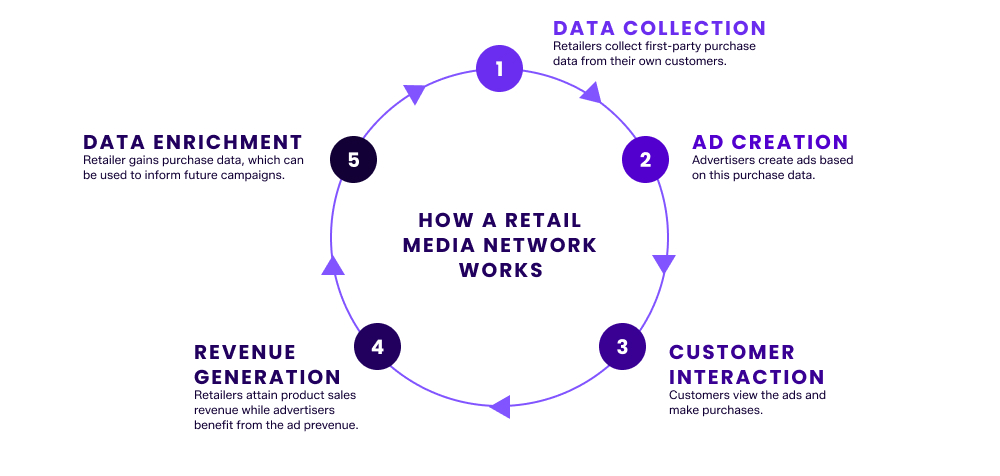
Retail media is not new. Sampling, coupons, loyalty programs, and endcaps have existed for decades in the form of shopper marketing. But today they are digitized, scaled, and trackable in ways that align with modern media planning. When done well, RMNs create a win-win-win for retailers, advertisers, and shoppers.
From the retailer’s perspective, media is a highly attractive business line: gross margins on retail media can be dramatically higher than traditional retail margins, helping offset competitive pricing pressure, labor costs, and fulfillment investments. That economic reality is a major reason nearly every sizable retailer and many non-retailers with strong first-party data are now building some flavor of a media network.
RMNs provide privacy-compliant access to first-party data that reveals what people actually buy, not just what they browse or like. That lets you target high-intent audiences (e.g., category purchasers, lapsed brand buyers, new-to-category shoppers) at key decision points and measure downstream impact with far more precision than many upper-funnel channels. Because campaigns sit so close to the point of purchase, retail media is also a powerful environment for controlled tests of incrementality, profit, and full-funnel contribution.
Media is now a material P&L line alongside core merchandise and services. RMN revenue helps fund the tech investments needed to compete with Amazon and large platforms, and it allows smaller or specialty retailers to monetize their unique audiences and loyalty data, even if their total traffic is smaller.
Well-executed retail media feels like relevant discovery rather than clutter: personalized recommendations, timely offers, and content that helps them compare products or find new favorites. In some cases, media revenue can indirectly subsidize sharper pricing or greater value for members, particularly where networks are explicit about staying “member-first,” as with Costco.
The power of retail media lies in retailer first-party data and closed-loop measurement: you can see how media exposure changes actual purchase behavior rather than just proxy metrics. For retailers, that same infrastructure creates a high-margin, non-merchandising revenue stream that can materially outperform traditional retail margins.
As programs mature, the question shifts from “Should we invest in retail media?” to “How should we allocate across it?” We recommend treating allocation as a portfolio decision rather than a channel-by-channel fight.
As a high-level guideline, a 60/40 split between onsite and offsite retail media spend can help balance conversion efficiency with long-term brand growth. On-site media captures existing intent and influences decisions at the point of sale, while off-site media, often through video and CTV, builds reach and consideration across the full funnel. This ratio is not a hard rule; in practice, we adjust allocations based on retailer goals, audience dynamics, competitive pressure, and the sophistication of each channel.
Within onsite budgets, a 70/30 split between search and display is a useful starting point. Dedicating roughly 70 percent to search helps harvest active demand and defend against competitor conquesting, while the remaining 30 percent in display leverages high-impact placements on home, category, and aisle pages to drive new-to-brand discovery and additional PDP traffic. Again, these ratios are guidelines; the right mix varies by category, margin structure, and your position on the measurement-maturity curve.
One important nuance is coordinating retail media with your broader Google Search strategy so you are not bidding against yourself, driving paid search traffic to both your DTC site and retailer PDPs without a clear plan. A unified view of search and retail media helps avoid internal cannibalization and puts spend where it creates the most incremental value.
Most retail media networks offer a common core of on-site inventory: search ads and sponsored products on search, browse, and category pages; sponsored brand and video units; display banners across home and category pages; and custom landing or brand pages. Many also layer in onsite sponsored email, app placements, and personalized onsite modules as extensions of that core.
For in-store media, impressions typically reflect the number of shoppers who are estimated to pass a given screen, endcap, or audio zone during a campaign, with dwell time being the time spent physically in front of the screen. Retailers generally derive this from store traffic data, mobile retailer apps, hardware and software that can detect basic human (privacy-safe) presence and of course, device or loyalty-card signals, then apply it as a reach or frequency proxy or even tie back to specific shoppers.
Just about everyone with an e-commerce site and a brick-and-mortar footprint seems to be in the retail media game today, usually starting with onsite sponsored products. Rather than listing every network, this list focuses on 15 established and emerging players that matter to most brands evaluating their next moves.
Below, each network includes a short takeaway for when and why it matters.
Walmart Connect is Walmart’s retail media business, built on the strength of a massive physical footprint (90% of Americans live within 10 miles of a Walmart) and growing ecommerce sales. The network’s focus is true omnichannel: connecting in-app and online behavior with in-store activity through features like product location, app-driven shopping (including scan and go checkout), fulfillment method (like pick up or delivery), Walmart+ membership and at-shelf reviews on physical tags.
From a media standpoint, Walmart offers sponsored products, sponsored brands, and video, display (including self-serve via Walmart DSP), social and CTV partnerships, and in-store advertising and shoppable TV formats. For brands, the headline is “reach plus recency”: the ability to combine national reach with fulfillment from local stores, compressed delivery windows, and increasingly tight measurement between screens and shelves.
Walmart Connect at a glance
| Dimension | Details (2026) |
| Core strength | Omnichannel reach and scale across grocery, general merchandise, and CTV |
| Key surfaces | On-site search and display, Walmart DSP off-site, in-store screens, shoppable TV |
| Best for | Brands seeking national scale, strong physical coverage, and full-funnel retail media presence |
Key reasons Walmart advertising is worth your attention:
Roundel is Target’s retail media arm, pairing nearly 2,000 U.S. stores with a loyal Target Circle membership base and a growing portfolio of owned and partner surfaces. Like Walmart, Target leans into curbside pickup and same-day fulfillment, often via its Shipt acquisition, which tightens the loop between media and purchase.
Roundel offers sponsored products (via partners like Criteo and CitrusAd), on-site display, CTV ads, Circle Promotions in the app, social extensions, and off-site programmatic ads activated against Target audiences. Where Roundel shines is the combination of a brand-friendly environment, specialized merchandising assortments (like in beauty, health & wellness), deep loyalty data, and flexible activation models (managed service or BYO-DSP).
Target Roundel at a glance
| Dimension | Details (2026) |
| Core strength | Loyal, data-rich audience and strong brand environment |
| Key surfaces | Sponsored products, onsite display, CTV, Circle Promotions, social |
| Best for | Brands leaning into family, beauty, and lifestyle categories at scale |
Key reasons Target advertising is worth your attention:
Kroger Precision Marketing (KPM), powered by 84.51°, combines one of the largest grocery footprints in the U.S. with deep loyalty data and a mature media stack. Kroger continues to invest and push brands into digital channels, ranging from its mobile app to TOA (targeted onsite ads), pairing them with targeted coupons (goodbye, foot-long printed coupons for random items) and weekly digital deals. Their Boost membership program includes delivery capabilities (including a partnership with Instacart to increase the delivery range)
KPM offers onsite sponsored products, rich audience targeting, private marketplace (PMP) deals for activation in a DSP of your choice, and growing in-store and offsite capabilities. For brands, KPM is often synonymous with serious measurement: advanced audience frameworks, clean-room-style environments, and disciplined incrementality work that helps tie retail media back to the rest of the mix.
“The launch of the new Kroger Ad Platform enables Tinuiti to manage our Kroger buys more efficiently by allowing us to see everything we need for our on-site campaigns within one platform. This gives us the ability to measure, gather insights, and optimize campaigns quickly to drive better performance for our clients.”
Raquel Kozlowski, Sr. Director, Innovation and Growth at Tinuiti
Kroger at a glance
| Dimension | Details (2026) |
| Core strength | Loyalty-driven grocery audiences and advanced measurement/PMP options |
| Key surfaces | On-site search, PMP off-site, coupons, in-store media (select programs) |
| Best for | CPGs needing grocery scale and clean-room-style analytics |
Instacart is a grocery-first but category-broad marketplace that sits across hundreds of retailers and tens of thousands of stores, with a vast, shoppable product catalog. Shoppers log in, select their local store, and then search. That inherently low-funnel behavior makes Instacart one of the most intent-rich environments in commerce. They also handle delivery for a LOT more than groceries, with notable partnerships including Sephora, Five Below, Bath & Body Works, Sam’s Club, and Kiehl’s.
From a media perspective, Instacart offers sponsored products, sponsored video, branded pages, coupons, shoppable display, shoppable video, and managed delivery promotions. They have also leaned into AI-driven features (such as in-store app modes) and CTV measurement partnerships that link streaming impressions to Instacart basket data. The Instacart Platform offers retailers a range of options to meet their partnership needs, including Retailer Storefronts, Fulfillment, Connected Stores, Modular E-commerce, and more.
Instacart at a glance
| Dimension | Details (2026) |
| Core strength | Cross-retailer, ultra-high-intent grocery and general merchandise shoppers |
| Key surfaces | Sponsored products, video, brand pages, shoppable CTV integrations |
| Best for | Brands seeking incremental reach across multiple banners without separate RMNs |
Key reasons Instacart advertising is worth your attention:
Costco’s retail media offering has historically been more merchant-first and less noisy than many peers, with a strong emphasis on serving members rather than maximizing media density. In 2026, Costco is formalizing this as Costco Velocity, a platform that lets advertisers log in and buy on-site display and “digital endcap” inventory, often referred to as Reserved Display.
Every activation starts with operational alignment: products must be available in-warehouse for at least two weeks before digital advertising goes live, and there must be a live, functioning PDP on Costco.com (no placeholders or pre-launch pages). Creative must be co-branded and approved, and while timing varies by tactic, campaigns can launch quickly once PDPs, inventory, and creative are in place. With a new ad server and an AI-powered optimization partnership with Moloco, Costco Velocity is bringing more automation and measurement to a historically IO-driven channel, while staying disciplined about merchandising outcomes. Costco recently unveiled all partners in their tech stack to give members visibility into how the data is being used, where, and how.
For off-site activation leveraging Costco’s first-party data, brands and agencies currently use LiveRamp Safe Haven to onboard audiences and distribute them to a DSP of choice in a privacy-safe way. Costco remains clear that media exists to support members and merchants first, which makes its network feel different from more aggressively monetized peers.
Costco Velocity at a glance
| Dimension | Details (2026) |
| Core strength | High-trust, value-driven member base and merchant-aligned programs focused on moving merchandise |
| Key surfaces | Reserved Display “digital endcaps,” onsite display, Criteo onsite, offsite DSP via LiveRamp Safe Haven |
| Best for | Brands with strong Costco distribution and compelling value propositions that can scale quickly |
Key reasons Costco Velocity advertising is worth your attention:
There is an entire blog (or ten) to write about Amazon alone, but it would be incomplete to omit it from any 2026 RMN list. Amazon combines a dominant ecommerce share with an escalating media stack across Sponsored Products, Sponsored Brands, Sponsored Display, Amazon DSP, and a growing CTV footprint via Prime Video and Fire TV.
What differentiates Amazon at this point is not just scale but also its ecosystem: retail media, streaming, devices, and generative shopping tools like Rufus all sit atop a shared data and identity layer. For brands, Amazon is often both a performance and brand channel, which increases the importance of robust measurement frameworks, incrementality testing, and disciplined budget allocation relative to other RMNs.
Amazon at a glance
| Dimension | Details (2026) |
| Core strength | Unmatched ecommerce scale and a diversified media/CTV ecosystem |
| Key surfaces | Sponsored ads, display, Amazon DSP, Prime Video/Fire TV, off-Amazon placements |
| Best for | Brands that need both scale and sophistication, and can invest in robust measurement |
Key reasons Amazon advertising is worth your attention:
Macy’s Media Network pairs the retailer’s department-store heritage with a growing retail media stack spanning on-site display, sponsored products, and off-site audience extensions. It’s particularly strong for brands in fashion, beauty, and home that want to reach premium and gifting-oriented shoppers, and its emerging partnership with Amazon’s Retailer Ad Service (RAS) adds incremental scale and monetization options.
Macy’s Media Network at a glance
| Dimension | Details (2026) |
| Core strength | Fashion, beauty, and home shoppers with strong gifting and seasonal intent |
| Key surfaces | On-site display and sponsored products, off-site audience extensions, in-store, and seasonal moments |
| Best for | Brands looking to reach style-conscious and gift-focused shoppers in a more premium department-store context |
Key reasons Macy’s Media Network is worth your attention:
Walgreens Advertising Group builds on the retailer’s nationwide pharmacy and convenience footprint, tapping into rich loyalty and health-adjacent data. For brands in OTC, health and wellness, beauty, and everyday convenience categories, WAG offers a way to reach frequent, mission-driven shoppers as they plan and fill baskets online and in-store.
Walgreens Advertising Group at a glance
| Dimension | Details (2026) |
| Core strength | Health, wellness, and convenience shoppers with frequent, high-basket trips |
| Key surfaces | On-site search and display, email and app media, off-site programmatic extensions |
| Best for | OTC, personal care, beauty, and snack/beverage brands looking to tie media closely to pharmacy and convenience trips |
Key reasons Walgreens advertising is worth your attention:
Best Buy Ads is built around high-consideration electronics and appliance purchases, where shoppers are actively researching big-ticket items and weighing options across brands and configurations. Its media offering spans sponsored products, geo-based placements, content integrations, and fast-expanding social and marketplace extensions.
Best Buy Ads at a glance
| Dimension | Details (2026) |
| Core strength | High-intent consumer electronics, appliances, and smart home shoppers |
| Key surfaces | Sponsored products, on-site display, geo-based placements, content partnerships, social extensions |
| Best for | Brands selling considered, complex products that benefit from research-heavy environments and expert positioning |
Key reasons Best Buy advertising is worth your attention:
Chewy Ads has quickly become one of the fastest-growing retail ad networks in the pet category, powered by a deeply loyal customer base and subscription-heavy purchasing behavior. Its proprietary platform gives pet brands direct access to shoppers who think in terms of long-term pet care, not one-off transactions.
Chewy Ads at a glance
| Dimension | Details (2026) |
| Core strength | High-LTV pet parents with repeat and subscription-based purchasing |
| Key surfaces | Sponsored search and listings, on-site display, branded experiences, Meta self-service extensions |
| Best for | Pet food, treats, supplies, and healthcare brands seeking recurring revenue and lifetime value, not just single orders |
Key reasons Chewy advertising is worth your attention:
Gopuff Ads taps into an instant-needs, convenience-driven audience that sits somewhere between grocery delivery and Q-commerce. Its users turn to the platform for fast delivery of snacks, beverages, household essentials, and late-night “need it now” items, creating a uniquely impulse-friendly context for brands.
Gopuff Ads at a glance
| Dimension | Details (2026) |
| Core strength | Instant needs, often younger and urban shoppers with high impulse propensity |
| Key surfaces | In-app placements, sponsored listings, homepage, and category features, off-site extensions |
| Best for | CPG brands in snacks, beverages, alcohol, personal care, and quick-need categories are looking to drive trial and basket builds |
Key reasons Gopuff advertising is worth your attention:
Home Depot’s Orange Apron Media (often grouped under its Retail Media+ offerings) is built around home improvement projects, seasonal refreshes, and a large base of both DIY and pro customers. For brands in building materials, tools, décor, lawn and garden, and adjacent categories, it offers a way to reach shoppers who are actively planning and executing projects–not just browsing.
Home Depot Orange Apron Media at a glance
| Dimension | Details (2026) |
| Core strength | Home improvement, DIY, and pro customers planning specific projects and seasonal upgrades |
| Key surfaces | On-site search and display, Retail Media+ programmatic, in-app and in-store placements tied to project journeys |
| Best for | Brands in tools, building materials, décor, lawn and garden, and home services looking to reach project-based shoppers |
Key reasons Home Depot’s Orange Apron Media is worth your attention:
Ulta’s UB Media sits at the center of a robust beauty ecosystem built on tens of millions of Ultamate Rewards members and a strong mix of prestige, mass, and salon offerings. Layer in Ulta’s shop-in-shop footprint inside Target stores, and you get a retail media network that can reach beauty shoppers across channels, life stages, and price points.
UB Media at a glance
| Dimension | Details (2026) |
| Core strength | High-intent beauty, skincare, and self-care shoppers within the Ultamate Rewards ecosystem |
| Key surfaces | On-site search and display, email and app, off-site audience extensions, retail-within-Target integrations |
| Best for | Beauty, skincare, haircare, and self-care brands looking to drive discovery, sampling, and loyalty across price tiers |
Key reasons Ulta / UB Media is worth your attention:
CVS Media Exchange (CMX)
CVS Media Exchange leverages CVS’s national footprint and ExtraCare loyalty program to reach high-value audiences across health, wellness, beauty, and everyday essentials. CMX combines on-site placements, off-site programmatic, and increasingly robust measurement to help brands reach frequent shoppers with strong first-party signals, for both endemic CPGs and adjacent categories like health services and financial products.
And that’s just 15 top networks to explore, not even touching on SSPs (sell-side platforms) and retail media platforms like Criteo and CitrusAd, which help brands purchase retail media at scale across multiple networks. It’s a lot to keep up with, so we made it a full-time job for a whole team of talented experts.
CVS Media Exchange at a glance
| Dimension | Details (2026) |
| Core strength | Loyalty-rich ExtraCare audience across health, wellness, beauty, and essentials |
| Key surfaces | On-site search and display, email/app, off-site programmatic and social extensions |
| Best for | OTC, beauty, personal care, and adjacent categories (like health services or financial products) seeking privacy-safe, health-oriented audiences |
Key reasons CVS advertising is worth your attention:
It is easy to get distracted by shiny new logos and announcements; the harder work is deciding which networks actually move the needle for your business. A simple way to frame this is: audience, distribution, economics, and measurement.
| Audience → | Distribution → | Economics → | Measurement |
| Does the network’s first-party data map to the shoppers you care about? How does that audience differ from other channels you already invest in? | Do you have meaningful in-store or online distribution with the retailer today? Is your product available where and when the media will run (especially important for brands without full national distribution) | Do margin structures, co-op funds, and trade budgets support scaled media investment, not just tests? | Can you actually prove incrementality and profit impact across networks, not just within each silo, given your current tech stack and analytics maturity? |
Tinuiti’s POV is that retail media decisions should be made at the portfolio level, with measurement at the center rather than bolted on after the fact. That means using tools like Bliss Point, always-on incrementality testing, and cross-network optimization frameworks to evaluate how each RMN fits into a full-funnel plan designed to drive growth.
Across published case studies, retail media campaigns frequently report double-digit incremental sales lift when measured via controlled testing, with results varying by category, creative, and placement mix. The key is not the headline lift number, but whether the test design credibly isolates the media’s causal impact and ties back to profit, not just revenue.
Tinuiti’s POV is that retail media decisions should be made at the portfolio level, with measurement at the center rather than bolted on after the fact. That means using tools like Bliss Point, always-on incrementality testing, and cross-network optimization frameworks to evaluate how each RMN fits into a full-funnel plan designed to drive growth.
As with all advertising initiatives, there is a lot to consider when adding retail media to your marketing mix. Your goal is not to be everywhere, but to be intentional about which networks you fund, how you use them, and what proof you demand in return. Once you have that high-level lens in place, the next step is to get more tactical about evaluating specific RMNs and operationalizing them.
The following questions and considerations can help you vet networks, align budgets, and make sure your tech, data, and teams are set up to get real value from retail media–not just another set of line items.
“Where is the money going to come from?” is still one of the most common questions we hear when brands expand or mature their retail media programs. Retail media dollars can sit in a lot of different places–trade and shopper, brand, performance, ecommerce, even test-and-learn funds–which makes it easy for ownership to get fuzzy if you do not align early.
Rather than treating RMN investment as a last-minute carve-out, build it into your annual and quarterly planning as its own line item with clear objectives: what is meant to drive incrementality, what is defensive, and what is pure experimentation. Many brands began by reallocating budgets from in-store sampling, shopper marketing, or traditional trade during COVID and supply-chain disruptions, but the most mature organizations now plan retail media alongside search, social, and CTV as part of a single connected commerce budget.
Setting those budgets early–and agreeing on who owns which pieces–also makes it easier to enforce guardrails like your 60/40 onsite-to-offsite and 70/30 search-to-display guidelines, and to fund the measurement work needed to prove incrementality instead of just chasing short-term ROAS.
The networks you choose should align with what you’re selling and the audiences you want to reach. If you sell cosmetics, for example, it makes sense to buy ad space at Ulta, Target, CVS, or even Kroger. Maybe skip Home Depot; even though half of their customers are women who might be in your target market, they don’t sell cosmetics. But they have expanded to some apparel!
When choosing a Retail Media Network, network size is an important factor. Generally, larger networks can reach a broader audience, which is crucial if your products appeal to a wide range of customers. For instance, a general-use product may benefit from the expansive reach of a large RMN to maximize exposure.
However, smaller RMNs can still be highly effective if they cater to a specific audience relevant to your brand. For example, a cosmetic brand advertising on Ulta’s RMN may achieve significant engagement despite the network’s smaller size because it reaches a concentrated audience interested in beauty products.
It’s important to remember that a newer RMN from a specialty retailer isn’t likely to have the same breadth of options as a larger, more established network like Amazon, Walmart, or Target. That said, if you have specific needs in mind, there are a few questions you should start with in evaluating if a network will be a likely good fit, including:
It’s all about the audience. Retailers have amassed years of loyalty data through programs with perks, points, and personal information. While that data used to be leveraged in slow-to-scale, impersonal ways, retail media lets them harness “people as data sets” with far greater relevance and higher-quality targeting. That is especially powerful for brands looking to generate new-to-brand buyers, foster loyalty, and close the proverbial loop between media and sales.
We are now starting to look at audiences over channels: a single customer can exist in social, programmatic, Google, email, and local all at once–so the question becomes how to reach them efficiently and retain and engage them over time. The answer is not eight separate budgets and a wish; it is thinking through the customer journey and designing touchpoints for when and where they actually are. At the retailer or channel level, not all audiences are created equal–lapsed buyers at Walmart vs. Target, or CVS’s social audience vs. Ulta’s–because they are charged at different rates, have different reach, and perform differently.
More variables and shiny objects are coming, and if you are waiting for retailers to build exactly what you want, you will be waiting a long time. The reality we operate in is only a few years old, and it is tempting to compare every RMN to Amazon, Google, and Meta, which have had years and massive resources to build their stacks. Retailers, by contrast, still run 90-plus percent of their business through classic in-store frameworks and have divided attention.
Consider how your existing tech will interface with information from retail media networks: what you already have, what you need, and where data should live, come from, and be accessed. Getting outputs into a format where you can compare CPMs, return on ad spend (ROAS), audience types, and then cross-reference against other retailers will give you a much better sense of how audiences move around and where that next dollar is best spent.
Ask for what you want or need. Do not assume that what you see in a rate card or UI is all that exists, or that you must draw a definitive business conclusion from every single campaign. Some results will look too good to be true; they probably are, and that is your cue to dig into the measurement and understand whether you are seeing the full picture or something closer to half the picture.
Across published case studies, retail media campaigns frequently report double-digit incremental sales lift when measured via controlled testing, but those numbers only matter if the test design credibly isolates causal impact and ties back to profit, not just revenue.
Retailer relationships can be tricky. Do the math and push back if the promised audience size or return seems too good to be true, and have a general sense of what is realistically possible versus what should be considered an “investment.” Always ask for more in the metrics department; lack of a metric often means no one has asked for it yet, not that it is unimportant.
Some retailers are a bit behind on the technology front. How do they close the gap? After all, they are retailers, not technology companies. It’s expensive to employ a team of software engineers, data scientists, and wizards, as well as the infrastructure needed to host, maintain, and innovate to keep up with demand and differentiate.
So, you buy existing technology, dig deep to make it, or strike strategic partnerships with the latter two, emerging as the path forward for now. Every week, there’s an announcement of an acquisition, a preferred partner, or a chain of software platforms to execute on a media type. For example: PromoteIQ, Criteo, and Quotient–all working directly with retailers of all shapes and sizes to enable different types of digital media– most commonly, sponsored or featured products. Makes sense. Building an ad network is not a small undertaking.
Amazon and Walmart are creating a tech empire that their offerings sit atop, and that expands far beyond sponsored products into programmatic/display, video, and AI-enabled units at scale. They also have hundreds of billions of dollars. Walmart’s playbook has been a combination of building (Media Group, Walmart Plus, Walmart Fulfillment Services), buying (Joyrun), and partnerships, notably Rover.com, thredUP, and Shopify.
Comparatively smaller–though, by no means small–retailers like Target, Kroger, CVS, Best Buy, and Home Depot have found their path forward by staying the course as a go-to destination, but also by integrating with partners, building on their first-party data/audiences, and diversifying their offerings to include social media placements, private marketplaces for programmatic, email placements, search engine advertising placements, and onsite offerings through those partnerships. (Walmart does have some of these as well.)
And then, of course, there’s Instacart, everyone’s best friend for delivery and partner extraordinaire, with the exclusion of Target, which bought delivery competitor Shipt.
For all their promise, RMNs come with structural challenges that senior marketers need to plan for up front.
Marketers do not truly “own” the data inside each network, and even clean-room or collaboration environments can become walled gardens if you cannot normalize outputs and join them across partners. Capabilities and standards are inconsistent, which makes apples-to-apples comparisons difficult. This fragmentation makes cross-platform and cross-channel decisions difficult. Brands can mitigate this issue by developing their own data, measurement, and analytics strategies to gain a clearer picture of their marketing performance. Industry groups like the IAB are pushing for more standardized definitions and buying guides across online and in-store media, but adoption is uneven.
There is a real gap between perception and reality: many organizations describe their retail media programs as “operationalized” or “advanced,” but only a small subset has truly automated, full-funnel measurement and optimization. In our experience, the most sophisticated teams are the ones that consistently run structured experiments and integrate lessons back into planning.
ROAS alone is no longer enough for most brands. Decision-makers want proof of causal impact. Did the media actually change behavior, or did it simply show up where demand already existed? Methodologies such as randomized controlled trials and synthetic control testing help quantify incremental sales, margins, and long-term brand effects, but they require planning, access to data, and statistical discipline.
Retailers must balance monetizing digital real estate with maintaining a clean, trustworthy shopping experience; ad overload or irrelevant placements can erode both conversion and brand perception. Shoppers appreciate personalized discounts and relevant recommendations, but they remain highly sensitive to data privacy and intrusive advertising, and regulators are paying closer attention to competition and data-use practices.
As more brands invest in RMNs, competition for key placements intensifies, raising bid pressure and expectations for creative quality. The brands that win are not simply the largest spenders, but those with a clear testing agenda, a strong measurement backbone, and the discipline to walk away when the audience, economics, or incrementality are not there.
Looking ahead, a few themes are shaping how retail media evolves.
Find out what’s coming in 2026 and beyond, and what marketers can do to be ready.

The world of retail media is only getting more complex, particularly as private marketplaces, third-party marketplaces, and private-label brands become more deeply embedded in retailers’ search results and merchandising strategies. Connecting in-store transactions to online ads every time is still an investment and organizational challenge, not just a vendor decision.
What comes next is less about adding more logos to the list and more about expanding where and how commerce media shows up. Larger themes to watch include the growth of in-store audio, live sports partnerships, and deeper CTV integrations that connect streaming exposure more directly to household purchase behavior. As retailers gain more control over screens in the home, screens in the aisle, and the data layer connecting them, attribution windows may shrink, and full-funnel measurement will have to evolve with them.
For brands, the most sustainable path is to treat retail media as part of a connected commerce and measurement strategy, not as a separate budget bucket. That means choosing networks based on audience and distribution fit, building a tech and analytics stack that can reconcile performance across them, and reserving room for experimentation with emerging capabilities rather than chasing every new format as it appears.
Want to learn more about how Tinuiti can help you elevate your retail media strategy on Amazon and beyond? We’d love to chat!
Editor’s Note: This post was originally published by Elizabeth Marsten in January 2021 and has been updated for freshness, accuracy, and comprehensiveness.

Vice President, Commerce
Elizabeth Marsten is Vice President of Innovation & Growth, Commerce Media at Tinuiti, where she leads holistic commerce and retail media strategy across major marketplaces and retail partners. She is a frequent industry speaker, Adweek contributor, and board member of IAB Commerce and Retail Ascendant Network. Outside of work, she practices Kendo, a Japanese martial art.​