Future of Amazon Search: Innovations to Targeting, Formats, and Measurement


AI has changed how shoppers discover products long before they ever type a query into Amazon. That upstream shift is forcing brands to rethink how they approach targeting, formats, and measurement on the world’s biggest ecommerce search engine. The brands that win the next era will treat these three levers as a single operating system rather than three disconnected workstreams.
The marketplace is no longer the starting line. Shoppers are increasingly using AI tools, social platforms, and retailer sites upstream to research and refine what they want, then coming to Amazon with a specific product type, a brand shortlist, or a set of non-negotiable attributes already in mind.
Tinuiti’s 2026 Beauty Marketing Study, based on data from 1,050 US beauty shoppers, found that 38% of beauty shoppers have used AI to research and/or purchase beauty products, including 55% of Gen Z and 51% of millennials. Despite that, Amazon remains the most common website or app for making beauty purchases, chosen by 29% of respondents, ahead of Walmart at 26%. Together, those data points show a pattern your Amazon strategy needs to account for: Discovery and evaluation are splintering across AI chatbots, social feeds, and retailer content, but Amazon remains where a large share of carts get checked out, and Alexa for Shopping is Amazon’s move to pull more of that upstream decision-making back inside its own ecosystem.
On search volume, this shift shows up as pressure on broad, generic category queries and growth in branded and long-tail, intent-rich searches, something our Amazon teams are seeing across categories as more shoppers arrive with specific attributes or brands already decided. In beauty, for example, shoppers are spreading discovery across social and AI (38% using AI for research/purchase), but still end up consolidating checkout on a few large retailers, with Amazon and Walmart leading the pack. That behavior tends to translate into fewer “shampoo” searches and more queries like “sulfate-free shampoo for colored hair” or searches for branded variants.
For CPCs, fewer but more competitive category terms mean the remaining broad queries often see intense auction pressure, which can keep near-term CPCs elevated even if overall category search volume softens. Layer on top the need to defend branded and consideration-stage queries, and you end up with budgets concentrated in pockets where competition is fiercest rather than evenly spread across the category.
On conversation rate (CVR), our POV, reinforced by cross-client performance work, is that the biggest swing factor is PDP alignment with specific, pre-qualified intent, not just traffic volume. When a shopper lands on a detail page after using AI (per the 38% in the beauty study) or Alexa for Shopping to narrow options, they expect clear confirmation of the use case, audience, constraints, and benefits they already have in mind; when that match is strong, conversion rates can hold or improve even on lower traffic, and when it’s weak, drop-off is faster despite healthy session counts.
On Tinuiti’s “Evolving Amazon’s Search Strategy for 2026” panel during our Amazon & Retail Media Summit, Ryan Yamamoto, Ken Magner, Dan Kartchner, and Anne Harrell all came back to the same point: you cannot move just one part of your Amazon program and expect durable gains. Tightening targeting without updating how you measure it can make inefficient campaigns look healthy; launching new formats on top of legacy keyword logic wastes creative; and upgrading measurement often exposes gaps in both targeting and creative you did not know you had.
The brands that are actually growing share in this environment treat targeting, formats, and measurement as a single operating system, not three separate workstreams. Targeting evolves from keyword lists to intent clusters and Alexa-for-Shopping prompts; formats shift toward video-forward, PDP-aware units; and measurement moves beyond advertising cost of sales (ACoS) into incrementality, query-level visibility, and AI-influenced demand. The rest of this article unpacks each of those pillars in turn, then brings them back together into a 2026 playbook you can use for high-stakes moments like Prime Day and peak holiday.
Shoppers no longer search “baby bottles”; they search “glass baby bottles BPA-free 8oz” because they’ve already decided on materials, safety, and size before they ever reach Amazon. That shift punishes brands that rely on broad, category-only head terms and rewards brands that organize their content and targeting around intent clusters that reflect real-world scenarios: the problem a shopper is solving, the audience they’re buying for, the constraints they care about, and the outcome they want.
Under the hood, Amazon’s COSMO commonsense knowledge system is built to connect products to exactly those richer scenarios and use cases, which means the platform itself is getting better at reading intent far beyond raw keywords. Tactically, that pushes listing optimization away from static keyword lists and toward backend terms, bullets, and A+ content that carry contextual, long-tail phrases that spell out who the product is for, when it is used, and why it is chosen, so both Alexa for Shopping and traditional search can match your ASINs to the right intent clusters.
For targeting strategy, that means keywords become an output of intent work, not the starting point. You still bid on queries in Sponsored Products and Sponsored Brands, but the way you structure campaigns, choose match types, and layer Amazon Marketing Cloud (AMC) audiences should mirror the same clusters you’re encoding into PDPs: “giftable under $25,” “sensitive skin, fragrance-free,” “small-space storage,” and so on. When targeting and content are both built from those intent clusters, you’re giving Amazon’s systems multiple, consistent signals about which specific jobs your products should win, which is what ultimately shows up as better efficiency and stronger incremental revenue.
Alexa for Shopping (previously Amazon Rufus and Alexa+) is Amazon’s AI shopping assistant. A conversational, generative layer on top of the search bar that helps shoppers ask questions, refine needs, and compare products in natural language. It brings together the intent-understanding backbone that originally powered Rufus with the familiarity and personalization of Alexa, so shoppers experience it as “Alexa, but for Amazon.com.”
Tinuiti’s Q1 AI Citation Trends data shows that more and more shopping research is happening in AI environments before a user ever hits the Amazon search bar. Across all categories and AI platforms tracked, Amazon faces fierce, specialized competition upstream. For instance, in beauty, Amazon is neck-and-neck with Ulta with a 4% average cross-platform citation share. Meanwhile, in electronics, Best Buy actually outpaces Amazon, capturing over 6% of AI citations compared to Amazon’s 4%.
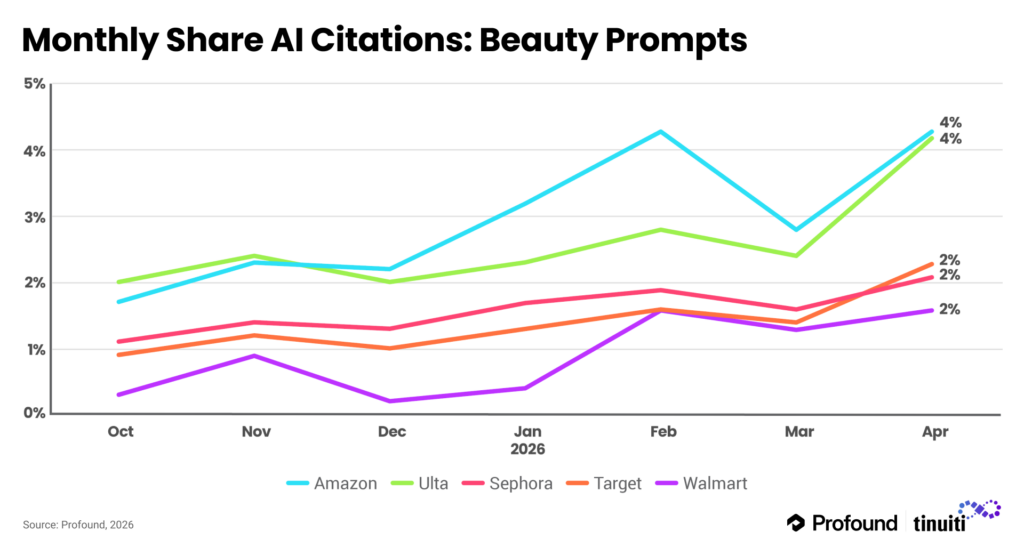
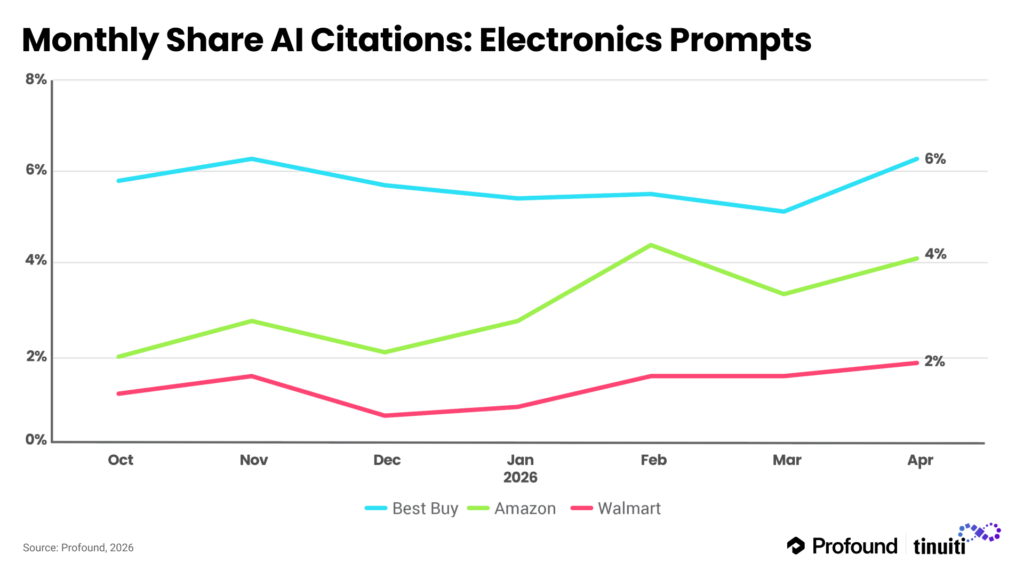
Alexa for Shopping is Amazon’s answer to that shift: instead of letting external agents own the whole conversation and send buyers to competing sites, Amazon is building an in-house assistant that can capture those “Which one should I buy?” moments and hand them seamlessly into the shopping app and product detail pages. For advertisers, the strategic move is less about chasing a specific assistant-only performance lift, and more about making sure your PDPs and retail media strategy are optimized for the way Alexa for Shopping talks about your category, and the upstream AI signals (like Reddit and other social content) that feed those conversations.
Your roadmap to the new era of search, where AI visibility drives business growth.

In traditional SEO, the goal was to organize content so a search engine could rank it on a “10 blue links” results page. In the AI era, the interface is the answer, and the job has shifted from chasing rank to building what Simon Poulton, EVP, Innovation at Tinuiti, calls agentic influence “shaping the information that conversational agents and AI assistants rely on when they make decisions for users.”
That’s where Generative Engine Optimization (GEO) and Agent Engine Optimization (AEO)* come in. GEO is about how well your content surfaces and is cited in generative experiences when users ask detailed, multi-part questions. AEO goes a step further: It’s about being the product or brand selected by agentic shoppers acting on someone’s behalf, whether that’s Alexa for Shopping recommending an ASIN or an off-platform agent building a cart from scratch.
Across the clients we see, only a subset of brands are even ready for this shift. In the webinar above, our Amazon experts estimated that roughly 30% of brands pass a basic SEO content-readiness test, fewer than 10% would be considered GEO-ready, and under 2% are truly optimized for AEO. There’s no conflict between SEO and GEO at the character level—the same title, bullets, and descriptions should serve both—but GEO forces brands to layer in contextual phrasing (who, when, why, with what) instead of leaning on keyword density alone.
Practically, GEO and AEO mean your PDPs need to read like answers to real prompts, not like keyword checklists. That includes explicitly stating who the product is for, naming the use cases, calling out constraints and compatibilities, and structuring content into scannable Q&A blocks that answer engines can easily parse. When you combine that kind of answer-ready content with the intent clusters and AMC audience strategies described earlier, you’re no longer optimizing for a single SERP, you’re optimizing for the way human shoppers and AI agents now co-decide what to buy on Amazon.
*While AEO is often used for “answer engine optimization”, experts in our recent session had a different use for the acronym.
| GEO principle | On-page example | Helps who most |
| Answer who it’s for | “For sensitive, acn-prone skin” in bullets and A+ | Shoppers & AI assistants |
| Name the use case | “Ideal for small apartments and dorm rooms” in title/image text | Intent clustering & GEO |
| Include constraints/compatibility | “Fits under 12″ cabinets; works with K-Cup pods” | Agents filtering options |
| Use scannable Q&A structure | “Q: Is this machine noisy? A: Under 60 dB on normal mode” | Agents extracting answers |
| Optimize top three images | Image 1 = product; 2 = in use; 3 = spec/benefit callouts | LLM indexing & conversion |
“A lot of brands have a lot of work to do to have their content optimized for [Alexa for Shopping and agent shopping]… they’ve got their content dialed, but they don’t have those contextual formats in there, and that’s going to be the new age of search.”
Dan Kartchner, Chief Revenue Officer DetailPage
During our panel above on the Future of Amazon search, Ryan Yamamoto, Ken Magner, Dan Kartchner, and Anne Harrell all came back to the same point: You cannot move just one part of your Amazon program and expect durable gains. Tightening targeting without updating how you measure it can make inefficient campaigns look healthy; launching new formats on top of legacy keyword logic wastes creative; and upgrading measurement often exposes gaps in both targeting and creative you did not know you had.
The brands that are actually growing share in this environment treat targeting, formats, and measurement as a single operating system, not three separate workstreams. Targeting evolves from keyword lists to intent clusters and Alexa-for-Shopping prompts; formats shift toward video-forward, PDP-aware units; and measurement moves beyond ACOS into incrementality, query-level visibility, and AI-influenced demand. The rest of this article unpacks each of those pillars in turn, then brings them back together into a 2026 playbook you can use for high-stakes moments like Prime Day and peak holiday.
Our Amazon Prime Day Study reveals how Higher Gas Prices, AI Tools, and June Timing Will Impact Amazon’s Biggest Sales Event

One of the most immediately actionable ideas from the panel was simple: train your internal teams to use AI shopping agents in the same way your customers do. When marketers prompt for their own categories by asking detailed questions, comparing edge cases, and following AI agents down comparison paths, they see attributes and scenarios that standard keyword tools tend to miss.
This kind of hands-on prompting practice is a low-cost research loop that can inform how you write bullets, what you feature in images, and how you structure comparison tables. It also exposes new angles for differentiation that serve as raw material for both organic content and paid search copy.
Early in 2025, many brands experimented with building dedicated campaigns around single Amazon Marketing Cloud (AMC) audiences, with low base bids and aggressive bid modifiers to isolate performance. The data showed higher conversion rates but also higher CPCs and limited reach because each audience lived in its own silo.
In 2026, the more mature pattern is to layer AMC audiences onto broader targeting so that audiences act as qualifiers rather than containers. This lets brands see how specific audience segments actually search across a broader query set, which PDPs they convert on, and how they move through the funnel, without sacrificing the reach and efficiency of broad targeting.
In crowded categories, Sponsored Products Video (SPV) has graduated from an experimental beta to a core driver of click-through rate. SPV behaves as a free creative add-on for Sponsored Products: brands attach a video asset to an ASIN within an existing campaign instead of bidding on a separate unit.
There are a few format specifics that matter for strategy and production. Audio is not expected to work the same way it does in Sponsored Brands video, which means short, visual demos and use-case angles generally outperform broader brand storytelling in this placement. Video needs to be customized at the ASIN level, which can become resource-intensive for large catalogs—so the recommended approach is to tier SPV deployment, starting with top-spend ASINs in the most competitive categories.
On the summit panel, the team reframed Sponsored Brands as less of a pure brand-awareness unit and more of a catalog expansion workhorse. Recent updates from Amazon support that shift: collections are now defined as a product-centric experience featuring 3–10 related products in a single ad unit, with product images and key details designed to help shoppers quickly evaluate and click through.
Instead of relying on custom lifestyle imagery and handcrafted headlines, the collections format leans on your existing catalog: Amazon surfaces your brand logo, an auto-generated title, a CTA, and a curated set of ASINs, either chosen by your team or by Amazon’s AI based on relevance signals. That makes Sponsored Brands collections especially effective for competitor conquesting, cross-selling to existing buyers, and introducing a broader portfolio to warm traffic, because you’re always showing a cluster of related products, not a single hero SKU. It also throws more weight on PDP fundamentals. When the format pulls directly from your listing images and product data, any weakness in those assets shows up not just on the detail page, but in how your Sponsored Brands units perform and how shoppers (and AI assistants) perceive your catalog.
Alexa for Shopping and other AI assistants do not just read your text; they’re increasingly looking at your images. Panelists flagged that the top three PDP images are now being scraped and indexed by LLMs as part of agentic shopping journeys, including Alexa for Shopping and external tools.
That changes the job of those top image slots. They no longer strictly function as conversion levers for human shoppers; they’ve become discoverability levers that influence whether Alexa for Shopping recommends your product when a shopper asks, “What’s a good option for…?” or “Which one is best for…?”
To make those LLM-indexed slots work harder:
Images 4+ then become the place to add variation, redundancy, and social proof, but the first three are now your creative “gatekeepers” for both humans and AI.
The panel drew a line between upper-funnel environments, where AI-generated creative is already triggering fatigue, and marketplace contexts like Amazon, where shoppers are more tolerant of clean, AI-assisted product imagery. High-ROI use cases in 2026 include seasonal background swaps, color or variant changes, localization of language and context, and short-form video derived from existing product assets.
Where AI creative tends to break is on details that matter for fit, safety, or brand integrity: logos, precise product features, and categories like intimates where realism and accuracy are non-negotiable. Many sophisticated brands now use AI output as FPO (for-position-only) concepts that internal or agency teams recreate within brand guidelines, rather than publishing AI assets directly.
AMC has evolved from a clean-room tool for SQL-literate data scientists into what panelists described as the “central nervous system” of Amazon advertising. Templated queries, friendlier interfaces, and LLM-assisted SQL mean more brands can use AMC to understand journey-level behavior rather than just last-click outcomes.
Extended view windows, added in late 2025, unlocked valuable year-over-year and seasonality analysis, which is especially powerful for seasonal categories that see different search terms and paths around events like Valentine’s Day, Mother’s Day, or the holidays. There is no single “correct” way to use AMC; its highest-value applications vary by brand depending on goals, margins, and category dynamics.
ACoS is shifting from a primary planning metric to more of a diagnostic, as sophisticated brands lean into metrics that reflect longer horizons and actual business outcomes. Those now include long-term ROAS and long-term ACoS from Ads Console, lifetime value (LTV) and customer acquisition cost (CAC) from AMC, total advertising cost of sales (TACoS)* as a view of ad cost against total revenue, total CPA per unit, and, increasingly, explicit measures of incrementality.
On the summit panel, experts cautioned against treating ROAS as the north star in isolation, since a high ROAS on a narrow slice of spend can still mean you’re under-invested in growth elsewhere in the portfolio. Instead, they advocate for a balanced scorecard where classic efficiency metrics like ACoS and ROAS sit alongside growth (revenue and share), customer economics (LTV:CAC), and causal impact (incremental lift) so teams can see not just how cheap a conversion was, but whether it expanded the business you actually care about.
*TACoS is a Tinuiti metric measuring total ad spend relative to total revenue (organic + paid), rather than just ad-attributed revenue. It offers a comprehensive view of business health, helping identify if ad spend is fueling growth or merely replacing organic sales.
At the center of that measurement evolution is a deceptively simple question: if you turn off a given keyword or placement, how much revenue do you actually lose? Native Amazon attribution can show paths and correlations but cannot, on its own, distinguish whether an ad caused a sale or merely appeared on the journey.
Incrementality modeling, whether through Amazon’s own tools or third-party consoles, uses machine learning to estimate the causal lift of specific campaigns, keywords, or formats. Panelists were clear that “incremental good, non-incremental bad” is an oversimplification; in some cases, paying “rent” on must-win defensive terms is rational even if those placements are not strictly incremental, because they protect share among existing customers.
How Smart Testing Highlights Waste and Opens Opportunities

As Alexa for Shopping becomes the entry point for more high-intent journeys, the brands that win will be the ones reading performance at the query level across paid, organic, and assistant-driven behavior. Share-of-voice tools already show how your ads and organic listings stack up on priority terms; now you also need to understand which conversational prompts Alexa for Shopping is normalizing in your category.
Search Query Performance and Brand Analytics can help you see how your brand’s purchase share is moving for those themes over time, while Amazon Attribution reveals how off-site traffic interacts with assistant-driven discovery. Instead of asking “What’s my ROAS on this keyword?” the more future-proof question becomes “When shoppers ask Alexa for Shopping about this need state, how often does my brand show up, get clicked, and actually get chosen?”
During our “Evolving Amazon’s Search Strategy for 2026” panel above, Dan Kartchner laid out one of the simplest but most actionable ways to rethink keyword strategy: separate your world into A terms and B terms instead of treating every query the same. A terms are the dominant, high-competition category keywords—“protein powder,” “running shoes,” “vitamin C serum”—where entrenched competitors already own organic rank and ad auctions are crowded and expensive. B terms are the more specific, lower-competition queries—“vegan protein powder for smoothies,” “wide-toe box trail shoes,” “vitamin C serum for sensitive skin”—where your brand can realistically win visibility and build momentum.
The trap Dan sees frequently is brands over-funding A terms because they look important on paper, then declaring victory when ROAS looks acceptable, even though they’re mostly paying to show up where they were never likely to win in the first place. In his words, that’s how you end up “paying rent” on the most expensive real estate in the category without actually increasing your share of the market. The more sustainable approach is to treat A terms as defensive real estate you need to occupy in your organic content and selectively in paid, and treat B terms as your offensive growth engine.
A Terms vs. B Terms Framework
| A terms (defensive) | B terms (offensive) | |
| Definition | Dominant, high-competition category keywords where entrenched players own the SERP. | More specific, lower-competition queries tied to concrete use cases, audiences, or benefits. |
| Typical examples | “protein powder,” “running shoes,” “vitamin C serum,” “baby bottles.” | “vegan protein powder for smoothies,” “wide-toe box trail shoes,” “vitamin C serum for sensitive skin,” “glass baby bottles BPA-free 8oz.” |
| Role in strategy | Protect presence on must-win category and branded territory; signal category relevance. | Drive incremental growth by winning intent-rich queries where your brand can realistically dominate. |
| Where to prioritize in content | Titles, bullets, A+ content, Brand Store navigation so shoppers and Alexa for Shopping connect you to the core category. | Backend search terms, bullets, imagery, and Q&A that explicitly encode use cases, audiences, and constraints. |
| Where to prioritize in paid | Selective, measured spend; treat as mostly defensive and evaluate through an incrementality lens. | Heavier investment in Sponsored Products and Sponsored Brands where CPCs are lower and win rates higher. |
| Success signal | Stable presence and share on core category and branded queries without overspending. | Rising revenue and share from long-tail, intent-rich queries and improved competitiveness on adjacent A terms over time. |
The playbook works like this. A terms belong in your titles, bullets, A+ content, and Brand Store navigation so shoppers and Alexa for Shopping can still connect your brand to the core category. But when it comes to budget allocation, you shift a meaningful share of your paid search investment toward B terms, placing those in backend fields and targeted campaigns where CPCs are lower and win rates are higher. Think of queries like “for oily, acne-prone skin,” “for small kitchens,” or “for under-desk use”—they may not show up in traditional keyword tools as massive opportunities, but they are exactly the kind of B terms where a well-matched PDP can consistently win.
Over time, as you win more of those B terms and prove strong conversion, your relevance signals compound. Amazon’s systems start to see you as a credible option not just for “vitamin C serum for sensitive skin” but for adjacent category searches, which gradually improves your competitiveness on A terms without requiring you to brute-force your way in with unsustainably high bids. Only at that point does it make sense to consider scaling spend back into the most expensive head terms—and even then, A-term spend should be evaluated through an incrementality lens rather than as a default habit.
Before chasing the latest format or optimization acronym, our panelists suggest that marketers execute a back-to-basics audit of PDPs. Running Sponsored Products Video or complex Alexa for Shopping tests on product pages with weak mobile images, dense or outdated copy, or poor review hygiene simply amplifies friction.
A solid foundation includes top images that read clearly on a six-inch screen, A+ content that is legible and scannable on mobile, titles and bullets aligned to current intent language, and reviews and Q&A that build trust rather than raise new objections. Only once those basics are in place does it make sense to layer on advanced formats and GEO/AEO optimization.
The future of Amazon search also demands a clearer split between offensive and defensive tactics. Defensive terms, as explained in the chart above, include branded and category-defining queries where your absence hands existing customers to competitors. Here, incrementality may be lower, but presence is non-negotiable.
Offensive terms, by contrast, are B terms, emerging long-tail queries, and Alexa for Shopping prompt themes where you can capture new demand and expand your footprint. Mapping spend explicitly across these two buckets helps align stakeholder expectations: some dollars are “protection,” others are “growth,” and they should not be judged by the same yardstick.
When asked what percentage of revenue spent on ads should trigger concern, panelists agreed that100% is a clear red flag, but everything below that is situational. The healthy range depends on competitive density, growth goals, seasonality, and the maturity of the category and your brand on Amazon.
What matters is not chasing a single “right” ratio but ensuring that spend by share of revenue is consistent with your appetite for risk and grounded in incrementality insights, not just ACoS targets. Brands should aim to move meaningfully away from a world where every dollar of revenue is tied to paid impressions and toward a blend in which paid impressions accelerate, rather than replace, organic demand.
With Alexa for Shopping now live as Amazon’s primary AI shopping agent, a wait-and-see stance is the riskiest option. The bidding switches will come later; the groundwork you lay in 2026 is about understanding how your category is actually being discussed and decided inside the assistant.
6–12 Month Alexa for Shopping Action Plan
| Action | What you’re doing | Why it matters in 2026 |
| Audit Alexa for Shopping prompts & queries | Review assistant prompt/query reports weekly to build a taxonomy of real shopper questions in your category. | Reveals how people actually ask for your products so you can align content, targeting, and measurement to real intent. |
| Rewrite titles, bullets, and A+ around “who/when/why/with-what” | Update PDP copy to explicitly answer who the product is for, when it’s used, why it’s chosen, and what it’s used with. | Makes PDPs GEO/AEO-ready and more readable for both Alexa for Shopping and human shoppers using conversational language. |
| Refresh top three PDP images | Redesign the first three images on priority ASINs to show the product, the use case, and key specs/benefits. | These images are now inputs for LLMs and assistants, not just humans, so they shape both discoverability and conversion. |
| Run Sponsored Products Video (SPV) tests | Launch structured SPV tests on top-spend ASINs to measure how video affects CTR and CVR when traffic comes from Alexa. | Helps you understand how video creative performs when assistant-qualified traffic drops into traditional search results. |
| Layer AMC audiences onto broad/auto campaigns | Add at least one AMC audience as a bid modifier on a broad or auto campaign and study how that audience searches and buys. | Shows how high-value audiences behave across a wider query set, including how often they intersect with assistant journeys. |
| Establish incrementality baselines on must-win queries | Run incrementality analyses on a small set of priority terms before Q4 to benchmark causal lift, not just ROAS/ACoS. | Lets you see how assistant-driven behavior is changing the true impact of your spend as adoption scales into peak season. |
Win the next era of Amazon search by treating targeting, formats, and measurement as a single operating system. Our Amazon and AI search teams help brands build that operating system around real shopper intent, Alexa for Shopping, and incrementality, so every change you make shows up in both rankings and revenue.
Whether you’re re-platforming PDPs for GEO/AEO, scaling Sponsored Products Video and Sponsored Brands collections, or pressure-testing your Prime Day strategy with AMC and incrementality modeling, we’ll architect the roadmap and the measurement to match. If you’re ready to turn AI-shaped demand into durable Amazon growth, connect with Tinuiti’s Commerce team to see how our Bliss Point Marketing Operating System can plug into your Amazon program.
Measurement tech that shows what’s driving growth—and exposes what’s holding it back.


Copywriter, Tinuiti
Jenn Wheatley is a senior content strategist and copywriter who turns complex marketing data into clear, actionable stories. She develops research-backed reports and thought leadership that help brands navigate critical business decisions. Based in Utah, she enjoys cooking, strength training, and traveling with her family.